
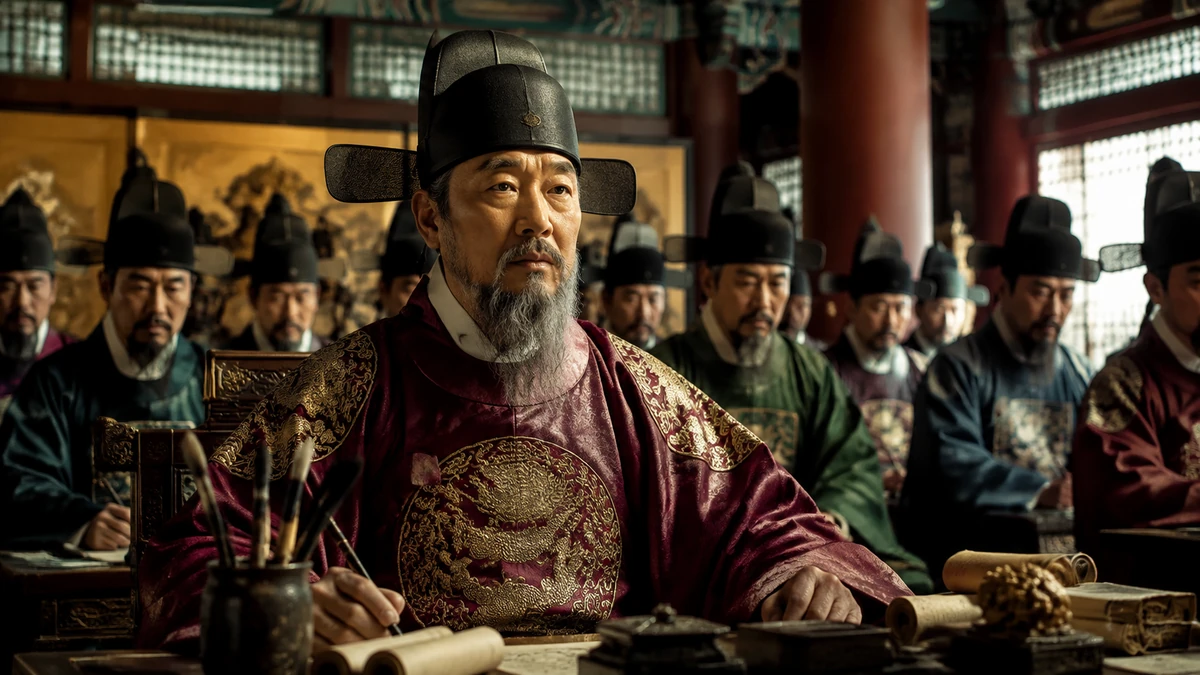
Image to help understand the article
A Korean Statesman Remembered Across Centuries
Long before South Korea became known for technology giants, global entertainment and modern democracy, the Korean Peninsula was shaped by centuries of dynasties, political reforms and debates over good government. Among the historical figures who continue to influence how Koreans think about leadership is Hwang Hee, a senior official of the Joseon dynasty who served as the kingdom’s top government minister for 18 years during the reign of King Sejong, one of Korea’s most admired rulers.
Hwang Hee (1363-1452) is remembered as a symbol of the ideal public servant in Korean history. His reputation rests on several elements: his long service, his ability to manage political disagreements, and his image as a modest official who placed national stability above personal ambition. In Korean historical memory, he represents the concept of the cheongbaek-ri, or an honest and incorruptible government official.
For American audiences, Hwang’s role can be compared loosely to a combination of a trusted presidential adviser, cabinet-level official and experienced civil servant who helps guide a government through major transitions. His career unfolded during one of the most important moments in Korean history: the fall of the Goryeo dynasty and the establishment of Joseon in 1392.
From Political Upheaval to the Joseon Government
Hwang was born in Gaeseong, the capital of the Goryeo dynasty, during a period of political uncertainty. The Goryeo kingdom had ruled Korea for centuries, but internal conflicts and challenges from military leaders eventually led to its collapse. A new dynasty, Joseon, was founded by Yi Seong-gye, who became King Taejo.
Like many officials of his generation, Hwang faced a difficult choice after the change of power. Some former Goryeo officials refused to serve the new government and withdrew from politics to preserve their loyalty to the previous dynasty. Hwang briefly joined this group, known as the scholars of Dumundong, who symbolized resistance to the political transition.
However, Hwang eventually entered the Joseon administration. His decision reflected a practical approach that would define much of his career: balancing personal principles with responsibility toward society. Rather than remaining outside government, he chose to use his abilities to help build the new state.
His early political career was not smooth. He experienced removals from office, political disputes and periods of exile. Yet his reputation for careful judgment and administrative ability allowed him to repeatedly return to government service.
The Adviser Trusted by Kings Taejong and Sejong
Hwang’s influence grew significantly during the reign of King Taejong, the third ruler of Joseon. Taejong was known as a powerful monarch who strengthened royal authority and reorganized government institutions. Although Hwang did not come from the powerful group of founding elites who helped establish Joseon, Taejong recognized his talent and relied on his advice.
Hwang eventually became one of the central figures in state administration. He held leadership positions in several government ministries, including departments responsible for justice, military affairs and personnel management. His broad experience gave him a detailed understanding of how the Joseon government functioned.
His political style was based on moderation and careful evaluation. A famous traditional story describes Hwang asking a farmer which of two oxen working in a field was stronger. The farmer moved away from the animals before answering, explaining that even if the oxen could not understand human speech, criticizing one animal in front of another was unfair. The story became associated with Hwang’s belief that leaders should consider the feelings and dignity of others.
While historians debate the accuracy of many traditional stories, such accounts reveal how later generations viewed Hwang: as a person who valued fairness, restraint and thoughtful decision-making.
Hwang Hee and the Golden Age of King Sejong
Hwang reached the height of his career under King Sejong, who ruled from 1418 to 1450 and is widely considered one of Korea’s greatest monarchs. Sejong is best known internationally for creating Hangul, the Korean alphabet, which made literacy more accessible to ordinary people. But his reign also included major advances in science, agriculture, military organization and government reform.
Behind many of these achievements was a network of skilled officials, including Hwang Hee. As yeonguijeong, the highest-ranking position in Joseon’s government, Hwang served as the leading coordinator of state affairs for 18 years.
His relationship with Sejong demonstrates an important feature of Joseon politics: the king depended on experienced ministers who could challenge ideas and provide practical advice. Unlike systems where leaders are surrounded only by supporters, Joseon’s Confucian political tradition emphasized debate between rulers and officials.
During his service, Hwang helped oversee government administration, regional policies and efforts to support citizens during difficult periods. His reputation was especially strengthened by his work as a regional governor, where he was credited with responding to famine and improving local administration.
However, modern historians also view Hwang as a more complex figure. Although he became a symbol of clean government, historical records mention controversies involving members of his family and accusations that affected his reputation. This complexity is part of why Hwang remains an important subject of historical discussion rather than simply a legendary hero.
What Hwang Hee’s Legacy Means for the United States
For Americans, the story of Hwang Hee offers a window into how Korea has historically viewed government leadership. In the United States, discussions about public service often focus on elected officials, presidents and constitutional institutions. Korean historical traditions also place significant importance on professional administrators who maintain continuity beyond individual leaders.
The idea of a highly experienced civil servant supporting a respected national leader has modern parallels in the United States. Figures such as long-serving cabinet officials, national security advisers and senior government administrators have often played important roles in maintaining policy stability across administrations.
Hwang’s legacy is also relevant as South Korea continues to deepen its relationship with the United States. Today, the two countries cooperate closely in areas including security, technology, trade and cultural exchange. Understanding Korea’s historical values around leadership, education and public responsibility helps explain aspects of modern Korean society, including the strong emphasis placed on expertise and institutional achievement.
American interest in Korean history has expanded alongside the global popularity of Korean culture. The same audiences who follow Korean films, television dramas and music are increasingly exploring Korea’s historical traditions, from royal palaces in Seoul to figures such as King Sejong and Hwang Hee. Historical storytelling has become another part of the broader cultural connection between the two countries.
Why Historical Figures Like Hwang Hee Still Matter Today
In contemporary Korea, Hwang Hee represents more than an individual from the past. He reflects a continuing national conversation about what qualities define good leadership. His story raises questions that remain relevant around the world: Should leaders prioritize loyalty or practical results? How should officials balance personal beliefs with public responsibilities? Can a government worker maintain integrity while operating inside a complicated political system?
These questions are not limited to Joseon-era Korea. They appear in modern democracies, corporations and public institutions everywhere. The challenges faced by historical administrators often resemble challenges faced by leaders today: managing competing interests, making difficult decisions and maintaining public trust.
Hwang Hee’s 18 years as Joseon’s top minister remain one of the longest examples of sustained political service in Korean history. His career shows how Korea’s past was shaped not only by kings and major events but also by skilled officials working behind the scenes.
As interest in Korea continues to grow among American audiences, stories like Hwang Hee’s provide a deeper understanding of the country beyond popular culture. They reveal a civilization with a long tradition of debates about education, responsibility and ethical government. Those ideas continue to influence how Korea sees leadership in the modern era.




0 Comments