
Image to help understand the article
Samsung’s latest Fan Edition is less about one phone than a broader shift
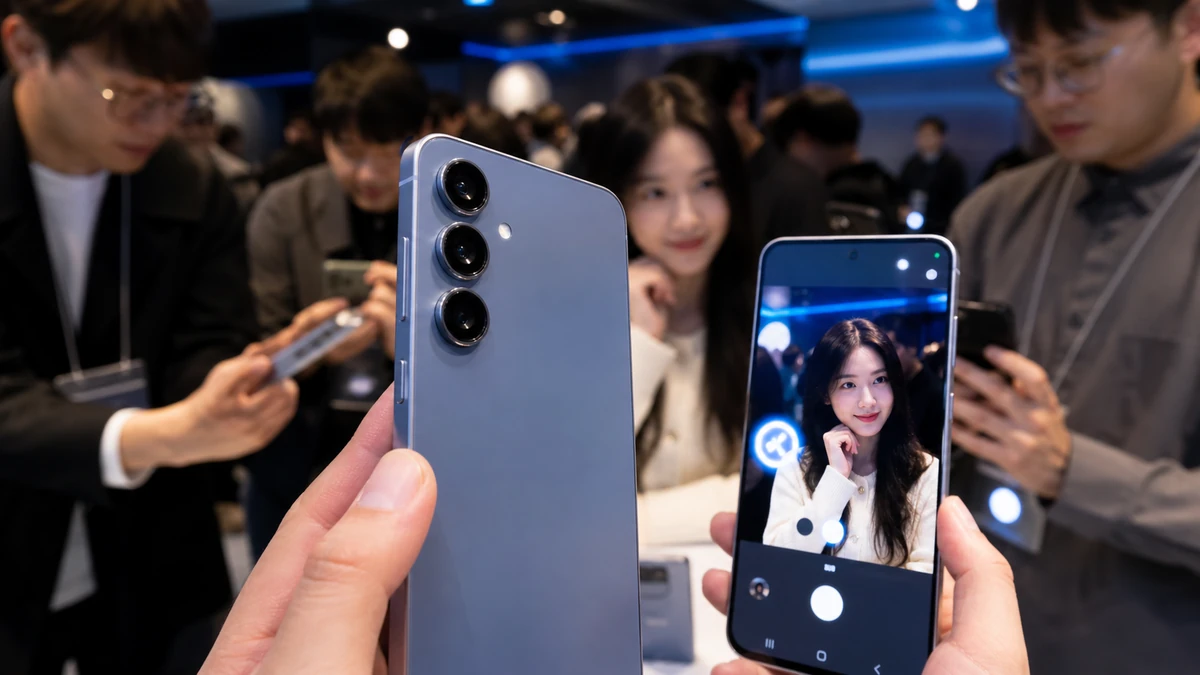
Samsung Electronics says it will release the Galaxy S26 FE in South Korea on Sept. 4, positioning the device as a more affordable entry point into the company’s premium smartphone lineup while putting new emphasis on artificial intelligence, camera performance and portability. On paper, that may sound like a routine product refresh. In practice, it says something larger about where the global smartphone business is heading.
The “FE” in Samsung’s Galaxy lineup stands for “Fan Edition,” a category that has become increasingly important as smartphone makers try to solve a basic market problem familiar to American consumers: plenty of people want the marquee features advertised on high-end devices, but not everyone is willing or able to pay top-tier prices. In the U.S., that tension shows up every fall when flagship phones arrive with premium price tags that rival the cost of a laptop. In South Korea, where Samsung is not just a phone brand but a national industrial giant, the same tension plays out in a market that closely watches whether cutting-edge features actually spread beyond the wealthiest early adopters.
Samsung’s message with the Galaxy S26 FE is straightforward. The company wants to bring what it describes as core Galaxy S experiences to a broader group of buyers, not simply by stripping down an expensive handset, but by deciding which features people use most often and making those the center of the value proposition. According to the company, that means cameras, AI-powered tools and a thinner, lighter design.
That strategy matters because the smartphone industry has entered a period in which the biggest competitive question is no longer just who can build the most advanced technology first. It is increasingly about who can turn advanced technology into everyday habit for the largest number of users. Samsung appears to be betting that AI will matter only if it stops feeling like a premium add-on and starts functioning like a routine part of mobile life.
Why the Fan Edition model matters in Korea — and beyond
For readers in the United States, Samsung’s Fan Edition approach may be easiest to understand as the company’s version of a “sweet spot” device: a phone aimed at consumers who want something clearly above bargain-basement models but still below the cost of an ultra-premium flagship. In American retail terms, it occupies a space somewhat analogous to the middle ground that has long existed in cars, televisions and laptops: consumers still want a recognizable premium brand, but they are increasingly selective about which premium features justify the extra expense.
That balancing act is especially important in the smartphone business because hardware upgrades have become more incremental. For years, the industry sold people on annual leaps in processing power, display quality and camera improvements. Now, with many consumers holding on to phones for longer periods, companies need a stronger reason to persuade users to upgrade. AI has become the new answer. But AI alone is not enough if it lives only inside the costliest models.
That is where the Galaxy S26 FE becomes significant. Samsung is using the Fan Edition line as a bridge between aspiration and affordability. The company is effectively arguing that a premium mobile experience is not defined only by the absolute best specs available at any price, but by a package of features people can actually use day after day: a capable camera system, software enhancements tied to AI, and a device light enough to carry comfortably.
In South Korea, this is also a brand-management exercise. Samsung has to maintain the prestige of the Galaxy S line while broadening the base of people who can enter that ecosystem. It is a delicate move. If the phone is too expensive, it fails at accessibility. If it feels too compromised, it risks weakening the premium image it is supposed to extend. The Fan Edition line exists to thread that needle.
The company’s framing of the S26 FE suggests it believes that price-sensitive buyers do not necessarily want a “cheap phone.” They want a phone that feels close enough to premium in the ways that matter most. That distinction is crucial. It reflects a larger change in consumer behavior in Korea, the United States and other mature smartphone markets, where buyers are increasingly practical about spending but still highly responsive to recognizable flagship features.
Cameras and AI are becoming one product category, not two
Samsung says the Galaxy S26 FE includes a 50-megapixel wide rear camera, a 12-megapixel ultrawide camera and an 8-megapixel telephoto camera that supports 3x optical zoom and up to 30x digital zoom. On the front, it has a 12-megapixel camera. Those numbers, by themselves, tell only part of the story. The more important point is how Samsung is presenting the camera system: not as a single standout sensor, but as a set of tools designed to handle multiple everyday shooting situations, from wide scenes to distant subjects.
That approach is increasingly in line with how consumers actually use phones. Most people do not evaluate smartphone cameras like professional photographers. They judge them by whether the phone can handle a child’s soccer game, a concert, a night out with friends, a travel photo, a pet picture or a quick social media video without much effort. In other words, convenience matters as much as raw imaging horsepower.
Samsung is also explicitly pairing the camera story with AI, which reveals something important about the modern smartphone business. Cameras are no longer just hardware. They are one of the clearest places where software and machine learning shape what users experience. Whether it is scene optimization, image processing, editing assistance or language and search features that intersect with visual content, the line between camera capability and AI capability is becoming harder to separate.
The Korean summary provided by Samsung does not spell out every AI feature in the new device, and responsible reporting means not filling in those blanks. But even without a full feature list, the company’s positioning is telling. Samsung is not marketing AI as an abstract technical milestone. It is tying AI to the parts of smartphone use consumers repeat constantly. That is a practical choice and, from a business standpoint, probably a necessary one.
American consumers have already seen a version of this marketing shift. AI on phones in the U.S. is often introduced with sweeping language about the future of computing, but the features that catch on are usually much more ordinary: better photo cleanup, smarter search, translation assistance, writing prompts or easier organization of daily tasks. Samsung appears to understand that the path to AI adoption is not through futuristic rhetoric alone. It is through repetition, familiarity and convenience.
That may also explain why the company is highlighting camera quality so heavily in a Fan Edition device. The camera is one of the easiest ways for consumers to feel the payoff of software improvements immediately. You do not have to learn a new category of behavior. You just take a picture, edit it or share it. In that sense, cameras have become one of the smartphone industry’s most effective delivery systems for AI.
Thin, light and easier to live with: the quiet side of premium
Samsung is also emphasizing the S26 FE’s thin and lightweight design, and that detail deserves more attention than it might get in a flashy launch headline. In a market saturated with technical claims, portability can sound almost modest. But for millions of users, it is one of the most consequential parts of the ownership experience.
Smartphones are intimate devices in a way many consumer electronics are not. People carry them in pockets, hold them for long stretches, use them during commutes, rely on them while traveling and reach for them dozens or hundreds of times a day. A phone’s thickness and weight shape the experience more constantly than many benchmark numbers ever will. In practical terms, a lighter phone may improve satisfaction more than a marginally faster processor most users will never notice.
That is part of why Samsung’s positioning here is meaningful. The company is not just trying to democratize access to premium features. It is trying to lower the day-to-day friction of using a premium-leaning device. That is an increasingly important distinction in a mature category. Consumers no longer need to be convinced that smartphones are essential. They need to be convinced that a new one will feel materially better to live with.
There is a broader industry trend behind that decision. After years in which smartphone marketing centered on peak performance and maximum specifications, the business has gradually moved toward quality-of-life selling points. Battery life, durability, repairability, device protection services and the comfort of the hardware itself all matter more in upgrade decisions than they once did. Samsung’s mention of device management services through its subscription club, including Samsung Care Plus and accessory discounts, fits that pattern. It suggests the company is thinking not only about the moment of sale, but also about the full ownership cycle.
That mirrors a larger shift in consumer electronics, including in the United States, where companies increasingly want recurring relationships with customers rather than one-time transactions. From wireless carrier installment plans to streaming bundles to device protection subscriptions, the smartphone business is no longer just about selling a handset. It is about building a continuing revenue and loyalty ecosystem around it. Samsung’s after-purchase benefits are part of that playbook.
What this means for the United States
For American readers, the most relevant takeaway is not simply that Samsung is launching a new phone first in South Korea. It is that the company is refining a product strategy with direct implications for the U.S. market, where Samsung remains one of the few brands with the scale, retail presence and carrier relationships to challenge Apple in premium smartphones.
The U.S. smartphone market has become unusually top-heavy. Apple dominates mindshare, especially among younger consumers, and the iPhone’s cultural role in America extends beyond hardware into messaging habits, social signaling and ecosystem lock-in. Samsung, by contrast, has often had to win by offering consumers a different mix of features, pricing and form factors. The Fan Edition line gives Samsung a potentially useful tool in that effort.
If Samsung can successfully package AI and camera improvements into a device that sits below the price of its top flagship models, it strengthens its pitch to several important American groups at once: buyers frustrated by flagship inflation, Android users who want premium features without premium pricing, families purchasing multiple devices, and upgraders who care more about practical value than brand theater. In the U.S., where phone prices are often softened by trade-ins and carrier deals, value can be obscured. But it still matters, especially when households are budgeting across several connected devices and subscription bills.
There is also a competitive signaling effect. American tech consumers have heard repeated promises that AI will redefine the smartphone. What they have not always seen is a clear path for that technology to become mainstream across price tiers. Samsung’s Fan Edition strategy suggests that one answer is to move AI downward from halo products into more accessible premium devices. If that approach works, it could pressure rivals across the U.S. market to do the same.
That matters not only for Samsung and Apple, but for wireless carriers, retailers and app developers in the United States. If AI-capable features become more common in sub-flagship premium phones, carriers have more opportunities to market upgrades, retailers have a stronger narrative around value, and software companies gain a wider installed base for services that depend on newer on-device capabilities. In plain English, Samsung is not just selling a phone; it is trying to widen the audience for a category of mobile computing behavior.
There is a U.S.-Korea economic dimension here as well. South Korea is one of America’s closest Asian allies and a major technology partner, and Samsung’s product decisions often illustrate broader themes in that relationship: supply chains, advanced manufacturing, consumer technology leadership and standards for next-generation devices. When Samsung pushes AI deeper into mainstream hardware, American companies pay attention because the move can influence everything from component demand to software priorities to the features U.S. consumers come to expect by default.
Just as importantly, the Korean Wave — usually discussed in the U.S. through K-pop, Korean dramas and film — has helped normalize Korean consumer brands as cultural forces, not just foreign manufacturers. Samsung already had global scale long before the term “Hallyu” became common in American media, but today’s audience understands Korean influence more broadly. That makes South Korean product strategy itself more interesting to U.S. readers. The choices made in Seoul increasingly reverberate in stores, screens and social feeds across the United States.
A sign of where the AI smartphone race is headed next
The most revealing aspect of the Galaxy S26 FE may be what it suggests about the next phase of smartphone competition. For the past several years, tech companies have raced to claim innovation leadership through splashy launches, first-to-market features and top-end hardware. That model still matters. Flagship devices remain the industry’s showroom windows. But the long-term winners in AI smartphones may be determined less by who dazzles first than by who scales useful features most effectively.
Samsung’s new Fan Edition is a case study in that shift. The company is taking functions associated with its Galaxy S family and moving them into a product explicitly designed to be more attainable. That is not simply a pricing maneuver. It is a distribution strategy for technology adoption.
Historically, many consumer tech breakthroughs followed a similar path. Flat-screen TVs, advanced digital cameras, voice assistants and even streaming video all spent time as high-end novelties before becoming normalized across broader price ranges. AI in smartphones appears to be entering that stage now. The question is no longer whether companies can build AI features into premium devices. The question is whether they can spread those features widely enough that consumers start to view them as standard rather than exceptional.
The Galaxy S26 FE, at least as Samsung is framing it, is built around that logic. The company is not describing the phone as a radically experimental object. Instead, it is presenting it as a way to bring together camera quality, AI assistance, portability and ownership support in a package intended for broader appeal. That is a more mature, less theatrical conception of innovation — and in many ways a more commercially important one.
There are still open questions. The Korean launch date does not by itself tell us exactly how the device will be positioned in every overseas market, how aggressively Samsung will price it elsewhere, or how consumers will respond once they can compare the phone against rivals in stores. And as always in smartphones, the final verdict will depend not on launch messaging alone but on everyday experience: whether the AI features feel genuinely useful, whether the camera holds up under real conditions, and whether the lighter design translates into noticeable comfort.
But even at this early stage, the strategic direction is clear. Samsung wants to make “Galaxy AI” less exclusive. It wants more people to encounter advanced mobile software not as a niche premium experiment, but as part of normal smartphone use. That is a meaningful shift for the global market and a particularly relevant one for the United States, where consumers are growing more selective, more value-conscious and more skeptical of innovation claims that do not translate into obvious everyday benefits.
In that sense, the Galaxy S26 FE is not just another iteration in a crowded product cycle. It is evidence that the smartphone industry’s AI contest is moving from the penthouse to the main floor. For Samsung, and for competitors watching from California, Shenzhen and beyond, that may be where the real battle begins.


0 Comments