
Image to help understand the article
South Korea is using a consumer festival to make a bigger point about travel
South Korea has chosen the historic city of Andong as the opening host for the 2026 Korea Grand Festival, a government-backed consumer event that will run nationwide from Oct. 29 to Nov. 15. On paper, that may sound like a straightforward designation for a kickoff ceremony. In practice, it says something more ambitious about where Korean tourism policy is headed and how the country wants visitors, including Americans, to experience it.
The Korea Grand Festival is designed to boost domestic demand and encourage spending in regional economies. But the Andong selection matters because South Korean officials are not simply promoting a bargain-hunting event or a one-weekend attraction. They are trying to tie shopping, food, heritage and local street life into what tourism planners increasingly describe as a longer-stay model — one that gets visitors to do more than arrive, take a few photos and leave.
That distinction is important in a country where international tourism has often been defined abroad by a familiar shortlist: Seoul shopping districts, K-pop landmarks, glossy beauty stores, major palaces and a few marquee destinations such as Busan or Jeju Island. By opening the festival in Andong, located in North Gyeongsang province, the government is signaling that the next phase of Korea travel promotion may rely less on the capital region and more on regional cities with strong cultural identities.
Andong is known within Korea as a center of traditional culture. It is closely associated with Confucian heritage, old village architecture, ritual customs and a slower, more historically grounded image than the hypermodern Seoul that many foreign visitors first encounter. For American readers, a useful comparison is the difference between visiting New York City for flagship stores and Broadway, versus going to a smaller city known for preserving an older layer of national identity — somewhere where food, streetscapes and local traditions feel like part of the attraction rather than background scenery.
That is why this story is bigger than a ribbon-cutting. South Korea appears to be testing whether a major national promotion can redirect attention from the country’s biggest metropolitan centers to places where the draw is not only what people buy, but how long they stay and what kind of lived culture they encounter while spending money.
Why Andong fits the strategy
According to South Korean officials, Andong was selected through a competition open to 13 metropolitan-level local governments outside the Seoul, Gyeonggi and Incheon capital region. That detail matters. Excluding the greater Seoul area from consideration underscores the policy goal: spread tourism and consumer spending beyond the nation’s economic core.
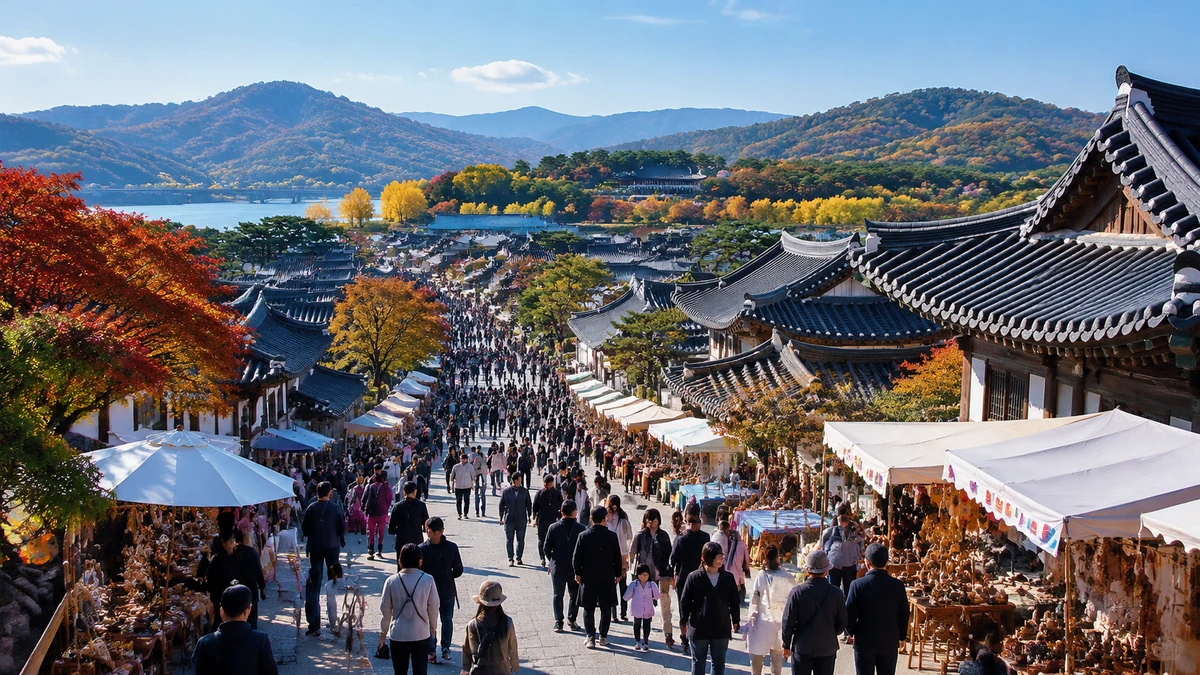
Andong offers an especially useful test case because it combines several ingredients Korean planners now want to package together. There are traditional markets, older downtown commercial districts, recognizable cultural assets and a broader provincial identity that can be marketed as authentically local. In tourism language, this is about creating a travel ecosystem rather than an isolated venue.
Korean officials say they want to connect Andong’s traditional markets, its original downtown business areas and its cultural and tourism resources so that visitors move through the city and spend across multiple neighborhoods. That may sound bureaucratic, but the underlying idea is easy to understand: a festival has more lasting value if people do not just crowd into one plaza for an opening show, but instead walk the markets, eat locally, visit heritage sites, browse small shops and possibly spend the night.
For years, many cities around the world have tried to solve the same problem. Big events generate attention, but they do not automatically help small businesses unless the event footprint extends beyond the main stage. In American terms, hosting a major sports weekend or music festival does not necessarily mean the economic benefit reaches family-owned stores a few blocks away. It depends on transportation, programming, marketing and whether visitors have a reason to circulate.
That is exactly the challenge Andong now faces. Being named opening host gives the city symbolic prestige and a surge of early attention. But the success of the strategy will not be judged only by crowd size or national headlines. It will be judged by whether festivalgoers actually fan out into markets and neighborhood shopping streets, and whether local merchants feel the benefit in measurable sales.
From quick stopovers to longer stays
One phrase in the Korean discussion stands out: the expansion of “stay” and consumption. In other words, officials are less interested in raw visitor counts than in length of stay, movement through multiple spaces and spending that reaches local businesses. That reflects a broader shift in tourism thinking, not only in Korea but globally.
Destinations increasingly understand that one-day spikes in traffic can produce crowding without delivering durable economic gains. A traveler who arrives by bus, attends an event, posts on social media and leaves by evening may boost visibility but not necessarily a local economy. A traveler who sleeps overnight, eats multiple meals, shops at a traditional market, visits a museum or heritage site and wanders through an older downtown district leaves behind a very different financial footprint.
South Korea is trying to build more of that second kind of travel. In Andong, the planned model connects commerce and culture rather than treating them as separate lanes. Traditional markets are not being framed merely as places to buy souvenirs or snacks. They are being presented as part of the itinerary itself — a way to encounter Korean daily life, regional tastes and neighborhood character.
For foreign visitors, including Americans, that approach may be especially appealing. A trip built around one blockbuster attraction can be efficient, but it often flattens a place into a checklist. By contrast, a route that includes markets, alleys, older shopping streets and cultural sites offers something closer to texture. Travelers are not just consuming a branded attraction; they are moving through environments where local habits, architecture and commerce overlap.
That model has become more attractive as global travelers seek what the industry often calls experiential tourism — trips organized around immersion, foodways, craft traditions and local routines rather than only famous landmarks. In that sense, Andong’s opening role in the Korea Grand Festival is not just about promoting one city. It reflects South Korea’s attempt to align regional tourism policy with what many travelers now say they want.
Still, the strategy carries risk. “Authenticity” is one of the most overused words in tourism, and it can quickly become a sales pitch detached from local reality. If the festival is too stage-managed, visitors may get a polished version of regional life rather than the thing itself. If the event remains concentrated around a ceremonial core, the promised spillover to markets and small merchants may be weaker than advertised. The goal of turning a national shopping festival into a genuine longer-stay experience is appealing. Achieving it will be harder than naming it.
What traditional markets mean in Korea — and why they matter here
For American audiences, the emphasis on traditional markets deserves explanation. In Korea, a traditional market is not simply the equivalent of a generic farmers market or a nostalgic tourist bazaar. These markets are often dense commercial spaces where food vendors, household goods sellers, clothing merchants and small independent businesses operate side by side. They can serve as community anchors, especially in older districts that have been pressured by chain retail, redevelopment and online commerce.
That helps explain why Korean officials see them as more than shopping zones. They are also social and cultural spaces, repositories of local memory and everyday rhythms. When policymakers talk about linking traditional markets to tourism, they are often talking about preserving economic life in districts that might otherwise lose relevance as consumer habits change.
There is a familiar American parallel here. Think of the renewed interest in public markets, Main Street districts and historic downtowns in smaller U.S. cities. Local officials across the United States have tried to revive brick-and-mortar neighborhoods by pairing them with food tourism, arts programming and heritage branding. Sometimes that produces real revitalization. Sometimes it produces a cosmetic makeover that benefits only a handful of businesses or accelerates displacement. Korea is hardly alone in grappling with that tension.
In Andong’s case, the policy logic is fairly clear. The city’s traditional markets and old downtown areas are being positioned not as leftovers from a pre-digital era, but as reasons to visit. That is a notable reframing. It treats older commercial spaces as assets in a national tourism strategy rather than as sectors to be protected quietly on the side.
There is also a cultural argument embedded in the plan. South Korea’s global image has been transformed over the past two decades by the Korean Wave, or Hallyu — the global spread of Korean popular culture, including K-pop, television dramas, film, fashion and beauty. But the international success of contemporary Korean culture has also created an opportunity to introduce audiences to a wider and older Korean cultural landscape. Cities like Andong can benefit from that curiosity if officials are able to translate broad enthusiasm for Korea into actual regional travel.
In other words, the success of Korea’s soft power abroad may now be feeding a second-stage question at home: Once people want to visit Korea, where can the country steer them beyond the obvious first stops? And how can that interest be converted into economic gains for local communities, not just luxury retail corridors in Seoul?
What this means for the United States
For the United States, the Andong designation is not a niche municipal story. It is part of a larger evolution in South Korea’s global economic and cultural strategy, one that increasingly intersects with American consumers, airlines, travel companies, media platforms and local tourism planners.
First, the story matters because the American audience for Korea is no longer limited to diaspora communities or specialist travelers. Korean dramas dominate streaming conversations. K-pop tours reliably fill U.S. arenas. Korean skin care has become a recognizable retail category in American stores. Korean food, once concentrated in immigrant enclaves, now appears in mainstream supermarket aisles and restaurant chains. That broader familiarity creates a new kind of traveler: Americans who first encounter Korea through entertainment and consumer culture, then begin looking for deeper, more place-based experiences.
Andong is well positioned for that next step in theory, even if it is not yet a household name in the United States. For American visitors who have already absorbed the polished imagery of Seoul through Netflix series, social media and K-pop content, a city marketed around historic streets, traditional markets and regional identity may feel like a more layered follow-up. It is the difference between seeing the country’s export-facing image and encountering its local social fabric.
Second, the policy behind this festival could affect U.S. travel and hospitality businesses with Korea-facing products. Tour operators that once built Korea itineraries around Seoul, Busan and perhaps Jeju may find stronger incentives to add inland regional destinations. Airlines, online booking platforms and hotel groups all benefit when a destination succeeds in converting short urban visits into longer multi-city stays. A traveler who adds Andong or nearby regional circuits spends more nights, books more transportation segments and tends to distribute spending more widely.
Third, the strategy may look familiar to American city and state officials trying to revive local business districts through event tourism. The same questions apply on both sides of the Pacific: Can a splashy event drive spending toward small merchants rather than national chains? Can cultural branding help older downtowns compete in an e-commerce era? Can a local identity be marketed without reducing it to a caricature? South Korea’s experiment in Andong will likely be watched with interest by tourism professionals well beyond Korea.
Finally, there is a diplomatic layer. The U.S.-South Korea relationship is often discussed through security, semiconductors, automobiles and China policy. But cultural and consumer ties have become a major part of the relationship’s public face. As Korea tries to widen the map of what foreign visitors see, it is also subtly widening the map of what Americans may associate with the country. That may sound soft compared with trade or defense, but soft power frequently shapes how economic and political relationships are lived by ordinary people.
If the Korea Grand Festival succeeds in directing international curiosity toward regional Korea, Americans may gradually come to know the country less as a single urban brand and more as a set of distinct places. That is good news for Korea’s regional economies, and it could deepen the sophistication of American engagement with one of its closest Asian allies.
The real test is whether small businesses feel the difference
Korean officials have been explicit that the ultimate goal is not ceremonial prestige but real sales for small merchants. That is the right benchmark. Governments everywhere are good at announcing festivals, less good at proving that the economic benefit reaches the businesses most in need of support.
In Andong, success will depend on logistics as much as symbolism. Visitors need easy ways to move from the opening event to markets, downtown streets and cultural sites. The city and province will need clear signage, transportation planning, coordinated programming and persuasive storytelling that makes those separate locations feel like parts of a single experience. Without that connective tissue, the strategy risks becoming a slogan about local revitalization rather than a functioning economic model.
The timing also matters. The festival runs for 18 days nationally, and the opening event sets the tone. First impressions are powerful. If Andong can present itself as more than a ceremonial backdrop — if it can turn the opening into an invitation to linger — it may strengthen Korea’s broader case that regional destinations belong at the center of the country’s tourism future.
There is another reason this matters now. Many countries are rethinking how tourism should work after the pandemic-era disruptions and amid continued pressure on household spending. Growth for its own sake is not always the goal. Policymakers increasingly want visitors whose spending patterns are sustainable, geographically distributed and compatible with local community life. The Andong model, at least on paper, aims for exactly that.
But good intentions will not be enough. Residents and small business owners tend to judge festivals by very practical questions: Did foot traffic increase in the right places? Did spending reach independent shops? Did visitors stay long enough to matter? Did the city gain repeat interest after the event ended? Those are the measures that will determine whether Andong becomes a case study in successful regional tourism or merely the latest city to host a well-publicized opening ceremony.
A sign of where Korean tourism may be headed next
The choice of Andong suggests that South Korea wants its tourism story to evolve from “visit Korea” to “move through Korea differently.” That is a meaningful shift. It places less emphasis on headline attractions alone and more on circulation, duration and local texture. It recognizes that markets, alleys and older downtown districts can be economic assets when paired with strong cultural storytelling. And it hints that the next stage of the Korean Wave may not be confined to entertainment exports, but may extend to how global audiences travel through the country itself.
For Americans, that shift is worth watching. The Korea many U.S. audiences first met through pop culture is now mature enough as a global brand to promote a more complex itinerary. If Seoul was the gateway, regional cities like Andong may become the next chapter.
That does not mean every traveler will suddenly trade Myeongdong for a market in North Gyeongsang province, or that one festival opening will redraw Korea’s tourism map overnight. It does mean the South Korean government is placing a strategic bet: that visitors are ready for a version of Korea centered less on quick consumption and more on time, place and local connection.
Whether that bet pays off will depend on execution. But the logic behind it is sound, and increasingly familiar around the world. In an era when travelers say they want depth, and local governments want spending that reaches beyond flagship districts, the winners may be the places that can turn browsing into belonging, however briefly. Andong now has a chance to show whether South Korea can do exactly that.


0 Comments