
Image to help understand the article
A sweeping claim with global implications
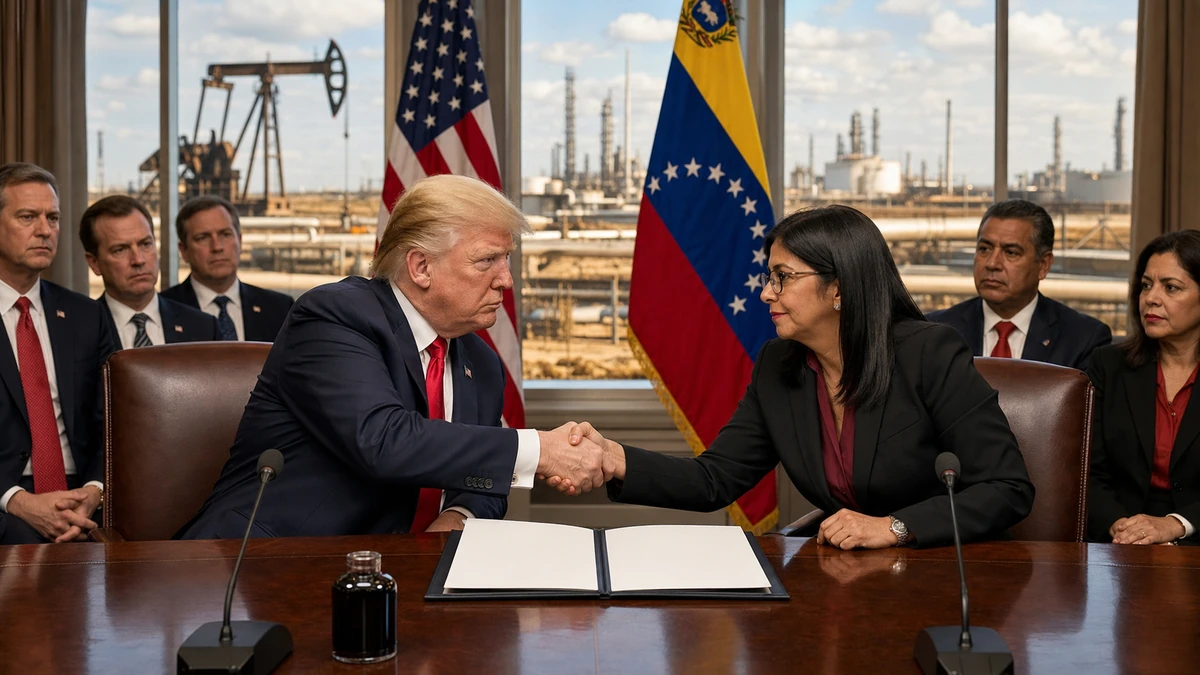
President Donald Trump says the United States has reached an oil agreement with Venezuela that would give the U.S. “majority control” over more than 65 billion barrels of the country’s proven oil reserves, a statement that — if borne out by actual contracts and government approvals — would mark far more than a routine energy deal. It would suggest an attempt to extend American influence deep into the development, management and possible sale of one of the world’s largest hydrocarbon endowments.
That is why this story matters beyond the splashy headline. Oil agreements are common. Governments buy crude, companies sign production contracts and traders move shipments around the world every day. What Trump described is something bigger and far more politically loaded: not simply access to oil, but “control” over a large portion of another country’s underground resource base. In the language of global energy, that is the difference between buying gasoline at the pump and owning a major stake in the refinery, the pipeline and perhaps even the oil field itself.
For American readers, the most important point right now is also the simplest one: the public still does not know exactly what “majority control” means in legal or commercial terms. Based on the account summarized in South Korean media, Trump announced the arrangement on Truth Social and said it was the largest oil deal in world history. He also said the agreement was structured through collaboration involving Secretary of State Marco Rubio, Defense Secretary Pete Hegseth and Venezuelan interim President Delcy Rodriguez, with private companies playing a major role so that, in Trump’s telling, U.S. taxpayers would not bear the cost.
Those are major assertions. But they are still assertions. The announcement, as described, did not spell out whether the United States would hold ownership rights over reserves, operational authority over development projects, rights over production and exports, or some combination of those things. It also did not identify the private companies involved, the amount of capital they would invest, how profits and risks would be divided or what enforcement mechanism would make the arrangement durable over time.
That gap between political language and contractual reality is where this story sits for now. The implications are potentially enormous. The verifiable details are still incomplete.
Why the word “control” matters more than “deal”
The most striking part of Trump’s announcement is not that it concerns Venezuela or even that it concerns a very large volume of oil. It is the use of the term “control.” In ordinary business reporting, a crude supply agreement usually means one side agrees to deliver a specified amount of oil at a set price or under a benchmark formula. A long-term development agreement might give a foreign company an operating role in extracting petroleum. But claiming majority control over proven reserves moves into a different category — one closer to strategic resource governance than to a standard commodity transaction.
That distinction matters because proven reserves are not just barrels waiting to be pumped tomorrow. They are an estimate of economically recoverable oil under existing conditions. In practical terms, control over reserves can mean many things, from a dominant operating stake in projects tied to those reserves to priority rights in future development, marketing or export decisions. It can also be a political shorthand that sounds larger and cleaner than the messy legal architecture underneath.
For that reason, investors, diplomats and energy analysts would likely want to see at least four things before drawing hard conclusions. First, what specific fields or assets are covered? Second, what rights does the U.S. side actually obtain — ownership, management, financing leverage or commercial off-take rights? Third, what role do Venezuelan state authorities retain? And fourth, who exactly are the private-sector participants expected to fund and run the arrangement?
Until those questions are answered, the scale of the figure — more than 65 billion barrels — should be treated as strategic messaging rather than a complete economic picture. A reserve number that large captures attention because it evokes long-term influence, not just a one-off purchase. But underground resources do not become market power automatically. They require infrastructure, financing, political stability, regulatory clarity and time.
That is especially true in a country like Venezuela, where any major energy plan would be inseparable from questions about governance, sanctions, institutional legitimacy and physical capacity. Even if a government announces broad rights, turning that into daily production is another matter entirely. Oil history is full of giant promises that ran into smaller realities once engineers, lawyers and investors took over.
Venezuela’s oil wealth has always been about more than energy
To understand why this announcement landed so forcefully, American readers need a bit of context about Venezuela. The country sits atop some of the world’s largest oil reserves, a fact that has shaped its politics, its economy and its relationship with Washington for decades. In theory, immense petroleum wealth should make a country rich and geopolitically influential. In practice, resource wealth can become a trap when it distorts an economy, feeds political centralization and leaves the country vulnerable to swings in global prices.
That broader pattern is familiar to Americans because the United States has long debated the strategic importance of oil in places from the Persian Gulf to Latin America. The phrase “energy independence” has been a recurring slogan in U.S. politics for generations. So has the idea that access to oil is about national security as much as economics. Trump’s framing appears to tap directly into that tradition: secure access to a giant reserve base, rely on private companies rather than direct public spending and present the outcome as a geopolitical win.
In that sense, the Venezuela announcement is part of a larger and very American storyline. U.S. presidents of both parties have often treated energy supply as an issue that sits at the intersection of foreign policy, commerce and security. What differs here is the explicitness. Trump’s reported language does not merely emphasize partnership or market access. It foregrounds dominance, scale and control — themes that fit his political style and his preference for announcing deals in maximal terms.
There is also a deeper historical echo. Around the world, major powers have often sought influence over natural resources through a blend of state diplomacy and private capital. In older eras, that model was associated with concession politics and spheres of influence. In modern form, it can appear through sovereign partnerships, infrastructure financing, energy diplomacy or long-term development contracts. If the arrangement Trump described is real and enforceable on the terms he suggested, it would represent a contemporary version of that logic: the state opens the door, private money does the work and strategic influence follows.
But that “if” remains crucial. Without documentation, it is not yet possible to say whether this is a durable resource structure or a political announcement built to project strength ahead of fuller disclosures.
What the involvement of Rubio and Hegseth suggests
Another revealing part of Trump’s statement is the reported involvement of Secretary of State Marco Rubio and Defense Secretary Pete Hegseth. Their participation, if accurately described, suggests the White House views the matter as more than a business transaction. The presence of the top U.S. diplomat and the Pentagon chief in discussions connected to oil signals a strategic framing: Venezuela’s petroleum is being treated as both an economic prize and a security asset.
For American audiences, that should sound familiar. Washington often approaches certain commodities — semiconductors, rare earths, advanced batteries and oil among them — not simply as goods to be bought and sold, but as strategic inputs that shape power. In recent years, U.S. officials have increasingly blended industrial policy, alliance management and national-security thinking. That has been visible in everything from chip export controls on China to electric-vehicle battery supply chains to reshoring efforts in critical manufacturing.
Seen through that lens, an effort to lock in major influence over Venezuelan oil would fit a broader pattern in U.S. policy thinking: reduce vulnerability, secure supply and leverage private-sector muscle in support of national objectives. The language about avoiding taxpayer burdens strengthens that interpretation. It implies a model in which Washington provides diplomatic cover and political architecture while private companies absorb the investment risk and operational burden.
This matters because it reflects how resource power is often exercised in the 21st century. Direct state ownership is no longer the only or even the preferred route. Influence can come through financing, project operation, technology, shipping, insurance, trading rights and long-term purchasing agreements. In other words, a country can shape a resource system without formally owning every barrel in the ground.
Still, the ambiguity here is impossible to ignore. Even in the most favorable reading of Trump’s announcement, “control” must eventually be translated into documents, corporate structures and regulatory authority. Political theater and commercial enforceability are not the same thing. And in global energy, the difference is everything.
What this means for the United States
For the United States, the significance of Trump’s claim lies less in the immediate possibility of cheaper gasoline and more in what it could say about the next phase of American energy statecraft. If a U.S.-backed arrangement were to give American companies dominant access to Venezuelan development projects, Washington could gain a stronger hand in Western Hemisphere energy flows while reinforcing a familiar strategic message: the U.S. intends to remain central to global resource networks even as the world talks about energy transition.
That has implications for American businesses, consumers and policymakers. For U.S. oil companies and energy service firms, access to large reserve bases can mean long-term opportunity, though only if political and legal conditions are stable enough to justify massive investment. For refiners and traders, Venezuelan crude can matter because different types of oil fit different refining systems, and supply diversity still has value in a volatile market. For policymakers, a deeper role in Venezuelan petroleum could be framed as a way to shape regional influence, blunt rival powers’ access and keep supply options closer to home.
For ordinary Americans, however, the headline should not be confused with an instant pocketbook effect. A reserve claim is not the same as a flood of new production. Oil prices are set in a global market influenced by supply discipline, refinery capacity, transportation logistics, geopolitical shocks and investor expectations. Even a large strategic agreement would take time to translate into barrels on the market, and even then its effect on prices could be diluted by events elsewhere.
The political appeal in the United States is easy to see. Trump has long presented himself as a dealmaker who can convert foreign relationships into economic advantage without leaning heavily on taxpayers. This announcement fits that template almost perfectly: a giant asset, a promise of national gain, private capital doing the heavy lifting and an America-first narrative around control rather than dependence. In a U.S. political culture that often admires scale, ownership and leverage, the pitch is legible.
But so are the risks. If the arrangement is vague, overstated or legally vulnerable, American companies could find themselves exposed to political blowback, sanctions complications or disputes over legitimacy. U.S. administrations of both parties have learned repeatedly that resource diplomacy can look straightforward in a statement and become highly complicated in execution. Energy policy in unstable political environments rarely unfolds like a clean real-estate closing.
There is also a broader reputational question for the United States. Washington often speaks the language of markets, sovereignty and rules-based order. A deal publicly framed around controlling another nation’s resources will inevitably invite scrutiny about where partnership ends and coercive influence begins. That does not make the arrangement illegitimate. It does mean the optics matter, especially in Latin America, where memories of outside intervention and economic leverage run deep.
Why this story also resonates in South Korea and beyond
It is not accidental that this story surfaced in the South Korean news ecosystem with a focus on the structure and implications of control. South Korea is one of the world’s major trading economies and a country deeply attuned to the geopolitics of supply chains, energy security and U.S. power. Like Japan and many European allies, South Korea imports the vast majority of its energy and watches global resource politics closely because distant developments can quickly affect domestic industry, shipping costs and inflation.
For Korean readers, the story is not just about Trump or Venezuela. It is about how major powers are increasingly trying to shape access to strategic commodities through hybrids of diplomacy, capital and corporate execution. That is a trend South Korea understands well. Whether the commodity is oil, liquefied natural gas, semiconductors or battery minerals, middle powers and export-driven economies have become acutely aware that markets are no longer separated neatly from geopolitics.
American readers can recognize the same phenomenon at home. The U.S. debate over supply chains after the pandemic, the scramble for critical minerals tied to electric vehicles and the pressure to de-risk exposure to geopolitical rivals all point in the same direction. The world is not de-globalizing in a simple sense. It is reorganizing around strategic dependencies. Trump’s Venezuela claim, if accurate in substance, would be one more example of that shift.
It also highlights an uncomfortable truth about the energy transition. Even as governments pledge to expand clean energy, oil remains central to economic and strategic planning. Airlines still need jet fuel. Freight still moves on diesel. Petrochemicals remain embedded in modern life. And countries still think in terms of long-term energy leverage. The future may be lower-carbon, but the present remains deeply shaped by hydrocarbons — and by who can influence them.
The real test is whether a political headline becomes an enforceable structure
For now, the most responsible way to read Trump’s announcement is as a major strategic claim awaiting proof. If documents emerge showing that U.S.-aligned entities truly have majority operational or commercial control over projects linked to more than 65 billion barrels of proven reserves, this would represent a significant development in global energy politics and in the use of public-private partnerships to extend national influence abroad.
If, on the other hand, the phrase turns out to describe something narrower — rights tied to selected development blocks, future off-take options, marketing arrangements or conditional operational stakes — then the practical meaning of the deal could be far smaller than the headline suggests. That would not make the story unimportant. It would simply place it back into a more familiar category: ambitious political branding around a complicated commercial reality.
Either way, the episode is revealing. It shows how energy is being packaged politically in the Trump era: not merely as supply, but as leverage; not merely as trade, but as control; not merely as economics, but as national strategy. It also underscores how modern resource competition increasingly runs through alliances between governments and corporations rather than through straightforward state spending alone.
What to watch next is straightforward. Are the terms of the agreement released? Do Venezuelan authorities provide matching details? Are private companies named? Is there clarity on what kind of control is involved — ownership, operation, sales rights or financing authority? And do legal, diplomatic and commercial institutions line up behind the rhetoric?
Until those answers arrive, the biggest takeaway is not that the United States has definitively secured dominion over Venezuelan oil. It is that the White House wants the world to think in those terms. In today’s political economy, that messaging alone is significant. But in energy, as in journalism, the crucial difference is always between the claim and the evidence.


0 Comments