
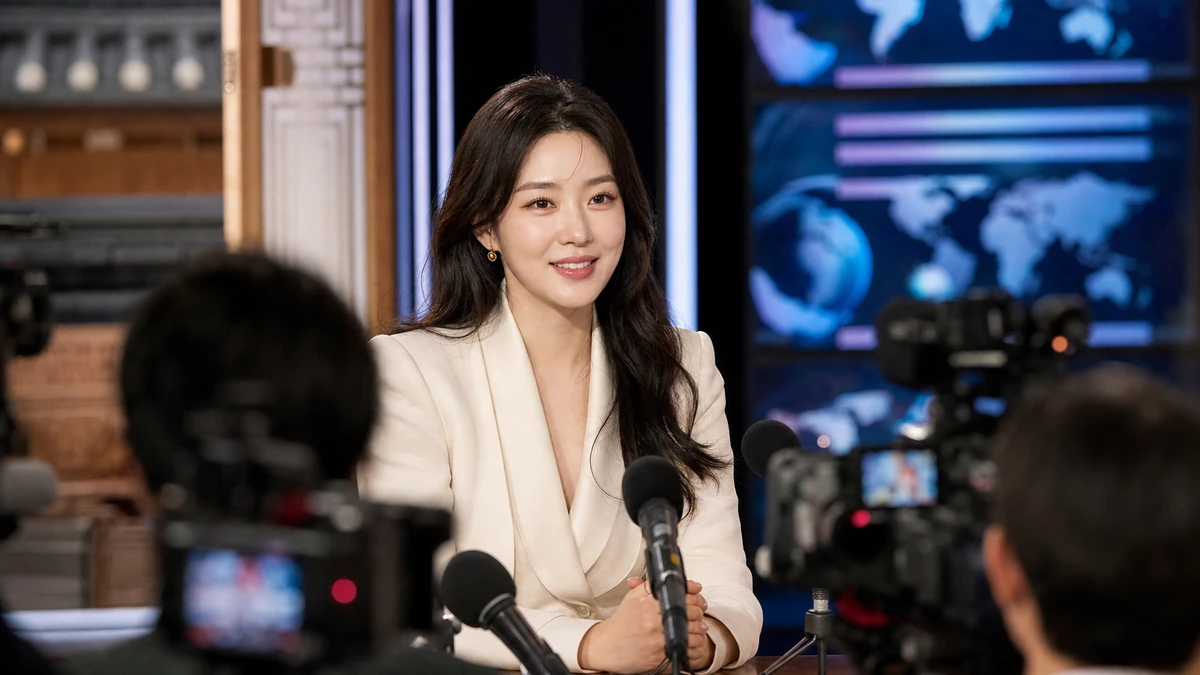
A Korean drama rooted in classrooms breaks through worldwide
South Korean actress Jin Ki-joo is thanking viewers at home and abroad after the Netflix series “True Education” surged to the top of the streamer’s global non-English TV chart just three days after its release, a rapid rise that says as much about the changing reach of Korean drama as it does about one show’s early momentum.
Speaking in Seoul on June 16, Jin said she was deeply grateful that audiences outside South Korea had connected with the series, according to remarks carried by Yonhap News Agency. Netflix ranked the show No. 1 globally among non-English television titles, and it entered the Top 10 in 48 countries, an unusually broad early showing for a drama centered not on romance, zombies or palace intrigue, but on the strained emotional terrain of schools.
That detail matters. For American audiences who have come to associate Korean television exports with glossy love stories, twisty thrillers or high-concept survival dramas, “True Education” arrives with a different pitch. It uses the school system as its setting, but its appeal appears to rest on something more universal: outrage at injustice, sympathy for people who feel unprotected, and the satisfaction of seeing wrongs confronted head-on.
Those themes are not uniquely Korean. They are familiar to anyone who has watched American courtroom dramas, underdog stories or procedural series built around restoring order after institutions fail. What makes “True Education” notable is the way it translates those emotions through a distinctly Korean backdrop while still landing with viewers far beyond South Korea. At a time when subtitles are no longer the barrier they once were, the emotional architecture of a story often matters more than its geography.
Jin’s response to the global reaction also highlights a broader shift in entertainment flows. Not long ago, the conventional wisdom in Hollywood held that non-English series could travel mainly if they had a hook so big it overrode cultural distance. But the last several years have challenged that assumption. Audiences in the United States and elsewhere have grown more comfortable entering stories through specific local worlds, trusting that the human stakes will eventually do the work. “True Education” seems to be the latest example.
What “True Education” is about, and what it is not
The premise of “True Education” may sound bluntly institutional, but it is built around a fictional device designed for dramatic force. Jin plays the only female inspector in a made-up agency known as the Teacher’s Rights Protection Bureau. The bureau does not exist in real life. It functions instead as a narrative tool, allowing the series to dramatize conflicts inside schools and to stage confrontations over power, responsibility and harm.
That distinction is important for readers unfamiliar with the Korean context. South Korea, like the United States, has had recurring public debate over what schools owe students, what authority teachers should have, and how systems respond when people inside institutions feel powerless. But the series is not presented, based on the available reporting, as a direct reenactment of any one real case or as a literal blueprint for policy. It is fiction, and its cultural significance lies less in any specific institutional argument than in the feelings it taps into.
In that sense, the show’s title and setup are doing double duty. They evoke a desire for order in an environment widely understood as formative and emotionally charged. Schools are supposed to be places of learning, protection and structure. When a drama presents them instead as spaces where those guarantees have eroded, the tension becomes instantly legible, even to viewers who know little about South Korea’s education system. American audiences do not need a primer on Korean schooling to understand the underlying anxiety of a place meant to protect young people and adults alike but failing to do so.
The series also appears to organize itself around what Korean speakers often describe with the phrase “good punishing evil,” a familiar storytelling principle in East Asian popular culture that can sound overly literal in English if translated word for word. A more natural American rendering would be moral reckoning or the restoration of justice: people who abuse power are made to answer for it, and those who were wronged receive some measure of acknowledgment or comfort. That formula is hardly niche. It is a major reason legal thrillers, crime procedurals and revenge dramas continue to draw large audiences in the United States.
What may be different here is the combination of that moral framework with the school setting. Education is a deeply local subject. Every country treats classrooms as both a practical system and a symbolic battleground. Yet “True Education” seems to show that even when the institutional details are culturally specific, the emotional logic can still travel. Viewers do not need to recognize every social reference to understand anger at abuse or the relief that comes when someone finally pushes back.
Why Jin Ki-joo’s performance is emerging as the center of attention
Much of the conversation around the show has centered on Jin herself, who said she has been especially moved by viewers calling the role her “character of a lifetime,” a Korean entertainment phrase used when audiences feel an actor has found a defining part. In Hollywood terms, it is the kind of reaction actors get when a performance sticks so strongly that it reshapes how the public sees them. The phrase is less about awards-season prestige than about emotional imprint: the sense that a role has fused with the actor in the audience’s memory.
Jin’s comments suggest the part was not an easy one to take on. She described it as a challenge that demanded both vocal force and physical credibility. To build the role, she said she learned to deliver explosive shouted lines from the lower abdomen, a technique in Korean performance language often described as bringing sound up from the body’s core. For American readers, the closest analogy might be the diaphragmatic control used by stage actors, singers and martial artists, where power comes not from strain in the throat but from support lower in the body.
She also trained at action school for six months to prepare for the series’ physical scenes. That kind of preparation helps explain why the role is resonating. On screen, characters who confront injustice can easily feel one-dimensional if they are defined only by anger. The challenge is to make determination feel lived-in rather than symbolic. Physical training matters because audiences can tell when movement carries conviction and when it does not. Action travels especially well across borders because it depends less on translation. Subtleties of dialogue may shift through subtitles, but posture, speed, hesitation and impact are all instantly readable.
For a non-English series seeking global traction, that combination of emotional clarity and physical expressiveness is a major asset. Viewers may come for the premise, but they stay when the lead performance creates enough momentum to pull them through local details they might not fully know. If Jin’s character has become the emotional anchor of the show, that helps explain why the series is being discussed not just as a hit but as a turning point for the actress herself.
Her colleagues seem to have noticed the shift as well. According to the Korean report, actors Cha Tae-hyun and Zo In-sung, both senior figures in the industry and connected to Jin through her agency, reached out after the show’s release to praise her work. That kind of peer recognition is worth noting because it points to something beyond streaming metrics. Rankings can measure attention; fellow actors often register craft. When people inside the industry respond quickly to a performance, it usually means they see a meaningful expansion in what the actor is doing on screen.
What the Netflix ranking actually tells us
A No. 1 finish on Netflix’s global non-English chart is not just a vanity statistic. It places “True Education” in one of the most watched and competitive lanes for international television, alongside series from countries that have all become major players in the streaming era. The chart is specifically for programming produced in languages other than English, which means the show is being measured in a category that has become one of Netflix’s most important engines of growth and cultural influence.
Just as significant is the breadth of the response. Reaching the Top 10 in 48 countries indicates more than a concentrated burst of fandom in one or two regions. It suggests broad discovery across multiple markets, even if the ways viewers are interpreting the show may differ from place to place. The available information does not tell us exactly why each national audience clicked in, and responsible coverage should avoid pretending otherwise. But it does show that a drama grounded in a specifically Korean social setting can scale internationally at speed.
That matters because it adds another data point to an already clear trend: Korean television is no longer traveling overseas through only a narrow set of genres. For years, romantic dramas served as a common entry point for new global fans, while thrillers and horror series expanded the audience further. Now the field is wide enough that a show dealing with social tension inside schools can launch globally without first needing a more obvious crossover gimmick.
American viewers have seen this pattern before in other national cinemas and television industries. British series long built U.S. followings through crime and costume drama, Spanish-language shows crossed over through thrillers and telenovela energy, and Scandinavian television found export strength through noir. South Korea’s advantage in the streaming era has been range. It is producing stories that are emotionally compressed, visually polished and structurally addictive across multiple genres. “True Education” appears to fit squarely within that model, mixing realism, confrontation and action into a package that feels both culturally distinct and easy to binge.
It is also worth noting what these rankings do not prove. They do not, by themselves, settle debates about the real conditions of schools or validate every social implication viewers might draw from the story. They measure viewership and interest, not policy truth. But in culture, that distinction still leaves plenty to analyze. A hit can reveal what anxieties and hopes audiences are ready to process, and “True Education” seems to have arrived at a moment when stories about institutional failure and moral accountability are landing with unusual force.
Why a local school story can feel universal
Part of the show’s appeal appears to come from its emotional orientation toward victims, a point Jin herself highlighted. In the Korean summary of her remarks, one recurring idea is consolation for people who have been hurt and a strong desire to see justice restored. Those are not abstract values in popular storytelling. They are among the oldest engines of audience investment. People watch because they want to see pain recognized, not ignored, and because they want someone to do what institutions would not.
For American audiences, there are easy parallels. School-based stories in the United States often turn on familiar questions: Who gets protected? Who is believed? When authority breaks down, who steps in? Whether the genre is prestige drama, young-adult television, documentary or crime series, the classroom frequently becomes a stage where larger social battles are made personal. It is where rules meet emotion. It is where adults fail in public view. And it is where unfairness often feels especially intolerable because the setting is supposed to model fairness in the first place.
That is likely why a Korean series so embedded in its own cultural environment can still resonate elsewhere. Viewers do not need to know the exact contours of South Korean educational debate to recognize the dread of institutional drift or the catharsis of someone refusing to let harm slide. In a streaming ecosystem flooded with choices, stories that clarify those stakes quickly have an advantage.
There is also a structural reason these themes travel. The language of injustice is highly exportable. So is the grammar of action. When a series pairs a clean moral engine with a pacey visual style, it lowers the threshold for international entry. Subtitles may transmit the plot, but rhythm transmits urgency. A viewer in Chicago, London or Sydney may not catch every layer of local nuance in the first episode, but they can feel immediately whether a show knows who is in pain, who is abusing power and who is going to fight back.
That helps explain why the show’s early success is drawing attention beyond fandom circles. It is one thing for a Korean drama to score internationally through a genre already known to travel. It is another for a series built around schools, emotional injury and moral confrontation to do so this fast. The message to the industry is clear: specificity is not the enemy of scale if the emotional stakes are legible enough.
What this moment says about Korean drama now
As of June 17, 2026, the buzz around “True Education” is not simply that it climbed a chart. It is that the climb reinforces a larger reality about Korean entertainment: its global era is mature enough that viewers are following not just stars or trends, but increasingly varied kinds of stories. K-pop may still be the most visible gateway for many international fans, but television drama is proving again and again that it can sustain deeper engagement through characters and accumulated emotion.
That is where Jin Ki-joo’s moment becomes especially interesting. Her gratitude toward viewers reads not as a routine promotional soundbite but as a response to a genuine inflection point. When an actor says a project was one they long anticipated, and when audiences answer by saying the role feels career-defining, the exchange matters. It suggests that the labor behind the performance was legible on screen and that the story found viewers ready to meet it.
There is a temptation, whenever a Korean series breaks out internationally, to treat it as another chapter in an endless wave of export success. But that flattening misses what is actually new each time. In this case, the novelty is not that Korean content can travel. That has long been established. The novelty is that a drama about school conflict, built around a fictional bureau and driven by consolation, rage and moral payback, can become global so quickly.
For U.S. audiences, the takeaway is straightforward. If Korean television once seemed like a niche import requiring acquired taste, that era is over. Shows such as “True Education” are increasingly entering the same cultural conversation as any buzzy domestic release: not as curiosities from abroad, but as major streaming events with themes that feel immediately intelligible. The setting may be Seoul. The emotional logic is much wider.
And that may be the clearest explanation for the show’s early success. A Korean actress took on a demanding role that required voice, physicality and moral intensity. A series set in one country’s school environment leaned into a story about people who feel abandoned and someone willing to confront that abandonment. Three days later, viewers in 48 countries had pushed it onto their watch lists and, in many cases, into their conversations. In a fragmented entertainment market, that kind of connection is difficult to fake and even harder to dismiss.
For now, the numbers show strong curiosity. The real test will be whether “True Education” converts that opening burst into longer-term staying power, critical discussion and perhaps a wider profile for Jin herself. But even at this early stage, the message is unmistakable: Korean drama’s global reach is no longer dependent on a single formula, and audiences far from South Korea remain willing to follow compelling local stories wherever they lead.



0 Comments