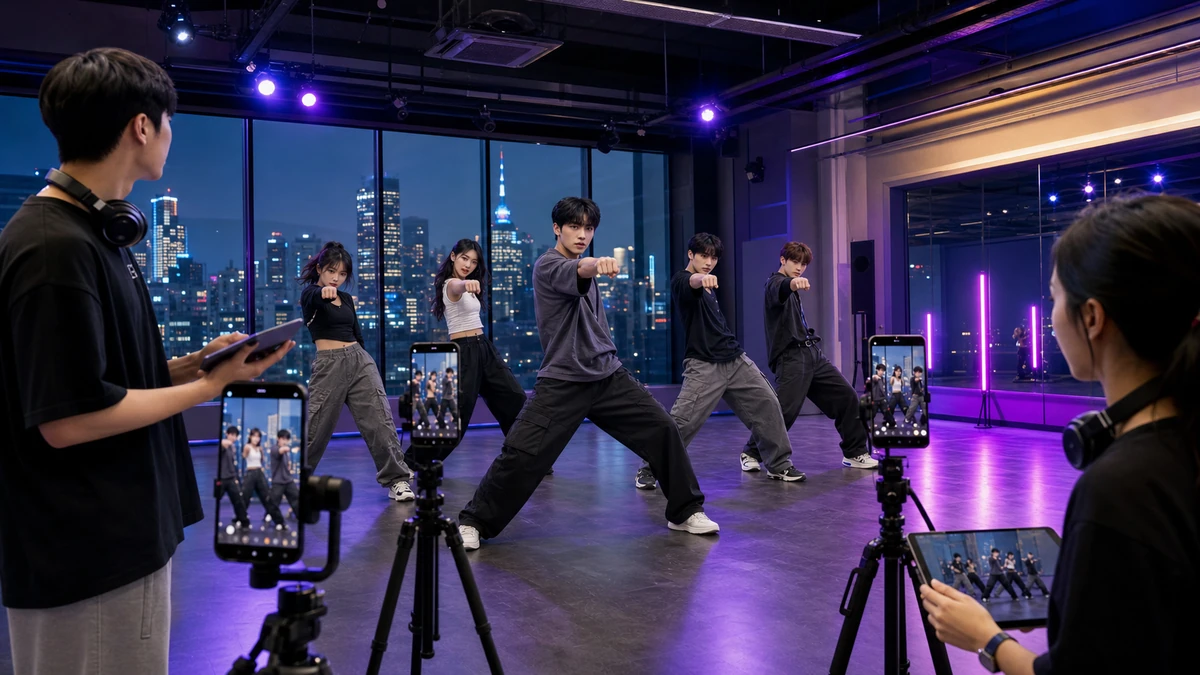
The new first listen happens on a phone screen
For years, the standard rollout for a new pop song looked familiar on both sides of the Pacific: a live TV performance, a radio appearance, a glossy music video, an interview circuit and, for devoted fans, a showcase event designed to turn anticipation into sales and streams. In South Korea’s K-pop industry, that old sequence has not disappeared. But it has been decisively reordered by TikTok, Instagram Reels and the short-form video culture that now shapes how songs are discovered.
In today’s K-pop market, industry observers increasingly see the dance challenge — a short, repeatable choreography clip designed for vertical video — as one of the central engines of promotion for a new release. That is true for rookie acts trying to introduce themselves to the public and for established superstars including BTS, whose members and peers have participated in the same short-form grammar that drives online buzz. The shift is larger than a marketing tweak. It changes the point of first contact between a song and the audience.
Instead of hearing an entire track first and then deciding whether to seek out the performance, many listeners now encounter a song through a few seconds of its chorus, paired with a signature move, a facial expression or a hand gesture crafted to be memorable on a phone screen. In practical terms, the most widely recognized part of a song may arrive before the song itself. For American audiences, a rough comparison might be how a catchphrase from a streaming series or a snippet from a halftime performance can become instantly recognizable online before many people have watched the full program. In K-pop, however, that dynamic is even more baked into the product because the genre has always fused music and choreography.
That fusion gives K-pop a natural advantage in the short-form era. A few seconds can carry melody, movement, personality and visual branding all at once. A user who has never heard of the artist does not need to understand Korean lyrics, know the group’s backstory or belong to a fan community to participate. They only need a catchy hook and a movement simple enough to imitate, remix or share. That structure has turned the dance challenge into the new starting line for a song’s public life.
Why K-pop fits TikTok better than almost any genre
K-pop was built, long before TikTok, as a multimedia form. Songs are not just audio products; they are tightly engineered performance packages. Agencies develop artists with an eye toward stagecraft, styling, camera awareness and choreography that can define an era. In the age of MTV, American pop also relied on visuals to make stars. But K-pop’s training system and promotional model made that connection especially systematic. That helps explain why the genre has adapted so quickly to a media environment dominated by vertical clips and algorithmic recommendation feeds.
Short-form platforms reward clarity and compression. They favor content that can deliver emotion, rhythm and identity almost instantly. A user scrolling through TikTok is not settling in for a three-minute song with a patient build. The platform demands an immediate hook. K-pop’s “point choreography” — a term widely used in Korea to describe a signature move that anchors a song’s performance — is uniquely suited to that environment. These are the kinds of gestures that can be recognized after a single viewing: a hand motion, a shoulder bounce, a finger snap or a synchronized turn that feels both polished and accessible.
The vertical screen matters, too. Traditional television performance shots often highlight the full stage, group formations and wide camera sweeps. By contrast, a smartphone frame narrows the field of vision and brings faces and upper-body movements closer. In that space, expressiveness becomes crucial. A raised eyebrow, a wink, a sharp hand move or a tightly framed chorus sequence can do more promotional work than a wide-angle stage shot. K-pop performers, trained to communicate through facial expression and precise movement, are especially effective in that format.
That is one reason dance challenges have become more than fan service. They are now part of the music’s architecture. Producers, choreographers and agencies increasingly think ahead to what will work in a 10- or 15-second clip. The song is no longer just something later adapted for social media. In many cases, it is shaped from the outset with social media circulation in mind.
When a few seconds can change a song’s fate
One of the clearest illustrations of this shift comes from the girl group ILLIT and its song “It’s Me,” which drew attention not simply because of its release, but because of what happened after release. According to the account summarized in Korean media coverage, the song initially ranked only No. 131 on Melon, one of South Korea’s leading music platforms, based on its daily chart performance. In the old model, that kind of start might have signaled a lukewarm public response or at least a slower climb. But the trajectory changed once challenge videos began circulating widely.
The song later climbed as high as No. 2, a striking reversal that underscored how short-form momentum can alter chart outcomes after a modest debut. The details matter. This was not only a case of a young fan base reposting the same clip. Challenge videos featuring veteran entertainer Lee Jung-hyun and others helped expand the song’s reach across generations and beyond the typical boundaries of a rookie idol fandom. That cross-generational effect is significant in Korea, where entertainment remains highly stratified by age cohort, platform habits and genre preference. When an established figure joins a challenge, the song can break out of its expected demographic lane.
American readers may recognize a similar pattern in how an older celebrity appearance on a late-night show or a sports arena singalong can give a pop song second life. But the Korean version moves faster and is more participatory. The public is not just passively noticing that a song exists; people are being invited to embody a piece of it themselves. The challenge format lowers the barrier between consumption and promotion. A person can become part of the campaign simply by mimicking one move or using the sound in a post.
That blurring of audience and promoter is one of the most important features of the short-form K-pop economy. A song that does not explode on day one can still find its audience if one segment of choreography catches fire. Industry executives increasingly view that possibility as central, not incidental. A strong challenge can drive renewed streams, boost name recognition, generate media coverage and ultimately reshape a track’s commercial path.
From Seoul to the Billboard Hot 100
The impact of these clips does not stop at South Korea’s domestic charts. Short-form platforms are global by design, and K-pop has long been one of the most internationally networked music industries in the world. That makes dance challenges and viral snippets powerful tools not only for local awareness but for cross-border chart movement.
A recent example cited in the Korean summary involves Blackpink’s Jennie and Australian act Tame Impala on a track titled “Dracula.” After a remix version involving Jennie spread quickly on short-form platforms, the song staged a late surge and eventually reached No. 10 on the Billboard Hot 100, according to the summary. Whatever the exact mix of factors behind that climb, the broader point stands: K-pop artists now function as accelerants inside a global recommendation system where language and national origin matter less than algorithmic momentum and shareable performance fragments.
This is one reason K-pop often seems to travel more fluidly across language barriers than traditional music industry logic would predict. The entry point is frequently nonverbal. A listener in Ohio, São Paulo or Manila may first encounter a song through a dance move, a meme format or a reaction clip before ever looking up the lyrics. The challenge is the translation. It converts a full song into a portable, repeatable unit of culture.
For American audiences who may still think of K-pop primarily through stadium tours, chart records or fan armies known for online coordination, the short-form shift reveals another layer of the industry’s strength. This is not only about giant fandoms mobilizing en masse. It is also about reducing the amount of prior knowledge required to engage. You do not have to identify as a fan of a group to post a challenge, imitate a hook or save a sound. The threshold for participation is much lower than buying an album, watching a full comeback showcase or joining a fan community.
That matters because platforms like TikTok reward casual engagement at enormous scale. A fan base can light the initial spark, but broader chart effects often depend on people outside that core audience. In that sense, the challenge acts as a bridge between fandom and the general public — a role that American radio once played more consistently for mainstream pop. In the current environment, however, the bridge is interactive, visual and often driven by user behavior rather than gatekeepers.
Songs and choreography are now being designed for the swipe
Perhaps the most consequential change is happening before the public ever hears the music. Inside the K-pop industry, professionals increasingly consider challenge potential during the planning stage, not just after a song is completed. That means choruses may be shaped to be instantly memorable, and choreography may be built around movements that are striking without being too difficult for ordinary users to copy.
This is a delicate balancing act. If the routine is too complex, participation drops. If it is too generic, the clip gets lost in an endless feed of similar content. What producers want is a point move that looks polished when performed by idols but remains approachable enough for fans, influencers, fellow celebrities and casual users. That requirement influences composition, arrangement, styling, camera blocking and even how a chorus is cut for preview use.
Some critics may worry that optimizing songs for short clips risks reducing music to a gimmick — turning a three-minute composition into bait for an algorithm. That concern is real, and similar arguments have appeared in the United States as artists tailor songs to fit streaming economics or viral trends. But the Korean industry’s defenders argue that the picture is more complicated. Designing for short-form does not automatically mean lowering artistic standards. In some cases, it demands tighter integration among songwriting, choreography and visual storytelling. The challenge is not just to create a catchy sound, but to distill the song’s identity into a brief moment without losing the larger performance experience.
Seen this way, the short-form era may be pushing K-pop toward even greater coordination across creative departments. The writer, producer, choreographer, stylist and video team are all working toward a common question: What is the one moment that will make people stop scrolling? That question can sound commercial because it is. But pop music has always been commercial. The difference now is that the unit of competition is no longer only the single or the music video. It is the clip.
Rookies and superstars now play on the same digital stage
One of the most striking aspects of the challenge boom is that it places newly debuted groups and global stars inside the same platform logic. In older media ecosystems, the difference between a rookie act and a world-famous artist was reflected in access: TV slots, radio priority, magazine covers and distribution muscle. Those advantages still exist. A group with the reach of BTS or Blackpink can trigger immediate response from millions of fans in a way a new act cannot. But once the campaign enters TikTok or Instagram, both are operating inside the same format: a short vertical video asking viewers to react, imitate and share.
That does not erase power differences, of course. Major stars begin with a huge built-in audience and immediate press attention. Rookies are still fighting for name recognition. Yet the platforms offer at least a theoretical opening for newer acts to compete on memorability rather than scale alone. If a song’s hook and choreography connect, it can travel well beyond the artist’s existing fan base. In some cases, the public may know the dance challenge before they know the group’s name — a modern version of how listeners once recognized a hit hook on the radio before they could identify the singer.
This dynamic also changes fan culture. In K-pop, fandom has long been unusually participatory, with organized streaming, coordinated event support, dance covers and online content creation all playing major roles. Short-form video intensifies that participation and makes it more visible to outsiders. Fans do not simply consume a comeback; they perform it. They edit it, duet it, parody it, teach it and circulate it. In effect, they become an unpaid but highly motivated promotional network.
That user labor has always existed in digital fan communities, but short-form platforms package it in a way that algorithms can rapidly amplify. The result is a promotional machine that looks less like traditional advertising and more like social contagion. For entertainment companies, that is extraordinarily valuable. For audiences, it can make the line between fandom expression and marketing harder to see. Both things are happening at once.
The vertical-video mindset is spreading beyond music
The rise of K-pop dance challenges also points to a broader transformation in Korean entertainment. The same forces shaping music promotion are influencing film, television and web-based drama formats. Korean media creators increasingly treat the smartphone, not the movie theater or living room television, as a primary screen rather than a secondary one. That shift has led to experiments with vertical framing, bite-size storytelling and shorter episode structures intended for mobile-first viewing.
In that sense, K-pop’s adaptation to short-form culture is part of a larger industrial adjustment. Korean entertainment companies are proving unusually fast at absorbing shifts in platform behavior and turning them into exportable content strategies. This agility is one reason South Korea, a country of about 51 million people, continues to exert cultural influence far beyond its size. From K-dramas on Netflix to K-beauty on social media to K-pop on global charts, the pattern is similar: local industries study platform habits closely and design products for frictionless international circulation.
Dance challenges are a vivid example because they turn performance into a globally legible language. They do not require subtitles. They do not require familiarity with Korean celebrity culture. They ask only for a phone, a few seconds of attention and perhaps enough confidence to try a move in front of a camera. In an age of shrinking attention spans, that is a powerful proposition.
It also helps explain why Korea’s experimentation matters beyond K-pop fans. What happens in the country’s music industry often functions as an early signal for where global pop promotion is headed. American labels have also embraced TikTok-first rollouts, influencer seeding and highly clip-friendly hooks. But K-pop’s tightly integrated system — where music, visuals, choreography and fandom are coordinated with unusual discipline — makes the trend especially visible there. The Korean industry can move from concept to execution with a speed and cohesion that many Western labels still struggle to match.
What the rest of the music business should be watching
Not every dance challenge succeeds. Virality remains stubbornly difficult to manufacture. A song needs the right chorus, the right move, the right participants, the right timing and a degree of genuine public response that no company can fully script. Even in K-pop, where agencies are famous for precision, online culture still contains an element of chaos. Plenty of challenge campaigns are launched; only some break through.
Still, the industry lesson is becoming hard to ignore. Short-form video is no longer an optional add-on to a release strategy. It increasingly determines how songs are introduced, remembered and revived. A challenge can help a middling debut become a chart climber. It can carry a Korean release across generations at home. It can also help connect a song to global chart systems including Billboard by reaching users who may never have gone looking for it in the first place.
For American readers, that is the larger takeaway from what might otherwise sound like a niche trend in Korean pop marketing. This is not only a story about dance clips. It is a story about how music discovery works in the smartphone era. In that environment, the first impression of a song may be visual, participatory and only a few seconds long. K-pop, perhaps more than any other pop system, has recognized that reality and built around it.
The result is a new kind of launch sequence. A song no longer begins when it hits streaming services or when an artist performs it on television. It begins when one fragment of it becomes irresistible enough to leave the artist’s account and enter the public’s hands. In K-pop today, that fragment is often a dance challenge — a tiny performance with outsized power, turning ordinary users into distributors and a vertical screen into the most important stage in pop.
Comments
Post a Comment