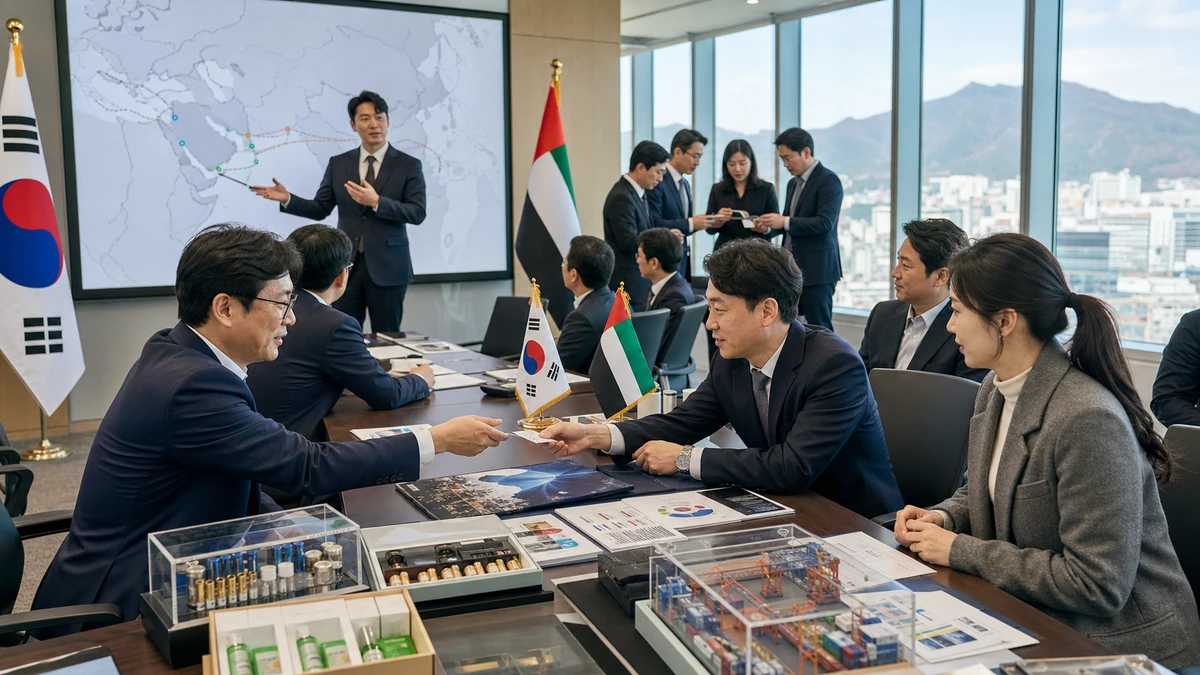
A trade pact becomes a local story
In the United States, trade agreements are often discussed in the abstract: tariffs, supply chains, diplomatic strategy and headline-grabbing numbers. In South Korea, those same forces can land in a much more intimate place — a provincial meeting room, where small manufacturers, biotech firms and cosmetics exporters gather to ask a practical question: What does this mean for us?
That is the backdrop for an event scheduled for June 30 in Gangwon, a northeastern South Korean province better known abroad for ski resorts, mountain scenery and the 2018 Winter Olympics than for export strategy. Provincial officials said they will hold a briefing and consultation session to help local companies understand how to use the newly enacted Korea-United Arab Emirates Comprehensive Economic Partnership Agreement, or CEPA, which took effect May 1.
The meeting, organized by the Gangwon provincial government and the Gangwon office of the Korea International Trade Association, may sound technical. But in South Korea’s regions, far from Seoul’s corporate towers and the country’s best-known conglomerates, such events can carry outsized importance. They are where global policy is translated into factory-floor decisions, marketing plans and, potentially, new jobs.
For American readers, it may help to think of this as the equivalent of a state-level export office in, say, Ohio or North Carolina gathering local companies after a major trade opening in the Gulf. The goal is not to celebrate diplomacy for its own sake. It is to help businesses figure out whether lower tariffs, better market access and government-backed support can actually move their products overseas.
In Gangwon’s case, officials are pitching the UAE not simply as a destination market, but as a strategic gateway to a wider region including the Middle East, North Africa and parts of Europe. That framing matters. It signals that South Korea’s regional governments are increasingly thinking beyond one-off export deals and toward longer-term commercial footholds in new markets.
The significance of the event lies there: not in a single contract announcement, and not in a guaranteed sales boom, but in the early stages of a broader shift. South Korea’s global economic reach, long associated with giants like Samsung, Hyundai and LG, is being recast as something that provincial small and midsize businesses can also claim.
Why the Korea-UAE agreement matters
The CEPA between South Korea and the UAE is described by Korean officials as Seoul’s first free trade agreement with an Arab country in the Middle East. That alone gives it symbolic weight. South Korea has spent decades building an export-driven economy, but its trade relationships have often been understood through the lens of the United States, China, Japan, Southeast Asia and Europe. The Gulf, while important in energy and construction, has not always occupied the same place in the public imagination as a destination for a broad mix of Korean regional exporters.
A CEPA is not identical in every respect to what Americans may think of as a traditional free trade agreement, but the basic idea is familiar: reduce barriers, improve market access, create clearer rules for goods and services, and encourage investment. For businesses, what matters is less the legal label than the practical outcome. If tariffs come down over time, paperwork becomes more predictable, and government agencies help companies navigate the rules, exporting becomes more plausible — especially for smaller firms that do not have large overseas teams.
That is why Gangwon officials are focusing not just on the agreement itself, but on how to use it. Trade deals often generate lofty rhetoric when they are signed, yet many businesses — especially outside major capitals — struggle to determine whether those agreements apply to their products, how quickly tariffs will be cut, what standards must be met, and whether the costs of shipping, certification and market entry still outweigh any benefit.
The Gangwon event is meant to address exactly those questions. According to provincial officials, the June 30 session will explain how local exporters can connect the CEPA to real business operations. In other words, it is less a diplomatic seminar than a field guide for companies that want to know whether this agreement changes their balance sheets.
There is also a broader geopolitical subtext. The UAE has steadily positioned itself as a commercial hub linking Asia, the Middle East and Africa. For export-oriented countries like South Korea, that makes it attractive not only as a consumer market but as a regional logistics and distribution base. American companies have long made similar calculations about Dubai and Abu Dhabi, viewing them as entry points into neighboring markets where direct access can be more complicated.
For South Korea, then, this agreement is not just about selling more goods to Emirati buyers. It is about creating a more durable institutional pathway into a region that can be commercially promising but operationally challenging for smaller firms.
Gangwon’s ambitions beyond tourism
Gangwon occupies a distinctive place in South Korea. It is often associated with natural beauty, winter sports, coastal tourism and a quieter pace of life than the Seoul metropolitan area, where roughly half the country’s population lives. To many outsiders, it may not immediately register as an export story.
But that image can obscure the complexity of the provincial economy. Gangwon has been trying to broaden its industrial base, with interests spanning manufacturing, bio-health products, medical technology and specialized components. Like many regions in advanced economies, it faces a familiar challenge: how to create growth opportunities that are not entirely dependent on tourism, seasonal spending or metropolitan spillover.
In South Korea, this challenge carries added urgency. The country’s economic success has long been concentrated in and around Seoul, as well as in a handful of industrial centers tied to major conglomerates. Regional governments have spent years searching for ways to keep local businesses competitive, attract young workers and prevent economic hollowing-out. In that sense, export policy is not merely about overseas sales. It is about whether smaller cities and provinces can secure a viable place in a highly globalized national economy.
That is one reason the Gangwon briefing has drawn attention beyond the narrow confines of trade administration. Officials say they want to use the event to identify local demand for entering Middle Eastern markets. That may sound bureaucratic, but it points to something important: the provincial government is trying to determine what its companies actually want and need, rather than simply announcing a generic support package from above.
For readers in the U.S., the idea is comparable to a state economic development office surveying regional manufacturers before tailoring export assistance. Which sectors show real interest? Which products have a price advantage if tariffs fall? Where do firms need help — market research, regulatory paperwork, insurance, shipping, branding, local partners? Those questions are less glamorous than a summit photo-op, but they often decide whether trade policy succeeds on the ground.
Gangwon officials appear to understand that. Their messaging suggests they are treating the CEPA as a tool that must be translated into business-specific advice, not simply celebrated as a diplomatic milestone. That practical orientation may prove more consequential than the event itself.
The products in focus — and why they fit
Provincial officials highlighted several categories they see as promising under the Korea-UAE deal: cosmetics, pharmaceuticals, medical devices and auto parts. At first glance, that mix may seem eclectic. In reality, it reflects several of South Korea’s export strengths, as well as the kinds of goods that can benefit significantly when tariffs are reduced gradually and market access becomes more predictable.
Cosmetics are perhaps the easiest for international audiences to recognize. South Korea’s beauty industry, often grouped under the term K-beauty, has built a global reputation over the past decade for trend-setting skincare, fast product innovation and a sophisticated consumer culture around appearance and self-care. American consumers may know K-beauty through sheet masks, serums and sunscreen brands that have moved from niche Asian beauty stores into major U.S. retailers and online marketplaces.
That cultural context matters because Korean cosmetics are not just a manufactured product; they are also an export of lifestyle branding. They travel alongside the broader Korean Wave, or Hallyu — the global rise of Korean pop culture through music, television, film, fashion and food. A trade agreement cannot create that demand on its own, but it can make it easier for companies to price products competitively and establish distribution channels where interest already exists.
Pharmaceuticals and medical devices involve a different equation. Those sectors depend less on trend and more on trust, regulation and technical credibility. In the U.S., for instance, even a promising medical product cannot move far without compliance, certification and institutional confidence. The same is true in Gulf markets. Lower tariffs can help, but they are only one piece of the puzzle. That is why Gangwon’s emphasis on follow-up support for certification and logistics is important. In health-related sectors, the practical barriers are often as decisive as the tariff schedule.
Auto parts, meanwhile, fit into the quieter but vital world of industrial supply chains. Unlike finished consumer goods, components often move through long-term business relationships and recurring procurement needs. South Korea already has deep manufacturing expertise tied to the automotive sector, and parts suppliers can sometimes find more stable export opportunities than companies relying on one-off retail demand. If trade conditions improve, even modest gains in price competitiveness can matter.
None of this guarantees an export surge. The province has not announced major deals, and the news at hand is not about immediate sales results. But the list of targeted sectors offers a revealing snapshot of how Gangwon sees its place in the global economy: not as a single-industry region, but as a province trying to connect culture, manufacturing and technology to overseas demand.
From policy to paperwork: Why local companies need more than tariff cuts
One of the most telling aspects of the Gangwon initiative is that it combines a briefing session with one-on-one consultations. That format acknowledges a basic truth that anyone who has covered trade long enough learns quickly: lower tariffs alone rarely solve a small exporter’s problems.
A business can have a competitive product and still struggle with shipping costs, customs procedures, regulatory certification, market intelligence, language barriers, contract risk and payment insurance. For a large multinational, those are standard operating challenges. For a regional midsize company — or a smaller manufacturer hoping to make its first real push into a new market — they can be prohibitive.
Gangwon officials said they plan to link the CEPA briefing with broader export support programs, including trade consultations, overseas marketing assistance, logistics support, certification help and insurance. That suggests the province sees trade promotion as a chain rather than a single event. The agreement may open the door, but companies still need help walking through it.
This is where the story becomes particularly relevant for Americans watching debates over industrial policy and regional development at home. Governments often announce headline initiatives — semiconductor subsidies, clean-energy incentives, strategic trade partnerships — but the success of those policies frequently hinges on mundane follow-through. Can local firms access the right information? Do they know how to comply with rules? Are they able to absorb the costs of entering a market before revenue arrives?
In South Korea, where national growth has historically leaned heavily on exports, local governments have become increasingly active in answering those questions. Their role is not merely ceremonial. They act as intermediaries between international agreements and domestic businesses, translating complex policy into sector-specific support. The Gangwon event is an example of that intermediary function in action.
There is also a more human scale to this. When local officials talk about export strategy, they are not only discussing customs classifications or tariff lines. They are talking about whether a small medical device maker can hire additional staff, whether a cosmetics producer can invest in new packaging lines, whether younger workers can see a future in a provincial city instead of moving to Seoul. The connection between trade policy and everyday life can be indirect, but it is real.
That may be why this otherwise technical announcement has resonance in South Korea’s domestic news cycle. It touches on a central question facing many advanced economies: can globalization be made to work not just for capital cities and corporate giants, but also for regional communities looking for durable growth?
The UAE as a gateway, not just a customer
Gangwon’s economic officials have framed the UAE as more than a single export market. Kim Man-ho, the province’s economy director, said the government wants to help local companies use the Korea-UAE CEPA to strengthen price competitiveness and establish stable entry not only into the UAE but into wider markets across the Middle East, North Africa and Europe.
That language is strategic. It reflects a business view of the UAE that many global firms share: the country functions as a regional node, with sophisticated logistics infrastructure, international connectivity and a reputation as a relatively accessible commercial environment compared with some neighboring markets. For smaller Korean exporters, that can make the difference between an intimidating region and a manageable first step.
American readers may recognize the pattern from how companies use Singapore in Southeast Asia or the Netherlands in Europe — not because those places are merely end markets, but because they provide efficient entry into broader commercial networks. The UAE can serve a similar role for firms looking west from East Asia.
Still, “stable entry,” as the Gangwon official put it, is the key phrase. Export expansion is easy to romanticize, especially when governments speak about gateway markets and emerging demand. But lasting commercial success depends on continuity: repeat buyers, reliable distribution, regulatory compliance and the ability to manage risk over time. A trade agreement can improve the odds, but it does not remove the need for strategy.
That is why the province’s emphasis on listening to local companies is notable. Officials are not simply announcing a target region and hoping businesses follow. They say they want to assess actual interest and connect firms with practical support tailored to their needs. If done well, that approach can make policy more efficient. If done poorly, it becomes another public-sector seminar that generates little beyond PowerPoint slides and polite applause.
At this stage, the story is best understood as an opening move, not a finished outcome. The CEPA is in force. Gangwon is trying to mobilize around it. The sectors have been identified. The support language is in place. What comes next will depend on whether local firms see real commercial opportunity — and whether the province can help them navigate the hard, unglamorous parts of exporting.
A small window into South Korea’s changing economic map
For years, the global story of South Korea has been told through its largest brands, its technological prowess and, more recently, the worldwide popularity of its culture. Those narratives are true, but they can flatten the country into a handful of familiar symbols: K-pop, Oscar-winning films, smartphones, cars and Seoul’s hyper-modern skyline.
The Gangwon-UAE story offers a different angle. It shows how South Korea’s globalization is increasingly being pursued in provincial settings, through smaller firms and with help from local governments trying to widen the country’s economic map. In that sense, the development is not just about trade with the Gulf. It is about how a mature export economy tries to spread opportunity beyond its dominant urban core.
That matters socially as much as economically. South Korea has grappled with regional inequality, demographic pressure and the concentration of opportunity in the capital region. When provincial governments seek export openings, they are also trying to address those structural strains. A stronger foothold abroad can support local production, encourage business investment and, at least in theory, make it easier for young people to imagine careers outside Seoul.
No one should oversell a single June briefing as a turning point. There is no evidence yet of a dramatic employment effect, a sudden jump in orders or a guaranteed transformation of Gangwon’s economy. The article that prompted this attention does not claim any of that. The event is better understood as a practical starting point: an attempt to convert a new international agreement into something local companies can actually use.
But starting points matter. In trade, as in politics, the most consequential changes are often not the grand declarations but the quiet administrative moments when a policy begins to enter ordinary institutions — chambers of commerce, provincial agencies, consultation rooms and business plans.
That is what makes this story worth watching. It captures a moment when regional South Korea is trying to connect its everyday economy to a wider world. Not through slogans, and not through the country’s most famous corporations, but through the painstaking work of helping local businesses understand a new set of rules and imagine a larger market beyond the horizon.
If the strategy works, the effects will not be confined to spreadsheets. They could show up in hiring decisions, investment plans and the long-term resilience of a province seeking to define itself as more than a tourist destination. In that sense, a trade briefing in Gangwon is also a story about economic identity — about who gets to participate in globalization, and from where.
Comments
Post a Comment