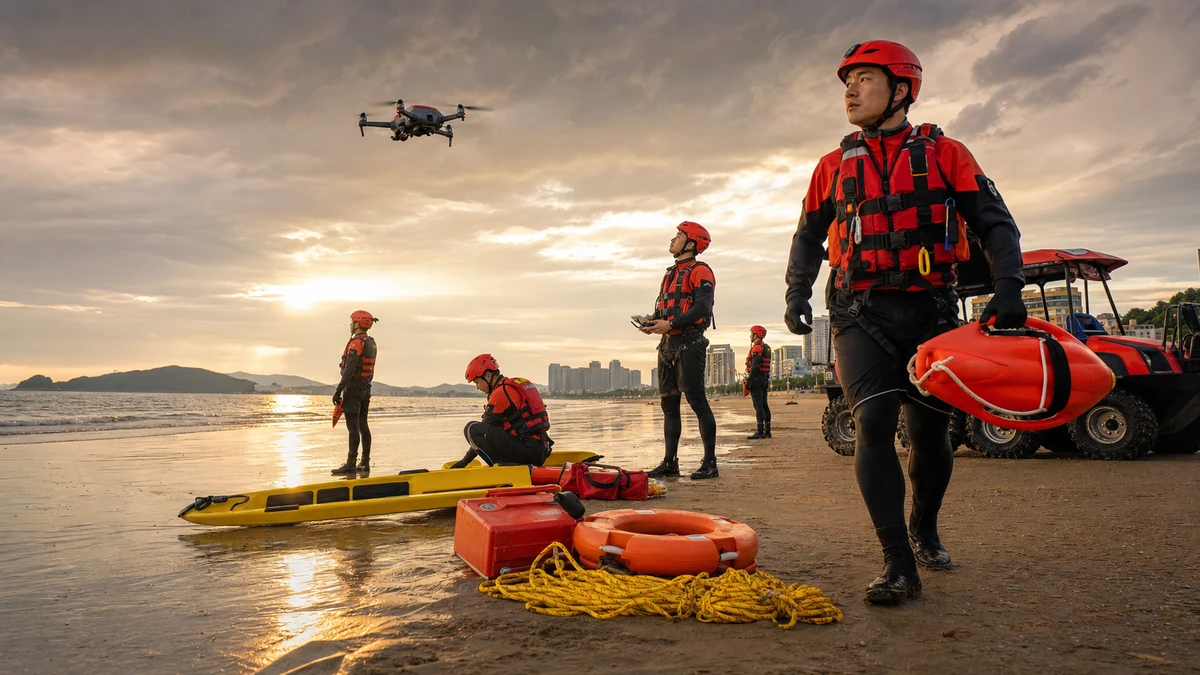
A coastal city near Seoul moves early on summer safety
Before peak beach season fully arrives in South Korea, officials in Incheon are putting a highly visible safety system in place along some of the region’s busiest waterfront destinations. The Incheon Fire Headquarters said it will operate its seasonal “119 Citizen Water Rescue Team” from July through August, deploying personnel and equipment across 16 beaches and waterside recreation areas to reduce accidents during the height of summer travel.
For American readers, Incheon may be best known as the home of South Korea’s largest international airport, the main gateway to Seoul. But it is also a coastal city with easy access to beaches, islands and tidal flats that draw large numbers of day-trippers from the greater Seoul metropolitan area, a region of roughly 26 million people. In practical terms, that makes Incheon something like a mix of a major transit hub and a regional beach escape — a place where urban life and summer tourism meet at close range.
That geography helps explain why water safety there is treated as a core public service, not just a seasonal extra. According to the fire headquarters, the city plans to station rescue personnel at six major beaches and run patrol operations at 10 additional sites. The overall operation will involve 388 people, including 121 firefighters and 267 volunteer fire brigade members, along with 265 pieces of equipment such as amphibious vehicles and drones.
The announcement underscores a reality familiar to coastal communities almost anywhere: beautiful waterfronts also require constant vigilance. Whether the setting is a Jersey Shore boardwalk, a Florida Gulf Coast beach or a popular California cove, warm-weather crowds bring a predictable mix of risks — fatigue, dehydration, children wandering from guardians, swimmers misjudging currents and visitors ignoring warnings. Incheon officials appear to be building their summer strategy around that same understanding, with an emphasis not only on emergency rescues but also on the less dramatic interventions that often prevent tragedies from happening in the first place.
In South Korea, the emergency number 119 functions much the way 911 does in the United States for fire and many medical emergencies. That makes the “119 Citizen Water Rescue Team” branding instantly legible to local residents: this is the emergency response system extending itself to the beach. The addition of “citizen” also reflects the role of community-based volunteer responders, a structure that blends professional response capacity with neighborhood familiarity and local presence.
As South Korea enters the hottest part of the year, the broader message from Incheon is straightforward: beach safety is infrastructure. It is as much a part of a successful summer season as parking, transit, restrooms or food stands. And in a coastal city where millions can reach the water in a relatively short drive, the stakes are high.
Why Incheon’s beaches matter in the Seoul region
Incheon’s beach network serves a specific social function in South Korea. While the country is surrounded by water on three sides, not every urban resident has simple access to a classic beach getaway without taking a longer trip to the east coast, the south coast or Jeju Island. Incheon, by contrast, gives residents of the Seoul area a comparatively convenient option for short summer trips. That helps explain why places such as Eulwangni, Wangsan, Hanagae, Sipripo, Janggyeongri and Dongmak beaches see heavy seasonal traffic.
For a U.S. audience, it may help to think of these beaches less as remote resort enclaves and more as high-volume public recreational spaces within reach of a massive metro population. Their importance lies not only in scenery but also in accessibility. Families with children, groups of friends, young couples and domestic tourists can make a beach day part of an ordinary summer weekend without the planning required for a longer vacation. That convenience is one reason officials are treating safety preparations as urgent before crowds fully build.
In many countries, beach safety is associated primarily with lifeguard towers, warning flags and public signage. Those features matter in South Korea too, but the public management model often has an added emphasis on coordinated local government response. A beach is not simply a leisure site; it is a managed public environment where crowd control, emergency medical response, communication systems and local volunteer participation all intersect. Incheon’s latest summer plan reflects that approach.
The city’s decision to cover 16 sites is also revealing. It suggests that summer visitors are not funneling into only one or two marquee destinations. Instead, beachgoers spread out across a broader coastal system, including island-linked beaches and smaller shoreline recreation areas. That makes uniform planning difficult. A site that attracts large crowds for swimming may need permanent on-site staffing, while another may require moving patrols to scan a wider area and respond as conditions change throughout the day.
For tourism officials anywhere, safety is often discussed as a secondary benefit — something nice to have once a destination is already popular. In practice, it works the other way around. Families return to places where they feel secure. Visitors are more likely to stay longer, spend more and recommend destinations to others when basic safety systems are visible and reliable. In that sense, Incheon’s deployment is not just an emergency preparedness measure. It is also a statement about the kind of summer public space the city wants to offer.
That matters especially in South Korea, where dense urban living and intense domestic travel patterns can produce large spikes in visitors during school breaks and holiday periods. A beach close to the capital region can go from ordinary to crowded very quickly. Officials are effectively acknowledging that the difference between a manageable day at the shore and a chaotic one often comes down to whether trained responders are already nearby when something starts to go wrong.
What last year’s numbers say about real beach risk
The strongest argument for the expanded operation may be the city’s own record from last summer. According to Incheon authorities, the 119 Citizen Water Rescue Team handled 44 life-saving rescues, 1,421 first-aid responses and 1,666 safety measures last year, for a combined 3,131 field actions.
Those numbers tell a more nuanced story than the phrase “water rescue” might suggest. To many people, a rescue team conjures images of dramatic saves: a swimmer caught in rough surf, a child pulled from danger, a boat emergency unfolding in public view. Those situations do happen, and the 44 rescues indicate that life-threatening incidents were very real. But the much larger numbers in first aid and safety actions show that the daily work of beach safety is often quieter and more repetitive.
That pattern would be familiar to American first responders. On a crowded summer beach, responders may be called for heat exhaustion, cuts, minor falls, dehydration, panic, exhaustion after overexertion, children separated from parents or visitors entering restricted areas. Each incident may seem small on its own, but collectively they define the workload. More important, many serious emergencies begin as small problems that were missed, ignored or left unmanaged for too long.
Incheon’s data suggest that prevention is not an abstract talking point but the center of the job. If more than 1,600 safety measures were needed last year, that means responders were repeatedly intervening before conditions escalated. A safety measure can include giving warnings, redirecting visitors away from hazardous zones, reinforcing instructions, responding to risky behavior or controlling access around changing tides or surf conditions. In the public imagination, these steps may not draw the same attention as a rescue. Operationally, they are often the reason a rescue never becomes necessary.
The first-aid figure — 1,421 cases — is just as significant. It indicates that beach safety is closely tied to medical readiness. A summer shoreline is not only a place for swimming; it is a place where people stand in the sun for hours, consume alcohol in some cases, walk over uneven terrain, care for small children and move between parking lots, food areas and the water. Medical incidents are part of the environment even when no one is in obvious danger offshore.
From a public policy perspective, last year’s results provide a rationale for this year’s staffing and equipment. If dozens of lives required direct rescue and thousands of situations called for first aid or preventive intervention, then visible on-site personnel are not a symbolic gesture. They are an evidence-based response to known demand. Incheon is not building a beach safety system for a hypothetical problem. It is scaling a system that was heavily used the previous season.
That distinction matters because local governments are often pressured to show efficiency in public spending. By pointing to 3,131 interventions last year, officials can argue that beach safety is measurable, frequent and operationally necessary. For the public, those numbers may also be a reminder that summer recreation, however routine it feels, carries risks that are neither rare nor evenly distributed.
A hybrid force of professionals, volunteers and technology
This year’s operation combines 121 firefighters with 267 volunteer fire brigade members, a structure that offers insight into how local emergency management works in South Korea. The country has long relied not only on professional emergency personnel but also on organized volunteer fire units that support local response activities. These volunteers are not casual helpers in the everyday sense of the word; they are typically affiliated with structured community organizations that assist in prevention, emergency support and public safety efforts.
For American readers, a rough comparison might be volunteer fire departments or auxiliary emergency support units that play important roles in some parts of the United States, especially in smaller communities. The difference in South Korea is that these volunteers often operate within a more centralized and visibly integrated public safety framework. In a beach setting, that can be especially valuable because local knowledge matters. Volunteers may know the rhythms of specific shorelines, common visitor behavior, nearby access points and the places where problems tend to develop.
The equipment list — 265 items, including amphibious vehicles and drones — also points to a modernized approach to shoreline response. Amphibious vehicles can improve mobility at the boundary between land and shallow water, particularly in areas where sand, mudflats, changing tides or difficult access complicate conventional rescue movement. Drones, meanwhile, can help responders monitor large stretches of coastline, identify people in distress more quickly and observe conditions in areas that are difficult to scan from the ground.
But technology here is best understood as support, not replacement. Beaches are highly variable environments shaped by weather, tide patterns, crowd density and human behavior. A drone can spot unusual movement or scan an expansive area faster than a person on foot. It cannot persuade a visitor to leave a dangerous zone, calm an anxious family member, perform CPR or make the kind of instant judgment that comes from field experience. The Incheon plan appears to recognize that effective safety depends on the combination of people and tools, not on gadgets alone.
That is an important distinction in a period when public agencies around the world are eager to emphasize high-tech solutions. There is understandable appeal in aerial surveillance, data-driven deployment and specialized equipment. Yet many emergencies still hinge on simple human factors: whether a warning is heeded, whether a responder gets there quickly enough and whether someone on the scene can read a fluid situation before it worsens. Incheon’s personnel-heavy model suggests the city sees technology as a force multiplier rather than a substitute for boots on the ground.
The scale of the deployment also reinforces how labor-intensive public safety can be in recreational spaces. A beach may look open and simple, but protecting it is complicated. Responders must watch the water, monitor the crowd, coordinate with local officials, provide first aid, deliver warnings, handle lost children, assist exhausted visitors and stay ready for rare but serious emergencies. The announced staffing numbers are large because the task itself is large.
Why some beaches get fixed teams and others get patrols
One of the most notable features of Incheon’s plan is that it does not treat all 16 sites the same. Six beaches — Eulwangni, Wangsan, Hanagae, Sipripo, Janggyeongri and Dongmak — will have personnel stationed on site, while the remaining 10 locations will be covered through patrol operations.
That distinction may sound technical, but it reflects a strategic judgment about how to use limited resources. Permanent placement offers the fastest response in places where visitor traffic is consistently heavy or where risks are concentrated. Patrol coverage, by contrast, allows responders to move across a wider set of lower-density or more dispersed sites, providing visibility and intervention without committing fixed teams everywhere.
This is a common problem in public safety management: full-time presence everywhere is ideal in theory but usually unrealistic in practice. Cities must decide where immediate response is most essential and where mobile coverage can still provide meaningful protection. Incheon’s split approach suggests officials are trying to balance efficiency with readiness.
There is also a broader lesson here about tourism geography. Not all beaches function the same way. One may draw large numbers of swimmers close to transportation links. Another may attract walkers, campers or families wading in shallow areas. Still another may involve changing tidal conditions that create specific hazards at certain hours. By separating fixed-post and patrol locations, the city is effectively acknowledging that risk is uneven — not just from beach to beach, but often from hour to hour and activity to activity.
For readers used to U.S. beach culture, this may resemble the difference between a heavily staffed municipal beach and a less developed shoreline where rangers or rescue teams circulate more broadly. The core principle is the same: tailor the response to crowd levels, terrain and incident patterns rather than imposing a one-size-fits-all model.
That kind of differentiated management can also improve public trust. Visitors do not necessarily need to see identical staffing at every site to feel safe. They do need to believe the system makes sense — that authorities understand where people gather, what hazards exist and how quickly help can arrive. Incheon’s public breakdown of six fixed locations and 10 patrol locations signals an effort to show that the deployment is deliberate rather than arbitrary.
If the plan works as intended, it should reduce response times at the busiest beaches while still extending a preventive presence across a broader shoreline network. In a summer setting, minutes matter. The value of a fixed responder at a crowded site is obvious when someone is in distress. The value of a patrol may be less visible, but it can be just as important when it interrupts a risky situation before it becomes an emergency.
Public cooperation is part of the safety system
In announcing the summer operation, Incheon Fire Headquarters Commissioner Lim Won-seop said the agency would work to ensure residents and visitors can enjoy the season safely and urged the public to cooperate with safety personnel and follow public-address announcements. That appeal may sound routine, but it points to one of the most important truths in beach safety: the system works best when visitors see themselves as participants, not just consumers of a service.
Anyone who has spent time at a crowded public beach knows that rules and warnings can feel inconvenient. A whistle from a lifeguard, a taped-off area, a broadcast asking people to move back or stop swimming can be easy to dismiss, especially on a day meant for relaxation. Yet those brief moments of friction are often the practical expression of risk assessment. Officials are not trying to spoil a holiday mood; they are trying to keep a manageable environment from turning into a dangerous one.
That message may be especially relevant in South Korea’s summer beach culture, which is strongly communal. Families, friend groups and tour visitors often share packed public spaces where one person’s behavior can quickly affect others nearby. Entering a restricted zone, ignoring warnings, overestimating swimming ability or allowing children to stray too far can create ripple effects that draw responders away from other needs. In that sense, cooperation is not simply about personal responsibility. It is about preserving the capacity of the entire safety system.
The large number of first-aid responses and safety interventions last year suggests officials are dealing not only with rare crises but with constant low-level noncompliance, confusion and preventable mishaps. Better public cooperation could shift more of the rescue team’s energy toward prevention and rapid readiness rather than repeated correction. That is the kind of trade-off emergency managers notice immediately, even if beachgoers do not.
There is a cultural point here that travels beyond South Korea. Safe recreation in public space depends partly on what might be called civic discipline — the willingness to follow rules designed for collective benefit even when they feel annoying in the moment. Americans encounter the same tension at beaches, national parks, lakes and trail systems every summer. Warning signs are ignored. Barriers are crossed. Instructions are second-guessed. Then a rescue follows. Incheon’s appeal for cooperation fits that universal pattern.
The deeper idea is that mature leisure culture includes safety culture. A good beach experience is not only about freedom, scenery and escape from routine. It is also about accepted norms that let large numbers of strangers use the same space without unnecessary harm. Incheon’s rescue deployment is one part of that equation. Public behavior is the other.
What Incheon’s plan says about modern urban summer life
At one level, Incheon’s seasonal rescue operation is a straightforward local government announcement: more responders, more equipment, more oversight at beaches during the busiest months. At another level, it captures a larger feature of modern urban life in South Korea and beyond. Cities are increasingly judged not only by how they manage work, transit and housing, but also by how safely they manage leisure.
That shift is easy to underestimate. Recreation can look informal from the outside — a beach day, a weekend drive, children splashing in shallow water, friends taking photos at sunset. But when those activities happen at metropolitan scale, they require systems. Parking must be managed. Crowds must be directed. Medical response must be close by. Public communication has to be clear. Risks have to be anticipated before people arrive. What seems spontaneous to visitors is often highly structured behind the scenes.
Incheon appears to understand that the quality of a summer destination depends as much on that hidden structure as on the natural appeal of the shoreline itself. The city’s beach safety plan treats waterfront recreation as part of civic infrastructure — a public good that needs staffing, planning and enforcement. That is likely one reason officials moved before the season fully peaks: once crowds are already on the sand, prevention becomes harder.
For English-speaking audiences watching South Korea through the lens of pop culture, technology or geopolitics, a story like this offers a different window into the country. It is not about K-pop, semiconductors or North Korea. It is about local government, public space and the mechanics of keeping ordinary life running smoothly in a densely populated society. Those stories can be less flashy, but they reveal how institutions actually touch daily life.
And they raise questions familiar far beyond Korea. How much safety presence do people expect in public recreational spaces? How should cities divide resources between prevention and emergency response? What role should volunteers play? How much technology meaningfully improves safety, and how much is for show? Incheon’s approach suggests that, at least for this summer, the answer is a layered system: professionals, volunteers, mobile equipment, targeted deployment and constant reminders that the public has responsibilities too.
As July and August bring larger crowds to the water, the effectiveness of that system will be measured not only by the rescues that do happen, but by the accidents that do not. In public safety, the most successful outcomes are often the hardest to see. A warning obeyed, a hazard noticed in time, a child redirected, a swimmer helped before panic sets in — these are small moments, but they are what make a summer beach feel safe enough to enjoy. Incheon is betting that those moments are worth organizing for before the season reaches full speed.
Comments
Post a Comment