At a Children’s Hospital in South Korea, a Puppet Show Turns Climate Change and Medicine Safety Into a Community Lesson
A hospital visit becomes a classroom
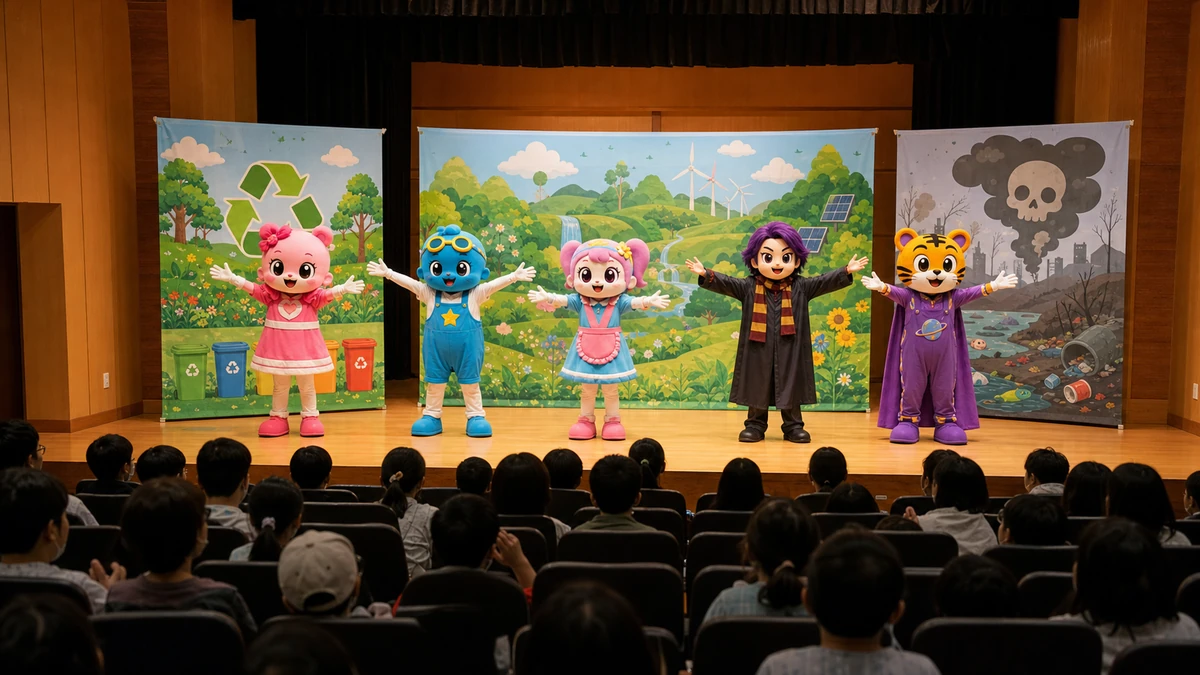
At a children’s hospital in Chuncheon, a midsize city northeast of Seoul known to many Koreans for its lakes and mountain scenery, the usual rhythms of appointments, checkups and inpatient care gave way, at least for part of a day, to something more theatrical. Children gathered not just for treatment, but for a puppet show.
That might sound modest, even quaint, to American readers used to hospital outreach programs built around clowns, therapy dogs or bedside arts education. But the event held this week at Kangwon National University Children’s Hospital carried a broader public message. It brought together hospitalized children, outpatients, parents and elementary school students from a nearby school for a performance about climate change, everyday environmental protection, and the safe use and disposal of medicine.
In practical terms, it was a children’s educational show staged inside a hospital. In symbolic terms, it was something bigger: a sign of how South Korean public institutions are increasingly trying to meet children where they are, in spaces that are part of daily life rather than reserved for formal instruction. The hospital, often seen as a place defined by anxiety, needles, waiting rooms and recovery, was temporarily recast as a shared civic space — part clinic, part classroom, part community center.
According to the hospital, about 140 people took part, including pediatric patients, caregivers and students from Buan Elementary School in Chuncheon. The program was hosted by two public agencies, South Korea’s Health Insurance Review and Assessment Service and the Korea Environment Corporation. For an American audience, those are not familiar names, but their involvement matters. One sits at the crossroads of the country’s national health insurance system, reviewing and assessing medical costs and care; the other is a state-run environmental body. Together, they staged a program that treated health and the environment not as separate policy silos, but as connected parts of daily life.
That connection is increasingly central in many countries, including the United States, where public health officials have been forced to talk more often about heat waves, wildfire smoke, asthma, chemical exposure and the disposal of prescription drugs. What made the Chuncheon event notable was not that it addressed those themes, but that it translated them into a format children could absorb: a live puppet performance in a place where young patients and families were already gathered.
For children spending time in hospitals, whether for chronic treatment, short-term illness or routine outpatient visits, the institution can become an unexpected part of childhood. In that sense, the question facing pediatric hospitals is not only how to deliver care, but what kind of environment surrounds that care. The puppet show in Chuncheon suggests one answer: make room for learning, participation and a sense of normalcy, even inside medical spaces.
Why a puppet show matters in Korea
Puppet theater occupies a slightly different cultural niche in South Korea than it might in the United States, where many adults associate puppets with “Sesame Street,” local library programming or children’s museum performances. In Korea, educational puppet shows have long been used in schools, community centers and public campaigns to teach young children about safety, hygiene, etiquette and social values. Their appeal is straightforward. They lower the barrier for difficult topics by wrapping instruction in humor, repetition and characters children can remember.
That matters when the subject is climate change or pharmaceutical disposal, both of which can sound abstract even to adults. A lecture on carbon emissions is unlikely to land with a first grader. But a puppet character who learns why littering matters, why extreme weather is becoming more common, or why leftover medication should not be tossed out carelessly can make the same information stick.
The program in Chuncheon appears to have been designed around that principle. Organizers used a scenario-based performance to explain the seriousness of climate change, steps children can take in everyday life to protect the environment, and the right way to take and discard medicine. In a children’s hospital, that last point is especially relevant. For many young patients and their caregivers, medicine is not an abstract public health topic; it is part of the routine of life.
In the United States, public agencies frequently warn against flushing medications down toilets or throwing unused pills into the trash without guidance, because of risks tied to accidental poisoning, misuse and environmental contamination. National Prescription Drug Take Back Day, organized by the Drug Enforcement Administration, has become a familiar example of how American authorities try to link home medicine cabinets to broader public safety concerns. The Korean event tackled a similar issue, but in child-friendly terms and in a setting where medicine already has immediate meaning.
That combination — familiar format, difficult subject, emotionally charged setting — helps explain why the event resonated beyond its scale. It was not merely entertainment for children waiting out an afternoon at the hospital. It was an effort to teach children and adults together, in a language of performance rather than bureaucracy.
It also reflects a wider Korean habit of public education through lived spaces. In South Korea, government-backed messaging often appears not only in classrooms and public service ads, but in places like subway stations, apartment complexes, neighborhood health centers and community festivals. The message of the Chuncheon event was clear: hospitals, too, can serve as platforms for public learning.
Health and the environment, explained through everyday life
One of the more striking aspects of the program is how directly it tied environmental behavior to personal health. That may sound obvious, but public discourse often treats the two as separate conversations. Climate change is discussed as a global policy issue. Health is discussed as a medical issue. Waste disposal is discussed as a civic or sanitation issue. For children, though, those distinctions are rarely useful.
What children understand more readily are concrete actions and recognizable consequences: using less waste, keeping their surroundings clean, taking medicine properly, asking adults for help, and learning that what goes into the environment can come back to affect people’s bodies and communities. By introducing climate change in everyday terms, the organizers appear to have moved the topic out of the realm of distant headlines and into the world of daily choices.
That is a significant educational strategy in South Korea, where environmental awareness has become a larger part of childhood education over the past decade. Like schools in the United States and Europe, Korean schools have increasingly incorporated lessons about recycling, emissions, plastic use and sustainable habits. What sets this event apart is not the subject matter alone, but the setting: a pediatric hospital, where the link between care, vulnerability and environmental well-being becomes harder to ignore.
Children dealing with respiratory illnesses, compromised immune systems or long recovery periods may be particularly attuned — or their parents may be — to questions about air quality, hygiene and safe medication practices. Even if the program did not present itself as a formal medical intervention, it addressed themes that sit close to many families’ everyday concerns. A child who has to take medicine on a schedule, for example, is already living at the intersection of health education and household routine.
That is why the decision to include caregivers alongside children matters. In public health messaging, adults are often the ones who actually implement what children learn. A child may remember a puppet’s lesson about leftover medicine, but a parent decides how it is stored or disposed of. A child may absorb the message about protecting the environment, but an adult often determines shopping habits, transportation choices and home recycling practices. Teaching both groups in the same room can reinforce the idea that these are shared responsibilities.
And by including local elementary school students alongside patients and families, the hospital and its partners widened the frame even further. The lesson was not limited to children who happened to be receiving care. It became a community lesson with the hospital as host, suggesting that health institutions can contribute to civic education in ways that extend beyond diagnosis and treatment.
From treatment center to community space
There is a larger social story here about how pediatric hospitals are changing, not just in Korea but around the world. Children’s hospitals have long tried to soften the emotional strain of medical care through murals, playrooms, music therapy and child life specialists. The idea is familiar to American parents: a child who feels less frightened may cope better with treatment, and a parent who feels supported may be better able to navigate difficult decisions and long days.
The Chuncheon event fits within that broader shift, but with a distinct Korean public-service angle. Rather than focusing solely on comfort or distraction, the program reframed the hospital as a child-friendly cultural space — a place where children could participate, learn and interact with peers from the surrounding community.
That phrase, “child-friendly cultural space,” carries a particular resonance in South Korea, where local governments and public institutions often emphasize “family-friendly” and “child-friendly” design as markers of modern public service. In practice, that can mean anything from safer sidewalks and playground access to educational programming and inclusive facilities. When the head of the children’s hospital said the institution wants to keep expanding public-interest programs that support children’s healthy growth beyond medical treatment, he was articulating a broader institutional vision, not merely promoting a one-day event.
For American readers, one possible comparison might be the way some libraries in the United States have reinvented themselves. A library is no longer just a place to borrow books; in many communities, it also hosts job workshops, language classes, children’s story hours, health screenings and civic events. Something similar is happening here with the hospital. It remains a medical facility first, but it is also experimenting with a wider public role.
That role can be especially meaningful in regional cities like Chuncheon, which is not Seoul and does not operate on the same scale as the capital’s giant medical centers. In places outside a country’s most globally visible urban hubs, institutions often serve overlapping functions. A hospital may be a treatment site, but also an anchor of local identity, education and public trust. By inviting neighborhood students into the hospital for a shared event with patients and caregivers, organizers blurred the line between inside and outside, patient and non-patient, treatment and community life.
That matters because hospitals can feel isolating, especially for children. Inpatient care can separate young patients from classmates, routines and a sense of participation in ordinary life. Programs that bring community into the hospital do not erase that burden, but they can reduce its sharpness. They remind children that the hospital is not only a place where things happen to them, but a place where they can still engage, learn and belong.
The event also included participatory elements rather than simply asking children to sit and watch. That approach is increasingly common in children’s education because active involvement tends to produce stronger recall than passive listening. A child is more likely to remember “we did this together” than “someone told me this.” In a hospital setting, participation may carry an added emotional benefit: it gives children a moment of agency in an environment often defined by adult schedules and medical instructions.
A public-service approach shaped by Korean institutions
To understand why this event stands out in South Korea, it helps to understand the institutional backdrop. The country’s public sector is often more visibly involved in everyday life than many Americans might expect. Health care financing, education campaigns and local welfare services frequently operate through partnerships among hospitals, schools and government-affiliated agencies. In that context, a puppet show hosted by a health review body and an environmental corporation is not an odd pairing so much as a practical example of how policy gets translated into everyday outreach.
The Health Insurance Review and Assessment Service, one of the event’s hosts, plays a major role in the Korean health system by reviewing medical claims and assessing care under the national insurance framework. It is not a household name outside Korea, but it sits near the center of how the country manages and monitors health care. The Korea Environment Corporation, meanwhile, oversees environmental work that touches public education, waste management and resource protection. Their collaboration around children signals an official recognition that long-term public outcomes begin with habits formed early.
That logic is familiar in the United States as well, even if the institutional structure differs. American public health agencies have long emphasized early education about smoking, nutrition, seat belts, handwashing and drug safety because behaviors learned in childhood can shape later life. What differs in Korea is the highly coordinated style in which public agencies often operate, especially when working with schools and hospitals.
There is also a social dimension worth noting. South Korea has spent years grappling with how to support children and families in a highly competitive, fast-paced society. Debates about education pressure, youth well-being, low birth rates and family support are constant features of public life. In that environment, programs aimed at children often carry extra symbolic weight. They are not just about one lesson or one afternoon. They are part of a larger national conversation about what kind of social environment children are growing up in.
Seen that way, the puppet show at Kangwon National University Children’s Hospital becomes a small but telling example of Korean civic culture. It is not splashy like K-pop, K-drama or Korean beauty exports, which often dominate global coverage of the country. Instead, it shows a less glamorous but arguably more revealing side of contemporary Korea: a network of regional institutions trying to fold care, education and public responsibility into the routines of ordinary life.
That may be precisely why the story is worth attention outside Korea. International coverage often gravitates toward crisis, conflict or blockbuster cultural phenomena. But sometimes a local event — children in a hospital auditorium, parents watching, students from a nearby school visiting, puppets explaining climate and medicine safety — says more about a society’s priorities than a major speech or headline-making scandal.
What this says about Korea’s changing social culture
The Chuncheon program also points to an evolution in how South Korea approaches civic education for children. Older models of public instruction, in Korea as elsewhere, often relied on lectures, slogans and top-down campaigns. Children were told what to do, and adults hoped the lesson would stick. Increasingly, institutions are moving toward immersive, experience-based formats that recognize how children actually learn.
That shift mirrors broader changes in Korean society, where younger generations and families have placed greater value on emotional well-being, interactive learning and child-centered environments. It also reflects the influence of developmental education trends that stress participation over rote instruction. A puppet show in a hospital may not sound revolutionary, but it is part of that larger move away from simple didactic messaging and toward engagement.
The inclusion of small takeaway items such as sticker books and key rings may seem like a minor detail, but in children’s programming such objects often serve as memory anchors. Any American parent who has watched a child come home from a museum or school event clutching a themed handout or trinket understands the point. The item extends the experience beyond the event itself. It prompts later questions, repetition and, sometimes, new habits. In this case, organizers appear to have recognized that if the environmental and health lessons were to last, they needed to travel home with the children in some form.
There is, of course, a limit to what a single performance can accomplish. No puppet show, however thoughtfully designed, can by itself change environmental behavior or ensure correct medicine disposal over time. The hospital itself appears to acknowledge that the larger challenge is continuity: whether children and caregivers retain the message, whether schools and families reinforce it, and whether institutions keep building follow-up programs instead of treating such events as one-off public relations exercises.
Still, the significance of the program does not depend on proving a measurable transformation overnight. Its value lies in what it attempts. It suggests that a children’s hospital can do more than heal the body in the narrowest clinical sense. It can also participate in raising informed, socially conscious young citizens — and in supporting parents as partners in that process.
That may be the most resonant part of this story for readers outside Korea. At a time when public trust is strained in many democracies, and when climate change can feel overwhelming or politicized, the Chuncheon event offered a much smaller, more human-scale model of public engagement. Start with children. Use language they understand. Bring institutions together. Meet families where they are. Treat education not as a lecture from afar, but as part of everyday life.
In a global media landscape crowded with darker headlines, the event at Kangwon National University Children’s Hospital stands out for another reason: it is a story about constructive social imagination. Not a utopian one, and not a grand national initiative, but a practical effort to make a medical space feel more humane, more connected and more useful to the community around it.
That is easy to overlook, especially when Korea is so often framed abroad through its export culture or geopolitical tensions. But for one afternoon in Chuncheon, the story was simpler and in some ways more revealing. A hospital opened its doors not only to patients, but to neighboring schoolchildren. Public agencies used puppets instead of pamphlets. Children learned that caring for their health and caring for the environment belong in the same conversation. And a place associated with illness became, however briefly, a place of shared civic learning.
Comments
Post a Comment