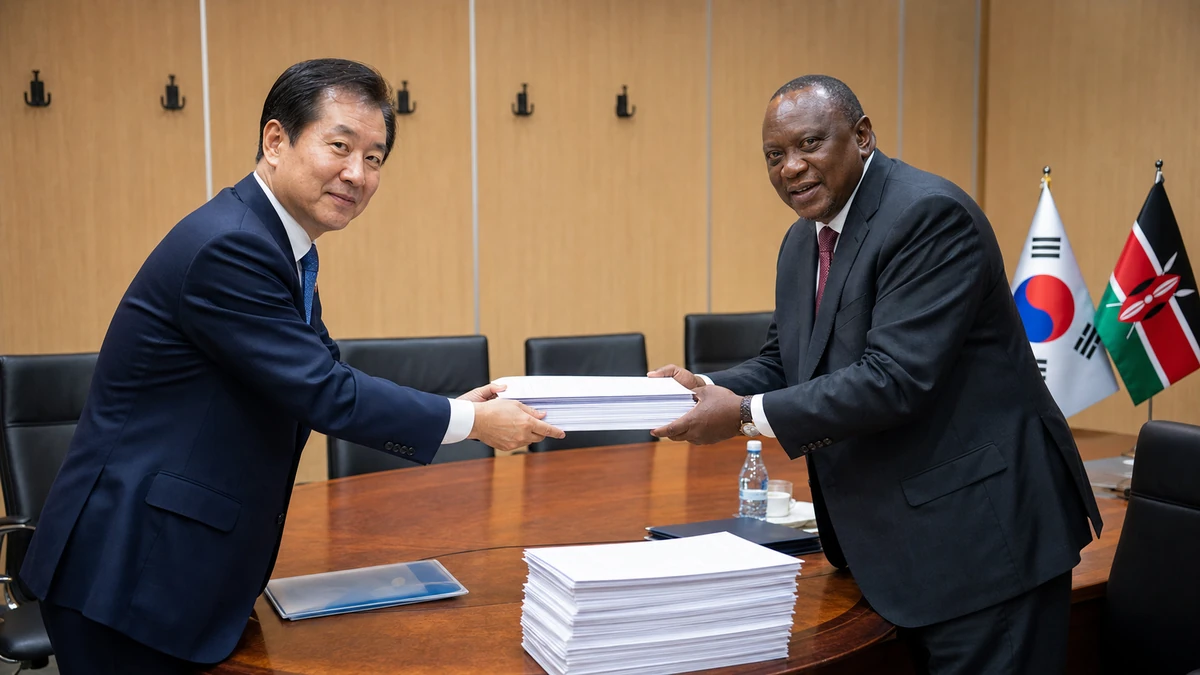
South Korea uses a G7 backdrop to widen its diplomatic lens
When most Americans think about a Group of Seven summit, they picture the world’s wealthiest democracies arguing over tariffs, wars, climate targets and the latest fracture in the global order. South Korea is not a G7 member, but its leaders are often invited to attend parts of the gathering, and those appearances have increasingly become about more than ceremonial participation. On the sidelines of this year’s summit meeting in Evian, France, South Korean President Lee Jae-myung held a bilateral meeting with Kenyan President William Ruto, using one of the world’s most elite diplomatic stages to make a broader point about where Seoul sees its role in the world.
According to the South Korean government’s account of the meeting, Lee told Ruto that he hoped to deepen cooperation between South Korea and Kenya beyond its current level. Ruto, who has visited South Korea twice, responded in a way that gave the conversation unusual weight: Kenya, he suggested, has something to learn from South Korea’s rise. No new treaty or major business package was publicly announced. There was no splashy headline about military sales, infrastructure financing or a development fund. But the significance of the meeting lies elsewhere. It showed South Korea trying to turn its own national history into a usable diplomatic language, particularly in conversations with African countries that are navigating questions of growth, industrial policy and state capacity.
For American readers, the easiest comparison might be to the way U.S. officials sometimes invoke the Marshall Plan, the Tennessee Valley Authority or the postwar expansion of the American middle class when speaking to developing countries. Nations often tell stories about themselves in foreign policy. What stood out in Evian was the story Lee chose to emphasize. Instead of presenting South Korea simply as a polished technology powerhouse home to Samsung, Hyundai and K-pop, he underscored a harder memory: Korea was once colonized, poor and dependent on help from abroad.
That matters because it suggests South Korea is trying to distinguish itself from older powers whose development advice can sound paternalistic. Seoul’s message, at least in this exchange, was not that it arrived at wealth through national genius alone. It was that it came through trauma, rebuilding, outside assistance and sustained effort. For countries like Kenya, that may make South Korea sound less like a distant lecturer and more like a partner whose experience feels relevant.
A development story with emotional and political resonance
To understand why Lee framed the conversation this way, it helps to understand how central South Korea’s development narrative is to its modern identity. In the span of a few generations, South Korea went from war devastation and widespread poverty to one of the world’s leading industrial and cultural powers. In American classrooms, the shorthand phrase is often the “Miracle on the Han,” a reference to the Han River that runs through Seoul and to the country’s rapid postwar economic transformation. The phrase can oversimplify a complicated history, but it captures why South Korea’s rise still carries symbolic force abroad.
Lee reportedly reminded Ruto that Korea had once been under colonial rule, was later liberated, and developed rapidly with help from other countries. That is not a casual historical note in the Korean context. Korea’s colonization by Japan from 1910 to 1945 remains one of the most politically charged and emotionally enduring experiences in modern Korean life. It shapes domestic politics, memory culture and diplomacy in Northeast Asia. When a South Korean president invokes that history abroad, he is doing more than reciting a timeline. He is identifying South Korea as a country that began from subjugation rather than privilege.
That framing also broadens how South Korea wants to be seen internationally. For years, the country’s global image has been dominated by visible success: Oscar-winning films, chart-topping music, advanced semiconductors, sleek consumer brands and an export-driven economy that many governments admire. Those achievements are real, but they can make South Korea look like a finished product rather than a country with historical experience that might translate into policy lessons. Lee’s comments suggested that Seoul wants foreign partners, especially in the developing world, to focus not just on what South Korea became, but on how it got there.
That distinction is important. There is a difference between selling success and sharing process. Success can feel unattainable when presented as a final state. Process is more useful because it includes mistakes, institutions, foreign aid, strategic planning and political choices. Lee’s language of “sharing experience” appears calibrated to that difference. It is a softer formulation than promising to deliver development. It implies that South Korea is offering lessons, perspective and cooperation, not a one-size-fits-all blueprint.
For an American audience, this may sound similar to debates over whether development policy should be prescriptive or collaborative. Washington has spent decades struggling with that question in Africa, Latin America and Asia. South Korea, by virtue of its own trajectory, may believe it has a comparative advantage in speaking about development without sounding like a former imperial manager. Whether that advantage holds in practice is another question, but the diplomatic instinct behind it is clear.
Why Kenya matters in this conversation
To some American readers, Kenya may not seem like the first country one would expect to feature in a Korean diplomatic headline from a European summit. But Kenya occupies a prominent place in African politics and economics. It is one of East Africa’s most important commercial hubs, home to a major financial center in Nairobi, a growing technology ecosystem and a diplomatic community that often serves as a gateway to the region. It is also a country whose leaders regularly speak in terms of modernization, industrialization, infrastructure and development strategy — themes that naturally intersect with South Korea’s preferred foreign-policy story about itself.
Ruto’s reported interest in learning from South Korea’s leap is therefore not especially surprising. African leaders have long looked outward for models of growth, sometimes toward China, sometimes toward Singapore, sometimes toward postwar Europe, and often toward multiple examples at once. South Korea occupies a distinct space in that conversation because it is seen as a country that industrialized quickly, built globally competitive firms and expanded educational attainment within living memory. It is not ancient history. It is still close enough to the present that policymakers can study it as a case rather than a legend.
Ruto’s own prior visits to South Korea added another layer to the meeting. Heads of state do not visit countries as tourists. Such trips are usually opportunities to see political institutions, industrial systems and state priorities up close. By referring to Ruto’s past visits, Lee appeared to signal that the relationship already has some accumulated familiarity. In diplomacy, that matters. It lets both sides present the relationship as more than a passing photo opportunity on the sidelines of a major summit.
Still, it is important not to oversell what happened. The public statements available so far do not show that South Korea and Kenya reached a concrete new agreement or launched a specific major initiative. In diplomatic reporting, what is not announced can be just as important as what is. The absence of a defined package suggests this meeting was more about signaling direction than finalizing deliverables. That does not make it trivial. Often, the point of these summit encounters is to establish tone, identify shared interests and create political room for working-level officials to follow up later.
For Kenya, South Korea offers a potential partner whose strengths in manufacturing, technology, education and state-led development planning may be relevant. For South Korea, Kenya offers something equally important: a credible foothold in a region where influence is increasingly contested and where future diplomatic, economic and demographic significance is hard to ignore.
What South Korea is really saying about its place in the world
The most revealing part of the Lee-Ruto meeting may be what it says about South Korea’s evolving self-image. For decades, South Korean diplomacy has been heavily shaped by immediate security concerns: North Korea, the U.S. alliance, relations with China and Japan, and the management of regional tensions in Northeast Asia. Those issues remain central and will continue to dominate the country’s strategic thinking. But South Korea is also trying to act like a country with wider reach and a wider portfolio of relationships.
That is where an encounter like this one becomes meaningful. By meeting the Kenyan president during a G7-related gathering, Lee demonstrated that South Korea does not view major international forums only through the lens of traditional great-power relationships. The country is increasingly using those spaces to cultivate ties with nations outside its usual security orbit. In practical terms, that can mean trade, technology partnerships, development cooperation, education exchanges and support in international institutions. In symbolic terms, it means South Korea wants to be seen not just as a stakeholder in East Asian security, but as a middle power with something broader to contribute.
The phrase “middle power” comes up often in conversations about countries like Canada, Australia, South Korea and Turkey, though each case is different. It usually refers to nations that are not superpowers but still possess enough economic heft, diplomatic capacity and institutional credibility to shape outcomes in selective ways. South Korea has long fit that description, but it is increasingly trying to define what kind of middle power it wants to be. One answer seems to be this: a country that can convert its development experience into diplomatic capital.
That approach also reflects a subtle kind of ambition. South Korea cannot outspend China across the developing world. It cannot match the United States militarily. It cannot replicate Europe’s colonial-era institutional reach. But it can offer a narrative of transformation that few advanced economies can claim with the same immediacy. It can point to a living memory of aid dependency followed by export-led growth, democratization and global cultural influence. In other words, it can present itself as proof that dramatic national reinvention is possible.
Whether foreign governments find that story persuasive will depend on what follows. Development narratives are powerful, but they can ring hollow if not backed by real engagement, financing, exchanges and policy cooperation. The challenge for Seoul is to make sure the rhetoric of shared experience leads to structures that partners can actually use.
The careful language of “sharing experience”
One reason this meeting deserves attention is the restraint in the language used. Lee did not appear to promise that South Korea would solve Kenya’s development challenges or transplant the Korean model wholesale. Instead, he spoke in terms of sharing experience and cooperating where possible. That may sound vague, but in diplomacy vagueness can be strategic. It avoids commitments that outpace policy, and it leaves room for the relationship to develop organically.
The phrase “sharing experience” also carries a different tone from aid or instruction. It suggests a peer conversation rather than a hierarchy. That distinction matters in Africa, where governments have long navigated relationships with outside powers that arrive bearing funding, advice and geopolitical agendas in unequal measure. South Korea is likely aware that it can be more effective if it avoids sounding like it has come to lecture.
At the same time, “experience” is a broad term. It can encompass industrial policy, vocational training, public administration, education, digital government, export strategy, rural development and the politics of institution-building. South Korea has spent years exporting versions of that knowledge through development agencies, training programs and technical cooperation. What Lee’s remarks did was elevate that practice to the presidential level and place it in a larger narrative about South Korea’s own past.
There is also a domestic dimension to this. Korean leaders often speak to international audiences with one ear tuned to voters at home. A message about South Korea as a country that once received help and now shares its experience can resonate domestically because it affirms national pride without sounding triumphalist. It says the country has achieved enough to be useful to others, but it also remembers the vulnerability that came before success. That blend of pride and memory is politically potent in South Korea.
For Americans, there is a recognizable pattern here. U.S. leaders, too, often frame foreign policy in ways meant to reinforce a national story for domestic audiences. What makes the Korean case distinctive is that its development story is compressed into such a short time span that it remains personal, even familial, for many citizens. Grandparents who knew deprivation helped raise children who entered the middle class and grandchildren who grew up in one of the world’s most connected societies. That historical compression gives South Korea unusual credibility when it talks about change over a generation or two.
Africa is becoming harder for middle powers to ignore
The Lee-Ruto meeting also points to a larger trend that extends well beyond South Korea: Africa is becoming harder for middle powers and advanced economies to treat as peripheral. The reasons are straightforward. The continent’s population is young and growing. Its markets are expanding unevenly but meaningfully. Its countries matter in multilateral institutions. Its mineral resources are central to the energy transition and advanced manufacturing. And its political alignment can shape debates over everything from trade rules to U.N. votes.
South Korea is hardly alone in recognizing this. The United States, China, the European Union, Japan, Turkey, the Gulf states and India have all intensified their engagement with African countries in recent years. What distinguishes South Korea’s pitch is less its scale than its framing. Seoul tends to emphasize technology, development partnership, education and the lessons of late industrialization. That message may have particular resonance in countries that are less interested in ideological alignment than in practical examples of state-led modernization.
Kenya, for its part, fits naturally into that framework. It is one of the African countries most frequently discussed in terms of entrepreneurship, digital adoption, logistics and regional economic influence. It also faces the same hard questions many developing states face: how to build jobs at scale, improve infrastructure, reduce inequality, attract investment and strengthen institutions without becoming overly dependent on any single external partner. South Korea’s experience does not provide easy answers, but it offers a case study that policymakers may find useful.
That said, there are limits to the analogy. South Korea’s path was shaped by Cold War geopolitics, U.S. security guarantees, a highly specific industrial structure and domestic political conditions that cannot simply be duplicated elsewhere. Kenya’s history, demographics, political economy and regional environment are different. The risk in every development conversation is that admiration for one country’s rise turns into false confidence that the same formula can be copied. The most responsible reading of the Lee-Ruto meeting is not that South Korea has a ready-made model for Kenya, but that both leaders see value in exploring what parts of Korea’s experience might be relevant.
What comes next will matter more than the optics
In the short term, the Evian meeting is best understood as a directional signal. South Korea wants deeper ties with African countries and is increasingly comfortable making its development history part of that pitch. Kenya appears receptive to that framing, at least rhetorically, and already has enough familiarity with South Korea to make follow-up plausible. Those are meaningful facts, even if they stop short of a policy breakthrough.
But summit diplomacy has a way of generating more symbolism than substance. The photographs are easy. The difficult part is the layer beneath them: ministerial meetings, working groups, financing arrangements, technical partnerships, educational exchanges and private-sector involvement. If Seoul wants this relationship to become more than an episodic talking point, it will have to show continuity. That could mean sustained engagement by development agencies, more structured economic dialogue, support for training and technology transfer, or simply a more regular pattern of high-level contact.
For now, what stands out is the message. In a venue defined by the world’s richest democracies, South Korea used its access not only to confer with traditional powers but also to connect with an African partner on terms shaped by memory, development and shared ambition. That is a subtle but telling sign of how South Korea’s diplomacy is changing.
For American readers used to seeing South Korea mainly through the lenses of North Korea, semiconductors or pop culture, this is a reminder that the country’s global identity is broadening. South Korea is no longer just a frontline ally or a manufacturing success story. It is also trying to become a country that turns its own history into a foreign-policy asset — a nation that says, in effect, we were once poor, vulnerable and dependent too, and that experience is part of what we can offer the world now.
Whether that message translates into lasting influence will depend on follow-through. But in Evian, on the margins of one of the world’s premier diplomatic gatherings, South Korea made clear that this is the role it increasingly wants to play.
Comments
Post a Comment