At Jeju Forum, South Korea’s top diplomat casts Korean Peninsula stability as a global security priority
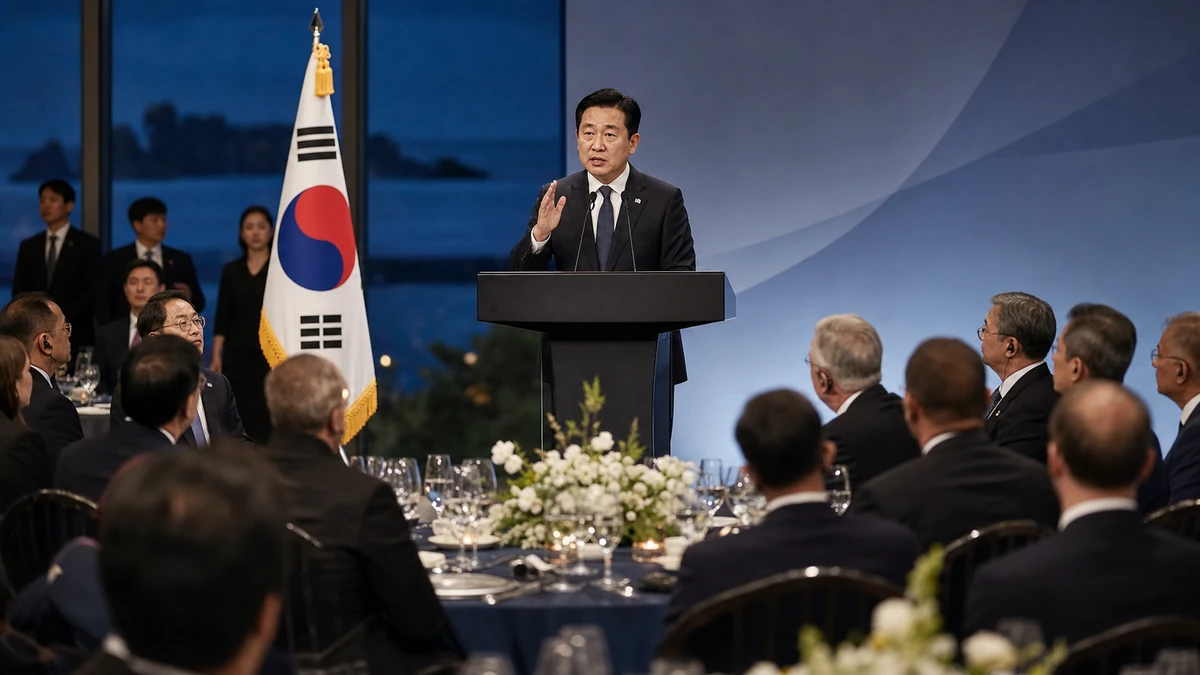
A warning from an island built for dialogue
South Korea’s foreign minister used one of the country’s best-known international policy gatherings this week to deliver a message aimed well beyond Seoul: preventing the Korean Peninsula from becoming the site of another major geopolitical clash is not simply a Korean concern, but a matter of broader global stability.
Speaking at the Jeju Forum, an annual conference on peace and prosperity held on South Korea’s southern resort island of Jeju, Foreign Minister Cho Hyun said maintaining peace and stability on the peninsula remains South Korea’s top priority. He also warned that if peace and stability in the wider Indo-Pacific are shaken, the world could face upheaval on a scale not seen in more than 75 years.
For American readers, the significance of that framing is hard to miss. Washington often talks about the Korean Peninsula through the lens of North Korea’s nuclear program, U.S. troop deployments and alliance coordination with Seoul and Tokyo. Cho’s remarks broadened the picture. His message suggested that the risks surrounding the Korean Peninsula are tied not only to military deterrence, but also to global shipping lanes, supply chains, investor confidence, diplomatic alignments and the larger international order that has underpinned economic growth since the end of World War II.
That may sound abstract, but it is not. South Korea is home to some of the world’s most important semiconductor, battery, auto and shipbuilding industries. Northeast Asia sits alongside sea routes that help power the global economy. A crisis on the peninsula would not stay local for long. Americans who remember how a pandemic-era factory disruption in Asia could affect car prices in the United States, or how attacks on shipping routes can raise costs worldwide, will understand the basic point: instability in a strategically central region travels fast.
Cho’s remarks did not announce a new treaty, a fresh diplomatic initiative or a breakthrough with North Korea. They were instead a strategic statement of priorities. But in diplomacy, especially in a region as tense and layered as Northeast Asia, that matters. Publicly repeating a message about de-escalation, trust-building and creating conditions for dialogue is one way a government signals what it wants both allies and adversaries to hear.
Why the Korean Peninsula matters far beyond Korea
To many Americans, Korea can still seem like a place Washington pays attention to mainly when North Korea conducts a missile test or threatens a nuclear strike. But the peninsula occupies a much bigger place in the geopolitical map.
It is one of the world’s most heavily militarized regions, where North and South Korea remain technically at war because the 1950-53 Korean War ended in an armistice, not a peace treaty. It is also a place where the strategic interests of the United States, China, Japan and Russia intersect, sometimes uneasily. Few regions combine unresolved war, nuclear risk, alliance politics and economic centrality quite like this one.
That is why Cho’s phrase about preventing the peninsula from becoming a “site of another geopolitical conflict” carries weight. He was effectively arguing that Korea should not be treated as an isolated flash point or a recurring headline about North Korean provocations. Instead, he presented it as a key test of whether major powers can keep competition from tipping into crisis.
That framing also reflects a long-running South Korean concern. Seoul has often had to navigate between the hard realities of deterrence and the equally important need to avoid being reduced to a battleground for bigger powers. In the Cold War, the Korean Peninsula stood at the front line of ideological confrontation. Today, as U.S.-China rivalry deepens and Russia’s war in Ukraine reshapes global security thinking, South Korea is trying to prevent its neighborhood from becoming another arena where strategic competition overwhelms diplomacy.
For Americans, a useful comparison may be Taiwan in the way policymakers discuss systemic risk, though the historical and political circumstances are very different. The point is not that the Korean Peninsula and Taiwan are the same. They are not. But in both cases, instability would immediately affect questions much larger than one territory or one bilateral dispute. Markets would react. Allies would recalibrate. Supply chains would shudder. Military planners would move from theory to contingency.
Cho’s message suggests Seoul wants the world to understand that Korean peace is not a niche regional issue. It is part of the architecture of global order.
The language of de-escalation, not drama
One of the most notable aspects of Cho’s remarks was the vocabulary he chose. Rather than emphasizing punishment, pressure or retaliation, he focused on easing tensions, rebuilding mutual trust and creating conditions for dialogue. In the often rigid language of national security, those words stand out.
That does not mean South Korea is abandoning deterrence. The U.S.-South Korea alliance remains the backbone of Seoul’s security posture, and there is no sign South Korea intends to weaken that. North Korea’s nuclear and missile capabilities remain a central concern in Seoul and Washington alike. But Cho’s emphasis suggests that South Korea also wants to keep diplomatic space alive, especially at a moment when regional tensions can easily harden into permanent confrontation.
That distinction matters. In Washington, foreign policy debates often gravitate toward visible actions: sanctions, military exercises, summit meetings, new defense systems. What Cho described is less dramatic and more patient. It is about managing risk before a crisis spirals, reducing the chances of miscalculation and sustaining an environment where talks remain possible even if progress is slow or uncertain.
In practical terms, that is the diplomatic equivalent of trying to lower the temperature in a room where everyone is armed and no one fully trusts the other side. It may not produce splashy headlines. It may not satisfy those who want immediate results. But for governments living with daily security risk, it can be the difference between manageable tension and dangerous escalation.
Cho also spoke about “sustainable peace and coexistence,” a phrase that deserves unpacking for readers outside Korea. In the South Korean context, coexistence does not imply approval of North Korea’s political system or a sudden end to the peninsula’s division. It refers more narrowly to the idea that two rival states with radically different systems must still find ways to avoid war, limit crises and preserve enough stability for diplomacy to function. “Sustainable” peace, meanwhile, signals that temporary calm is not enough; what Seoul wants is a longer-term framework that survives beyond any single summit, administration or news cycle.
That kind of language has deep roots in Korean diplomacy, which has often tried to combine realism about the North Korean threat with the recognition that there is no purely military solution to the peninsula’s future. Cho’s comments fit squarely within that tradition.
Why the Jeju Forum stage matters
The setting of Cho’s remarks is also part of the story. The Jeju Forum is not the U.N. General Assembly or a military summit, but it has become a significant venue for South Korea to present its diplomatic thinking to an international audience. Hosted on Jeju, a volcanic island south of the Korean mainland known to many tourists for its beaches and dramatic landscapes, the event brings together government officials, international organizations, scholars and policy experts to discuss peace, security and regional cooperation.
To an American audience, Jeju might best be understood as both a symbolic retreat and a serious policy platform, something like combining the atmosphere of a global ideas conference with the strategic intent of a regional diplomatic summit. It offers Seoul a space to talk about security in a register broader than military deterrence alone.
That symbolism matters because South Korean politics can be deeply polarized, especially on North Korea policy. By delivering this message not in the center of Seoul’s day-to-day political combat but at an international forum devoted to peace and prosperity, Cho underscored that the government wants its Korea policy to be understood in global, not merely domestic, terms.
There is another layer here as well. Jeju itself occupies a complicated place in Korean memory. The island is now marketed as a destination of natural beauty and international exchange, but it is also associated with painful historical violence from the late 1940s, when a brutal state crackdown left deep scars. Without turning Cho’s speech into a historical meditation, it is still worth noting that a place marked by both trauma and reconciliation has become a stage for talking about peace. In Korea, that symbolism is not incidental.
Cho reportedly reinforced his message more than once during the day, including in remarks tied to a conversation involving a candidate for U.N. secretary-general and again at the forum’s official dinner. Repetition in diplomacy is usually deliberate. When a foreign minister publicly returns to the same themes in multiple appearances, it is generally because the government wants to leave no doubt about its priorities.
The Indo-Pacific connection and what it means for Americans
Cho’s warning linked the Korean Peninsula to the peace and stability of the broader Indo-Pacific, a term now central to how Washington and its allies describe the vast strategic region stretching from the Indian Ocean across East Asia and the Pacific. For U.S. policymakers, the Indo-Pacific has become shorthand for the century’s most important theater of economic competition, naval power and alliance management.
By tying Korea’s stability to the Indo-Pacific, Cho was making an argument Americans increasingly hear from their own officials: that what happens in Asia cannot be siloed. A shock in one part of the region can ripple into others, affecting security planning from Tokyo to Canberra and commercial calculations from Silicon Valley to Detroit.
That point is especially relevant at a time when the global economy remains highly sensitive to disruptions in critical technologies and maritime trade. South Korea is a major player in semiconductors, advanced manufacturing and shipping. The waters around Northeast Asia connect to trade routes essential for energy flows and export markets. If conflict or severe instability were to break out on the peninsula, the consequences would likely reach far beyond Korean households and border areas.
American consumers might feel that first through prices and supply constraints, just as they did when pandemic disruptions or global shipping snarls sent costs higher. Financial markets would likely respond quickly to any sustained military crisis. U.S. alliance commitments would come under immediate scrutiny. And a regional emergency could force Washington to balance simultaneous pressures in Europe, the Middle East and Asia.
That is one reason Cho’s comments are not just rhetorical positioning. They reflect a larger South Korean effort to define the country not only as a front-line state facing North Korea, but also as a middle power with an active role in supporting regional order. In foreign policy jargon, “middle power” refers to a country that is not one of the very largest powers but still has substantial diplomatic, economic and institutional influence. South Korea increasingly sees itself in that category.
When Cho talked about responsible global leadership, he appeared to be making that case. South Korea does not want to be seen solely as a security dependent asking for protection. It wants to be seen as a capable partner helping shape the rules and networks that reduce risk across the region.
What Seoul appears to be signaling now
It is important not to overstate what happened at Jeju. Cho did not unveil a new peace process, and there was no indication of an immediate policy shift or fresh agreement with North Korea. This was a statement of direction, not an operational blueprint.
Still, statements of direction can tell us a great deal. Cho’s remarks suggest South Korea wants to emphasize conflict prevention, diplomatic resilience and international cooperation at a time when the security conversation in Asia often tilts toward military buildup and bloc competition. That does not mean Seoul is naive about threats. It means it is trying to preserve a language of diplomacy while the strategic environment grows harsher.
Cho also referred to strengthening national capabilities and expanding networks of cooperation. In plain English, that means South Korea sees diplomacy and capacity as linked. A government can talk about peace all day, but its message carries more weight if it has the institutional competence, alliance credibility and policy consistency to back it up. Expanding cooperation networks, meanwhile, reflects an acknowledgment that no single country, including South Korea, can manage Korean Peninsula stability alone.
For the United States, that should sound familiar. Washington has spent years emphasizing alliances, partnerships and so-called integrated deterrence. Seoul’s language is different in tone, but there is overlap in substance. Both countries increasingly view regional stability as something built through webs of coordination rather than isolated bilateral moves.
The open question is what this diplomatic framing will lead to next. Will Seoul translate its emphasis on trust-building and dialogue conditions into specific initiatives with neighbors or international organizations? Will it find ways to keep channels open amid continued North Korean weapons development? And how will this message interact with the strategic competition now shaping the broader Indo-Pacific?
Those questions remain unanswered. But the Jeju message itself was clear enough: South Korea wants the world to understand that peace on the peninsula is not a side issue, not an old frozen conflict and not merely a local matter for Koreans to worry about alone.
A regional issue with global stakes
For decades, the Korean Peninsula has had a strange place in the American imagination. It is central to U.S. security commitments, yet often peripheral in day-to-day public attention, surfacing mainly during missile tests or summit spectacle. Cho’s remarks at Jeju were a reminder that this narrow framing misses the larger reality.
The Korean Peninsula sits at the intersection of military deterrence, economic interdependence and great-power rivalry. Peace there helps anchor a wider region that drives much of the world economy. Instability there would not remain a contained crisis.
In that sense, Cho’s message was both a warning and an appeal. The warning was that allowing the Indo-Pacific to slide into deeper confrontation could produce disorder on a historic scale. The appeal was that preserving peace requires more than military readiness; it also demands sustained diplomacy, trust-building and international cooperation.
That may not be the loudest message in global politics right now. But it is one American policymakers, investors and ordinary readers alike have reason to take seriously. In an era when faraway conflicts can affect grocery bills, stock portfolios, factory output and alliance credibility, the case that Korean stability is global stability is not difficult to understand.
From Jeju, South Korea’s top diplomat was effectively saying that the world should stop treating the peninsula as a recurring problem to be managed only in moments of alarm. It should instead be seen for what it is: one of the places where the durability of the international order will be tested in real time.
Comments
Post a Comment