China’s booming Antarctic tourism market is forcing a new debate
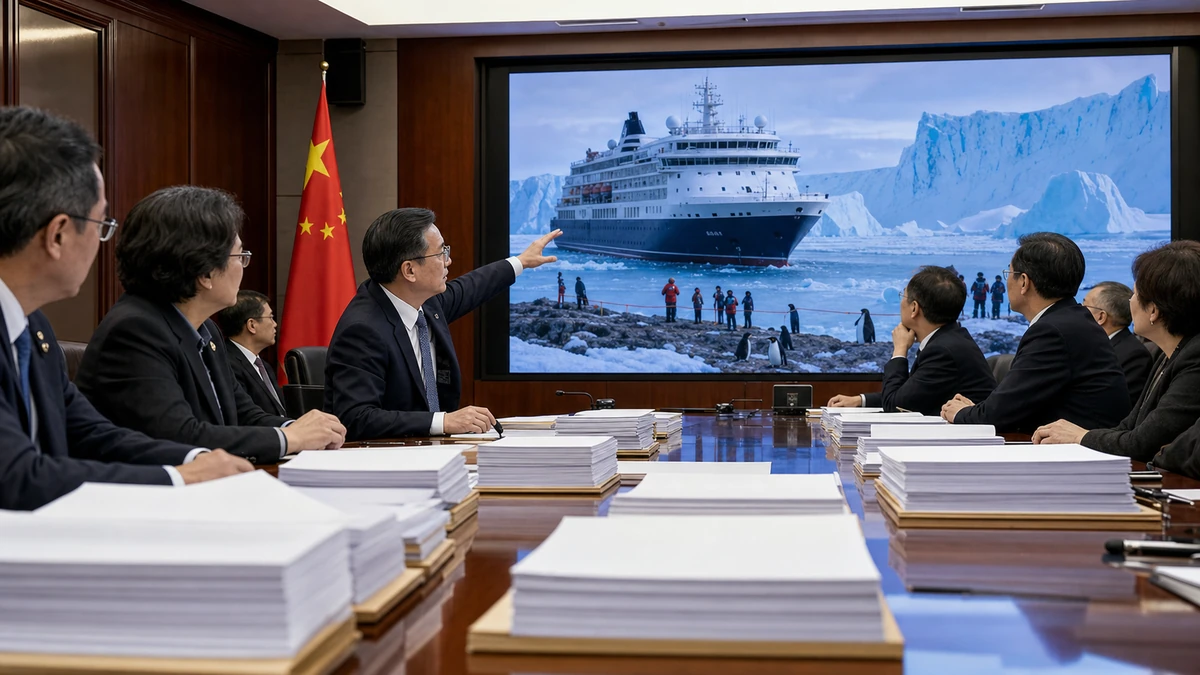
China is weighing a tougher legal framework for Antarctic tourism, a move that reflects how quickly the country has become a major force in one of the world’s most fragile travel markets. According to Chinese state media and reporting cited by South Korea’s Yonhap News Agency, lawmakers are reviewing a draft of an "Antarctic Activities and Environmental Protection Law" that would strengthen requirements for tourism operators and impose fines of up to 1 million yuan — roughly $140,000, or about 200 million won — for unauthorized activity. The draft is under review from June 23 to June 26 and, if approved, would take effect in 2026.
At first glance, that may sound like a niche regulatory update affecting a tiny corner of the global travel business. But the stakes are much bigger. Antarctica is not a typical vacation destination. It is not another version of Alaska, Iceland or even a remote safari park. It is governed through an international treaty system, valued for its scientific importance and environmental sensitivity, and increasingly burdened by two overlapping pressures: climate change and the growth of luxury, bucket-list tourism.
China’s proposed law matters because it suggests Beijing no longer sees Antarctic tourism as a side business that can be managed through internal administrative rules alone. Instead, it is treating polar travel as a matter of national responsibility, environmental governance and international credibility. In other words, this is not just about whether a cruise company has the right paperwork. It is about who gets to operate in Antarctica, under what rules, and how much responsibility governments should bear when their citizens travel to a place that belongs to no single country.
That debate is resonating far beyond China. As more affluent travelers around the world seek out so-called last-chance destinations — places seen as pristine, remote or threatened by environmental change — Antarctica has become one of the ultimate status trips. For regulators and environmental groups, the central question is no longer whether Antarctic tourism exists. It is how to contain its risks before the industry outgrows the rules meant to keep it in check.
From administrative approval to law, Beijing is raising the stakes
The most important shift in the Chinese proposal is not simply that officials want stricter oversight. It is that the oversight would be elevated from administrative regulation to formal law. That distinction may sound bureaucratic, but it carries real consequences. Administrative rules often set procedures and standards. A law, by contrast, signals stronger enforcement, clearer penalties and more formal state authority.
Under the draft, unauthorized Antarctic activity could bring fines of up to 1 million yuan. That penalty is significant enough to send a clear message to operators: Antarctic travel is no longer being treated as an exotic branch of the tourism industry where informal compliance might be tolerated. The proposed crackdown suggests China wants a system in which legal obligations, not industry custom alone, determine who can organize trips to the southernmost continent.
The draft also reportedly tightens qualifications for tourism operators, which could reshape the market itself. For travel companies, Antarctica has long occupied a rarefied niche — expensive, logistically difficult and heavily dependent on specialized vessels, safety planning and environmental protocols. If China raises the threshold for who can legally run or market such trips, the result could be fewer operators, more compliance costs and a stronger emphasis on environmental responsibility and risk management.
That would mirror a broader pattern seen in other industries when governments decide a sector has grown too important to remain lightly supervised. Americans have seen similar transitions in different forms, whether in commercial aviation, offshore drilling or adventure tourism in protected national parks. Once activity expands to the point that accidents, environmental damage or reputational fallout become harder to ignore, governments typically move from guidance to enforceable rules. China appears to be reaching that point with Antarctic tourism.
The language of the draft matters, too. By framing the measure as a law governing both Antarctic activities and environmental protection, Beijing is signaling that tourism is only one part of a larger issue. Research missions, commercial operations, travel companies and individual tourists all fall within the broader ecosystem of human activity in Antarctica. That framing suggests Chinese policymakers are trying to build a governance model that addresses the full footprint of national involvement on the continent, not just vacation packages.
Why Antarctica has become a magnet for Chinese travelers
The timing of the proposal is tied directly to demand. Hu Zhaozhao, director of the Chinese polar environmental protection group Polar Hub, said China is now the fastest-growing source of Antarctic tourists and ranks second globally in visitor volume. That is a striking statement, especially given how exclusive Antarctic travel remains. Trips often cost tens of thousands of dollars, require long-haul international flights and usually involve ship-based itineraries departing from South America.
For years, outbound Chinese tourism was associated in the American imagination with shopping districts in Paris, package tours through Europe or group visits to iconic U.S. landmarks. But as China’s upper-middle class has expanded and travel tastes have diversified, demand has spread well beyond conventional city vacations. Increasingly, affluent Chinese travelers are seeking experiences that signal rarity, prestige and personal distinction — the sort of high-end experiential travel that has also grown among wealthy Americans. Think of Antarctica as the polar equivalent of summiting Kilimanjaro, chartering a Galapagos expedition or booking a private African safari, only with even higher barriers to entry.
That helps explain why Chinese interest in Antarctica has become so important so quickly. The market is no longer marginal. It is large enough to affect international operators, booking patterns and the broader discussion around environmental limits. For the travel industry, that growth represents opportunity. For regulators and conservationists, it represents a management problem that cannot be ignored.
Antarctic tourism is unlike mainstream cruise travel, even if many visitors arrive by ship. Access is limited, weather can be severe, landings are tightly managed and the surrounding ecosystem is exceptionally sensitive. Tourists are not simply sightseeing in a remote place. Their movement, waste, photography, shore visits and transportation all occur in an environment where even small disturbances can carry outsized consequences. When the number of travelers rises sharply from any country — especially one with a large and fast-growing outbound market — the cumulative impact becomes part of an international governance question.
China’s leadership appears to recognize that reality. The draft law can be read as an effort to bring a fast-growing and symbolically potent travel sector under tighter state control before demand outpaces regulation. It is also a recognition that the country’s role in Antarctica is no longer just scientific or diplomatic. It is increasingly commercial and social, shaped by the choices of private companies and wealthy travelers as much as by official expeditions.
Climate change and tourism are creating a double burden
Environmental advocates have long argued that tourism in Antarctica cannot be discussed in isolation from climate change. Hu said rising visitor numbers and climate change are placing a dual burden on Antarctica’s cryosphere — a term that refers to the planet’s frozen regions, including snow, glaciers, sea ice and ice sheets. For American readers, that may sound like technical jargon, but the underlying point is straightforward: Antarctica is already under immense pressure from a warming planet, and additional human activity adds another layer of strain.
That matters because Antarctica is not just scenic. It plays a central role in regulating global climate systems and sea levels. What happens there does not stay there. Melting ice sheets influence coastal risks worldwide, including in the United States, where cities from Miami to New York to New Orleans already worry about sea-level rise and storm surges. So when environmental groups raise concerns about Antarctic tourism, they are not simply objecting to luxury travel on moral grounds. They are arguing that human activity in one of Earth’s most vulnerable regions deserves a much higher threshold of caution.
The tourism debate can be complicated because the industry often presents itself as a force for awareness. Visitors who see Antarctica firsthand may come away more committed to conservation, much as travelers to coral reefs, rainforests or national parks sometimes become advocates for protection. Operators also point to industry guidelines, limited group sizes and shipboard education programs as evidence that tourism can be managed responsibly.
Critics counter that even well-run tourism has a footprint. Ships burn fuel. Visitors can disturb wildlife. Increased traffic raises the risk of accidents, invasive species and pollution. And the very popularity of Antarctica as a once-in-a-lifetime destination can create a paradox: The more people want to witness a pristine environment before it changes, the more pressure they place on it.
China’s draft law appears to reflect that tension. It does not amount to a ban on Antarctic tourism. Instead, it suggests a strategy familiar in many environmental policy debates: accept that the activity will continue, but try to narrow the terms under which it takes place. Permits, operator qualifications and penalties are all tools for drawing those boundaries. The assumption behind them is that unregulated growth is no longer acceptable.
What this could mean for the global travel industry
Although the proposal is rooted in China’s domestic legal system, its effects could ripple across the international tourism market. Antarctic travel is inherently transnational. A Chinese traveler may book through a domestic agency, fly through another country, board a foreign-operated vessel in Argentina or Chile, and travel under rules shaped by international agreements and voluntary industry standards. Tightening Chinese legal requirements could therefore influence not just Chinese companies but global operators hoping to serve Chinese clients.
If Beijing demands stricter licensing, stronger environmental safeguards or clearer accountability, foreign and domestic companies alike may need to adjust how they market, document and manage Antarctic trips for the Chinese market. That could mean more due diligence, more compliance costs and perhaps a narrower field of operators able to meet the standards. In practical terms, it could favor larger, better-capitalized companies over smaller firms that lack the resources to navigate a more demanding regulatory regime.
The fine for unauthorized activity is especially notable. In industries tied to fragile environments, penalties function not just as punishment but as a warning shot. They tell the market that regulators are serious about enforcement and that noncompliance will carry financial and reputational consequences. For Antarctica, where a single incident can trigger international scrutiny, that signal matters.
There is also a broader geopolitical dimension. China has expanded its presence in polar affairs over the years through research, infrastructure and diplomacy. A more formal domestic legal framework for Antarctic activities could strengthen its claim to being a responsible stakeholder in the governance of the region. That does not necessarily mean other countries will agree with every aspect of China’s approach, but it does mean Beijing is trying to define itself as more than a late-arriving consumer of polar tourism. It wants to be seen as a rule-setting participant.
For American readers, there is a familiar analogy here. When a major market such as the United States or the European Union changes rules in aviation, finance or digital privacy, companies around the world often adapt because the market is too large to ignore. China’s role in Antarctic tourism is not as globally dominant as those examples, but the principle is similar. If one of the fastest-growing and largest source markets imposes tougher legal requirements, the effects are unlikely to stay within its borders.
The law is still a draft, but the message is already clear
It is important to separate what is confirmed from what remains uncertain. The measure is still in draft form and under review. Chinese state media reported that the Legislative Affairs Commission of the Standing Committee of the National People’s Congress is set to examine the proposal, but final passage and implementation details would still depend on later steps in the legislative process. In other words, this is not yet settled law.
Even so, drafts can reveal policy direction before formal adoption, and this one sends a strong signal. It follows an earlier round of deliberation last December, when the proposal was first reviewed at a meeting of the current National People’s Congress Standing Committee. Reports say the text has since been revised and refined after gathering input from multiple sectors, suggesting the government has been working through the practical challenges of enforcement rather than floating a symbolic gesture.
That matters because Antarctic regulation is difficult by nature. The sector involves government agencies, research institutions, tourism companies, crew members, port authorities and travelers themselves. A law that is too vague may be hard to enforce. A law that is too rigid could prove impractical in a setting defined by weather uncertainty, international coordination and specialized logistics. The revisions reportedly made after consultation suggest Chinese authorities are trying to build a framework that is not only strict on paper but workable in practice.
The larger message is that China now views Antarctic tourism as something requiring legal architecture, not merely administrative management. That shift may prove more consequential than any single fine amount or licensing clause. Once a government moves a sector into the realm of formal law, it creates a basis for sustained oversight, future amendments and stronger institutional expectations. It also signals that the activity has become politically visible enough that inaction is no longer an option.
A test case for how the world travels to its most vulnerable places
In many ways, the emerging fight over Antarctic tourism is a test case for a much wider global dilemma. Modern travel is built on access. The more flights, ships, wealth and social media visibility expand, the more people expect to reach places that were once the domain of scientists, explorers or the ultra-wealthy. But some places are not equipped to absorb mass aspiration, even in relatively small numbers. Antarctica is among the clearest examples.
The continent carries enormous symbolic power. For some travelers, it represents the last frontier, the ultimate proof that they have seen the planet at its edges. For scientists and conservationists, it represents something else: a global commons so environmentally important and so physically vulnerable that ordinary tourism logic cannot simply be applied there.
China’s proposed law does not resolve that tension. It does, however, bring the debate into sharper focus. Rather than asking whether people should be curious about Antarctica, policymakers are asking what kind of regulatory and ethical framework should govern that curiosity. Who is qualified to take people there? What duties do governments have when their citizens travel to fragile ecosystems? How high should penalties be when operators act outside the rules? And how much tourism can a place like Antarctica absorb before the idea of responsible visitation becomes self-contradictory?
Those are not abstract questions. They are likely to become more urgent as climate change reshapes travel patterns and as growing middle and upper classes in countries such as China, India and elsewhere seek experiences once available only to a narrow elite. The international travel industry, for its part, will have to decide whether it is prepared for a future in which access to the most remote destinations comes with far heavier legal and environmental obligations.
For now, China’s legislative review marks an important moment in that evolution. It suggests that one of the world’s fastest-growing source markets for Antarctic travel is beginning to treat the sector not as a glamorous fringe product but as a serious governance challenge. In the years ahead, that may be the real story: not simply that more people want to go to Antarctica, but that the world is being forced to decide how — and whether — such journeys can be responsibly managed at all.
Comments
Post a Comment