Cristiano Ronaldo Scores Twice Against Uzbekistan, Becomes First Player to Net Goals in Six World Cups
A World Cup Record That Spans Two Decades
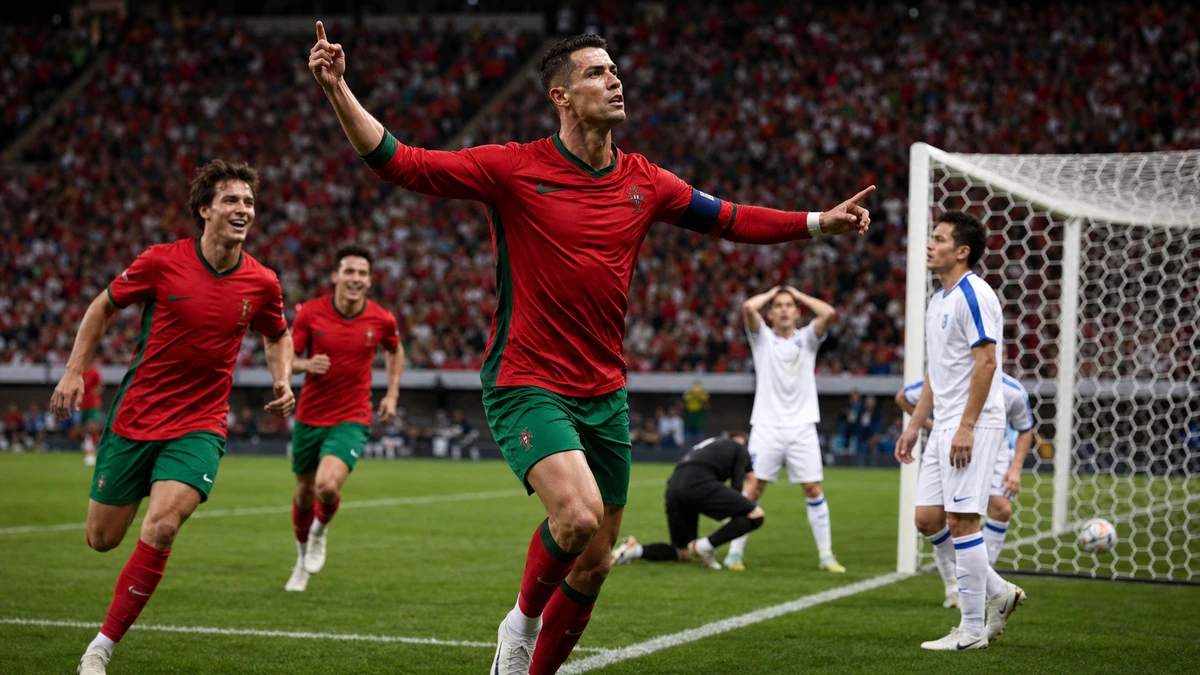
In a tournament built on short windows and fleeting chances, Cristiano Ronaldo delivered something far rarer: proof that one of soccer’s longest-running eras still has life in it. Portugal’s 41-year-old captain scored twice in a 5-0 win over Uzbekistan in Houston on Tuesday, becoming the first player in men’s soccer history to score in six different FIFA World Cups.
For American sports fans, the easiest comparison may be to the kind of longevity feats that become shorthand for greatness in other games: Tom Brady winning Super Bowls across generations, LeBron James remaining an NBA centerpiece deep into his late 30s, or Nolan Ryan throwing heat long after most pitchers were done. Ronaldo’s new milestone belongs in that conversation, not because it is exactly the same, but because it speaks to the same almost improbable endurance. The World Cup comes only once every four years. To appear in six editions is itself extraordinary. To score in all six is something else entirely.
Portugal’s emphatic victory in Group K of the 2026 World Cup was important in the standings. But it will be remembered more for the historical weight carried by the two goals Ronaldo scored in the first half. He struck in the sixth minute and again in the 39th, pushing his career World Cup total to 10 and moving past Portuguese legend Eusebio for the most World Cup goals ever by a Portugal player.
The setting added another layer for U.S. readers. This was not a memory from Lisbon, Doha or Moscow. It unfolded in Houston, one of the American cities helping host the first men’s World Cup jointly staged by the United States, Canada and Mexico. As soccer’s biggest event stretches across North America, one of its most recognizable stars is still shaping the tournament’s story.
That matters beyond Portugal. It matters because the World Cup has always been part competition, part mythology. Fans come for the scores and standings, but they stay for the moments that define an era. Ronaldo, who scored his first World Cup goal in 2006 in Germany, has now found the net in the same tournament family across 20 years. There are younger stars in this competition, and there will be newer ones soon enough. But for one more night, the old star remained central.
Portugal’s Response After an Unconvincing Start
The performance also served an immediate practical purpose. Portugal entered the match under pressure after a disappointing 1-1 draw against the Democratic Republic of Congo in its opening group game. For a team widely viewed as a contender, that result drew criticism and renewed familiar questions: Was Portugal too dependent on an aging icon? Could a talented supporting cast around Bruno Fernandes, Rafael Leao and Nuno Mendes translate promise into control? And was Ronaldo still a difference-maker on the sport’s biggest stage, or mostly a symbol of a glorious past?
Against Uzbekistan, Portugal answered quickly and decisively. The team pressed high, moved the ball with more urgency and attacked the flanks with the kind of speed that unsettles defenses early. Before the first goal, Portugal had already signaled its intent. Bruno Fernandes forced a defensive block inside the opening minutes, and Nuno Mendes delivered a dangerous cross that nearly found Ronaldo. Those early chances suggested Portugal was not interested in managing the game cautiously. It wanted to seize it.
Ronaldo’s first goal arrived in the sixth minute, immediately changing the tone. For a veteran striker whose game has evolved over the years, the goal represented something familiar: elite positioning, sharp timing and a sense for when pressure will create opportunity. He may not cover the field like he once did, but inside the penalty area, he still operates with the instincts that have defined his career.
Portugal doubled its lead in the 17th minute through Nuno Mendes, whose aggressive play down the wing had helped shape the match from the start. Then Ronaldo struck again in the 39th, giving Portugal a 3-0 halftime lead and effectively ending suspense long before the final whistle. In the second half, an own goal by Uzbekistan goalkeeper Abduvakhid Nematov and a late score from Leao rounded out the 5-0 result.
The score line was not just comfortable. It was corrective. After the stumble in the opener, Portugal needed a performance that restored confidence and quieted criticism. It got one. And Ronaldo’s goals did more than pad statistics; they gave Portugal the kind of early control that changes a match tactically as well as emotionally. When a favorite scores early, the game becomes less about surviving and more about dictating. Portugal dictated nearly everything.
Why Six World Cups Matters So Much
To understand why Ronaldo’s record resonates so strongly, it helps to step back from the game itself. In American sports, seasons are annual. A player can recover from a disappointing year and try again in a few months. The World Cup is different. A missed cycle can erase four years. An injury at the wrong time, a coaching change, a dip in form, a failed qualification campaign or the natural aging process can close the door forever.
That is why scoring in six World Cups is not merely a trivia note about longevity. It reflects an almost unbroken chain of elite performance, health, adaptability and political standing within a national team program. A player must remain good enough to make the squad, important enough to remain central, and fit enough to endure the wear of tournament soccer. He also must survive shifts in style and generation. The teammates around Ronaldo in 2026 are not the teammates who surrounded him in 2006. Coaches change. Systems change. The sport itself changes. Yet the expectation that Ronaldo might score remained in place across all of it.
His first World Cup goal came on June 17, 2006, against Iran in Frankfurt, Germany. It was a penalty, scored by a then-21-year-old forward whose talent was obvious but whose legend had not yet hardened into certainty. Twenty years later, he remains a scorer on the same stage. The continuity is remarkable precisely because World Cups are not built for continuity. They are built for turnover, heartbreak and sudden arrivals.
There is also symbolism in Ronaldo passing Eusebio’s World Cup scoring mark for Portugal. For many American readers, Eusebio may not be a household name in the way Pele, Diego Maradona, Lionel Messi or Ronaldo are. But in Portuguese soccer history, he is foundational. Nicknamed the “Black Panther,” Eusebio was the face of Portugal’s rise in the 1960s and a national icon whose achievements still define the country’s sporting memory. Surpassing him in a World Cup category is not just another personal milestone. It means Ronaldo has reached into one of the most revered parts of Portugal’s soccer identity and rewritten it.
That, in part, explains why the moment lands with such force. Records are common in sports headlines. Not all records feel historic. This one does, because it measures more than output. It measures duration, reinvention and the refusal to yield the spotlight entirely to time.
Uzbekistan’s Debut on the Biggest Stage
For Uzbekistan, the night was painful, but not meaningless. The Central Asian nation is playing in its first World Cup, an achievement that carries significance well beyond this result. Much like smaller or emerging soccer countries elsewhere, just reaching the tournament marks a turning point. It signals investment, developmental progress and a chance to test a national program against the world’s established powers.
American audiences may recognize the pattern from other sports or international competitions. A first-time participant often experiences an unforgiving introduction. The speed is faster, the margin for error smaller, the emotional stakes higher. Teams that have dominated in regional play can suddenly look overwhelmed when facing a contender whose individual talent and tactical discipline expose every hesitation.
That was the lesson facing Uzbekistan in Houston. The team showed commitment early, even blocking a Fernandes attempt in the opening minutes. But once Portugal’s pressure translated into an early goal, the game tilted sharply. Uzbekistan struggled to contain attacks from wide areas and had difficulty preventing runs into dangerous spaces near goal. Against a striker like Ronaldo, those small cracks become major damage. A half-step late, a cross slightly under-defended, a rebound not cleared quickly enough — on this level, those details are often the difference between hanging on and unraveling.
Now 0-2 in the group stage, Uzbekistan faces the hard reality of life at a first World Cup. Yet there is value in that exposure. Countries outside the traditional power centers often grow through these difficult introductions. Players learn what the top level demands in terms of pace, physicality and concentration. Coaches learn where systems hold and where they break. Federations learn what still separates them from the elite. Losses like this can be scarring, but they can also be instructive.
That does not soften the scoreboard. Portugal was dominant, and Uzbekistan looked second-best throughout long stretches. But in tournament history, many programs have taken their worst beatings before eventually becoming sturdier, smarter and more competitive. If Uzbekistan is to make future World Cups more than one-time appearances, this kind of harsh lesson may become part of its foundation.
Ronaldo at 41: More Than Nostalgia
There is a temptation, especially with stars who have lasted this long, to frame every late-career success as a sentimental farewell tour. Ronaldo keeps resisting that framing. He is not on the field simply to wave to crowds or lend his name recognition to the event. Portugal started him in the center of the attack because it still believed he could produce under pressure. Against Uzbekistan, he did.
That does not mean he is the same player he was at Manchester United, Real Madrid or in his earliest Portugal years. He is not. No athlete remains unchanged over two decades. What makes this phase of Ronaldo’s career compelling is how he has narrowed his game to the things that age can least diminish: finishing, anticipation, movement in the box, timing on aerial balls and the psychological gravity he exerts on defenders. Even when he is not scoring, back lines must account for him. When he does score, the entire architecture of the match shifts.
For U.S. readers more familiar with debates over all-time greatness than with the nuances of international soccer, Ronaldo’s latest feat will naturally invite comparisons with Messi and the long-running argument over who belongs at the top of the modern game. That debate will continue because it is part of how global soccer culture talks about both men. But this particular night belonged to Ronaldo on its own terms. It was about endurance rather than elegance, persistence rather than novelty. It was about an athlete extending his relevance far beyond what the normal calendar of sports is supposed to allow.
And there is something universally legible in that, even for people who do not follow soccer closely. Sports at their best tell stories about limits: who reaches them, who respects them and who manages, briefly or unexpectedly, to push past them. Time is the most democratic limit of all. Nearly every athlete loses the battle eventually. Ronaldo has not escaped that truth. But he has delayed it long enough to produce another chapter that feels almost unreasonable.
That is why his age matters so much in this story. Forty-one is not just older than most World Cup stars. It is an age when many elite soccer players have long since retired, moved into television or taken ceremonial roles. Instead, Ronaldo started a World Cup game, scored twice before halftime and left behind a record no one had managed before him. Nostalgia may follow him, but it no longer explains him fully.
What the Result Means for Portugal
For all the focus on Ronaldo, Portugal emerged from the match with larger reasons for optimism. The team did not rely on a single moment of brilliance or a late escape. It controlled the game from the outset, generated chances across multiple channels and saw contributions from younger stars as well as its veteran leader. Nuno Mendes’ goal highlighted Portugal’s threat from the wings, while Leao’s late finish underscored the attacking depth that makes the team dangerous beyond its captain.
That broader context matters if Portugal is to make a serious run in this tournament. Modern World Cups are rarely won by teams leaning solely on one aging star, no matter how famous. They are won by balanced squads that can absorb pressure, rotate threats and defend transitions. Portugal’s draw with the Democratic Republic of Congo had raised concerns that the team might be more fragile than expected. This win did not erase every question, but it offered a far more convincing version of what Portugal can look like when its talent aligns.
With four points through two group matches, Portugal moved to the top of Group K for the moment, ahead of Colombia, which had three points with its second match still to come. The standings remain fluid, but the psychological effect of this result may prove just as important as the arithmetic. A shaky opener can plant doubt. A five-goal response tends to uproot it.
From a tournament perspective, the ideal scenario for Portugal is that Ronaldo’s finishing remains available without becoming a necessity every night. If Bruno Fernandes can orchestrate midfield control, if Mendes and Leao continue to create from wide areas, and if the team presses with the same intensity it showed here, Portugal has the profile of a side no contender will want to meet in the knockout rounds.
What changed in Houston was not just the scoreline. It was the mood around Portugal. A team that had spent several days fielding criticism left the stadium looking like a serious threat again. In World Cup play, momentum is never permanent, but it can return in a hurry. Portugal found it through pressure, width, finishing and one more reminder that its most famous player still knows how to turn a game into a statement.
A Houston Night With Global Meaning
There is a certain fitting symmetry in Ronaldo making this kind of history on American soil. Soccer in the United States has spent decades chasing moments that pull the sport closer to the center of the national conversation. Hosting World Cup matches helps do that, but so do events that feel larger than one country’s fan base. A record like this, set by one of the most recognizable athletes on the planet, becomes part of the tournament’s public memory in the United States whether or not casual viewers can explain Portugal’s shape out of possession.
That is one reason the World Cup works so powerfully across cultures. It can be deeply local and unmistakably global at the same time. In South Korea, where overnight and early-morning World Cup viewing has long been part of the fan experience, news of Ronaldo’s milestone became a major talking point. In Portugal, it fed national pride. In Uzbekistan, it underscored the gap a first-time qualifier still must close. In the United States, the game landed inside a familiar narrative framework: the aging superstar, the record chase, the comeback from criticism and the spectacle of greatness arriving live in a home stadium.
That broad readability is part of what separates the World Cup from almost every other event in sports. You do not need to understand every tactical adjustment to grasp what happened here. A 41-year-old star scored twice. His team won 5-0 after being questioned. He set a record that required 20 years of staying at the highest level. Those facts carry their own drama.
By the end of the night, Portugal had more than three points. It had a reset. Ronaldo had more than two goals. He had another claim on permanence in a sport that is constantly renewing itself. And the 2026 World Cup had one more scene likely to endure when the tournament is remembered years from now.
The broader verdict can wait until the knockout rounds and the tougher tests ahead. Portugal still must prove that it can sustain this level against stronger opposition. Ronaldo still will be judged, fairly or unfairly, by what he does in the tournament’s defining matches. But one thing is already beyond dispute. Against Uzbekistan in Houston, the clock did not seem to beat Cristiano Ronaldo. For one more evening, he beat it.
Comments
Post a Comment