
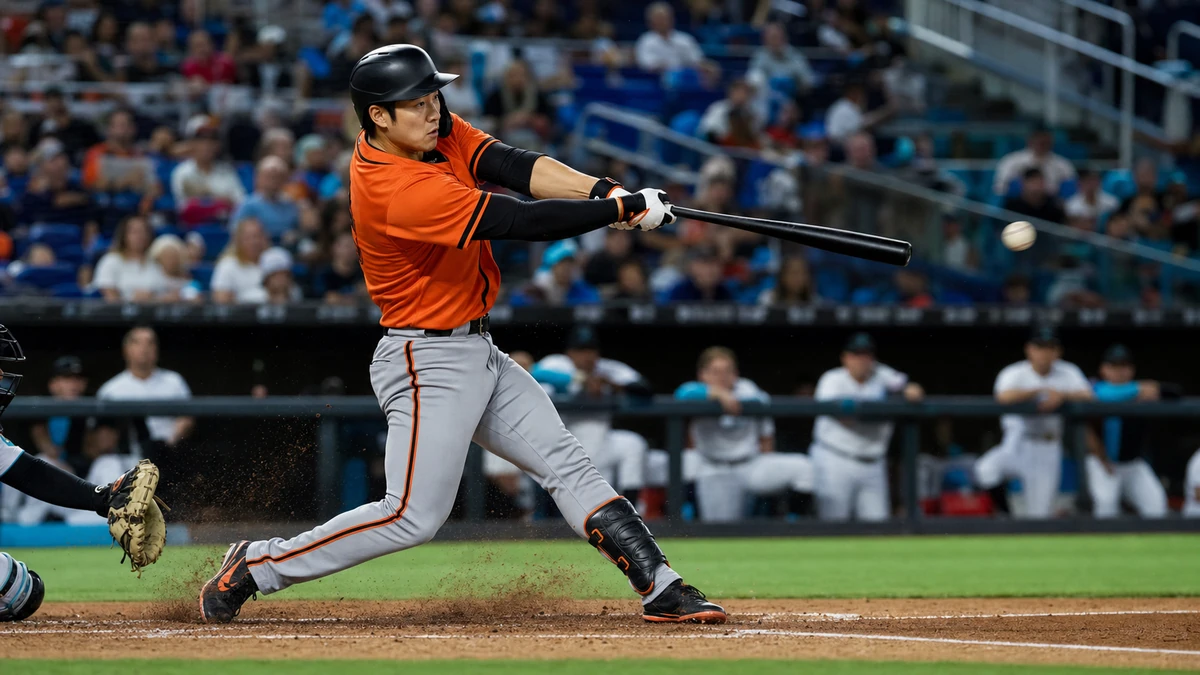
A strong night at the plate carries significance beyond one box score
For most Major League Baseball fans in the United States, a two-hit game in late-season play can blend into the daily churn of a 162-game schedule. But not every two-hit game means the same thing. When San Francisco Giants outfielder Lee Jung-hoo went 2 for 4 against the Miami Marlins at loanDepot park, scored a run and stole a base, the performance did more than pad his stat line. It pushed his batting average to .328 and tightened his pursuit of one of baseball’s most stubborn and closely watched measures of consistency: the batting title.
That matters on its own in any pennant race or awards conversation. It matters even more because Lee, a South Korean hitter in his first stretch of serious Major League scrutiny, is now firmly part of the National League batting race rather than merely a curiosity from overseas. According to the game details carried by South Korea’s Yonhap News Agency, Lee’s latest performance marked his 25th multi-hit game of the season, another sign that this is not a fleeting hot streak driven by bloops, luck or a favorable week. In baseball, where pitchers adjust constantly and scouting reports thicken by the day, repeated multi-hit games suggest something sturdier: timing, discipline and a swing that keeps holding up under pressure.
San Francisco lost the game 4-3 as Miami rallied for the win, ending the Giants’ three-game winning streak. In team terms, that is the headline result. But baseball has always allowed room for parallel story lines. A club can lose while one player’s season arc sharpens into something nationally relevant. That is what happened here. Lee’s night was not just productive. It placed him squarely in the foreground of a statistical race that American fans have historically used as a shorthand for elite contact hitting.
For readers who may not follow Korean baseball or the pipeline of stars who arrive from Asia, Lee’s surge is also a reminder that the globalization of the sport is no longer just about novelty, marketing or opening day features. It is about performance measured in the most unforgiving terms American baseball culture knows: daily numbers, league rankings and the ability to keep producing once the league learns your tendencies.
Why a .328 average still resonates in modern baseball
Batting average is not the all-purpose number it once was. Front offices now talk more about on-base percentage, slugging, OPS and advanced metrics that capture value more fully than simple hit totals. Still, batting average remains one of baseball’s most intuitive benchmarks, especially for casual fans. You do not need to know park-adjusted formulas or expected outcomes to understand what .328 means. A hitter is getting results in nearly one-third of his official at-bats. Over the course of a season, that becomes difficult to fake.
Lee’s rise to .328 moved him into second place in the National League batting standings, just six points behind Miami’s Otto Lopez, who went 1 for 4 in the same game and remained at .334. To non-baseball readers, six points may sound negligible, and in one sense it is. A single good afternoon can swing the standings. But that is exactly why the race is so compelling. The gap is narrow enough to change quickly, but meaningful enough to show that both hitters are operating at a high level over a substantial sample.
In practical terms, the batting race is a measure of steadiness. Sluggers can carry an offense for a week with a burst of home runs. Speedsters can create chaos on the bases without dominating the batter’s box. But staying near the top of the batting leaderboard deep into a season requires nightly repeatability. It means handling velocity, spin, defensive shifts in strategy and the mental drag of a long schedule. It also means finding ways to contribute when conditions are less than ideal, whether that involves a difficult road trip, a pitcher-friendly park or a club adjusting your position in the lineup.
Lee started in right field and batted fifth, a spot associated with run production and pressure. In American baseball terms, the middle of the order is where managers expect traffic on the bases to turn into runs. It is a role that asks for more than slap hitting. By finishing with two hits, one run scored and one stolen base, Lee affected the game in multiple ways. He was not merely collecting singles in low-leverage moments. He was participating in the shape of the offense.
That combination helps explain why this performance has drawn attention beyond the Korean media ecosystem that has followed Lee closely since his arrival in the majors. The league is not rewarding him with attention because of where he comes from. It is responding to what the numbers now demand.
What Lee Jung-hoo represents to Korean baseball fans
To understand why this story resonates so strongly in South Korea, it helps to know that Lee arrived in the majors with expectations that extended far beyond a standard rookie introduction. In South Korea, baseball has long occupied an important place in the sports culture, even if it does not dominate globally the way the NFL does in the United States or the Premier League does internationally. The Korea Baseball Organization, or KBO, has passionate fan bases, highly recognizable stars and a game-day culture that often feels louder and more coordinated than what many Americans expect at a baseball stadium. Cheer songs, organized rooting sections and deep team loyalty are central to the experience.
When a player from that environment succeeds in Major League Baseball, the achievement is often read in two ways at once. It is personal and national. American audiences have seen versions of this dynamic in other sports. Think of what it means when a young European basketball star becomes an NBA MVP candidate, or when a Japanese player changes expectations in the major leagues and inspires a surge of interest back home. The player is judged as an individual competitor, but he also becomes a symbol of what his country’s development system can produce.
For Korean fans, Lee’s place near the top of the National League batting table is not just a sign that one athlete is having a good month. It is evidence that a Korean hitter can be visible in one of the most demanding categories in baseball. That distinction matters. South Korean players have reached the majors before, and several have left meaningful marks. But every generation still confronts a version of the same question: can a player developed in Korea do more than survive in MLB? Can he become central to a race Americans recognize instantly?
Lee’s recent run suggests that the answer, at least this season, is yes. And because the major leagues generate constant statistical comparison, that answer does not depend on hype. It is renewed or challenged every day. Korean sports coverage often emphasizes that reality. Success in MLB is not symbolic if it keeps appearing in box scores, standings and nightly recaps. It becomes tangible, difficult to dismiss and impossible to wave away as a cultural talking point.
That is why the 25th multi-hit game is such a useful marker. One big game can happen to almost anyone in the majors. Twenty-five multi-hit games indicate recurring quality. They suggest a hitter who is solving problems repeatedly rather than living off a single hot streak.
The Miami matchup gave the batting race a face-to-face dimension
Baseball’s statistical races can sometimes feel abstract, like stock tickers updating in separate cities with little direct contact between the people involved. This game was different. Lee was chasing Lopez in the batting standings, and both players were in the same lineup card on the same night. Lopez, batting fifth for Miami and playing shortstop, collected one hit in four at-bats. Lee, also in the fifth spot, outpaced him with two hits in four trips. By the end of the night, the distance between first and second had narrowed to six points.
That head-to-head element gives the story texture for readers outside Korea and outside the Bay Area. It makes the batting race easier to picture. Instead of two names scrolling past on a standings page, it became a shared stage with immediate consequences. One player held the lead. The other made up ground in real time.
The final score still belonged to Miami, which came back for a 4-3 win. That matters, especially in a sport where clubs are judged by postseason positioning, not by individual milestones alone. But baseball has always tolerated layered meaning in defeat. Ted Williams’ place in history was not dependent on every Red Sox result. Tony Gwynn’s artistry at the plate did not disappear on nights San Diego lost. In that tradition, Lee’s game stands as a meaningful individual development even though San Francisco came away frustrated.
His stolen base also deserves more attention than it might ordinarily get in a short game brief. For a hitter already making solid contact, aggressive baserunning expands the threat profile. It forces pitchers to divide their concentration and can alter the kinds of pitches thrown to the next batter. In American baseball language, it means affecting the game beyond the batter’s box. For Lee, whose identity is increasingly tied to contact quality and consistency, the extra base showed that he can shape innings in more than one dimension.
That kind of all-around involvement is part of what helps a player graduate from being introduced as “the Korean outfielder” to being discussed simply as one of the more effective everyday hitters in the league. The distinction may sound subtle, but it matters. It marks the transition from novelty to normalcy, from cultural introduction to baseball merit.
From K-culture to Korean sports visibility in America
American audiences in recent years have become far more familiar with South Korea through popular culture than through sports. K-pop groups sell out arenas. Korean television dramas dominate streaming recommendation lists. Korean food, from Korean barbecue to fried chicken, has become part of the dining vocabulary in cities well beyond Los Angeles and New York. In other words, many Americans now encounter South Korea first through entertainment and lifestyle exports.
Sports tell a different story. They are less curated and less forgiving. A song can go viral worldwide regardless of local context. A hitter in the majors has to produce against elite pitching, under travel fatigue and in a culture that quantifies failure as relentlessly as baseball does. That is why Lee’s season carries a different kind of international significance. It broadens South Korea’s visibility in the United States from cultural consumption to competitive achievement.
There is also something especially compelling about baseball as the setting for that expansion. Unlike some global sports where Korean success is already well established in American public imagination, baseball remains closely tied to ideas of American tradition. It is the sport of box scores in local papers, long summer nights and arguments about whether old-school stats still matter. To stand out in that environment, particularly as a hitter chasing the top of the batting race, is to enter one of the country’s oldest sports conversations on its own terms.
That does not mean every good game by a Korean player should be inflated into a geopolitical event. Overstatement helps no one, and the facts here are straightforward. Lee had two hits, raised his average to .328, recorded his 25th multi-hit game and cut Lopez’s lead to six points. That is the clean core of the story. But it is fair to say those facts carry resonance beyond the night because they place a South Korean player in one of baseball’s most visible ongoing competitions.
For a U.S. reader who has mostly encountered Korean influence through music, film or beauty brands, Lee offers a different point of entry: disciplined athletic excellence in a daily American sports institution. He is not explaining Korea to the audience. He is compelling the audience to notice him because he keeps hitting.
What comes next in a race built on daily adjustments
The most honest way to frame this moment is as a development, not a conclusion. Lee has not secured a batting title. Lopez remains in first place. The difference between .334 and .328 is small enough that the leaderboard could shift quickly, but large enough that every 0-for-4 and every 3-for-5 matters. That volatility is what gives the race its suspense. It also makes discipline in coverage important. One night can move the numbers. It does not end the contest.
Still, there are reasons this latest performance should draw serious attention. First, the multi-hit total speaks to durability and repetition. Second, the lineup role indicates trust and responsibility. Third, the stolen base and run scored show that Lee’s impact is not limited to a clean batting average line. Finally, the context of a face-to-face game with the current league leader sharpened the stakes in a way that standing updates alone rarely do.
For the Giants, the hope is that Lee’s steadiness can help stabilize an offense over the long haul, even on nights when the bullpen or defense fails to preserve a lead. For the league, his pursuit adds intrigue to a batting race that might otherwise attract only die-hard stat watchers. And for the growing American audience interested in Korean athletes beyond headline moments, it offers a useful lens into how international baseball reputations are actually built.
They are built quietly, and then all at once. A line drive here. Another multi-hit game there. A rising average that starts as a small note in morning standings and becomes a nightly item worth checking. In that sense, Lee’s performance in Miami was not just a good game. It was another installment in the process by which a player becomes unavoidable.
That may be the most important takeaway for American readers. The story is not that a Korean player had a nice night. The story is that Lee Jung-hoo is making himself part of a conversation that baseball in the United States has always taken seriously: who is the toughest everyday out in the league, who keeps stacking hits, and who belongs at the top of the board when the sample size gets too large to ignore.
On a night when San Francisco lost, Lee still left with something substantial. He tightened the batting race. He reinforced the evidence of consistency. And he gave both American and Korean audiences another reason to treat his season not as a novelty from abroad, but as a legitimate Major League campaign unfolding in real time.



0 Comments