In South Korea, an Energy Company’s Home Repair Project Shows How ‘Energy Welfare’ Is Moving Beyond Utility Bills
A different kind of energy aid
In the United States, conversations about energy assistance often center on monthly bills: heating subsidies in winter, help with electricity shutoff notices in summer, or federal and state programs that cushion low-income households from spikes in utility costs. South Korea is increasingly asking a related but broader question: What if the problem is not only how much energy a family can afford, but also whether the home itself wastes that energy in the first place?
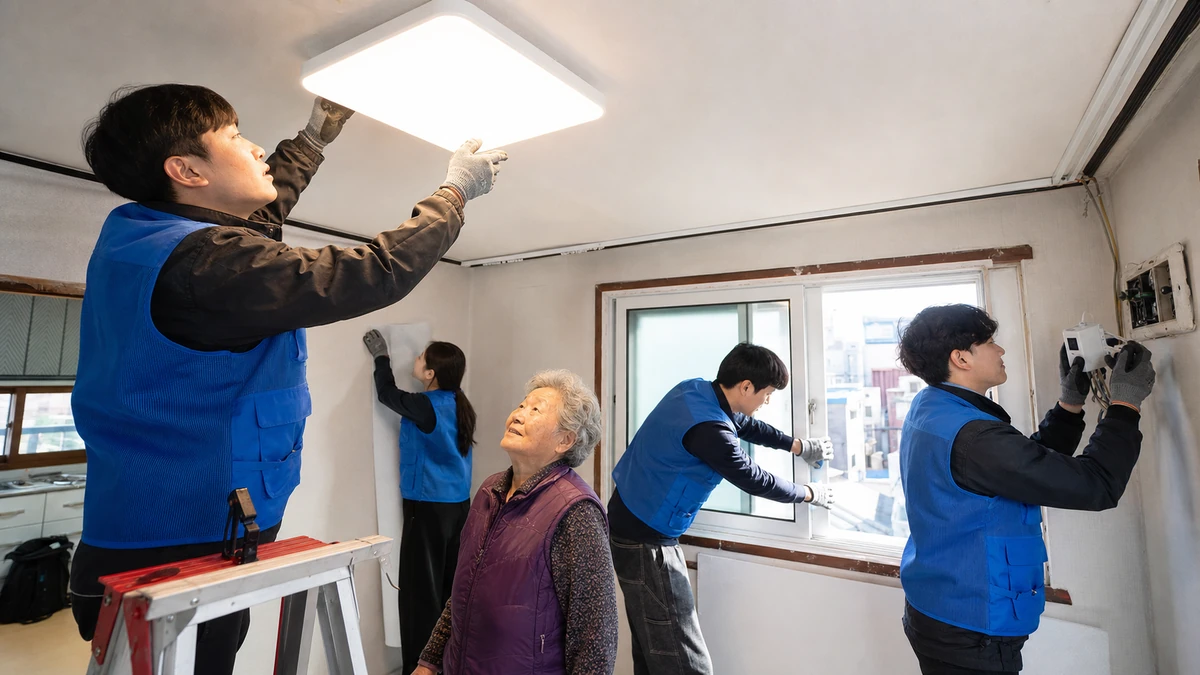
That question is at the heart of a small but telling social welfare project announced this week by Korea East-West Power, a state-run power generation company in South Korea. The company said it had completed the 31st round of a corporate social responsibility initiative aimed at improving living conditions for what Korean officials call the “energy vulnerable” — households and welfare facilities that struggle with the cost, efficiency or safety of basic energy use.
The program’s Korean name, loosely stylized as “Shinbakhan Energy Cleanup,” is difficult to render directly in English because it carries a playful, colloquial tone. The word “shinbakhan” suggests something clever, fresh or unexpectedly useful. But the work itself is serious and practical: insulation upgrades, wallpaper replacement, window improvements, installation of high-efficiency LED lighting, and devices that help manage electricity use.
To American readers, that list may sound more like weatherization and housing rehabilitation than traditional charity. That is precisely why the story matters. Rather than handing out one-time goods or short-term subsidies, the project treats energy hardship as a housing issue, a health issue and a quality-of-life issue all at once. In other words, it reflects a shift from helping people pay for an inefficient home to making that home less punishing to live in.
According to the South Korean company, the project has been running since 2021 and has become one of its signature “energy welfare” efforts. The phrase “energy welfare” is used in South Korea to describe policies and programs that help residents access energy safely, affordably and efficiently. At first glance, that may sound bureaucratic. In practice, it means something deeply concrete: a home that is less drafty in winter, less stifling in summer, brighter after dark, and cheaper to maintain month after month.
Why this story stands out in South Korea
The announcement might seem modest next to the splashier headlines that often shape international coverage of South Korea — semiconductors, K-pop, electric vehicles, or North Korea. But in the context of South Korean social policy, the project reflects an important evolution in how public institutions and state-backed companies are talking about inequality.
For years, energy welfare in South Korea was often understood in narrow terms: direct support for heating expenses, discounts on electricity, or seasonal help for lower-income residents. Those measures still matter, particularly in a country where winter heating costs can be burdensome and older housing stock can leave residents exposed to uncomfortable and sometimes unsafe indoor conditions. But a growing number of policymakers, local officials and public corporations are framing energy insecurity as something embedded in the physical condition of the home itself.
That distinction matters. If a household receives help paying an electric bill but lives in a poorly insulated apartment with aging windows and dim or inefficient lighting, the benefit only goes so far. The structure keeps leaking heat, power is used inefficiently, and daily life remains harder than it should be. By bundling insulation, window work, lighting improvements and electricity management tools into one intervention, Korea East-West Power is effectively saying that energy support should not stop at the meter.
There is also a symbolic element to the phrase “No. 31,” which the company used in describing the latest completed round. In South Korea, numbering projects in this way often signals continuity and accumulated effort. It tells the public that the program is not a one-off volunteer event staged for publicity, but a repeatable model. Whether that model grows in scale is another question, but the numbering itself underscores that this is intended as an ongoing series rather than a seasonal campaign.
The announcement was reported out of Ulsan, a southeastern industrial city that occupies a distinctive place in South Korea’s economic identity. If Detroit historically symbolized American auto manufacturing or Houston became shorthand for the U.S. energy industry, Ulsan has long stood as one of South Korea’s most important industrial hubs, closely associated with shipbuilding, heavy industry and energy infrastructure. That context makes the story more than a corporate good deed. It links the machinery of industrial power generation to the quieter, more intimate space of the home.
What “energy welfare” looks like on the ground
To understand why this project resonates, it helps to strip away the policy language and think about ordinary daily routines. A poorly insulated home is not just an engineering problem. It can mean a child doing homework in a room that never quite gets warm enough in January. It can mean an older adult enduring a muggy, overheated space in summer because cooling costs feel out of reach. It can mean constantly adjusting appliances and lights to save money, only to find that the building itself keeps draining comfort away.
The measures highlighted in the project are basic but powerful. Insulation work reduces the degree to which outdoor temperatures penetrate indoor life. Window work matters because drafty, aging or poorly sealed windows are a major source of heat loss and thermal discomfort in many homes. Wallpaper replacement may seem cosmetic to some readers, but in Korea, where apartments and small homes often rely heavily on wall finishes as part of the overall living environment, replacing damaged interior materials can be part of making a space feel orderly, healthy and dignified again.
The LED lighting component is especially easy to grasp across borders. High-efficiency LED bulbs and fixtures provide brighter light while consuming less electricity than older systems. For low-income households, that means a rare combination of immediate and long-term benefit: better visibility right away, lower electricity use over time. In a cramped or aging residence, better lighting can improve safety as well as comfort, particularly for elderly residents.
Then there is the installation of power management devices, which may be less visible but could prove just as significant. While the company did not release detailed technical specifications in the summary made public, such devices are generally understood to help monitor or control electricity usage, making it easier to identify waste and manage consumption more efficiently. That makes the project notable because it is not encouraging residents simply to use more energy. It is trying to make the energy they do use more effective.
That distinction gets at a broader shift in anti-poverty thinking, one familiar to many Americans who follow housing or climate policy. A family’s monthly costs are shaped not only by income, but by the quality of the systems around them: windows, insulation, fixtures, ventilation, appliances and basic building materials. When those systems are failing, poverty becomes more expensive. South Korea’s energy welfare debate is increasingly reflecting that logic.
The role of public corporations in Korean social policy
Korea East-West Power is not a charity in the conventional sense. It is one of South Korea’s public power generation companies, part of a state-linked energy structure that operates in an economy where public institutions often play highly visible roles in community outreach and social support. For Americans, the closest comparison may be a hybrid between a public utility, a state-backed energy operator and a corporate foundation with a mandate to show public value beyond its core business.
That helps explain why this kind of project carries political and social meaning. In South Korea, public corporations are often expected to do more than deliver services efficiently. They are also expected to demonstrate social responsibility, especially in the regions where they operate. That can include scholarships, volunteer programs, community partnerships, local development initiatives and welfare-oriented projects tied to the institution’s expertise.
What makes this case notable is that the social contribution is closely linked to the company’s core competency. A power generation company is not distributing random goods unrelated to its business. Instead, it is applying energy expertise to improve residential efficiency and living conditions. That alignment matters because it suggests a model of corporate social responsibility that is less about branding and more about using institutional knowledge where it can have lasting effect.
In South Korea, there has been a gradual move away from viewing corporate philanthropy solely as donations or ceremonial volunteerism. Increasingly, the more valued projects are those that connect a company’s technical or organizational strengths to a public need. A hospital may offer medical services, a telecom firm may address digital access, and an energy company may focus on how people power and inhabit their homes. The East-West Power program fits squarely within that trend.
It is also significant that the program includes welfare facilities in addition to individual households. That expands the impact beyond one family at a time. Welfare facilities in South Korea can serve seniors, people with disabilities, children, or others in need of support. Improvements to a shared facility can affect many users at once, which makes the intervention more like community infrastructure than private aid. In policy terms, that broadens the return on relatively modest physical upgrades.
Housing, dignity and the hidden costs of poverty
One reason stories like this are easy to overlook is that they do not produce dramatic before-and-after headlines. There is no new mega-project, no sweeping law, no flashy technology launch. But the quieter nature of the intervention is part of its importance. Some of the most meaningful welfare improvements are not visible in a single photograph. They show up over time in lower bills, better sleep, reduced stress and homes that feel more livable day after day.
That is particularly true for insulation and electricity management, which could be described as forms of “invisible welfare.” A new light fixture is easy to see. Better windows are noticeable. But a reduction in heat loss or more stable energy use often registers gradually, through comfort and cost rather than spectacle. Yet those invisible benefits may matter most to households that have long had to budget every degree of heat, every hour of cooling and every appliance use.
In both South Korea and the United States, housing vulnerability often sits at the intersection of multiple disadvantages: low income, aging buildings, neighborhood disparities, health risks and limited access to repairs. A home that is cold, damp, dark or inefficient can make everything else in life harder. It can affect concentration, sleep, physical health and emotional stability. It can also compound isolation, especially for seniors or people with limited mobility who spend much of their time indoors.
That is why the emphasis on the home as the starting point for welfare is so practical. Home is where people rest, eat, recover from illness, care for children and maintain the routines that make ordinary life possible. If that environment is constantly uncomfortable or costly, poverty is experienced not in the abstract but in every room. Upgrading walls, windows, lighting and power management may lack the rhetorical sweep of grand policy speeches, but it speaks directly to how hardship is actually felt.
There is also a dignity component that should not be dismissed. In American debates, housing aid is often discussed in terms of affordability and supply. Those are crucial issues, but habitability matters too. A home that looks and feels neglected can carry psychological weight. Wallpaper replacement, small interior improvements and better lighting help restore a sense of order and care, not merely thermal efficiency. For residents who have felt left behind, that can be meaningful in its own right.
What international readers should take from this
For readers outside Korea, the larger significance of this story lies in how it reframes energy as a lived social issue rather than a purely technical or macroeconomic one. South Korea is often seen abroad through the lens of high-tech exports, dense urban living and modern infrastructure. All of that is real. But this case is a reminder that even in advanced industrial societies, the benefits of modern energy systems are unevenly experienced at the household level.
Many countries are now wrestling with overlapping pressures tied to housing quality, energy costs and climate adaptation. In the United States, weatherization assistance, utility relief and home efficiency retrofits have become more visible topics as extreme weather intensifies and energy burdens remain high for many lower-income families. European governments have faced similar tensions around heating costs and building efficiency. In that sense, South Korea’s approach is easy for global audiences to understand: it tries to lower hardship by changing the physical conditions that produce it.
The story also illustrates a broader Korean pattern in which social welfare is often assembled through partnerships among public institutions, corporations, local communities and welfare organizations. Rather than operating through a single channel, assistance is frequently layered. A state-backed enterprise, local service networks and welfare facilities may all play a role. That ecosystem can appear fragmented to outsiders, but it also allows targeted programs to emerge from institutions that are not traditionally thought of as front-line welfare providers.
There are limits to what can be concluded from this one announcement. The publicly available summary does not provide a detailed budget, a full breakdown of the number of beneficiaries, or a region-by-region accounting of where all assistance was delivered. That makes it difficult to assess the project’s scale relative to need. What can be said with confidence is narrower but still meaningful: Korea East-West Power said it completed the 31st installment of a housing-focused energy welfare program on Friday, and that program included insulation, wallpapering, window work, high-efficiency LED lighting and power management installations for vulnerable households and welfare facilities.
Even with those limits, the underlying message is clear. Energy welfare in South Korea is no longer being framed only as help paying a bill. It is increasingly being defined as the ability to live in a home that is safe, efficient and humane. For a global audience, that may be the most interesting part of the story. The real subject here is not just charity from a power company. It is a changing understanding of what energy security means at the most intimate scale possible: the room where a person sleeps, the light they switch on after sunset, and the window that either lets winter in or keeps it out.
A small project with a larger policy signal
On its face, the completion of one more round of a home improvement campaign might look like a local brief. But these modest interventions can serve as policy signals. They suggest where institutions believe the public conversation is headed. In this case, the signal is that energy justice — to use a phrase more common in American advocacy circles — is becoming inseparable from housing quality.
That is a shift worth watching in South Korea, where questions of inequality, aging, regional disparity and rising living costs increasingly overlap. It is also worth watching elsewhere. As governments and utilities search for ways to help vulnerable residents, straightforward upgrades such as insulation, lighting, windows and power management may prove more durable than temporary relief alone. They do not replace direct financial assistance, but they can make that assistance go further.
For now, the East-West Power project remains a relatively contained example rather than a national transformation. But it captures something larger about contemporary South Korea: a society known for its cutting-edge industry is also trying, in practical and highly local ways, to apply that expertise to the texture of everyday life. In the process, it is turning energy from an abstract policy domain into something most people can immediately recognize — whether a home feels too cold, too hot, too dark or finally, after a modest repair, a little more like home.
Comments
Post a Comment