In a South Korean City, Repeated River Dredging Sparks a Bigger Debate Over Flood Control, Budgets and Urban Life
A Local Dispute With Global Echoes
In Daejeon, a major city in central South Korea, a fight over river management is turning into something much larger: a public argument about how cities should live with water in an era of heavier rain, tighter budgets and growing pressure to make urban spaces both safer and more livable.
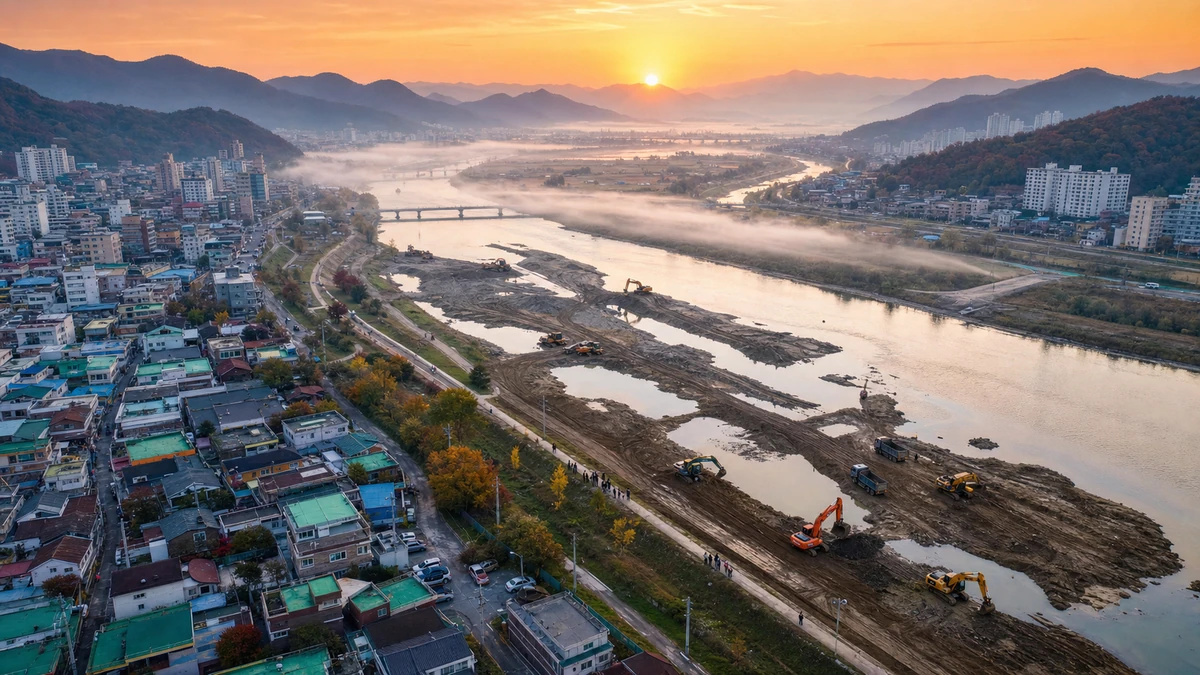
Two environmental groups in the city said this week that local officials are relying too heavily on repeated dredging — the practice of removing sediment, sand and soil from a riverbed — rather than pursuing more durable, nature-based strategies to reduce flood risk. Their central claim is striking in its simplicity. After monitoring national river dredging sites in Daejeon, the groups said they found eight sections that had been dredged within the past two years were being dredged again.
That detail has given the story traction beyond the technical world of public works. To many residents, the question is intuitive: If the same stretches of river need to be excavated again so soon, is the policy actually preventing future problems, or is it creating an expensive cycle of repeat construction?
The issue may sound hyperlocal, but it touches a debate that would be familiar to readers in the United States. American cities from Houston to New Orleans to parts of California have spent years wrestling with the limits of hard-engineering approaches to flood control, while also weighing greener alternatives such as restored wetlands, floodplains, permeable surfaces and riverbank buffers. Daejeon’s dispute reflects that same tension: whether water should be managed mainly through recurring construction or through systems that work more with the landscape than against it.
In South Korea, where urban development has often moved quickly and visibly, public works can carry political weight. A project with heavy equipment on site can signal action and competence. But repeated work in the same place raises another kind of signal, one that is harder for officials to control. It invites residents to ask not whether government is doing something, but whether it is doing the right thing.
That is what gives this story broader meaning. What is happening in Daejeon is not merely a dispute over dirt at the bottom of a river. It is a debate over what kind of city government residents want, what counts as responsible spending and how a modern urban area should prepare for climate-related risk without reducing its waterways to permanent construction zones.
Why Daejeon’s Rivers Matter So Much
Daejeon is one of South Korea’s larger inland cities, a regional hub known for government research institutes, universities and a sizable middle-class population. It is not as globally recognized as Seoul or Busan, but in Korean terms it is an important metropolitan center, and like many cities in the country, its waterways are tightly woven into daily life.
That context matters. In an American city, a river can be a shipping corridor, a scenic asset, a park spine or a hazard depending on where you live. In Daejeon, as in many Korean cities, a river often serves several of those roles at once, minus the large-scale commercial shipping. River corridors are places where people walk, bike, exercise and gather. They are part flood channel, part neighborhood amenity, part ecological zone and part symbol of civic identity.
That helps explain why dredging is not just a technical issue handled behind the scenes by engineers. When city governments reshape a riverbed, residents may experience the consequences directly — in the appearance of the waterway, the condition of adjacent paths, the state of local habitat and their sense of how safe nearby neighborhoods are during heavy rain.
South Korea’s monsoon season, typically concentrated in the summer, can bring intense rainfall in short periods. Climate change has sharpened public concern over extreme weather, just as it has in many other countries. Local officials therefore have strong incentives to show that they are taking flood prevention seriously. River management becomes more than infrastructure. It becomes part of a city’s social contract with residents.
That is also why the latest criticism from civic groups carries weight. The organizations involved — Daejeon Environmental Movement Alliance and Green Alliance Daejeon-Chungnam — are part of a broader South Korean tradition of local advocacy groups that monitor development projects, environmental policy and public spending. In the United States, readers might think of a mix of watershed watchdogs, neighborhood environmental coalitions and government accountability groups rolled into one. They often use statements, press conferences and site monitoring to bring issues into public view.
In this case, the groups are not simply opposing a single project. They are challenging the governing philosophy behind repeated dredging, arguing that the city should move toward what they call a nature-based prevention strategy. Even without a fully detailed blueprint attached, the phrase signals a deeper rethinking of flood management — one that puts restoration, resilience and long-term ecological function alongside immediate safety concerns.
The Numbers Driving the Controversy
The environmental groups’ critique rests heavily on two numbers: eight river sections and 6.3 billion won, or about $4.5 million at recent exchange rates. According to their statement, those eight sections had already been dredged within the last two years and are now undergoing dredging again. They also said 6.3 billion won was being spent to redredge the same sections.
Whether residents understand the finer points of sediment transport is almost beside the point. Numbers like these make the story legible in everyday terms. Eight sections suggest the problem is not an isolated exception. A multimillion-dollar price tag transforms an environmental complaint into a budget question, which in any democracy tends to draw wider attention.
The groups argued that spending that amount on repeat dredging either amounts to an admission that the earlier dredging did not meaningfully prevent flooding or implies that city and river authorities will have to keep pouring large sums into the same kind of work again and again. In other words, they are framing the issue as a dilemma: either the original intervention was ineffective, or the method itself is structurally repetitive and expensive.
That framing is politically potent because it crosses ideological lines. Residents concerned primarily about ecology may worry about habitat disruption and overengineering. Residents concerned mainly about taxes and public efficiency may ask why the same stretches require renewed excavation so soon. Residents focused on safety may want proof that the work is producing measurable flood protection, not just visible construction activity.
To be fair, river systems are dynamic by nature. Sediment returns. Water levels change. Storms alter channels. Public officials could plausibly argue that maintenance is not evidence of failure but a normal part of managing rivers that pass through dense urban areas. In the United States, agencies that manage levees, channels and reservoirs make similar arguments all the time: infrastructure requires upkeep, and waterways do not remain fixed simply because a project was completed once.
Still, the environmental groups have put their finger on a difficult public-policy problem. Maintenance is one thing. Cyclical intervention without a convincing long-term case is another. When the same solution must be repeated at significant cost over a short period, governments are typically expected to explain not only why the work is needed now, but also why alternative approaches were not chosen and how effectiveness is being measured.
As presented so far, the controversy is shaped largely by the civic groups’ account, because no detailed rebuttal from city officials was included in the material summarized. That absence does not prove the criticism is correct. But it does mean the public conversation, at least for the moment, is being driven by a straightforward and resonant challenge: If this is sustainable flood prevention, why does it look so much like starting over?
What “Nature-Based” Flood Prevention Means
The phrase “nature-based prevention measures” can sound abstract, especially in political debate, where it is sometimes used as a slogan rather than a plan. But the concept has become increasingly important in urban planning worldwide, including in the United States. At its core, it means designing flood control and water management systems that preserve or restore some of the natural functions that rivers, wetlands and open land already provide.
In practice, that can include giving rivers more room to spread during heavy rain, restoring vegetation along banks, protecting wetlands that absorb runoff, reducing paved surfaces that speed stormwater into channels and redesigning urban spaces so that water can be temporarily stored rather than rushed downstream as fast as possible. It does not necessarily mean abandoning engineering. Rather, it often means blending engineering with ecological design.
For American readers, the closest reference points may be projects that turn flood-prone land into park space, rebuild marshes as storm buffers or replace all-concrete stormwater systems with “green infrastructure” such as bioswales, retention zones and permeable streets. These approaches have become more common as cities recognize that climate change is increasing rainfall volatility and that older methods built around speed and channelization can shift, rather than solve, flood risk.
That is the conceptual backdrop to the Daejeon groups’ demand. They are effectively arguing that a river should not be treated only as a drain that needs periodic excavation to keep water moving. It should also be understood as a living system and as a public space whose ecological health affects long-term resilience.
That distinction matters in South Korea, where rivers in and around cities have often been highly managed. Over decades of rapid industrialization and urban growth, much of the country prioritized development, flood control and visible modernization. Those priorities helped deliver economic transformation, but they also contributed to a style of water management that sometimes favored straightened channels, reinforced banks and construction-led intervention.
Now, as Korean cities mature and public expectations evolve, residents are increasingly asking for more than narrow functional performance. They want waterways that are safe, yes, but also attractive, ecologically credible and financially sensible. In that sense, the Daejeon dispute is part of a broader shift in civic values. It reflects a move from asking whether government can control nature to asking whether government can manage risk without constantly overpowering the landscape.
There is a practical challenge, of course. Nature-based solutions usually require land, time, coordination and a willingness to accept that resilience is not always as visually dramatic as a construction project. A dredger in the river is easy to photograph. Expanded floodplain capacity, upstream watershed restoration or redesigned runoff management can be harder for the public to see, even if they are more durable over time.
That political reality may help explain why dredging remains attractive. It is tangible, immediate and familiar. But if the same locations require repeated intervention, critics gain an opening to argue that the appearance of action has begun to substitute for strategic planning.
How Civic Groups Shape Public Debate in South Korea
One reason this story has broader social significance is that it illustrates how civic oversight works in South Korea at the local level. The matter did not emerge from a criminal investigation, a court ruling or a catastrophic flood. It emerged because environmental groups monitored project sites, gathered observations and issued a public statement pressing for a policy shift.
That is a recognizable pattern in Korean civil society. Advocacy organizations often serve as intermediaries between technical policy and public understanding. They translate complex subjects — from redevelopment plans to energy policy to river management — into arguments ordinary residents can engage with. In this case, the key word is repetition. It is a simple word, but politically powerful. Why are we doing the same work again? Why is the same place costing money twice? Is this truly prevention, or merely recurring maintenance under a more urgent label?
Those are questions that cut through bureaucratic language. They do not require specialized knowledge of hydraulics or sediment loads. They require only a citizen’s instinct for accountability.
That may be why the story resonates as social news rather than just environmental news. Rivers touch multiple aspects of urban life at once. During storms, they are a safety issue. On ordinary days, they are recreational space. In city budgets, they are a public expenditure. In planning debates, they become symbols of what kind of development a city values.
In the United States, similar disputes often become flashpoints over whether officials are privileging visible infrastructure spending over deeper adaptation. One side argues that immediate action is necessary and practical. The other says repeated projects can become a costly treadmill if the underlying relationship between city and landscape remains unchanged. Daejeon appears to be entering that same conversation.
There is also a cultural dimension worth noting for non-Korean readers. South Korean local politics can be highly sensitive to public perceptions of efficiency, especially when it comes to construction and redevelopment. Residents are accustomed to seeing rapid physical change in their cities, and that history can produce a bias toward interventions that are concrete, fast and highly visible. At the same time, Korean civil society has become increasingly sophisticated at scrutinizing whether such interventions are genuinely serving the public interest.
The environmental groups’ statement fits squarely within that tradition. It is less an anti-development manifesto than an effort to widen the terms of the debate. Their challenge is not only about dredging as a technique. It is about the philosophy of urban water management and about whether local government can justify repeated spending in a way that residents find credible.
The Questions City Leaders Now Have to Answer
The most immediate issue for Daejeon officials is explanation. If repeat dredging was necessary, why was it necessary? Were the river sections reworked because of new sediment accumulation, altered hydrological conditions, emergency risk assessments or limitations in the earlier project? How is success defined? By water-flow speed, flood-stage reduction, maintenance intervals, ecological indicators or some combination of the above?
Those questions are not mere public relations concerns. They go to the core of how infrastructure policy earns legitimacy. In democratic cities, especially where public confidence can be shaken by perceptions of waste, technical necessity is rarely enough on its own. Officials must be able to connect engineering decisions to understandable outcomes.
The next question is whether Daejeon and other Korean cities are distinguishing clearly between short-term emergency works and long-term strategy. That distinction is crucial. In some cases, immediate dredging or other channel work may be justified as a stopgap to reduce pressing risk before the next rainy season. But a stopgap is not the same as a sustainable framework. If short-term measures become the default approach year after year, governments eventually have to confront whether they are managing symptoms rather than causes.
That is the larger challenge embedded in the environmental groups’ statement. They are effectively asking the city to separate what is urgent from what is enduring. A city may need temporary interventions while also pursuing broader reforms in land use, runoff management, ecological restoration and watershed planning. Without that distinction, every season can begin to look like the last one — another project, another expenditure and another promise that this time the problem will be under control.
There is also a question of public values. What do residents want their rivers to be? A river in a city is never only a river. It is a seam where safety, aesthetics, ecology, recreation and property concerns all meet. Decisions about dredging therefore reflect not just engineering judgments but civic priorities. How much habitat disruption is acceptable in the name of flood prevention? How much recurring cost is acceptable for maintenance? How much visible intervention makes people feel protected, and when does that visibility start to feel like evidence of policy failure?
Those are difficult questions in any country, and South Korea is no exception. But the Daejeon case suggests that Korean urban politics may be entering a new phase in which residents are less willing to accept repetitive construction as proof of competent governance. Instead, they may increasingly demand evidence that projects fit into a coherent long-term plan.
A Korean River Story That Speaks Beyond Korea
For global readers, the importance of this story lies in its familiarity. The names are Korean, the institutions are local and the civic groups come from Daejeon. But the underlying conflict is one many cities now face. How do governments protect residents from flood risk while preserving livability? How do they spend public money in ways that are measurable and durable? And how do they adapt older infrastructure habits to a climate future that punishes simplistic solutions?
What makes Daejeon’s debate compelling is that it crystallizes those issues in a single, easy-to-grasp image: heavy machinery returning to places that were already dredged not long ago. That image forces a public reckoning. Repetition can be interpreted as diligence, but it can also look like drift. The difference depends on whether officials can show that repeated work is part of a larger, rational system rather than evidence of dependence on a tool that may no longer be enough.
For now, the environmental groups have succeeded in reframing the issue. Instead of allowing river dredging to remain a routine administrative matter, they have turned it into a broader public conversation about urban philosophy. Is flood prevention primarily about moving water away as quickly as possible? Or is it about designing cities that can absorb, accommodate and coexist with water more intelligently?
That shift in framing may be the most significant development of all. Public debates often begin with numbers, budgets and technical works, but they endure when they tap into deeper civic anxieties. In Daejeon, those anxieties include the fear of flooding, the frustration of seeing repeated spending and the desire for rivers that are more than engineered corridors.
The city’s next steps will matter, not only because they will shape local waterways but because they may signal how South Korean cities intend to handle an increasingly universal urban dilemma. A safe city and a pleasant city are not always created by the same methods. The challenge is to build one without sacrificing the other.
That is the unresolved question now running through Daejeon’s riverbanks. It is also the reason a dispute over dredging has become something larger: a test of whether 21st-century cities can protect people from water without treating every river as a problem to be excavated again and again.
Comments
Post a Comment