In South Korea’s Chuncheon, a Water Plant Upgrade Becomes a Lesson in the Power of Invisible Infrastructure
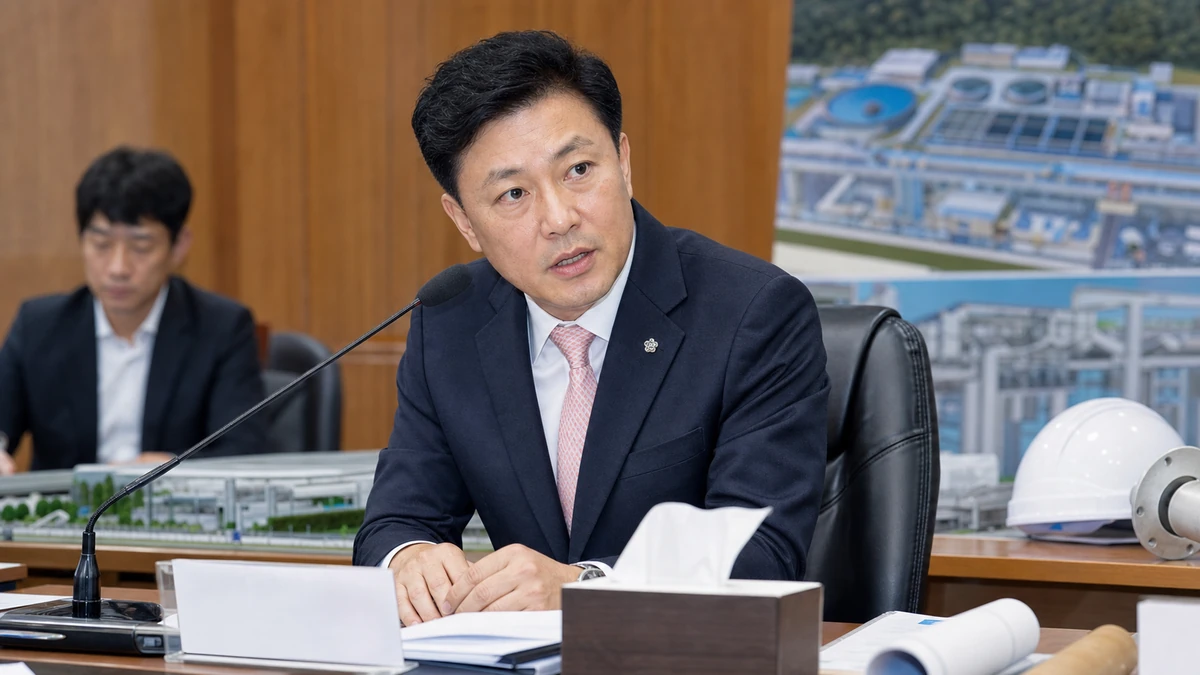
A major public works project in a city many Americans may know only as a travel destination
For many people outside South Korea, Chuncheon is best known for things that are easy to picture: scenic lakes, mountain views, and dakgalbi, the spicy stir-fried chicken dish that has become one of the city’s culinary calling cards. The city, located in Gangwon Province northeast of Seoul, also carries cultural recognition from television and tourism, part of the wider Korean Wave that has introduced international audiences to places far beyond the capital.
But the latest development in Chuncheon is not about pop culture, food or tourism. It is about water — specifically, the kind of public infrastructure that is essential to daily life but rarely makes headlines unless something goes wrong.
City officials say the modernization of the Yongsan Water Purification Plant has reached 77% completion as of Sunday and remains on track for completion in February next year. The project, valued at 84.9 billion won, or roughly tens of millions of U.S. dollars depending on exchange rates, is one of the city’s most significant infrastructure investments in recent years. According to local authorities, major building and civil engineering work on the treatment facility has already been completed, and the project has moved into the installation of mechanical, electrical and communications systems — the internal systems that will determine how the plant actually performs once it begins operating.
That may sound technical, even dry. But in practical terms, the Chuncheon project offers a revealing snapshot of how South Korean local governments are thinking about the future: not only in terms of flashy redevelopment or high-tech branding, but in terms of the invisible systems that make urban life possible.
In the United States, water infrastructure stories often become national news only after a crisis — a boil-water advisory, a drought emergency, a major pipe break, or a public health failure such as the one in Flint, Michigan. In South Korea, where public infrastructure is often maintained with a strong emphasis on continuity and modernization, the Chuncheon project reflects a more preventative approach. The city is not responding to a dramatic collapse. Instead, it is trying to reduce the risk that old facilities could one day become a problem.
That makes this story bigger than one treatment plant. It is about how a mid-sized Korean city is investing in basic systems before they fail, and in doing so, making a case that infrastructure most people never see may be just as important as highways, rail lines and office towers.
Why a water plant matters far beyond household taps
Water treatment plants are often discussed in narrow terms: sanitation, utility services, public health. Those are all accurate categories, but they can undersell the broader economic role of such facilities. A reliable water supply is one of the foundational conditions for a city to function. Homes need it, of course, but so do restaurants, hospitals, schools, factories, hotels, laundromats, public buildings and fire services. Without dependable water delivery, the rest of the urban economy becomes less predictable and more vulnerable.
That is why the Yongsan modernization project is better understood not just as a maintenance job, but as a strategic investment in Chuncheon’s operating capacity. The city’s plan includes a water treatment facility capable of processing 30,000 cubic meters of water per day, along with 7.1 kilometers, or about 4.4 miles, of water transmission and distribution pipelines. In other words, the project addresses both treatment and delivery — not only how water is cleaned, but how it moves through the system to reach homes and businesses.
That distinction matters. In infrastructure planning, bottlenecks often emerge not from a single point of failure, but from weak coordination across an entire network. A city can have adequate treatment capacity on paper and still face supply issues if its pipeline system is aging, undersized or vulnerable to interruption. By combining treatment upgrades with new or improved conduits, Chuncheon appears to be addressing the water supply chain as a system rather than as a set of isolated parts.
Americans have long understood this principle in other sectors. When people talk about supply chains in the U.S., they often think of ports, trucks, warehouses and semiconductors. Water infrastructure follows a similar logic. Producing clean water is only one part of the task; transporting it consistently and safely is what turns a utility into a dependable public service.
That is one reason local governments can justify spending heavily on projects that may not produce a visible ribbon-cutting effect. A water plant does not offer the political spectacle of a new stadium or a downtown mega-development. It offers something quieter: the confidence that faucets will run, businesses will stay open, and public services will function even under strain.
What 77% completion really means
On paper, 77% may sound like a straightforward progress statistic. In construction terms, though, it can signal a significant turning point. City officials say the building and civil engineering structures for the purification facility are complete, meaning the project has moved beyond excavation, site preparation and shell construction. The remaining work now centers on mechanical, electrical and communications installations — the systems that give the facility its operational intelligence and capability.
To borrow a comparison familiar to American readers, this is the stage at which a project stops being just concrete and steel and starts becoming a working utility. If the plant structure is the body, these internal systems are the nervous system and circulatory system. They are what enable operators to monitor water quality, regulate flow, maintain pressure, coordinate treatment processes and respond quickly to abnormalities.
In modern water treatment, communications systems are not an afterthought. They are part of what makes a facility manageable in real time. Sensors, control systems and internal network connections help operators oversee treatment conditions, equipment performance and transmission reliability. As water systems worldwide become more complex — and as climate pressures, urban growth and aging infrastructure create new uncertainties — these back-end systems grow more important.
The fact that Chuncheon has entered this phase suggests the project is in its later stretch, with most of the exterior and structural heavy lifting already completed. It also means the remaining months before the planned February completion will likely be critical. Installing equipment is one challenge; integrating it into a stable operating environment is another. Water plants must do more than exist physically. They must perform consistently under real-world conditions.
That is why officials’ target date matters, but so does the character of the work left to do. Mechanical and electrical installation is often where the true operational value of a project is determined. A city may be able to celebrate visible construction milestones early, but the public ultimately depends on what happens in the less visible final stages.
South Korea’s local infrastructure story is often overshadowed by its global brands
When Americans think about South Korea’s economic strength, the usual reference points are easy to name: Samsung, Hyundai, LG, semiconductors, electric vehicle batteries and K-pop’s global reach. South Korea is frequently framed through its export power and cultural influence, and not without reason. Those sectors have shaped the country’s international image.
But a city like Chuncheon reminds observers that national competitiveness does not rest on consumer brands alone. It also depends on whether ordinary places have dependable public systems. South Korea’s growth story has always involved this dual reality: world-famous industries on one hand, and a deeply built-out network of public infrastructure on the other.
Chuncheon is not Seoul, and that is part of what makes this project noteworthy. It is a provincial city with administrative, residential and tourism significance, serving as a hub within Gangwon Special Self-Governing Province. For international audiences, that “special self-governing” designation may need explanation. In the Korean context, it reflects a regional governance structure intended to give the province greater flexibility in development and administration. It does not mean independence, but it does signal a broader push to strengthen regional capacity outside the Seoul metropolitan area.
That broader regional strategy matters in a country where the pull of greater Seoul is immense. Like many nations, South Korea faces pressure to balance capital-region concentration with the long-term viability of secondary cities. Investments in water, power, transit and communications are part of how local governments make the case that smaller cities can remain livable, investable and resilient.
Seen in that light, the Yongsan Water Purification Plant is not merely a utility project. It is part of a local competitiveness strategy. Stable water service supports both quality of life and economic confidence. It helps households, but it also helps commercial districts, schools, health care facilities and tourism operations — all of which matter in a city that depends on a mix of residential life, local business and visitor traffic.
Americans can recognize a similar dynamic in their own communities. Whether in the Midwest, the Sun Belt or the Pacific Northwest, cities trying to attract residents and employers rarely succeed on branding alone. They need roads that work, grids that hold, broadband that reaches users and water systems that do not break down. Chuncheon’s project fits squarely within that universal urban equation.
The economics of prevention: replacing old systems before they become a crisis
One of the most important details in the Chuncheon project is also one of the least dramatic: the city says the modernization is designed to address aging facilities and establish a more stable tap-water supply system. That may not sound urgent in the way that disaster language does. But in infrastructure policy, the absence of drama is often the point.
Older infrastructure can be deceptive. It may continue functioning long after parts of the system have become inefficient, fragile or costly to maintain. Because the breakdown risk accumulates gradually, officials often face a politically difficult choice: spend significant public money before the average resident sees a problem, or wait until the system forces the issue through interruptions, emergency repairs or declining service quality.
Chuncheon appears to be choosing the first path. From an economic standpoint, that can be the cheaper and smarter option. Preventative modernization helps lower the risk of sudden failures that can disrupt households, local business activity and public administration. It can also reduce long-term maintenance strain and improve operational efficiency, though detailed performance metrics for the completed system have not yet been released.
In the United States, many local governments are wrestling with the same dilemma. Water mains in older cities can be decades old, sometimes older than the people now responsible for managing them. Deferred maintenance is common, not because officials do not understand the risks, but because budgets are tight and voters do not always reward spending on unseen systems. The result can be an expensive cycle of patching, emergency contracting and public frustration.
South Korea has its own infrastructure aging challenges, especially in areas developed rapidly during earlier phases of national growth. What is notable in Chuncheon’s case is the framing: this is not being described simply as a repair job, but as a step toward ensuring stable urban operation in the future. That language reflects a shift familiar to planners worldwide. Infrastructure is no longer just about replacing what is old; it is about preparing systems for a more demanding future, shaped by population change, environmental stress and rising expectations for reliability.
In that sense, the project is also about risk management. Clean, dependable water is so basic that its economic value is often invisible until it is compromised. A city that reduces that risk is not merely fixing pipes and pumps. It is improving the predictability on which ordinary life depends.
Beyond concrete: the broader investment footprint of a utility project
The Chuncheon project also illustrates how infrastructure spending ripples across multiple sectors. Early construction phases are typically dominated by civil engineering and structural work — the concrete, excavation and site development that physically shape the facility. But once a project enters its later phase, the mix of work changes. Mechanical equipment, electrical systems, controls and communications technologies become central to the build-out.
That shift matters because it shows how a public utility investment touches more than one corner of the economy. A modern treatment plant is not just a building. It is an integrated operating system that depends on engineering, power stability, control technologies and information transmission. The more advanced the system, the more coordination it requires across those fields.
In practical terms, this means the 84.9 billion-won investment represents more than a single construction contract. Even without a public breakdown here of every participating company or subcontracting arrangement, the project’s basic structure implies demand across multiple layers of the infrastructure economy. It supports jobs and expertise not only in heavy construction, but in equipment installation, system integration and utility operations.
That is a point often missed in public debate over infrastructure spending. Critics sometimes frame such projects as static costs: money spent to replace something old with something newer. But infrastructure modernization can also generate broader industrial demand, particularly when it involves advanced systems rather than simple refurbishment.
For South Korea, a country known for marrying manufacturing strength with high-capacity public systems, that overlap is especially important. Modern utility projects create a domestic environment where technical know-how in controls, energy systems and communications can be applied to public needs. That does not make every local project economically transformative, but it does mean infrastructure investment is tied to a wider ecosystem of engineering and operational capability.
For American readers, a useful comparison may be the rehabilitation of aging water systems in cities from Los Angeles to Pittsburgh, where the work increasingly involves not only pipes and treatment basins but also sensors, automation and networked monitoring tools. Chuncheon’s project appears to fit that global trend: utility systems becoming more integrated, more data-aware and more dependent on reliable internal communications.
Why this story resonates beyond South Korea
There is a temptation, when covering South Korea for foreign audiences, to focus mostly on what is exportable: music, streaming dramas, fashion, consumer electronics and geopolitical flashpoints involving North Korea, China or the United States. Those subjects matter, and they draw readers for good reason. But they can also narrow the picture of how contemporary Korea actually functions.
Local infrastructure stories like this one offer a different lens. They show what municipal governance looks like beneath the level of national politics and global branding. They reveal how regional cities prepare for the future, how they manage public expectations and how they define modernization in practical terms.
For global readers, the Chuncheon project also resonates because the challenge it addresses is universal. Cities everywhere are struggling with the same basic question: how do you maintain or rebuild essential systems before they fail in costly ways? Climate instability, population shifts, aging public works and budget pressures are not uniquely Korean problems. They are shared urban realities.
The numbers in Chuncheon’s project make that reality concrete. A treatment capacity of 30,000 cubic meters per day is not a symbolic upgrade; it is a statement about sustaining regular urban demand. A 7.1-kilometer pipeline component is not cosmetic; it reflects the practical fact that treatment only matters if water can move reliably where it is needed. And a 77% completion rate is not merely a construction statistic; it indicates that a city is moving from physical build-out toward the more exacting task of making the system work as intended.
If the project stays on schedule for completion in February, its ultimate value will not be measured in tourist photos or skyline changes. It will be measured in the absence of disruption — in steady service, lower risk and improved confidence in a municipal system most people will never visit.
That may make for a quieter kind of story. But it is exactly the kind of story that helps explain how modern cities endure. In Chuncheon, the most important upgrade underway may be one residents barely see at all. And that is precisely why it matters.
Comments
Post a Comment