In South Korea’s Mountain Farm Belt, Hundreds of Volunteers Step In as Rural Communities Struggle to Keep Up
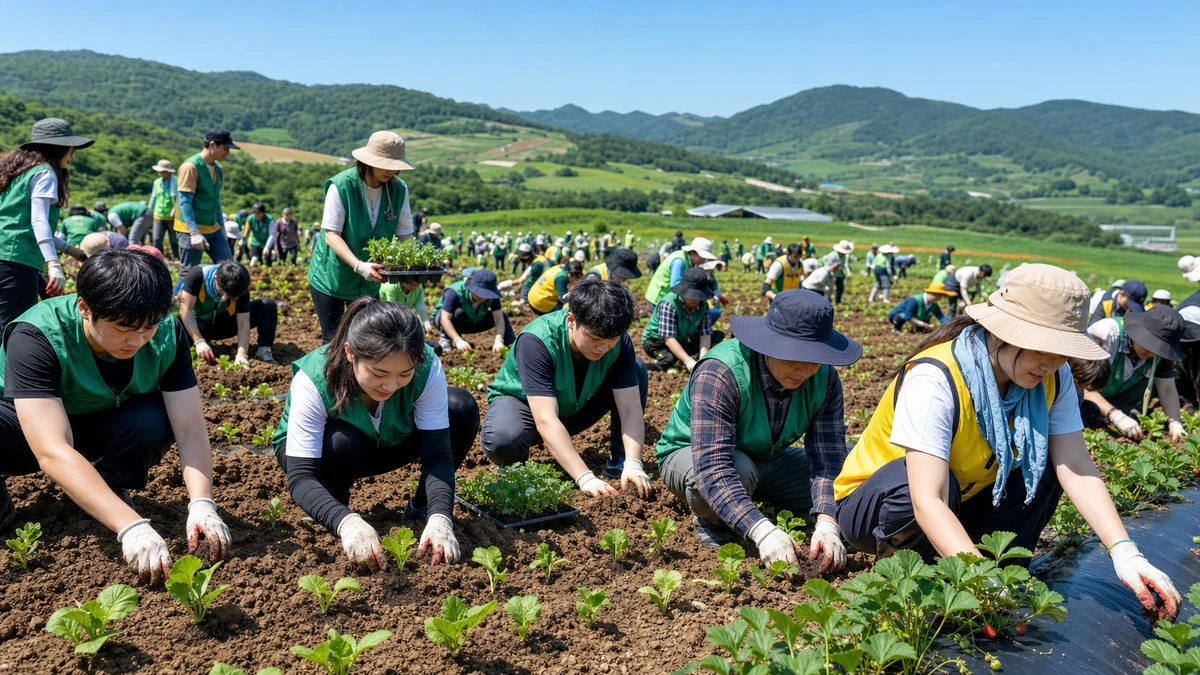
A summer workday in rural South Korea draws hundreds of extra hands
On a June day in Daegwallyeong, a highland farming area in South Korea’s northeastern Gangwon province, more than 200 people gathered not for a ceremony or a photo opportunity, but for fieldwork. They sowed radish seeds, planted lettuce seedlings and trimmed strawberry runners — the kind of repetitive, time-sensitive labor that keeps a farm operating during one of the busiest stretches of the year.
The event was organized by the Gangwon regional headquarters of NongHyup, the powerful agricultural cooperative network that plays an outsized role in South Korean farm life. According to South Korean media reports, participants included NongHyup Chairman Kang Ho-dong, regional officials, local women’s associations and college student volunteers. Across Gangwon that same day, roughly 1,000 NongHyup employees and volunteers fanned out to farms in a broader push to address labor shortages during the peak early summer season.
For American readers, the image may call to mind church volunteer days in small-town farm country, a county extension service mobilization, or even a corporate service event — except with a more direct, hands-in-the-soil urgency. This was not symbolic support. The work being done in Pyeongchang County, where Daegwallyeong is located, involved tasks that cannot easily be postponed and often cannot be fully mechanized.
The story offers a revealing look at a side of South Korea that many people outside the country rarely see. South Korea is often viewed through the lens of K-pop, Korean dramas, semiconductors and Seoul’s hypermodern skyline. But beyond the capital and industrial centers, the country still depends on aging rural communities, seasonal labor and tightly coordinated local support networks to keep food production moving.
That contrast — between a globally recognized technology powerhouse and the painstaking realities of farm labor — is part of what makes this moment significant. In one of the country’s best-known regions, hundreds of people spent the day doing work that is easy to overlook but essential to the nation’s food system.
What NongHyup is — and why it matters in Korean agriculture
To understand why this event drew such attention, it helps to understand NongHyup. Short for the National Agricultural Cooperative Federation, NongHyup is not simply a farmers’ group in the casual sense. It is one of South Korea’s most important agricultural institutions, combining the functions of a cooperative network, financial services provider, distribution channel and rural support system. If an American reader imagines a blend of a farm credit institution, a cooperative marketing organization and a community development network, that comes closer to NongHyup’s role.
Its influence extends into everyday rural life. NongHyup banks are deeply familiar in South Korea. So are its local branches, supply chains and support programs for farmers. When the organization launches a provincewide labor assistance drive, it is not acting as an outside charity. It is intervening from within a long-standing system that connects farms, communities and agricultural policy.
The June 19 event in Daegwallyeong was held under the banner of “Nongsim Cheonsim,” a Korean phrase that roughly conveys the idea of caring for the hearts of farmers and rural communities. It is a slogan with cultural weight. Rather than focusing only on efficiency or output, it reflects a recurring theme in Korean public life: that agriculture is not merely an industry but a social foundation tied to community well-being, food security and national identity.
That kind of language can sound lofty, but the practical stakes are real. South Korean farms, especially in regions like Gangwon, face severe pressures from an aging population, rising labor costs and increasingly erratic weather. In that context, slogans about solidarity are put to the test in very literal ways: Are there enough people to get the work done this week, in this field, before timing and weather shift again?
By dispatching hundreds of volunteers to farms at once, NongHyup appears to be trying to answer that question with organized manpower, however temporary. The fact that the effort expanded across the province suggests the need is not isolated to one town or one crop. It reflects a structural challenge spreading across rural South Korea.
Why June matters so much on Korean farms
One phrase cited by organizers captures the urgency of the season. Kang said June is such a busy month that, in Korean rural expression, “even the fireplace poker gets up to help.” The saying may sound quaint in English, but its meaning is clear: during peak farming season, every possible hand is needed.
For American audiences, a rough equivalent might be saying that during harvest or planting season, everyone from grandparents to teenagers is pulled into the work because the window is short and the consequences of delay are expensive. Agriculture everywhere runs on calendars set by weather, soil and crop biology. South Korea is no exception. But because the country has limited arable land, many farms are relatively small, labor-intensive and pressed to make precise use of time.
June is especially demanding because it is a transition month. Farmers are not doing just one thing. They may be seeding one crop, transplanting another and maintaining a third at the same time. In the Daegwallyeong event, volunteers worked on radishes, lettuce and strawberries — three different products requiring different kinds of attention. That mix illustrates how summer farm labor often involves overlapping tasks rather than a single, easily streamlined workflow.
Sowing radishes is about timing the start of production. Planting lettuce seedlings is about establishing the next stage of crop growth without losing momentum. Removing strawberry runners — the trailing stems that spread from the plant — is more delicate and maintenance-oriented, a reminder that some farm work still depends heavily on careful hand labor. Machines can do many things in modern agriculture, but not everything, and certainly not always in small plots or for precision tasks.
The seasonal rhythm matters in another way as well. South Korean consumers are accustomed to fresh produce being widely available in supermarkets, neighborhood produce shops and open-air markets. Like American shoppers who expect consistent produce sections year-round, many may not think often about the labor bottlenecks behind that reliability. Events like this one underscore how much food availability still depends on concentrated bursts of physically demanding work.
In that sense, the story from Gangwon is not just about a volunteer day. It is about what happens when the tempo of agricultural life collides with long-term demographic and economic strain.
Gangwon and Pyeongchang: A familiar name, a less familiar reality
Pyeongchang may be one of the better-known place names in South Korea for international audiences because it hosted the 2018 Winter Olympics. For many Americans, the name evokes ski slopes, opening ceremonies and South Korea’s global image as an organized, high-tech host nation. But the Pyeongchang featured in this story is a very different one: not an Olympic venue, but a working rural county where fields, seasonal labor and local institutions shape daily life.
Daegwallyeong, the township where the volunteer effort took place, is known for its high elevation and cool climate. Gangwon province more broadly is associated with mountainous terrain and what Koreans call “highland agriculture,” meaning farming adapted to elevated areas with distinct seasonal conditions. That geography helps support crops that benefit from cooler temperatures, but it can also make farming physically demanding and operationally complex.
To an American audience, it may help to think of the region as combining some of the agricultural identity of mountain states with the dense population pressures of a much smaller country. South Korea is about the size of Indiana, yet it must balance urban concentration, industrial development and domestic food production on far less open land than the United States enjoys. Rural regions such as Gangwon therefore occupy an important, if sometimes underappreciated, place in the national economy and imagination.
There is also a social dimension to this geography. Rural communities in South Korea, as in much of the developed world, have been hollowed out by migration to cities. Young people often leave for education and jobs in Seoul or other urban centers. Those who remain in farming areas are frequently older. As a result, even relatively routine agricultural tasks can become difficult to staff, especially during periods when several labor-intensive jobs overlap.
That makes volunteer mobilizations meaningful beyond the immediate number of workers involved. When 200 people show up at one site and about 1,000 take part across a province, they are filling a gap created by broader demographic change. They are also performing a public recognition of the value of farm work in a society where urban life dominates cultural attention.
The deeper problem: Aging farmers, rising costs and climate stress
The labor support event was framed by organizers as a response to three converging pressures: an aging rural population, higher labor costs and abnormal weather. Each of those would be difficult on its own. Together, they point to why stopgap volunteer efforts, however welcome, are unlikely to be a complete solution.
First is aging. South Korea has one of the fastest-aging populations in the world, and that pattern is often even more pronounced in the countryside. Farming communities can skew older because younger generations pursue more stable or better-paid opportunities in cities. That leaves many farms dependent on senior farmers who continue physically demanding work well into old age. In practical terms, it means fewer households have enough able-bodied family members to manage peak periods on their own.
Second is cost. Hiring workers has become more expensive, just as it has in many agricultural economies. Farmers who need temporary labor during narrow seasonal windows may find that wage costs cut sharply into already thin margins. This is especially difficult for smaller farms that do not have the scale to absorb higher expenses easily. South Korea’s agricultural sector, like many others, must navigate competition, volatile input prices and pressure from consumers who want affordable food.
Third is climate. Organizers referenced abnormal weather, and that concern resonates far beyond South Korea. American farmers, too, have grappled with unusual rainfall, heat waves, shifting growing seasons and greater uncertainty. In South Korea, where farming calendars are already tightly compressed by geography and land constraints, climate volatility can make planning even harder. A missed work window caused by rain, heat or other disruptions may not be easily recovered.
When these three factors reinforce one another, rural vulnerability deepens. Older farmers may need more outside help. Outside help costs more. Weather makes timing less predictable, raising the stakes of any labor shortage. The result is a system in which even a single delayed task — planting, thinning, trimming, weeding — can have outsized effects.
That is why the images from Daegwallyeong matter. They show not only community spirit, but also the underlying fragility of a farm economy that depends on precise labor at the precise moment.
Why student volunteers and women’s groups matter
One notable feature of the event was who showed up. In addition to NongHyup officials and employees, participants included members of local women’s groups and college student volunteers. That broadens the significance of the effort from a top-down institutional campaign to something closer to a community coalition.
In South Korea, civic and quasi-civic organizations often play a visible role in community support work. The groups mentioned in reports include networks sometimes translated as hometown women’s associations or farm household women’s groups. While those names may sound unfamiliar to Americans, the underlying idea is recognizable: local civic organizations, often built around long-standing social ties, mobilizing to meet a practical need.
These groups can be especially important in rural settings, where informal networks often support formal institutions. Their presence suggests that the response to labor shortages is not being left solely to markets or government bureaucracy. Instead, it draws on a Korean tradition of organized collective participation, one that can involve cooperatives, neighborhood ties and volunteer culture.
The participation of college students is also symbolically important. In an increasingly urbanized society, many young South Koreans have little direct connection to farm work. For students, volunteering at farms can serve both as labor support and as an education in the realities behind the food system. It puts them in contact with a side of national life that may feel far removed from university campuses, office towers and digital culture.
For American readers, there is a familiar parallel here too. Programs that connect young people to rural service, environmental restoration or food production often carry a dual purpose: meet immediate needs while narrowing the social distance between urban consumers and rural producers. In South Korea, where class, geography and generational divides can be pronounced, those encounters may carry added weight.
At the same time, it is important not to romanticize volunteerism. Student volunteers cannot replace a durable farm labor system. Nor can local women’s groups solve structural demographic decline. But their involvement does show how South Korean communities are trying to bridge those gaps in the short term — through what might be called a solidarity of hands.
A broader lesson about the Korean Wave and the Korea the world doesn’t always see
For those who follow South Korea mainly through the Korean Wave — the global rise of K-pop, K-dramas, Korean beauty brands and Korean cuisine — this story offers a useful corrective. The same country exporting polished entertainment and trendsetting consumer culture is also grappling with many of the same rural problems facing other advanced economies: labor shortages, aging producers, cost pressures and climate anxiety.
That does not make the story less Korean. If anything, it makes it more so. Modern South Korea is often defined by its speed — rapid industrialization, rapid urbanization, rapid cultural globalization. But beneath that speed is another Korea that still moves by the rhythms of planting, tending and harvesting. Rural communities may receive less attention than Seoul’s music labels or tech firms, yet they remain essential to daily life.
There is also a revealing tension here between image and infrastructure. International audiences may associate Pyeongchang with Olympic spectacle and Gangwon with tourism or mountain scenery. But those same places are also sites of essential labor, where national food systems depend on older farmers and temporary volunteer support. It is a reminder that behind every globally branded nation lies an internal landscape of less glamorous but indispensable work.
For American audiences, that should sound familiar. The United States, too, often celebrates innovation and cultural exports while overlooking the workers who sustain agriculture, food distribution and local economies. In that sense, the South Korean farm support drive is not a distant curiosity. It is part of a larger global story about who feeds modern societies and what happens when fewer people are available — or willing — to do that work.
The event in Daegwallyeong may not, by itself, transform the conditions facing Korean farmers. Reports did not specify how many farms were reached, how much land was covered or what longer-term measures might follow. But even with those limits, the significance is clear. A province mobilized roughly 1,000 people in the middle of a busy season because agricultural labor shortages have become impossible to ignore.
And in one highland farming community better known abroad for winter sports than summer fieldwork, more than 200 people spent the day doing something simple and consequential: helping make sure crops were planted, tended and kept on schedule. In a world increasingly disconnected from the sources of its food, that kind of story deserves attention.
It is also, in its own way, a story about national priorities. A society reveals itself not only in the songs it exports or the buildings it erects, but in whether it can still rally support for the ordinary labor that sustains everyday life. On that measure, the June mobilization in Gangwon was both a practical intervention and a public statement: that rural work still matters, even in one of the most urbanized, technologically advanced countries in the world.
Comments
Post a Comment