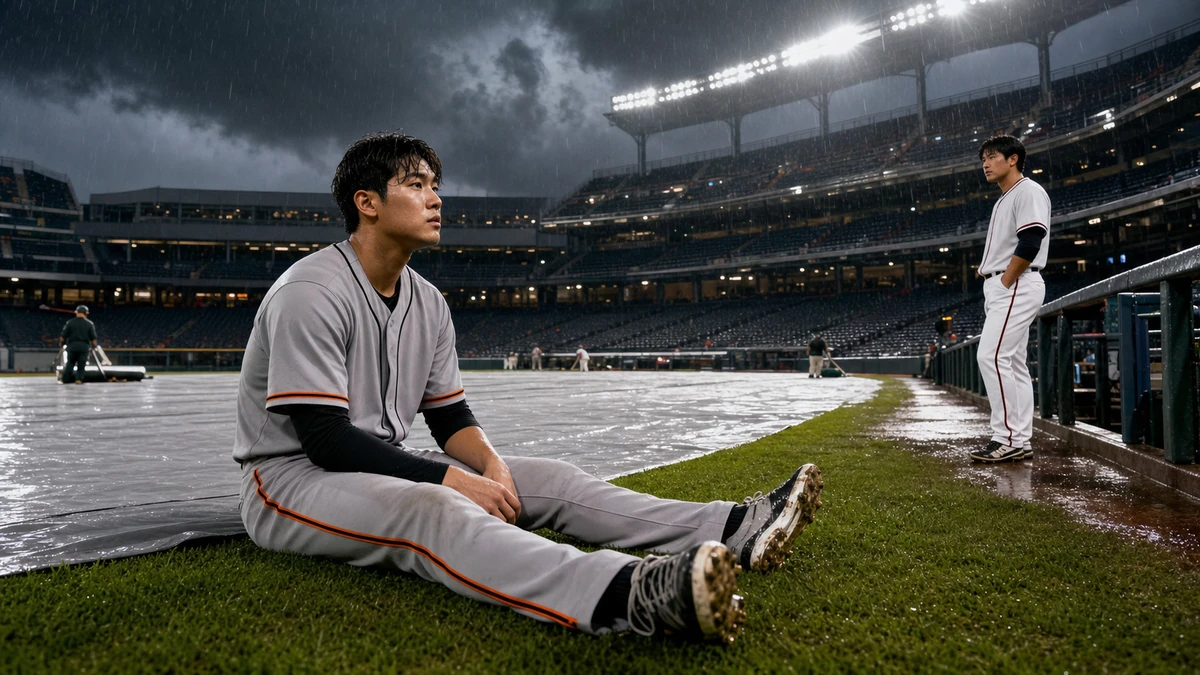
A weather delay postpones more than just another game
For most American baseball fans, a rainout in Atlanta in the middle of a long major league season barely registers as unusual. Summer storms reshape schedules every year, especially in the Southeast, where heat, humidity and sudden downpours are as much a part of the baseball calendar as getaway days and bullpen games. But this week’s postponement of a game between the San Francisco Giants and the Atlanta Braves carried a significance that reached far beyond the usual inconvenience of tarp-covered infields and revised ticket policies.
The game, scheduled for Truist Park in suburban Atlanta, was postponed because of heavy rain in the forecast linked to Tropical Storm Arthur, according to MLB.com. It has been rescheduled for Sept. 1 at the same ballpark. On paper, that is a straightforward logistics update. In practice, it put off a matchup many South Korean baseball fans had circled well in advance: a meeting between Giants outfielder Lee Jung-hoo and Braves infielder Kim Ha-seong, two of the most recognizable Korean players now competing in Major League Baseball.
In South Korea, matchups like this are often called a “Korean Derby,” a phrase used when Korean athletes face one another in overseas leagues. The term can sound a little grandiose to American ears, where “derby” is more commonly associated with horse racing or rivalry games like Yankees-Red Sox. But the meaning is easy to understand. When players who first became national stars at home meet on one of the most prominent stages in global sports, the event becomes bigger than a single regular-season result. It turns into a marker of visibility, pride and proof of how far a country’s sports culture has traveled.
That is what made this postponed game notable. Lee and Kim were not just two players in different uniforms. To many Korean fans, they represent different chapters of the same national baseball story: elite domestic talent graduating to the highest level of the sport and carrying with them years of expectations, comparisons and emotional investment. The game was delayed, not canceled, and that distinction matters. But the wait now stretches into September, changing the baseball context around it for both clubs and for the fans following along from half a world away.
Why Lee Jung-hoo and Kim Ha-seong matter in Korea and beyond
To understand why the postponement drew attention, it helps to understand where Lee and Kim fit in the modern Korean sports landscape. Baseball in South Korea is not a niche pastime. It is one of the country’s most established spectator sports, with a deeply rooted professional league, the Korea Baseball Organization, or KBO, and a passionate following that blends serious analysis with high-energy fandom. KBO games are known internationally for their organized cheering sections, fight songs, thunder sticks and a crowd atmosphere that can feel, to an American visitor, somewhere between college football and a summer carnival.
From that ecosystem, both Lee and Kim emerged as marquee names. Lee Jung-hoo entered pro baseball with unusual expectations. He is the son of Lee Jong-beom, a Korean baseball legend often compared, in terms of fame and all-around impact, to the sort of household sports figure Americans might recognize in the mold of a Ken Griffey Sr.-to-Jr. lineage, though the comparison is imperfect. Younger fans came to know Lee Jung-hoo not just as a famous son but as a star in his own right: a polished hitter with elite bat-to-ball skills, national-team credentials and the kind of clean, marketable profile that made him one of the faces of Korean baseball before he ever took a major league at-bat.
Kim Ha-seong followed a different path to broad recognition. He built a reputation as a dynamic infielder with power, speed and defensive range, then won over many American viewers with the type of versatility managers covet over a 162-game season. In Korea, Kim has long been seen as one of the country’s most complete players, and his success in the majors has had symbolic weight. Every time a Korean player not only reaches MLB but proves he belongs there every day, it reinforces the idea that Korean baseball is not just producing occasional novelties for international audiences. It is producing sustainable, big-league talent.
That is why head-to-head meetings matter. They offer more than novelty. They invite comparison, memory and a little national sentiment. In a media environment where Korean fans follow overseas sports in real time through clips, livestreams and increasingly seamless translation tools, an all-Korean MLB matchup becomes a communal event. Fans who watched these players in the KBO or on the international stage can now see them as part of the everyday fabric of the American game.
For American audiences, there is also a broader sports trend here worth noticing. Just as soccer fans in the United States now understand the outsized cultural importance of Korean captain Son Heung-min in the English Premier League, baseball is offering its own version of transnational fandom. The stars may be in U.S. stadiums, but the audience stretches far outside them.
The storm that altered the schedule
The immediate reason for the postponement was weather, and baseball remains unusually vulnerable to it. Football can play through rain. Soccer often does the same. Baseball, with its dirt infield, pitcher’s mound, slick baseballs and daily wear on players’ bodies, is much less flexible. A heavy rain forecast raises concerns about field conditions, player safety, travel logistics and competitive fairness. Even if a game could theoretically start, the likelihood of repeated delays or a midgame suspension can make postponement the more practical choice.
That was especially true here because rain had already disrupted the series in Atlanta. The opener had previously been suspended because of weather, forcing the Giants to return the next day and complete that game before playing the regularly scheduled contest. San Francisco ended up winning both, effectively sweeping the double-feature arrangement created by the earlier delay. By the time the third game on the schedule was postponed, weather had become the defining variable of the series.
In American baseball terms, that kind of sequence matters. A suspended game turned into a next-day continuation is not the same thing as a cleanly scheduled doubleheader. It can tax bullpen usage, scramble pregame routines and complicate lineup decisions. A manager has to think not only about who is available today, but also about how today’s improvisation affects tomorrow’s travel, next week’s rotation and the long tail of player fatigue in August and September.
The postponement also illustrates a tension baseball knows well: the sport is built on routine, but routinely disrupted by forces no team can control. For fans, the visible part is simple enough. The game disappears from the screen and reappears later on the calendar. For clubs, the consequences begin immediately. Starting pitchers are moved. Bench players may get fewer or more opportunities later. Relievers’ workloads are redistributed. Travel itineraries are adjusted. What looks like one missing game can ripple across two weeks of roster management.
In this case, the rainout did not erase anticipation around Lee and Kim. If anything, it may heighten it. Sports postponements often create a strange secondary drama. The event becomes less spontaneous and more narratively loaded. By the time the game is replayed, the standings may look different, injuries may have changed the available personnel, and what seemed like a tidy regular-season meeting can become a higher-stakes test in the season’s stretch run.
Why the new date could be harder on San Francisco
Rescheduling a game in late summer is rarely painless, and the Giants may feel the cost most sharply. Because of the revised calendar, San Francisco is now set to play 23 straight games without an off day from Aug. 19 through Sept. 10, ending with a game against the St. Louis Cardinals. In a sport where even healthy rosters can look worn down by the dog days of August, that kind of stretch is not just a scheduling footnote. It is a competitive burden.
To non-baseball readers, 23 straight games may sound manageable in a league accustomed to volume. But anyone who follows the major leagues knows off days serve as pressure-release valves. They are when pitchers get an extra day, position players can reset nagging aches, travel becomes slightly less punishing and coaches can reorient without also preparing for first pitch that night. Take those breaks away, and the attrition of the season becomes more visible.
There is an American sports analogy here that may help. Imagine an NBA team not just playing a dense cluster of games, but doing so while crossing time zones and managing a roster full of players with small but accumulating physical issues. Or think of an NFL team being asked to compress recovery time week after week, except without the once-a-week structure that allows for long preparation. Baseball’s grind is different, but no less real. Its difficulty comes from repetition rather than collision.
That matters for Lee and the Giants in particular because the late-season calendar often sharpens every lineup decision. The farther a team moves into late August and early September, the less room there is to treat a makeup game like administrative housekeeping. These are the weeks when playoff races take shape, when slumps feel more expensive and when a single extra game can alter bullpen availability over an entire series. A postponed contest can suddenly land in the middle of a crucial stretch and become far more meaningful than it looked on the day it was first scheduled.
For Atlanta, too, the makeup date could shift the meaning of the matchup. The Braves’ own priorities in September may look different than they did this week. Players who would have started now might be resting later. A team managing a division lead approaches September differently than one fighting for position. A club dealing with injuries or a compressed pitching plan may see a formerly routine game as strategically delicate.
That is one reason baseball people tend to talk about postponements less as delays than as redistributions of stress. The stress does not disappear. It moves to a new date, often with interest added.
A Korean Derby is about identity as much as competition
The phrase “Korean Derby” may sound promotional, but it reflects a real emotional logic in the way Korean fans experience overseas sports. When athletes leave the domestic league and succeed abroad, they remain connected to home in an unusually public way. Their achievements are not treated solely as private career milestones. They are folded into a broader national conversation about talent, identity and international standing.
Americans are familiar with versions of this dynamic, though usually on a regional rather than national scale. Think of how a small college town follows one former star into the pros, or how a community rallies around a hometown Olympian. Now scale that sentiment to a country with a highly networked media culture and a strong appetite for following its stars overseas. That helps explain the emotional intensity surrounding matchups like Lee vs. Kim.
There is also a media dimension. In Korea, sports coverage of players abroad is both immediate and personalized. A single game can generate headlines not only for results but for moments: a stolen base, a hard-hit single, a defensive stop, a dugout interaction. When two Korean stars share the field, the event becomes especially rich material for fans, broadcasters and digital platforms. Highlight packages are clipped and recirculated quickly. Commentary appears in multiple languages. Social media turns an ordinary Tuesday game in Atlanta into breakfast viewing in Seoul.
The appeal is not limited to Korean nationals or Korean speakers. There is a growing global audience for Korean sports narratives, helped by the same cultural currents that have carried Korean pop music, television dramas and film into the American mainstream. The so-called Korean Wave, or hallyu, has made U.S. audiences more attuned to Korean cultural exports than at any previous point. Sports has often moved on a parallel track, even if it draws less attention than entertainment. For some viewers, following Lee or Kim is part of a broader curiosity about contemporary Korea and the way it presents itself on global stages.
That does not mean every MLB fan in the United States will suddenly tune in because two Korean players are meeting. But it does mean these games sit at the intersection of sports and soft power in a way that is worth recognizing. They are reminders that major American leagues no longer function only as domestic products. They are international theaters where local fandom and global identity increasingly overlap.
San Francisco leaves Atlanta with wins, even if the finale waits
Lost in the weather story is the fact that San Francisco still had reason to feel good about the road trip. The Giants took the first two games of the Atlanta series, including the suspended opener that had to be resumed the following day. That is a meaningful outcome against a franchise that has been one of the National League’s benchmark teams in recent years. Even with the third game delayed, San Francisco emerged from Atlanta with momentum.
That matters because road series often reveal a team’s adaptability as much as its talent. Winning through interruptions, revised start times and a quasi-doubleheader environment requires concentration. Players have to restart mentally after long waits, coaches have to keep everyone physically ready, and the clubhouse has to maintain energy under less-than-ideal circumstances. None of that guarantees future success, but it can say something about a team’s resilience.
At the same time, the postponed game lingers as unfinished business. Makeup games can feel oddly detached from the series they belong to. By the time Sept. 1 arrives, the original rhythm of this Atlanta set will be gone. What remains is the record book, the travel history and the lingering storyline of the Lee-Kim matchup. The game will take place in the same ballpark, but almost certainly under different competitive pressures and perhaps a different emotional tone.
For fans, that means the anticipation survives. The disappointment is real, especially for those who had hoped to watch the third installment of this all-Korean matchup right away. But because the game was rescheduled rather than lost, expectation simply migrates with it. In some ways, that can make the eventual meeting even more compelling. A postponed game often returns carrying more context than it had before.
That added context could include playoff implications, personal milestones, lineup changes or the simple fact of endurance over a long season. Baseball is especially good at this kind of delayed storytelling. A game that vanishes in rain can reappear weeks later as a pivot point.
What this says about baseball’s global present
In the end, the story here is not just that tropical weather delayed a game. It is that a regular-season MLB matchup involving two Korean stars has become significant enough to resonate across borders, languages and fan cultures. That is a measure of how global baseball has become and how deeply intertwined the sport now is with transnational audiences.
For American readers, there is a useful way to think about it. The majors have long marketed themselves as the world’s best baseball league, but the lived reality of that claim depends on more than scouting or international signings. It depends on whether fans elsewhere see their own stories reflected in the league. When Korean viewers watch Lee Jung-hoo and Kim Ha-seong meet in an MLB game and treat it as an event, that is the league’s international reach made tangible.
It also underscores something important about Korean baseball itself. The country’s contribution to the global game is no longer episodic. It is sustained, visible and layered with narrative continuity. Fans can trace a line from KBO stardom to the major leagues, from domestic celebrity to international recognition. That continuity is what gives a game like this symbolic force.
The postponement, then, is best understood not as an interruption to the story but as a change in its timing. Lee and Kim are still set to share the field. The Korean Derby still exists. It has simply been pushed into a later chapter of the season, one that may prove more demanding for San Francisco and more consequential for both clubs.
For now, fans in Korea, in the United States and elsewhere are left with a familiar sports feeling: anticipation deferred, not denied. Baseball, like weather, rarely moves exactly when people want it to. But when the game does arrive on Sept. 1, it will carry with it more than the normal stakes of a makeup game. It will carry the expectations of two baseball cultures meeting in the same place, under the same lights, on a date the storm could postpone but not erase.
Comments
Post a Comment