From a wartime alliance to a broader mission
South Korean Prime Minister Kim Min-seok used a high-profile gathering in Seoul this week to deliver a message that says as much about where his country sees itself in the world as it does about its relationship with Washington: The U.S.-South Korea alliance, he said, is no longer only about deterring war on the Korean Peninsula. It is evolving into what he called a “global pivotal alliance,” a partnership meant to help address a tangle of international crises far beyond Korea.
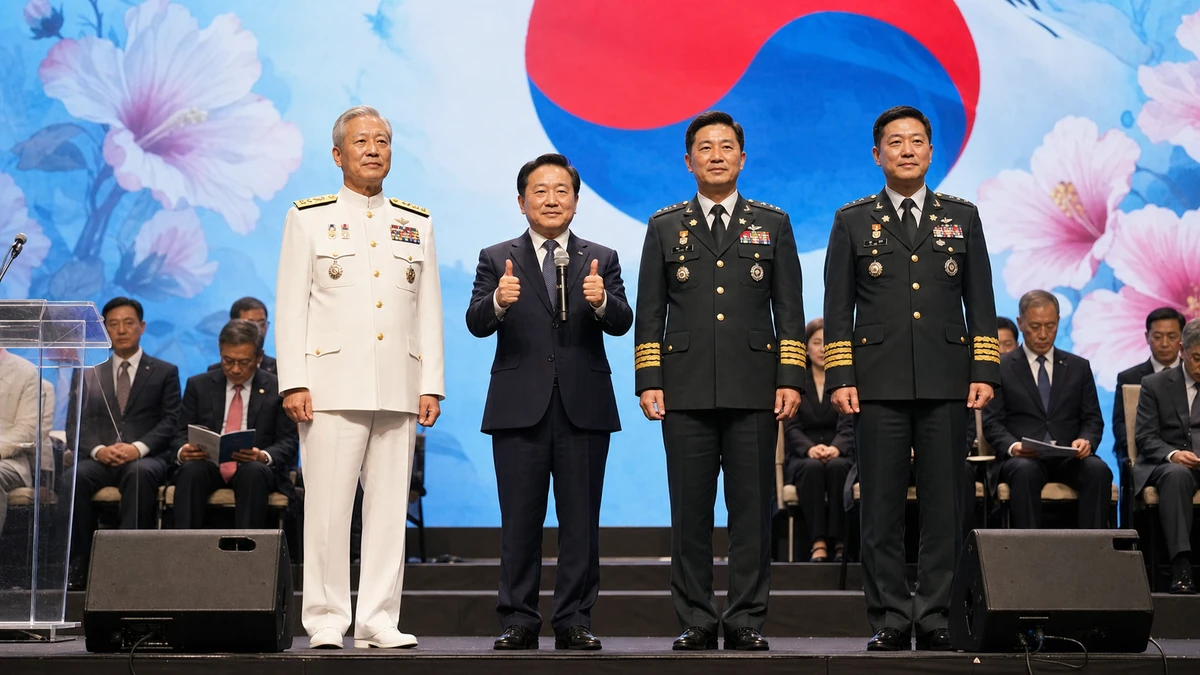
Kim made the remarks Saturday at the Korea-U.S. Friendship Peace Conference at the Grand Hyatt Seoul in the Yongsan district, a part of the capital closely associated with the modern history of the alliance. For American readers, the setting and the language both matter. This was not the announcement of a new treaty, military package or summit deal. It was something more subtle but still significant: a senior South Korean official publicly explaining how Seoul wants the alliance to be understood in 2026.
That may sound abstract, but in diplomacy, language often signals policy direction before detailed policies arrive. Kim, whose office roughly combines some administrative features Americans might associate with a prime minister in a parliamentary system and a senior coordinating official under a strong presidency, is one of the highest-ranking figures in South Korea’s government. When he speaks about the alliance in these terms, it is widely read as a statement of how the administration wants allies, rivals and domestic audiences to interpret South Korea’s place in the world.
For decades, the shorthand description of the U.S.-South Korea alliance has been straightforward: It was forged in war, anchored by mutual defense, and aimed first and foremost at preventing another conflict with North Korea. That remains true. Nearly 28,500 U.S. troops are stationed in South Korea, and the legacy of the 1950-53 Korean War still shapes strategy in Northeast Asia. But Kim’s remarks suggested that Seoul wants to move the conversation beyond that familiar frame.
His formulation reflects a broader trend in South Korean foreign policy. As the country has grown from a war-ravaged aid recipient into one of the world’s largest economies, a major exporter of semiconductors, cars and culture, its leaders have increasingly argued that South Korea should act like a global stakeholder rather than a front-line state concerned only with its own survival. In American terms, Seoul is saying it wants to be seen less as a protected ally and more as a co-manager of international order.
Why the phrase “global pivotal alliance” matters
The central phrase in Kim’s speech was his description of the alliance as evolving into a partnership capable of tackling “global complex crises.” That wording is important precisely because it is broad. He did not lay out a new bilateral initiative with a budget line, legislative timetable or operational blueprint. Instead, he used a phrase that folds together multiple overlapping pressures now confronting both governments: geopolitical rivalry, supply chain instability, security shocks, economic uncertainty and other transnational threats that no longer fit neatly into the old categories of “foreign” and “domestic.”
That kind of language has become common in capitals around the world, but it carries special weight in Seoul. South Korea sits in one of the world’s most heavily militarized neighborhoods, within range of North Korean missiles and under constant pressure to balance its alliance with the United States against its economic interdependence with China. When a South Korean prime minister says the alliance must help address complex global crises, he is effectively arguing that the country’s security can no longer be separated from broader international turbulence.
For an American audience, there is a useful analogy here. In the same way NATO has expanded in public discourse from a Cold War defense pact into a broader political and strategic community, South Korea is attempting to recast its alliance with Washington as more than a regional security arrangement. It is still rooted in deterrence, just as NATO still rests on collective defense, but its political purpose is being described in wider terms.
The word “pivotal” is also revealing. South Korean officials in recent years have used similar language to present their country as a middle power with outsized influence, one capable of connecting regional security concerns with global governance debates. It is a vocabulary of confidence. Implicit in it is the idea that South Korea should not be treated merely as a place where American troops are based, but as a country that helps shape responses to international problems.
That ambition is not simply rhetorical vanity. South Korea is the world’s 13th-largest economy, home to globally recognized brands and critical advanced manufacturing capacity, especially in semiconductors and batteries. It is also a democracy with a sophisticated defense industry and a culture sector whose reach extends from K-pop and Korean dramas to food, beauty and film. In other words, the image many Americans may still carry of South Korea as a narrow security flashpoint is no longer sufficient to explain what the country is or how it sees itself.
A history lesson embedded in the speech
Kim did not present the alliance’s broader role as a break from history. He did the opposite. He framed it as the latest chapter in a relationship with deep roots, citing the 1882 treaty between the United States and Korea, the American role in the Korean War, and the 1953 Mutual Defense Treaty that formally underpins the alliance to this day.
That historical arc is familiar in South Korean official speeches, but it serves a deliberate purpose. By linking present-day diplomacy to older milestones, Kim cast the alliance as something more durable than a temporary strategic convenience. The point was not just that Washington and Seoul have shared interests now; it was that they have built a relationship over generations through diplomacy, war, sacrifice and institution-building.
For readers in the United States, the Korean War portion of that story deserves special attention because it occupies a very different place in public memory in the two countries. In South Korea, the war is not a faded chapter from a textbook. It is a foundational national trauma that shaped the country’s political system, security structure and even its economic development path. Families remain divided by the Demilitarized Zone. Mandatory military service is still a fact of life for most South Korean men. Air raid drills, shelter systems and civil defense planning are not distant abstractions.
In the United States, by contrast, the Korean War is often called the “Forgotten War,” overshadowed by World War II and Vietnam. Yet for South Koreans, the memory of American intervention remains central to the legitimacy of the alliance. That helps explain why references to U.S. service members and allied veterans still feature prominently at diplomatic events. They are not perfunctory nods to the past. They are part of the moral narrative that underwrites the present relationship.
Kim said the alliance had served as an “ironclad” foundation for peace and stability on the peninsula and as a basis for economic prosperity. That pairing of security and prosperity is another theme Americans may miss without context. South Korea’s postwar rise, often described as the “Miracle on the Han River,” did not happen in a vacuum. It unfolded under a security umbrella that let the country industrialize, trade and build state capacity while still facing a heavily armed adversary to the north. In Seoul’s telling, the alliance was not only a military arrangement; it created the conditions for national transformation.
The conference blended diplomacy with remembrance
The event where Kim spoke was not solely a foreign policy forum. It also carried a strong message of remembrance, a feature that can surprise outsiders who are used to separating veterans’ commemorations from strategic discussions. In South Korea, those themes often overlap. The same public memory that honors wartime sacrifice also reinforces contemporary arguments about the value and legitimacy of the alliance.
Seoul Mayor Oh Se-hoon, who also attended the conference, used his remarks to highlight that the city had created a “Garden of Gratitude” to honor countries that fought for South Korea and the veterans who served. More than 160 people, including veterans and bereaved family members, attended the event.
For American readers, it may help to think of this as a mix of Memorial Day remembrance, alliance diplomacy and civic ceremony all rolled into one. The conference did not treat history as a museum artifact. It presented war memory as a living part of public life, one that still shapes how South Korea defines freedom, democracy and international partnership.
That is especially important in the Korean context, where the term “bohun,” often translated as veterans affairs or patriotic remembrance, carries emotional and political resonance. It refers not only to honoring veterans, but to a broader culture of public gratitude toward those who served or sacrificed for the nation. When South Korean leaders invoke veterans at an alliance event, they are signaling that the relationship with the United States rests on blood, memory and values as much as on current defense planning.
This dual message was one of the most notable features of the conference. Kim’s speech positioned the alliance as a tool for addressing future challenges. Oh’s remarks emphasized the need to remember the people whose sacrifices made the alliance possible in the first place. Together, the speeches suggested that South Korea is trying to modernize the meaning of the alliance without severing it from the Korean War generation that still gives it emotional depth.
What Seoul is trying to tell Washington — and the world
Kim’s comments also reflect a careful diplomatic balancing act. South Korea wants Washington to view it as a dependable partner with a wider global role, but it must communicate that ambition without creating the impression that it is neglecting the immediate threat from North Korea. That is why Kim placed “peace and prosperity on the Korean Peninsula” in the same sentence as “global complex crises.” The structure of the message was almost as important as the message itself.
First, it reassured domestic and regional audiences that the alliance remains grounded in deterrence. South Korean officials know that any talk of a more global mission can prompt concerns at home that local security needs are being diluted or subordinated to broader U.S. strategy. Second, it told foreign audiences that Seoul does not see peninsula security as an isolated issue. In a world of supply chain shocks, cyber threats, maritime tensions and intensifying great-power competition, South Korea is arguing that local stability and global order are intertwined.
That matters because South Korea’s role in the international system has changed dramatically. The country has become indispensable in sectors that American policymakers now define as strategic, including advanced chips, batteries, shipbuilding and defense manufacturing. It has also emerged as a major cultural exporter, shaping perceptions of Asia among younger Americans in ways that traditional diplomacy rarely could. When South Korean leaders talk about global responsibility today, they do so from a platform of real economic and soft-power leverage.
Still, Kim’s speech should not be overstated. Based on the information available, he did not announce a new agreement, military posture change or formal policy package. The significance lies in framing. Diplomatic framing is not empty theater, but it is not the same thing as policy execution. The speech is best understood as a political and strategic signal about how the South Korean government wants the alliance to be narrated at home and abroad.
There is also a domestic dimension, even if this was not framed as a partisan intervention. By speaking in continuity-rich, institutionally grounded language, Kim avoided the sharper ideological edges that sometimes define South Korean political debate. He emphasized endurance, responsibility and shared values rather than short-term political conflict. That choice suggests Seoul is trying to present the alliance as a durable national asset, not a tactical issue tied to any one faction or election cycle.
The American takeaway: South Korea wants to be seen differently
For Americans, the most important takeaway may be the simplest one: South Korea wants to be understood not just as a country the United States protects, but as a country that helps the United States shoulder international burdens. That is a meaningful shift in emphasis, even if the alliance’s military core remains unchanged.
To many Americans, South Korea is still most visible in moments of tension — missile launches by North Korea, summit diplomacy, troop discussions or defense cost-sharing disputes. But Seoul increasingly wants its identity in Washington to be broader than crisis management. It wants recognition as a technologically advanced democracy, an economic partner central to future industries, and a collaborator on issues that stretch beyond East Asia.
Kim’s “global pivotal alliance” language captures that aspiration in a compact phrase. It is a way of saying South Korea has moved beyond the posture of a country defined mainly by its vulnerability. It is also a way of reminding Americans that alliances are not static. Just as the U.S.-Japan alliance evolved after World War II and NATO evolved after the Cold War, the U.S.-South Korea alliance is being rhetorically updated for a world where economics, security, technology and democratic resilience increasingly overlap.
Whether that rhetoric becomes a more visible policy agenda will depend on what follows: coordination on supply chains, defense cooperation, diplomatic alignment on regional flashpoints and broader collaboration in international institutions. None of those next steps were formally announced at the conference. But the speech offers a clue about the direction Seoul hopes to travel.
It also serves as a reminder about the emotional foundation of the alliance. Even as South Korean officials talk about the future in terms of global responsibility, they continue to anchor that future in the memory of the Korean War and the sacrifices of veterans. In South Korea, those are not competing narratives. They are mutually reinforcing ones: a wartime alliance that preserved the state, a security framework that made economic growth possible, and a mature partnership now expected to contribute to solving wider global problems.
That layered message is what made Kim’s remarks noteworthy. He was not merely praising the alliance in ceremonial terms. He was trying to redefine its public meaning for a new era — one in which South Korea sees itself as both a front-line ally in Northeast Asia and a consequential actor in the broader international system. For Washington, and for American readers trying to understand where one of the United States’ closest Asian allies is headed, that is the real story.
What to watch next
The immediate significance of Kim’s speech is interpretive, not operational. It tells us more about South Korea’s diplomatic self-image than about any newly enacted policy. Still, that self-image matters. Governments often test arguments in public language before building them into concrete programs. If the phrase “global pivotal alliance” continues to appear in speeches, joint statements and ministry documents, it will be a sign that Seoul is institutionalizing this broader understanding of its partnership with the United States.
Observers should watch for several markers. One is whether future U.S.-South Korea statements continue linking peninsula security to wider global challenges. Another is whether remembrance events tied to the Korean War remain integrated into alliance messaging, reinforcing the moral and historical basis of the relationship. A third is whether South Korea translates this elevated language into more visible action in areas such as strategic industries, multilateral diplomacy and joint responses to cross-border disruptions.
For now, the facts are clear and limited. South Korea’s prime minister, speaking at a friendship and peace conference in Seoul, said the alliance with the United States is evolving beyond peace and prosperity on the Korean Peninsula into a “global pivotal alliance” capable of helping address complex crises around the world. He grounded that message in a long historical narrative stretching from 19th-century diplomacy to wartime sacrifice and the 1953 mutual defense pact. And he delivered it at an event that combined strategic language with explicit gratitude toward veterans and allied nations.
In another era, that might have been treated as ceremonial boilerplate. In 2026, it reads more like a statement of intent. South Korea is telling the world that it no longer wants its alliance with Washington defined only by the possibility of war. It wants it understood as a partnership for managing an increasingly disorderly world.
Comments
Post a Comment