South Korea coach Hong Myung-bo resigns after World Cup exit, opening a painful new chapter for one of Asia’s most visible soccer powers
A resignation that landed like a national reckoning
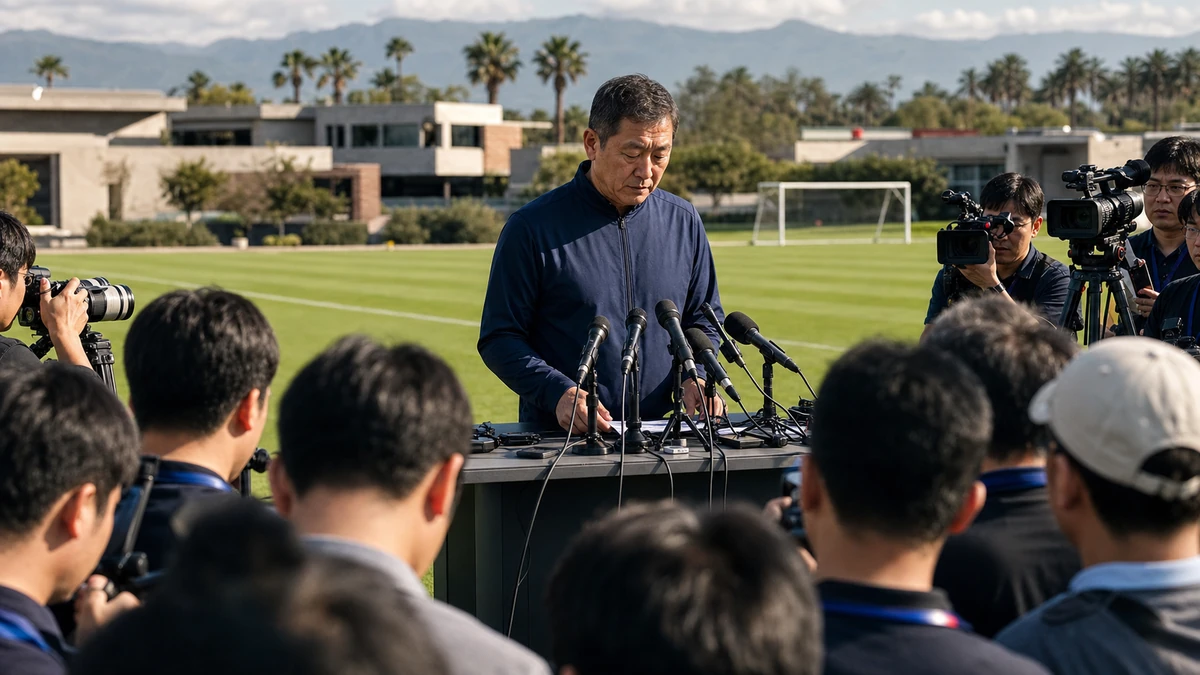
South Korea men’s national soccer coach Hong Myung-bo announced his resignation on the morning after his team failed to advance to the knockout stage of the 2026 FIFA World Cup, accepting responsibility for an exit that is likely to reverberate far beyond the final whistle. Speaking at Chivas Verde Valle, the training base in Zapopan, in the Mexican state of Jalisco, Hong told reporters he would step down after South Korea’s elimination in the tournament’s opening phase.
For many American sports fans, a coach resigning after a disappointing World Cup showing may sound like a familiar post-tournament ritual. But in South Korea, the symbolism is heavier. The national team is not simply another sports franchise. It is one of the country’s most visible international symbols, a team that carries not only competitive hopes but also a broader sense of national ambition, pride and global standing. When South Korea plays in a World Cup, the matches draw the kind of emotional intensity that in the United States might be reserved for the Super Bowl, the Olympics or a high-stakes presidential election night — only compressed into 90 minutes at a time.
Hong’s announcement came one day after South Korea’s failure to reach what Korean reports described as the tournament’s final 32, the first knockout round under the expanded 2026 format. That distinction matters. The World Cup has grown to 48 teams for the tournament hosted across the United States, Mexico and Canada, changing the math of qualification from the group phase and raising public expectations in countries such as South Korea, which has long viewed itself as more than just a participant on the global stage. Simply making the tournament is no longer enough to satisfy a fan base accustomed to seeing the team compete as a serious Asian contender.
At his news conference, Hong apologized to the public and said he would leave the position. In the language of Korean public life, that kind of statement carries weight. Public figures in South Korea, particularly in sports and politics, are often expected to address failure directly and in person. A resignation is not always the end of the debate; in some ways, it is the beginning of a broader national conversation about accountability, leadership and whether the people in charge understood the scale of the responsibility they carried.
That is why the scene in Zapopan felt bigger than a routine personnel change. The coach was not speaking from a federation office in Seoul, nor from a quiet written statement released days later. He stood at the team’s World Cup base camp, the place where South Korea had prepared for the biggest tournament in the sport, and there he announced that the journey was over — not only for this edition of the World Cup, but for his tenure as the man charged with guiding one of Asia’s most scrutinized national teams.
Why South Korea’s World Cup results matter so much at home
To understand why Hong’s resignation hit so hard, it helps to understand what the World Cup means in South Korea. Soccer, known there as football in the global sense, occupies a special place in the country’s modern sporting identity. Baseball is hugely popular, and South Korean athletes have excelled in sports ranging from archery to speed skating. But the men’s national soccer team has a unique role because it is where South Korea most visibly measures itself against the wider world.
No moment captures that better than the 2002 World Cup, co-hosted by South Korea and Japan, when South Korea made a historic run to the semifinals. For American readers, imagine a U.S. men’s national team suddenly storming into the final four on home soil and turning every downtown into a sea of red shirts, waving flags and street celebrations. That tournament became a defining national memory in South Korea, not just because of the wins but because it rewrote assumptions about what Korean teams could do in the most global arena in sports.
Since then, every World Cup has carried some echo of that breakthrough. Even when expectations are more modest, the baseline remains high. South Korea is widely seen as one of Asia’s leading soccer nations, alongside Japan, and its fans expect the team to get out of the opening round more often than not. When it does not, the disappointment is not just about tactics or a missed scoring chance. It feels, to many supporters, like a wasted opportunity to assert Korea’s place in the world.
That sentiment is intensified by the structure of fandom in South Korea. National team support is broad, multigenerational and highly visible. Big tournament matches draw crowds into public plazas, bars and late-night viewing gatherings because of time differences, much the way Americans gather for Thanksgiving football or March Madness. The national team also operates as a rare shared stage in a society otherwise segmented by age, politics, region and class. A World Cup disappointment, then, can feel unusually collective.
So when Hong said he was sorry and would step aside, he was speaking into that emotional landscape. His words were not merely directed at sports reporters. They were aimed at millions of supporters who had invested hope in the team and who, in the Korean view of public responsibility, deserved a direct acknowledgment that the result had fallen short.
Hong Myung-bo’s stature made this fall more dramatic
Hong is not just another coach who happened to be on the sideline during a bad tournament. He is one of the most recognizable figures in South Korean soccer history, a former national team star whose playing career made him part of the country’s sporting memory long before he returned as manager. That matters because his appointment carried a sense of familiarity and trust. He was not an outsider imported for a short-term project. He was, in many ways, a figure from inside the house.
According to the Korean summary of events, Hong was appointed on July 8, 2024, with a term expected to run through the 2027 Asian Cup. Instead, that tenure ended early after the World Cup disappointment. In practical terms, it means a coaching project designed to span multiple tournaments has been cut short by a result severe enough to override long-range planning.
That is common in international soccer, where coaches often live from qualifying window to qualifying window and where a single tournament can erase months of prior progress. Still, the abruptness is striking. Hong had been hired not simply to manage matches but to shape a national team cycle — selection, training, tactics, culture and preparation for Asia’s next major championship. His departure now suggests that the World Cup result was judged not as a temporary stumble but as evidence of a deeper failure.
There is an added layer to this story because Hong reportedly said that while he was giving up the coach’s position, he was not giving up on South Korean soccer itself. That distinction may sound rhetorical, but it speaks to how sports leadership is often framed in Korea. A coach can accept blame for failure while still insisting that his commitment to the broader national project remains sincere. In other words, stepping down is presented not as abandonment, but as an act of responsibility intended to help the program move forward.
It is also a reminder that legendary playing careers do not guarantee immunity when results collapse. American readers have seen versions of this in other sports: beloved former stars return as coaches or managers, carrying public goodwill that can evaporate quickly when the scoreboard turns against them. In South Korea, the emotional swing can be even sharper because respect for past service coexists with relentless scrutiny of present performance. Hero status buys attention, not protection.
The language of apology and accountability in Korean public life
One of the most notable parts of Hong’s resignation was the language he used. He reportedly told the public he was “truly sorry” and made clear that he would take responsibility for the outcome. In American sports, post-loss comments often lean on familiar formulas: the team did not execute, the players fought hard, the group will learn and come back stronger. In South Korea, especially after a major national disappointment, there is often stronger pressure for a leader to state plainly that the responsibility is his.
This does not mean Korean sports culture is uniquely harsh, nor that every resignation is purely voluntary. Public pressure, media criticism and federation politics all play their roles. But there is a distinct expectation that a person in authority should not appear evasive. An apology in that context is both moral and institutional. It is a signal that the leader understands the public nature of the failure.
Hong also reportedly said that over the past two years he had repeatedly asked himself whether each decision was truly for South Korean soccer — when making major calls, selecting players, preparing training and managing matches. That kind of explanation is important because it does something beyond apology. It offers a defense of motive even while conceding failure of result.
That nuance matters in Korea, where public controversies often turn not only on what happened but also on whether the person involved acted in the national interest, the organizational interest or narrow self-interest. By saying his standard was always what would benefit Korean soccer, Hong was effectively asking to be judged as someone whose decisions may have been wrong but whose intentions were not compromised.
He reportedly acknowledged as much, saying he could not claim all of his judgments had been correct. That may prove one of the more durable lines from the news conference. It is a rare formulation in sports, where leaders often defend decisions until the very end. Here, Hong appears to have done something more complicated: reject total self-justification while still arguing for the integrity of his process.
For supporters, that may not soften the pain of elimination. Results are what endure in tournament history. But accountability is part of how trust is rebuilt. In South Korea, where fans can be intensely demanding but also deeply loyal, the path back after failure usually begins with a public recognition that the disappointment was real and that those in charge are not pretending otherwise.
A base camp meant for preparation became the setting for an ending
The location of the resignation amplified its emotional force. Chivas Verde Valle in Zapopan had served as South Korea’s World Cup base camp, the daily workplace where players trained, recovered and prepared for matches. Base camps are usually places of continuity and routine — part hotel, part gym, part tactical laboratory. They are where teams build the habits they hope will carry them through the chaos of a major tournament.
Instead, this one became the backdrop for an exit speech.
That kind of image resonates because sports narratives often turn on place as much as on words. Americans know this instinctively: a locker room podium after a playoff collapse, a dugout farewell after a season-ending loss, a press conference at a training facility after a failed coaching era. The setting can tell the story before the speaker does. In South Korea’s case, the fact that the resignation came at the very site where the World Cup campaign had been built made the moment feel almost ceremonial.
The symbolism is hard to miss. A training ground is supposed to point toward the next game, the next adjustment, the next chance. Here, there was no next match to prepare for. The space built for hope had become the place where responsibility was publicly assigned and a chapter was closed.
There is also something revealing about the geography of this World Cup moment. South Korea’s campaign unfolded in North America, on terrain far from home but still under close watch from fans back in Seoul and beyond. The 2026 tournament, spread across the United States, Canada and Mexico, has made the World Cup feel more physically expansive than ever. Yet the emotional distance between base camp and home nation can shrink instantly in the digital era. A few remarks in Mexico become front-page news in Korea within minutes, dissected on television, replayed on phones and debated across social media.
That is part of what makes the role of a national team coach so precarious. He is operating in one place while answering to millions somewhere else. When the tournament ends early, the return trip home becomes not just a flight but a reckoning.
What this means for South Korean soccer after the World Cup
Hong’s departure leaves South Korea confronting questions that go well beyond the identity of the next coach. The immediate issue, of course, is succession. The Korea Football Association must now decide whether it wants continuity with another domestic figure, a sharp tactical reset with a foreign manager, or a broader overhaul of how the national team is run ahead of the 2027 Asian Cup and future qualifying cycles.
But coaching searches are often proxies for deeper anxieties. The harder question is why a country with South Korea’s resources, player pool and soccer pedigree failed to reach the knockout stage of an expanded World Cup format that, on paper, should have offered more pathways forward. Was the problem tactical conservatism? Player selection? Preparation? An inability to adjust under tournament pressure? Or does the answer lie in a larger structural gap between South Korea’s self-image as a top Asian football nation and its current place in the global hierarchy?
Those debates are likely to dominate Korean sports media in the weeks ahead. South Korea has produced internationally recognized players and has a domestic league with deep roots, but the national team is judged by a far harsher standard than the club game. The team is expected not just to compete respectably but to deliver moments that reassert South Korea’s relevance in elite international soccer.
That is why Hong’s resignation is not likely to end criticism; it will probably redirect it. Attention may soon turn to the federation, to long-term player development, to how coaching appointments are made and to whether the national team’s style reflects the strengths of the current generation. In many countries, a coach’s resignation offers a clean ending. In South Korea, it more often opens an argument about whether the entire system has learned enough.
For overseas readers, this is also a reminder that soccer in Asia cannot be understood through stereotypes about underdogs or emerging markets. South Korea is not a novelty story in global football. It is an established World Cup participant with real history, serious expectations and a fan base that treats failure with the urgency found in major European or Latin American football cultures. The stakes are real, and so is the disappointment when those expectations collapse.
More than one coach’s exit, this is a test of national trust
In the end, Hong’s resignation will be remembered not only as the departure of a coach after a failed World Cup, but as a public test of how a soccer nation absorbs disappointment. His message, as described in Korean reports, balanced apology, responsibility and continued loyalty to the future of South Korean soccer. He accepted that the result was unacceptable. He argued that his decisions were made with the national team’s interests in mind. And he stepped aside before anyone else had to force the issue publicly.
That combination may not satisfy everyone. Sports are not courts of law, and intentions do not erase outcomes. Fans wanted progression, not explanations. They wanted a team that could survive the opening phase of the sport’s biggest tournament and carry South Korea deeper into an event that still serves as one of the country’s most powerful mirrors of international prestige.
Still, there is a reason scenes like this resonate far beyond the score line. When a national coach stands before cameras after elimination and says, in effect, this failure is mine, he is speaking to a broader civic idea: that public trust matters, that representation carries consequences and that leadership is measured most severely when expectations are not met.
For Americans following global soccer, the story offers a useful window into why the World Cup remains more than a sporting event in so many countries. In South Korea, it is part competition, part identity and part emotional referendum on how the nation sees itself against the world. That is why a loss in Mexico can feel like a national mood shift in Seoul. That is why a resignation at a training base can become a major news event. And that is why the next chapter for South Korean soccer will be watched not merely as a coaching change, but as an attempt to restore faith.
Hong said he hoped the national team would again become a side that earns the people’s trust and love. That may be the clearest measure of the challenge ahead. In international soccer, rebuilding after a disappointing tournament is not just about new tactics or a new staff. It is about persuading supporters that the next campaign will once again be worthy of their emotional investment. For South Korea, one of Asia’s most visible football powers, that work starts now.
Comments
Post a Comment