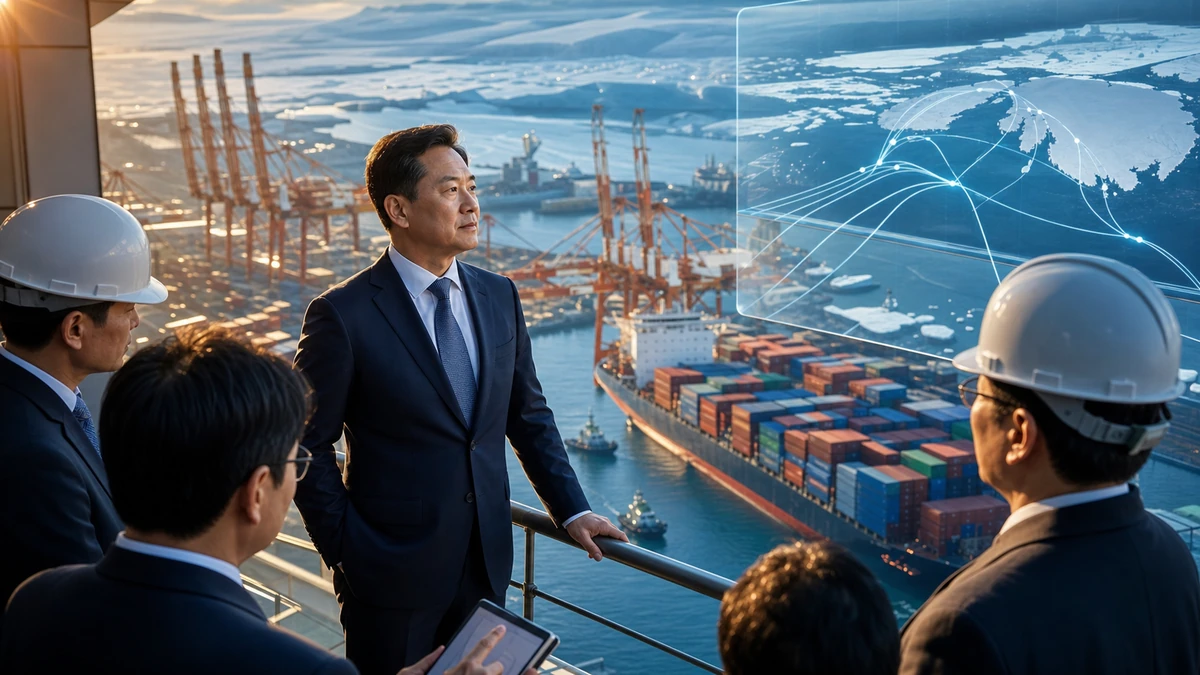
A technocrat’s promotion with larger economic meaning
South Korea’s decision to elevate Nam Jae-heon to vice minister of oceans and fisheries might look, at first glance, like the kind of routine personnel move that rarely draws attention outside government circles. In Seoul, however, the appointment is being read as something more consequential: a signal that the government wants to double down on a long-range maritime strategy built around ports, logistics competitiveness and the possibility of future Arctic shipping lanes.
That matters because South Korea is not just another trading nation. It is one of the world’s most export-dependent industrial economies, a country whose global success in cars, semiconductors, batteries, ships and consumer electronics depends on moving goods quickly and reliably across oceans. In that context, the Ministry of Oceans and Fisheries is not a niche agency. It sits near the center of the country’s economic plumbing, overseeing shipping, ports, fisheries and broader maritime policy.
Nam comes to the vice minister post with a resume that is unusually concentrated in port administration. According to the Korean summary of his career, he graduated from Yonsei University with a degree in civil engineering, entered government service after passing South Korea’s highly competitive technical civil service exam in 1998, and went on to hold a series of senior posts tied to port safety, port policy, regional port development and the management of major port projects. Those roles included work in the ministry’s port bureau, leadership of port policy offices, service as chief of the Busan North Port integrated redevelopment task force, and later director-general of the port bureau.
More recently, under the current administration, Nam served as head of the body charged with advancing policy on Arctic shipping routes, a project the government has treated as a major national agenda item rather than a one-off research exercise. That detail helps explain why his promotion is drawing notice. His career links three policy threads South Korea increasingly sees as connected: port infrastructure, national logistics strategy and the search for new maritime routes that could reshape regional competition over time.
For American readers, the comparison might be a senior U.S. transportation or port official suddenly becoming important not because of Washington staffing drama, but because that official had become associated with a potentially transformative trade corridor. The person matters because the route matters, and the route matters because supply chains have become a front-page economic and geopolitical issue. That is the frame in which Nam’s appointment is being interpreted.
Why Arctic shipping has become part of South Korea’s conversation
The Arctic shipping route, broadly speaking, refers to sea lanes that pass through Arctic waters. For years, the idea has hovered between strategic possibility and practical uncertainty. It attracts attention because, in theory, Arctic passages could alter travel patterns between Asia and Europe and create new options for commercial shipping. Even when those routes are not yet fully mainstream, governments and shipping interests study them closely because logistics networks are shaped years, sometimes decades, before they become visible to ordinary consumers.
South Korea’s interest in the Arctic route reflects this longer horizon. The route is not important simply as a line on a map. It is being considered as part of a larger question: if global trade corridors shift, which ports will benefit, which shipping industries will adapt fastest, and which countries will be best positioned to capture the next wave of maritime business?
That helps explain why the Korean government created an organizational structure with a designated official responsible for advancing the Arctic route agenda. Nam, as head of that effort, was not handling an abstract white paper. The government appears to have treated the issue as a policy project requiring institutional ownership, coordination and accountability. That is often how governments signal seriousness about a long-term initiative even before the financial returns are clear.
The summary of the Korean reporting says a trial voyage linked to the Arctic shipping route is scheduled for August of this year. Even without overstating what that means, the symbolism is clear. It suggests South Korea’s Arctic strategy is moving, at least in part, from concept and planning into a stage of practical testing. In policy terms, that is an important transition. Many ambitious infrastructure and logistics ideas remain trapped in the research phase. A trial run does not prove commercial success, but it does indicate the government wants to start evaluating how such a route might work in real operational settings.
For an American audience, it may help to think of this the way policymakers in the United States think about emerging freight corridors, ports modernization, or new energy transport systems. The strategic question is not just whether a route exists. It is whether public officials, port operators and private companies can prepare early enough to benefit if that route becomes economically meaningful.
South Korea is especially sensitive to that kind of question because it sits at the edge of some of the world’s busiest shipping lanes while lacking the large domestic market that lets bigger economies absorb shocks more easily. Its companies compete globally, but their advantage depends not just on making products well. It also depends on getting those products to market predictably, at competitive cost and with resilience against disruption. In the era after pandemic supply shocks, that concern is hardly unique to Korea. But in Korea, it is especially acute.
A career built around the machinery of ports
Nam’s career trajectory is central to why this appointment is being watched. In many governments, officials rise through broad administrative pathways and rotate across unrelated departments. Nam’s path appears more specialized. He built his reputation in the port sector itself, moving through jobs tied to technical safety, policy design, regional development and high-profile port management.
That kind of background matters because maritime logistics is not just about ships coming and going. It is an ecosystem. Ports have to operate safely. They need land-side connections, surrounding industrial development and regulatory coordination. They must fit into national strategies for exports, regional growth and industrial competitiveness. A shipping route on its own does not transform an economy unless the supporting infrastructure, governance and commercial networks are in place.
From that perspective, a vice minister with long experience in port administration may be particularly suited to an agenda like Arctic route development. The policy challenge is not limited to navigation. It includes how ports position themselves, how regional hubs are developed, how government agencies coordinate, and how long-term infrastructure planning lines up with national trade priorities.
The Korean summary also says Nam is viewed inside and outside the ministry as a forceful official with strong drive. Such descriptions are common in profiles of senior bureaucrats, but here they carry specific relevance. A project like Arctic shipping requires more than technical knowledge. It also demands bureaucratic endurance. Multiple agencies, local governments, port interests and long-term planning bodies can be involved. Keeping momentum behind a policy that may not deliver immediate results is often as much about administrative discipline as visionary rhetoric.
For U.S. readers, the word “bureaucrat” can carry a negative connotation, suggesting caution or inertia. In South Korea, as in several East Asian states, elite career officials often play a more visibly strategic role in industrial and infrastructure policy. A “technocrat” in this setting can mean someone who has spent decades learning how a system works and who is trusted to carry national priorities through layers of planning and execution. Nam’s appointment fits that pattern.
His engineering training also reinforces the image of a technical administrator rather than a purely political appointee. That does not guarantee policy success, of course. But it helps explain why his rise can be interpreted as a vote for implementation capacity and continuity, especially in a ministry where physical infrastructure and regulatory planning intersect every day.
Busan, regional development and the idea of a southern maritime hub
One revealing part of Nam’s background is his service leading the integrated development push for Busan North Port. For outsiders, Busan deserves a brief introduction. It is South Korea’s largest port city and one of the country’s most important gateways to global trade, often compared in broad economic significance to how major American port complexes anchor regional commerce and industry. If Seoul is the political and financial capital, Busan is one of the clearest symbols of South Korea’s maritime identity.
North Port in Busan has long carried significance beyond cargo handling alone. Port redevelopment in cities like Busan is often about more than efficiency at the docks. It can also involve urban transformation, waterfront planning, regional economic strategy and the effort to reconnect cities to industrial spaces that had once been walled off by logistics uses. In that sense, managing such a project requires a broader set of skills than traditional harbor administration.
The Korean summary says Nam has also been involved in advancing a plan to foster what is described as a “southern maritime capital.” That phrase may sound unfamiliar to English-language readers, but the underlying idea is not hard to recognize. It refers to a policy vision of strengthening the southern region of South Korea, centered on maritime industries and port functions, as a major national growth hub.
In American terms, one could think of it as a regional development strategy built around a logistics and industrial cluster. The concept suggests that South Korea does not view ports simply as isolated transport nodes. Instead, it sees them as engines of regional economic ecosystems, capable of supporting shipping, manufacturing, services, urban redevelopment and international trade all at once.
That link between Arctic shipping and southern maritime development is especially important. If South Korea is exploring new shipping routes, it also has to consider which domestic ports and regions would serve as the operational and economic beneficiaries of those routes. The Arctic discussion, then, is not just about foreign waters. It is also about domestic geography: where investment goes, how port competition evolves and which Korean cities become more central to future logistics networks.
This is one reason Nam’s promotion stands out. His career appears to connect the physical realities of port management with the broader strategic ambition of repositioning South Korea in changing maritime networks. That combination may prove politically useful for a government trying to present Arctic shipping not as a speculative dream, but as part of a grounded, infrastructure-based economic plan.
Policy continuity as an economic signal
In business and trade, continuity can be as important as speed. Companies that invest in ships, ports, terminals, warehousing and logistics software do not make decisions based on a single announcement. They watch whether governments sustain priorities over time, assign clear responsibility and keep experienced officials in place long enough to move projects forward.
That is one of the biggest takeaways from Nam’s appointment. Because he has already served as the official in charge of promoting the Arctic route agenda, his move into the vice minister role can be read as a sign that the government wants to preserve momentum rather than reset the issue under new leadership. In other words, the same policy stream now has a senior official at an even higher level who already understands its rationale and internal history.
That does not mean the economic benefits are settled. The Korean summary is careful on that point, and so should any responsible reporting. There is no verified estimate in the source material of what companies would gain, how much shipping costs might fall, or when exactly Arctic operations could become commercially transformative. Those are questions for future policy announcements, operating results and market developments.
What can be said now is narrower but still significant: South Korea appears to be reinforcing institutional continuity around a strategic maritime initiative. For markets and industry, that kind of continuity can create confidence that a policy will not disappear with the next staffing shuffle.
This is especially important for a project with long lead times. A country can spend years studying routes, building internal expertise, coordinating among ministries and testing operations before any broad economic payoff materializes. When the official most closely associated with that effort is promoted rather than sidelined, it sends a message that the initiative remains alive inside government.
In that sense, Nam’s appointment tells us something about how South Korea wants to be seen. It wants to project seriousness about logistics strategy. It wants to show that port competitiveness remains a core concern. And it wants to suggest that the Arctic route, however uncertain its eventual scale, is important enough to be linked directly to senior ministry leadership.
Why this matters beyond South Korea
For readers in the United States and elsewhere, a vice ministerial appointment in Seoul may seem remote. But the underlying issue is part of a much larger story about how countries are adapting to a world of more fragile supply chains, sharper strategic competition and mounting pressure to secure trade routes.
Over the past several years, Americans have seen how easily shipping bottlenecks can spill into everyday life, from higher prices on store shelves to shortages of critical components. Ports that once felt like background infrastructure suddenly became topics of national conversation. South Korea lives with that reality all the time. Its economy is deeply tied to the movement of goods, and its government has strong incentives to anticipate rather than merely react to changes in global transport patterns.
If South Korea succeeds in strengthening its ports and aligning them with future shipping options, the effects could extend beyond its own exporters. Northeast Asian logistics networks are tightly connected. Shifts in routing, port investment and maritime policy in one country can affect competitive dynamics in others. The Arctic route discussion, meanwhile, touches on broader debates about the future shape of global trade corridors.
None of that means a dramatic transformation is imminent. The prudent reading is more measured. South Korea is placing an experienced port official in a senior role at a time when it is trying to connect maritime infrastructure, regional development and new shipping possibilities into a coherent strategy. That by itself is notable.
It also reflects something broader about the Korean model of economic governance. Major strategic sectors are often advanced through ministries staffed by highly specialized officials who spend years mastering a policy domain. To outsiders, that can look technocratic. To supporters, it is a practical way to keep long-term national projects on track in a country where trade competitiveness is inseparable from state capacity.
Nam’s new role does not guarantee the success of Arctic shipping, nor does it resolve the many operational and commercial questions that surround such a route. But his appointment helps clarify where the South Korean government is placing its emphasis: on ports as strategic assets, on maritime logistics as a pillar of national competitiveness, and on policy continuity as a way to convert ambitious planning into real-world execution.
That is why this personnel move has drawn attention. It is not simply about who occupies the No. 2 slot at a ministry. It is about what South Korea’s leadership appears to believe the next chapter of maritime competition may look like — and who it trusts to help write it.
The next test comes in execution
The real measure of this appointment will not be the biography itself, impressive as it is within the Korean administrative system. It will be whether the government can translate experience into results. The upcoming trial voyage tied to the Arctic route will be watched as one indicator of whether policy planning is becoming operational learning. Future announcements on ports, regional maritime development and shipping coordination will offer further clues.
For now, the clearest conclusion is that South Korea is treating maritime strategy as an integrated national issue rather than a collection of separate policy silos. Ports, shipping lanes, regional development and export logistics are being framed as parts of the same puzzle. Nam’s career, built across those overlapping areas, makes him a logical face for that approach.
In the United States, appointments tied to infrastructure or trade often become politically polarized or disappear into bureaucratic obscurity. South Korea’s move is a reminder that in export-driven economies, maritime administration can be a front-line economic story. The official chosen to oversee ports and shipping policy may not become a household name, but the system that official manages has a direct bearing on industrial resilience, business confidence and international competitiveness.
That is ultimately what makes Nam’s promotion worth watching from abroad. It offers a window into how a key U.S. ally is thinking about the future of trade: not just through diplomacy or factory output, but through the less glamorous, deeply consequential world of ports, sea lanes and logistics strategy. If the Arctic route remains uncertain, South Korea’s intent is not. It wants to be prepared for a world in which maritime connectivity once again reshapes economic advantage.
Comments
Post a Comment