South Korea Issues Japanese Encephalitis Warning, Urging Residents to Treat Mosquito Prevention as a Summer Routine
A seasonal health alert with global echoes
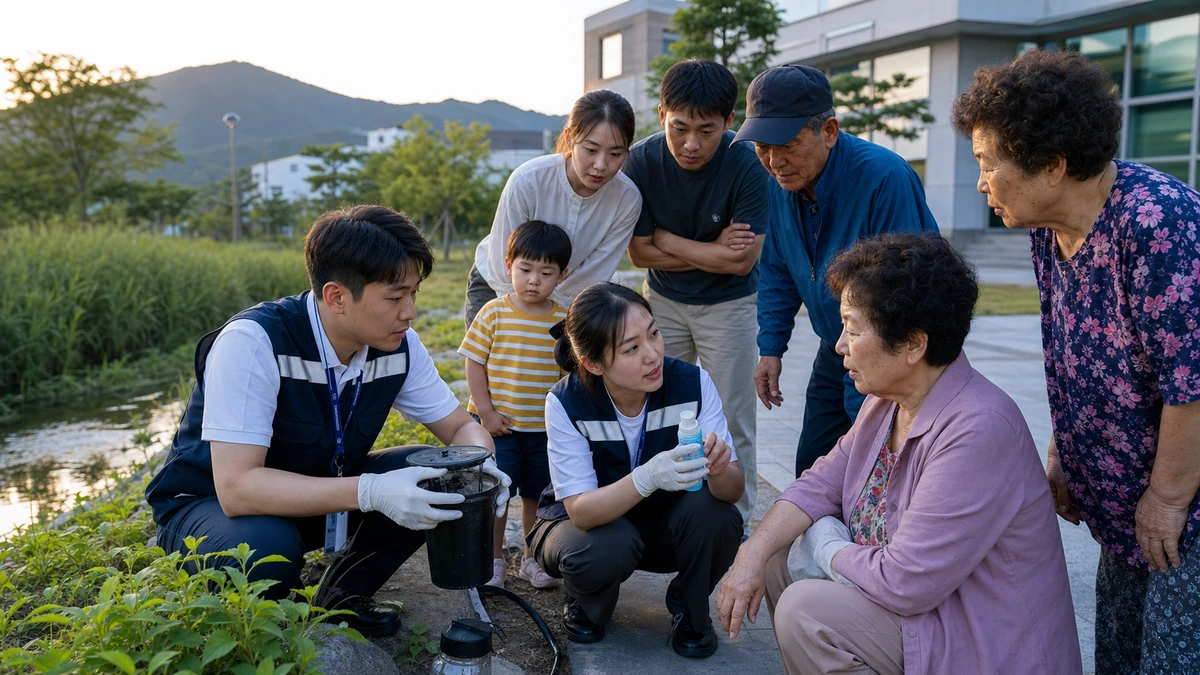
South Korean health officials are urging residents to take mosquito avoidance seriously after the country’s disease control agency issued a nationwide warning over Japanese encephalitis, a mosquito-borne viral disease that returns as a public health concern each summer. In the latest local response, the public health center in Ulju, a county within the southeastern industrial hub of Ulsan, called on residents this week to follow basic prevention measures, including limiting outdoor activity at night and wearing long, light-colored clothing when going outside.
The advisory followed a national alert issued July 17 by the Korea Disease Control and Prevention Agency, or KDCA, after genetic material from the Japanese encephalitis virus was detected in mosquitoes collected in the city of Daegu. Four days later, on July 21, the Ulju County Health Center translated that broader warning into the kind of practical guidance people can use in everyday life: avoid mosquito bites, pay attention to symptoms, and be especially cautious during the months when mosquitoes are most active.
For American readers, the closest comparison may be the way U.S. public health officials issue regional warnings about West Nile virus, Eastern equine encephalitis or other mosquito-borne illnesses in the summer. Those alerts often do not mean a major outbreak is underway, but they do signal that health authorities have detected a risk that warrants extra vigilance. South Korea’s current message fits that pattern. The emphasis is not on panic. It is on routine prevention.
The name “Japanese encephalitis” can also be misleading to English-speaking audiences unfamiliar with the disease. Despite the name, this is not a problem confined to Japan, nor is it a sign of a geopolitical or country-of-origin issue. It is a viral infection found in parts of Asia and spread through mosquito bites. In Korea, it is a recurring summer health topic because the environmental conditions that support mosquito activity are predictable, and public health agencies monitor them closely.
That makes the warning from Ulju more than a local bulletin. It is a window into how South Korea handles seasonal infectious disease risk: the national government conducts surveillance and sounds the alarm, then local health offices turn that alarm into concrete steps for families, outdoor workers, farmers, hikers, campers and anyone else likely to be outside after dark.
What officials know, and what prompted the alert
According to South Korean health authorities, the national warning was issued after mosquitoes collected in Daegu tested positive for genetic material linked to the Japanese encephalitis virus. That finding did not necessarily mean large numbers of human cases were imminent. But in public health terms, it was enough to justify a higher level of alert, especially during peak mosquito season.
Daegu is an inland city in southeastern South Korea, while Ulju is part of Ulsan, a major industrial city on the southeast coast known to many foreigners more for shipbuilding, automobiles and heavy industry than for public health headlines. But local geography matters less than the broader seasonal pattern. Once the virus is detected in mosquitoes, health authorities use the moment to remind the public that risk exposure is often shaped by ordinary habits: when people go outside, how much skin they expose, whether they use repellents and how quickly they respond to symptoms.
That approach reflects the structure of South Korea’s health system. The KDCA, which functions as the country’s top infectious disease management agency, plays a role similar in some ways to the U.S. Centers for Disease Control and Prevention. It monitors disease trends, collects surveillance data and issues national alerts. Local health centers, such as the one in Ulju, act more like county or municipal health departments in the United States, delivering guidance in a form residents can act on immediately.
In practical terms, that means a national detection in one area can quickly become a national prevention message. That may seem broad, but it is consistent with how mosquito-borne disease works. Mosquito populations shift with weather, standing water, temperature and travel patterns. By the time human cases emerge, the opportunity for early prevention may already be narrowing. Public health officials therefore often prefer to warn early rather than wait for a larger problem to unfold.
South Korea’s alert also highlights something epidemiologists have long stressed: the most important moment in many mosquito-borne illnesses is before infection, not after. Once a person is bitten by an infected mosquito, options narrow to symptom monitoring and supportive medical care. Before that happens, however, small choices can reduce exposure in meaningful ways.
Why the focus is on prevention, not fear
Ulju health officials said early symptoms of infection can include fever, headache and vomiting. Those are common, nonspecific symptoms that can resemble a summer cold, dehydration, food-related illness or any number of mild infections. That overlap is part of what makes public communication so important. Health officials are not telling people to assume every fever is Japanese encephalitis. They are reminding residents not to dismiss changes in their condition if they have recently been exposed to mosquitoes.
Officials also noted that in rare cases, the illness can progress to encephalitis, or inflammation of the brain, bringing more severe symptoms such as high fever, seizures and convulsions. That possibility is what gives the disease its gravity, even if most mosquito bites do not lead to serious illness. In public health messaging, this is a familiar balancing act: explain the worst-case scenario honestly without overstating the likelihood of it occurring in any one individual.
That balance may sound especially familiar to Americans who have followed warnings around West Nile virus. Most people exposed to mosquito-borne viruses never develop severe neurological disease. But because the consequences can be serious in a smaller number of cases, public health agencies keep returning to the same advice year after year: avoid bites in the first place.
South Korean officials appear to be making exactly that point. Their guidance is oriented toward prevention before symptoms arise, not merely toward medical response after someone gets sick. That is an important distinction. Public health alerts often gain the most traction when they move out of the realm of abstract disease names and into the everyday choices people make around clothing, timing and outdoor behavior.
There is also a cultural dimension here worth noting for readers outside Korea. In South Korea, local health offices regularly issue highly practical, behavior-based advisories that are woven into daily life, particularly during summer and monsoon season. These messages often reach people not just through news stories, but through municipal websites, public notices and neighborhood-level communication. The result is a style of public health messaging that tends to be specific, repetitive and action-oriented.
The key advice: watch the clock, cover the skin
The Ulju County Health Center’s recommendations are straightforward. From April through October, when mosquitoes are most active, residents are advised to avoid outdoor activities from just after sunset until before sunrise whenever possible. If going outside is unavoidable, officials recommend wearing long sleeves and long pants, preferably in light colors.
This may sound almost old-fashioned in an era of high-tech surveillance and genomic detection, but that simplicity is part of the point. In many mosquito-borne illnesses, the most effective interventions available to individuals are still the most basic ones. Time of day matters because mosquitoes are often more active during evening and nighttime hours. Clothing matters because skin exposure directly affects the chance of being bitten. Even color can be factored into risk-reduction guidance, as light-colored clothing is commonly recommended in summer mosquito advisories because it is more practical in heat and is often perceived as less attractive to biting insects than darker shades, though the exact effect can vary.
For people in South Korea, this advice fits neatly into summer routines that already include evening walks, late-night outdoor meals, camping trips, farm work and neighborhood exercise. For American readers, the comparable habits might be backyard barbecues, Little League games that run past dusk, evening jogs, lakeside camping trips or gardening after work. The public health logic is the same on either side of the Pacific: the season encourages people outdoors at precisely the time insects are most active.
Ulju’s message is particularly relevant in a county that includes both urbanizing areas and more rural landscapes. Agricultural work, outdoor labor and leisure travel all shape mosquito exposure. In that sense, the guidance is not targeted only at people who think of themselves as being “in nature.” Mosquito risk is often much closer to home: in residential neighborhoods, near vegetation, around standing water and anywhere warm weather supports breeding.
The advice also reflects a broader truth that health experts often struggle to communicate effectively: prevention does not have to be dramatic to be important. A bottle of water, sunscreen and bug precautions belong in the same mental checklist for summer. South Korean officials are essentially asking residents to build mosquito awareness into ordinary seasonal planning, rather than treat it as an extraordinary emergency.
How a local Korean health office fits into a larger system
To readers unfamiliar with South Korea’s local government structure, Ulju County may need a bit of explanation. Ulju is a county-level district within Ulsan, a major metropolitan city in the country’s southeast. Ulsan is perhaps best known internationally for its industrial economy, including Hyundai’s auto manufacturing presence and large shipbuilding operations nearby. But like counties and municipalities in the United States, it also has local health offices responsible for disease prevention, health education and community outreach.
Those local health centers are a crucial link in the chain between national policy and personal behavior. The KDCA can issue alerts based on scientific monitoring, but county and city-level authorities are often the institutions that translate those alerts into clear messages people can use. In the United States, this would be similar to the CDC flagging a seasonal vector-borne risk and local health departments then advising residents when to avoid mosquitoes, what symptoms to watch for and how to modify outdoor habits.
That distinction matters because infectious disease control is not only about laboratories and hospitals. It is also about communication. If residents hear that a virus has been found in mosquitoes but do not know what to do differently, a warning loses much of its value. Ulju’s guidance shows the next step in the process: putting risk into plain language and linking it to practical actions.
It also demonstrates how South Korea’s public health culture often works at the community level. In many cases, the goal of local advisories is not to introduce completely new information, but to reinforce seasonal habits. That is especially true for mosquito-borne diseases, where the preventive playbook changes little from year to year even when the surveillance data do.
Seen in that light, the Ulju announcement is not just reactive. It is part of a recurring summer rhythm in Korean public health, similar to how American audiences might expect reminders about heat stroke during a July heat wave, hurricane readiness in late summer or flu shots in the fall. The timing itself carries a message: this is the season to be alert.
What American readers should understand about Japanese encephalitis
For many Americans, Japanese encephalitis is not a household term. Diseases such as Lyme, West Nile and dengue tend to have greater name recognition, depending on the region. But Japanese encephalitis is a well-known mosquito-borne viral disease across parts of Asia, and its public health significance lies not in how often it appears in daily conversation, but in the severity it can cause in a smaller number of cases.
The most important takeaway is that this is not a disease spread casually from person to person in ordinary social contact. It is associated with mosquito exposure. That means people do not need to react to headlines with the kind of social anxiety that often accompanies respiratory illness. Instead, the concern is environmental and behavioral: where mosquitoes are active, when they bite and how effectively people protect themselves.
The disease’s name can be confusing for readers who instinctively associate it with one country. In reality, the term reflects medical naming history more than current geopolitical boundaries. South Korea, like other countries in the region, monitors it as a seasonal vector-borne illness. So while the headline may sound exotic or distant to U.S. audiences, the public health mechanics are familiar. Mosquitoes carry viruses. Health agencies monitor insect populations. Warnings go out when evidence of circulation appears. Residents are told to reduce exposure.
That framework is increasingly easy for global audiences to understand because mosquito-borne disease is no longer perceived as a narrow tropical issue. In recent years, climate patterns, travel and changes in habitat have made vector control a wider international concern. Even if Japanese encephalitis itself is not common in the continental United States, the logic of the warning is readily recognizable to anyone who has seen local advisories about avoiding standing water, using insect repellent or staying cautious at dusk.
What also stands out in the Korean response is the refusal to sensationalize. Officials are not framing the alert as a crisis of identity, nationality or blame. They are framing it as a manageable seasonal health issue. That may be one reason such guidance remains practical and credible: it focuses less on alarmist language and more on what individuals can actually do that same day.
A reminder that summer health news is often about everyday habits
At its core, the Ulju health center’s announcement is less about a dramatic new development than about renewing attention to a familiar seasonal threat. The virus name may sound intimidating, and the possibility of severe neurological illness is undeniably serious. But the day-to-day message from health officials is grounded in ordinary actions: know when mosquitoes are active, reduce time outdoors at night if you can, dress to cover exposed skin and do not shrug off symptoms if you have been bitten and start feeling unwell.
That kind of advice can sometimes seem too simple to merit a headline. Yet simplicity is often what makes public health useful. Telling people to change a routine is hard. Telling them exactly how to do it is more effective. The Ulju notice does the latter, translating a national disease warning into choices that can be made before an evening walk, a camping trip, a shift of farm work or an outdoor gathering.
It also offers a reminder relevant far beyond South Korea: summer disease prevention often succeeds or fails in ordinary moments. Not in the hospital, but on the porch. Not in a policy paper, but in the decision to head out after sunset in shorts and a T-shirt, or to take a few extra precautions.
For English-speaking readers looking at this story from abroad, the broader lesson is clear. Public health alerts do not always ask for sweeping disruption. Sometimes they ask for modest, repeatable habits that lower risk over time. South Korea’s latest warning over Japanese encephalitis falls squarely into that category.
And that may be why this local Korean health story resonates beyond its immediate geography. Whether the concern is Japanese encephalitis in South Korea, West Nile virus in the United States or another mosquito-borne illness elsewhere, the public health fundamentals are strikingly similar. Summer brings people outside. Mosquitoes follow their own seasonal rhythms. Health agencies track the threat. And communities are reminded, once again, that prevention begins long before anyone feels sick.
Comments
Post a Comment