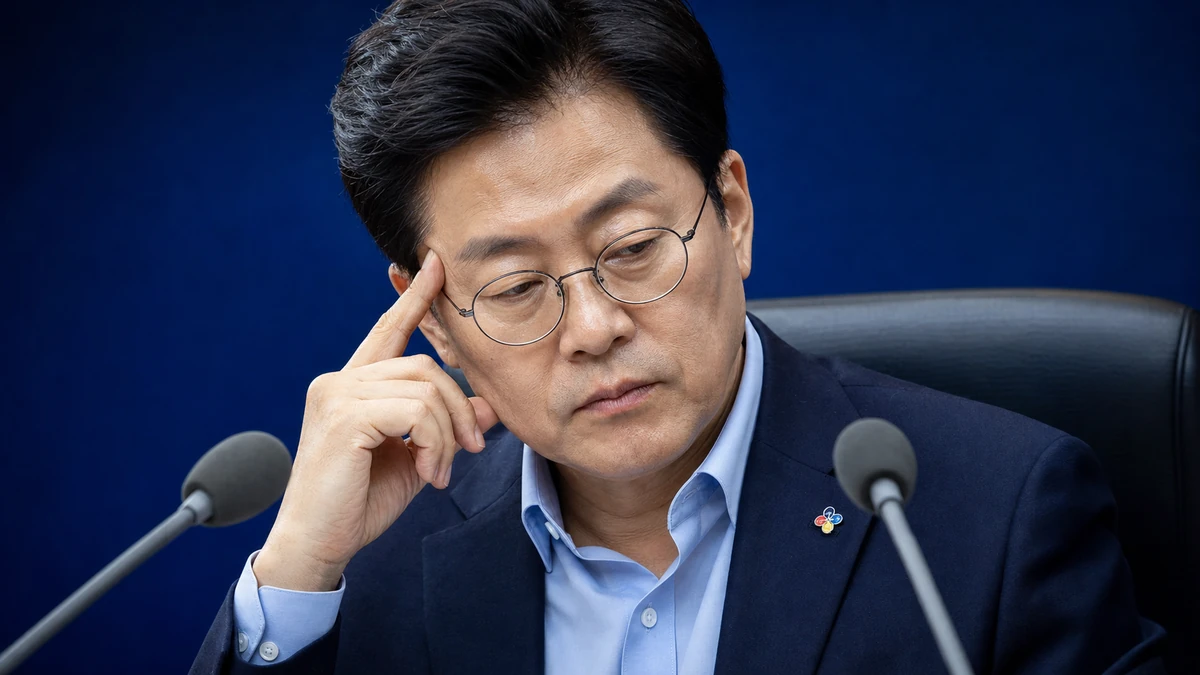
South Korea takes its AI message to a global stage
South Korea used one of the world’s most prominent economic gatherings this week to make a broader argument about artificial intelligence: Winning the next technology race will matter, but so will deciding who benefits from it.
Speaking at the annual Summer Davos forum in Dalian, China, Prime Minister Kim Min-seok outlined an ambitious vision for South Korea’s place in the AI era. In remarks delivered during a special session at the World Economic Forum’s summer meeting, Kim said South Korea should aim as high as possible in what he described as “physical AI” — the branch of artificial intelligence tied not just to software and chatbots, but to machines, factory systems, vehicles, robotics and other real-world devices.
His language stopped short of announcing a formal new national plan. Kim framed the idea conditionally, saying that if South Korea were to set a bold target, he would want it to aim for the top tier globally. But even without a detailed policy rollout, the message carried weight. It suggested that in Seoul, AI is no longer being treated simply as a matter for tech executives or industry ministries. It is becoming a question of national strategy, social policy and political philosophy all at once.
That matters beyond the Korean Peninsula. South Korea is not a speculative player in the global tech economy. It is a manufacturing heavyweight, home to some of the world’s most important semiconductor producers and electronics firms, and a country whose export-driven economy has long depended on staying ahead in advanced industry. When a South Korean prime minister talks about linking AI competitiveness to the distribution of wealth, it offers an early glimpse of a debate many other countries — including the United States — are likely to face more directly in the years ahead.
For American readers, the easiest comparison may be this: Imagine a U.S. administration official standing at the World Economic Forum and saying, in the same breath, that America wants to dominate the next generation of industrial AI while also openly wrestling with whether some of the gains from that technology might eventually support a universal basic income. That is roughly the lane South Korea is entering.
What “physical AI” means in the Korean context
The phrase “physical AI” can sound like the kind of broad, buzzy term that often follows emerging technologies. But in South Korea’s case, it carries a more concrete meaning.
Physical AI generally refers to artificial intelligence embedded in the real economy — in robots, autonomous systems, logistics networks, manufacturing lines, heavy equipment and mobility platforms. It is AI that does not stay on a screen. It interacts with warehouses, ports, assembly plants, delivery systems and transportation infrastructure. If generative AI is often associated with writing, coding and search, physical AI is more closely tied to factories, industrial hardware and the movement of goods and people.
That distinction is especially important in South Korea. The country has built much of its economic strength through advanced manufacturing, from semiconductors and consumer electronics to shipbuilding, autos and batteries. In the United States, conversations about AI can sometimes lean heavily toward Silicon Valley software or white-collar automation. In South Korea, the political and economic discussion is likely to look somewhat different because the country already sits atop a dense industrial base where AI could reshape production in visible, immediate ways.
That is why Kim’s comments resonate beyond rhetoric. South Korea has the ingredients that could make physical AI more than an aspirational slogan: a high-tech manufacturing sector, strong engineering capacity, global electronics champions and a national habit of viewing industrial policy as a legitimate tool of statecraft. In Washington, industrial policy has re-entered the mainstream through measures such as the CHIPS and Science Act and clean-energy incentives. In Seoul, state-guided economic strategy has a much longer history.
So when Kim talks about aiming for leadership in physical AI, the message is not merely that South Korea wants to keep up with the latest tech trend. It is that the country sees AI as a way to extend its influence in the sectors where it already has structural advantages. That includes the semiconductor supply chain, which remains one of the most geopolitically sensitive and economically consequential pieces of the modern global economy.
Even so, Kim did not present a finalized blueprint. His remarks appeared meant to establish direction rather than declare implementation. That nuance is important. South Korean officials are signaling ambition, not yet spelling out a fixed architecture for how that ambition will be funded, regulated or measured.
From industrial strategy to social contract
The most striking part of Kim’s remarks was not the desire to compete. It was his decision to connect AI competition with the problem of inequality.
Responding to questions about the social divide that AI could widen, Kim pointed to the large profits earned by South Korean semiconductor companies compared with the past. He then raised what may become one of the defining policy questions of the decade: How should the wealth generated by AI-intensive industries be distributed?
That is a politically significant shift in framing. In many countries, technology policy is still discussed as a growth story — more innovation, more productivity, more investment, more exports. Kim did not reject that logic. But he suggested it is incomplete. If AI creates major new wealth while also intensifying labor disruption, income concentration or regional inequality, governments will not be able to treat distribution as an afterthought.
That line of thinking is hardly unique to South Korea, but hearing it voiced so directly by a prime minister at an international forum is notable. It signals that Seoul may be trying to position itself not only as a fast adopter of AI, but also as a country willing to confront the downstream social consequences in public.
For U.S. audiences, this debate will sound familiar. America has spent years arguing over whether the gains from globalization and digital technology have been shared fairly. The same questions are now emerging around AI: If a small number of firms capture outsized returns while entire categories of work are transformed or diminished, what obligations do states have to cushion the transition? Should tax systems change? Should worker retraining be enough? Should society think more radically about public dividends from technological wealth?
South Korea has its own reasons to take those questions seriously. It is a highly advanced economy, but also a society with deep anxieties over housing costs, youth employment, demographic decline and economic polarization. The country’s intense education culture and competitive labor market have delivered growth, but they have also produced persistent pressure on younger generations. In that environment, AI is not just another industry. It is a force that could amplify both opportunity and insecurity.
Kim’s remarks suggest the South Korean government understands that any long-term AI strategy will have to answer not only how to create wealth, but how to maintain social legitimacy while doing so.
Why basic income entered the conversation
Perhaps the most attention-grabbing element of Kim’s comments was his mention of basic income as one possible idea under consideration in thinking about AI-driven wealth.
He did not present universal basic income as settled policy. He offered no timeline, no financing model, no target population and no legislative roadmap. By his own description, it remains an idea under examination rather than a government decision. That distinction matters, especially in a policy space where speculative comments can quickly be misread as formal commitments.
Still, the fact that a sitting South Korean prime minister floated the concept at all is telling. It reflects how the boundary between technology policy and welfare policy is starting to blur. If AI meaningfully increases productivity and profits, governments may eventually face pressure to create mechanisms that return some of those gains to the public — particularly if employment becomes more precarious in the process.
Basic income has circulated in political debate in various forms around the world for years. In the United States, it moved from academic circles into mainstream conversation through pilot programs, Andrew Yang’s 2020 presidential campaign and wider concerns about automation. In South Korea, the idea has also surfaced before, often in connection with regional experiments and debates about social safety nets. But attaching it explicitly to AI-generated wealth gives it a new political frame.
That frame is important because it shifts the argument from abstract fairness to technological causation. The question is no longer just whether a society wants a broader welfare state. It is whether a new class of technologies could produce such concentrated economic value that some form of social dividend becomes politically necessary.
Kim’s phrasing also suggested caution. He acknowledged that there is no definitive answer yet and that policymakers are still thinking through the problem. In some ways, that may be the most credible part of the message. Around the world, leaders are increasingly eager to project confidence about AI. Few are as comfortable admitting that the social distribution problem remains unresolved.
By framing basic income as an experiment-worthy concept rather than a prepackaged solution, Kim placed South Korea in a category that may become more important internationally: countries willing to test institutional responses to AI disruption before a crisis forces their hand.
A country offering itself as a policy laboratory
Kim went a step further by suggesting that if South Korea experiments with linking AI-era wealth to measures such as basic income, it could share both the strengths and weaknesses of that experience with the international community.
That language may sound modest, but it carries strategic significance. Countries often present their innovation agendas abroad as success stories in waiting. Kim’s formulation was more careful. He implied that the process itself — including tradeoffs, limitations and unexpected consequences — could be useful to others.
In practice, that positions South Korea as something more than a tech competitor. It frames the country as a potential policy laboratory for the AI age. That is a role South Korea has occasionally played in other domains. It is a digitally connected democracy with sophisticated consumers, large industrial champions and a government capable of moving relatively quickly compared with many larger Western states. Those characteristics make it a plausible testing ground for how democratic societies manage rapid technological transitions.
For American policymakers and business leaders, that is worth watching. The United States remains the world’s dominant AI ecosystem in many respects, especially in frontier models and venture-backed software innovation. But it is not always the place where social-policy experimentation happens most easily. Its political system is fragmented, its welfare debates are ideologically charged and national-level consensus is difficult to achieve. Mid-sized advanced democracies often move faster in testing new public frameworks.
South Korea also brings a distinctive vantage point because it sits at the intersection of multiple global pressures. It is a treaty ally of the United States, economically intertwined with China, deeply exposed to semiconductor geopolitics and under constant security pressure from North Korea. Any AI strategy it develops will be shaped by national resilience concerns as much as by economics. That gives its debates a seriousness that extends beyond corporate competitiveness.
The Dalian forum itself added to the symbolism. By laying out these ideas in China at a World Economic Forum gathering, Kim was speaking in a venue designed for cross-border debate about the future of the world economy. The message was not just for Korean voters or Korean industry. It was for other governments, multinationals and technologists deciding how to navigate an era in which AI, manufacturing power and social stability are increasingly intertwined.
Why this matters beyond South Korea
At one level, Kim’s speech was about South Korea’s ambitions. At another, it captured a much larger dilemma facing advanced economies everywhere.
The race to lead in AI has largely been narrated in terms of national champions, compute power, chip supply, research talent and strategic rivalry — especially between the United States and China. Those factors remain central. But they are only half the story. The other half is what happens inside countries as AI changes how wealth is created and how labor is valued.
South Korea’s intervention in Dalian matters because it ties those two halves together. The country is saying, in effect, that it wants to compete aggressively in AI while also openly asking what kind of social settlement will be needed if that competition succeeds. That is a more mature political question than simple boosterism.
It is also one that American readers should recognize from recent economic history. Over the past several decades, U.S. leaders often embraced technological change and globalization on the assumption that aggregate growth would ultimately lift living standards broadly enough to maintain public trust. In many communities, that promise rang hollow. Productivity gains did not necessarily translate into broadly shared security. Regional dislocation deepened. Political backlash followed.
AI could produce a similar pattern on a faster timetable if governments are not careful. A technology that improves output dramatically while concentrating returns among capital owners and highly specialized firms may widen the gap between headline prosperity and everyday economic confidence. That does not make AI undesirable. It means the politics of AI will depend heavily on whether its benefits feel inclusive.
South Korea’s conversation is therefore relevant not because it has found the answer, but because it is posing the right question in public. Can a country pursue technological leadership and social cohesion at the same time? Can a state encourage bold investment without ignoring public anxiety about displacement? Can industrial strategy and welfare design be thought of as part of one package rather than two separate debates?
Those questions are likely to define the next phase of AI politics not only in East Asia, but also in Washington, Brussels and beyond.
The road ahead for Seoul
For now, South Korea’s AI direction remains more conceptual than codified. Kim’s remarks did not amount to a finalized doctrine, and substantial details remain unanswered. What exactly would South Korean leadership in physical AI look like? Would it center on robotics, smart factories, mobility systems or defense-adjacent applications? How would the government coordinate ministries, companies and universities? What kind of regulatory environment would encourage deployment while protecting workers and consumers? And if ideas like basic income were seriously considered, where would the money come from and how would the political case be made?
Those are not small questions. South Korea, like many democracies, will have to navigate fiscal realities, partisan differences and the interests of powerful corporations. It will also have to consider how any new approach fits into its existing welfare model and labor-market structure.
Yet the significance of the Dalian remarks lies precisely in the fact that these issues are now being elevated to the top level of government discourse. AI is no longer just about research grants, startup culture or export competitiveness. It is becoming part of a bigger conversation about the social contract.
That evolution may be one of the most consequential political developments to watch in South Korea over the next several years. For American audiences used to seeing South Korea through the lenses of K-pop, Samsung, North Korea tensions or Oscar-winning cinema, this is a reminder that the country is also emerging as a serious arena for 21st-century policy innovation. It is wrestling with the same challenge confronting every advanced democracy: how to capture the upside of transformative technology without letting it fracture society in the process.
Kim’s message in Dalian did not offer a final formula. But it did something perhaps more important. It reframed the AI debate from a narrow contest over who builds the most powerful tools to a broader political question of who gets to live securely with the consequences. That is not just South Korea’s problem. It may soon be everyone’s.
Comments
Post a Comment