
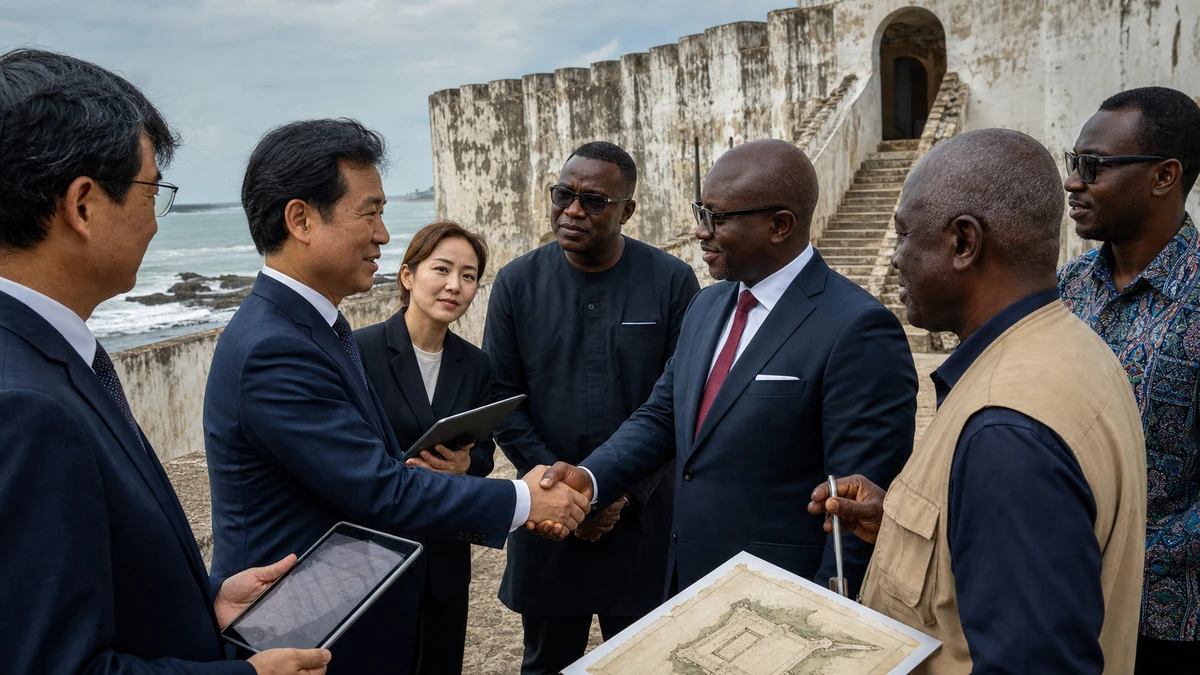
A new kind of Korean soft power
South Korea, a country better known globally these days for K-pop, Oscar-winning films and hit streaming dramas, is quietly expanding another form of influence abroad: cultural heritage diplomacy. In its latest move, the Korea Heritage Service, the government agency responsible for the nation’s historic sites, artifacts and preservation policy, has selected the Korean National Commission for UNESCO to carry out a project aimed at helping Ghana respond to climate threats facing cultural heritage in the Greater Accra Region.
That may sound, at first glance, like a narrow bureaucratic development. But it points to a broader shift in how countries are thinking about both climate change and culture. The headline is not simply that South Korea is assisting Ghana. It is that Seoul is treating climate change not only as an environmental or economic issue, but also as a danger to the physical places that hold a society’s memory.
In the United States, the idea is easier to grasp when framed through familiar examples. Americans understand what it means when stronger hurricanes threaten New Orleans’ historic neighborhoods, when wildfires menace Native American cultural sites in the West, or when rising seas put coastal landmarks at risk from Florida to the Carolinas. Historic preservation is no longer just about repairing old buildings after they crack or decay. It increasingly means preparing for a future in which heat, flooding, salt damage, erosion and extreme weather can alter or destroy irreplaceable places.
That is the logic behind the Korean-backed initiative in Ghana. According to South Korean officials, the project is designed as a capacity-building effort, meaning the goal is not merely to send one-time aid or complete a single restoration job. Instead, it is intended to strengthen local systems, expertise and planning so Ghanaian heritage professionals can better identify risks and respond over time. In development language, that distinction matters. It suggests a model built around training, institution-building and long-term resilience rather than a one-off intervention.
For South Korea, the decision also signals a widening of what “Korean influence” can mean on the world stage. For years, much of the discussion about Korea’s global reach has centered on entertainment and consumer culture. This project presents a different picture: a middle-power democracy using its own administrative experience in preservation, international coordination and public policy to contribute to a global problem far from the Korean Peninsula.
Why Ghana’s heritage matters far beyond Ghana
The project focuses on Ghana’s Greater Accra Region, though South Korean officials have not yet publicly laid out a full budget, detailed timeline or site-by-site implementation plan. Even so, the broader significance is clear. Ghana’s cultural and historic sites are part of the wider global heritage system recognized by UNESCO, the United Nations agency that designates World Heritage sites and promotes international cooperation in education, science and culture.
For American readers, UNESCO’s World Heritage framework is perhaps most familiar through places like Independence Hall in Philadelphia, the Statue of Liberty, Yellowstone National Park or Mesa Verde. The label does not simply mark a site as locally important. It carries the idea that certain places belong, in a cultural and moral sense, to the shared inheritance of humanity. When those places are threatened, the loss is not only national. It is global.
That is especially important in Africa, where many historic places carry the weight of precolonial history, colonial encounter, trade, faith, resistance, migration and memory. In Ghana’s case, heritage is deeply connected to major chapters of Atlantic and world history, including histories that intersect with Europe, the Americas and the trans-Atlantic slave trade. Even when South Korea’s announcement did not specify every site or every form of damage, the premise itself is powerful: climate change is affecting places that help tell the story not just of one nation, but of the wider human past.
Greater Accra, the region surrounding Ghana’s capital, is one of the country’s most visible and symbolically important areas. It is a political and economic center, but also part of a coastline and built environment increasingly exposed to changing climate conditions. In practical terms, that can mean heavier rains, flooding, coastal erosion, salt intrusion, humidity stress and the cumulative wear that comes from more volatile weather patterns. These are not abstract threats. They are the kinds of pressures that can weaken old materials, undermine foundations, damage protective surroundings and complicate preservation planning.
Heritage professionals have increasingly warned that climate change can act as a force multiplier. A site already struggling from age, underfunding or nearby development becomes even more vulnerable when the environment grows harsher and less predictable. In that sense, protecting heritage is no longer just an archival or architectural task. It is also an adaptation challenge.
From restoration to resilience
One of the most telling phrases in the South Korean announcement is “capacity building.” In international development work, that phrase can sometimes sound vague or overly technical, but here it gets at a real strategic shift. Preservation has often been imagined as something experts do to a monument: document it, repair it, conserve it, maybe reopen it to visitors. Climate change disrupts that model because the threats do not end once a restoration team leaves. The environment keeps changing.
That means a preservation strategy has to become more dynamic. Local staff need training not only in conventional conservation, but also in risk assessment, emergency response, long-term monitoring and adaptation planning. Institutions may need better coordination across cultural agencies, local governments, environmental offices and community organizations. Data collection matters. So does knowing which sites face the greatest danger, which materials are most vulnerable and which interventions are sustainable under local conditions.
Seen that way, the Korean-Ghanaian initiative is notable because it links cultural preservation to climate resilience in a formal development framework. The Korean National Commission for UNESCO said this is the first case in which South Korea’s official development assistance in the cultural heritage field is being attempted in connection with climate change. That makes it something of a pilot project, one that could shape how South Korea approaches similar efforts elsewhere if the model proves effective.
For U.S. readers, there is a parallel in the way federal, state and local agencies have had to rethink historic preservation after repeated climate shocks. The question is no longer whether old places deserve protection; it is how to protect them in conditions that may no longer resemble the past. A church, fort, palace, cemetery or archaeological site can be preserved beautifully according to traditional standards and still remain highly exposed if no one has accounted for changing rainfall patterns, shoreline retreat or stronger heat cycles.
That is why the most consequential part of this project may not be any single repair effort. It may be the creation of planning frameworks and professional capacity that remain in place after the project period ends. The South Korean government has described the effort as laying a long-term and comprehensive foundation for heritage conservation in Ghana. That wording suggests a broader ambition: to help build systems rather than simply deliver assistance.
There is also a diplomatic lesson embedded here. Cultural cooperation often gets treated as symbolic, soft or secondary compared with trade, security or energy policy. But climate-era heritage work shows how culture can become an arena for serious international policy, where expertise, institutions and long-range planning matter. Saving a historic site from environmental deterioration is not just a matter of sentiment. It can involve public administration, climate science, engineering, local consultation and international trust.
What South Korea is trying to prove
South Korea’s heritage authorities have cast the Ghana project as part of a larger effort to strengthen the country’s standing as a leader in cultural heritage. That phrase can sound self-promotional, but it reflects a genuine transition in South Korea’s international identity. For much of the late 20th century, the country was seen primarily through the lenses of war, rapid industrialization and the high-stakes security confrontation with North Korea. More recently, it has become associated with advanced technology, export brands and cultural production.
Now Seoul appears to be testing whether it can also build influence as a country with transferable governance experience in the heritage field. South Korea has spent decades balancing modernization with the preservation of palaces, royal tombs, Buddhist temples, historic neighborhoods and intangible traditions. It has navigated debates familiar to many fast-developing societies: how to protect the past while building new infrastructure, how to promote tourism without overwhelming fragile sites, and how to turn preservation into a public policy system rather than a boutique concern.
That experience does not automatically make South Korea an authority on every preservation challenge abroad. Ghana has its own history, institutions, climate realities and community priorities. But it does give Seoul something increasingly valuable in international cooperation: a practical record of building modern heritage administration while also confronting the pressures of urban growth and environmental risk.
The Korean National Commission for UNESCO, which will carry out the project, is also a significant player in this story. National UNESCO commissions serve as bridges between global UNESCO frameworks and domestic institutions. In plain terms, they help translate international goals into programs on the ground. By choosing the commission as the implementing body, South Korea is signaling that this is not merely a bilateral gesture. It is an effort that sits within a broader multilateral vocabulary about world heritage, education and international cooperation.
There is a political subtext here, too. Middle powers like South Korea often look for areas where they can exercise global influence without acting like traditional great powers. Heritage cooperation is one such space. It is less confrontational than security policy, less zero-sum than industrial competition and often better aligned with the image many countries want to project: constructive, technically capable and globally engaged. If K-pop concerts and Korean TV dramas built popular familiarity, projects like this aim to build institutional credibility.
The promise and the pitfalls of heritage aid
There is, however, a reason preservation experts often stress humility in international heritage work. Cultural sites are not generic infrastructure projects. They carry local meaning, often layered over centuries. Outside assistance can be valuable, but it can also become tone-deaf if it imposes foreign priorities, chases publicity or treats communities as passive recipients. That is especially true in places shaped by colonial histories, where control over cultural narratives and historical assets remains deeply sensitive.
The emphasis on capacity building may help South Korea avoid some of those pitfalls, because the term implies that local expertise and local institutions remain central. The most durable preservation work is usually the kind that supports the people already responsible for a site rather than replacing them. It respects that heritage belongs first to the communities and nations that have lived with it, cared for it and assigned meaning to it across generations.
Still, important questions remain unanswered. South Korean officials have not publicly detailed which specific sites in Greater Accra will be prioritized, what forms of climate damage are considered most urgent, how much funding is being committed, or how success will be measured. Those are not minor details. In a field where money is finite and climate threats are expanding, choosing where to focus can be as important as the intervention itself.
Another challenge is the time scale. Climate change does not operate on a grant cycle. A training program or assessment project may start important work, but genuine resilience requires repeated follow-up, updated data, maintenance funding and institutions with enough authority to act on warning signs. If a site is repeatedly exposed to heavy rains or encroaching coastal damage, then preservation cannot be reduced to reports and workshops alone. It eventually requires implementation, monitoring and, in some cases, difficult choices about adaptation.
There is also the broader issue of what international heritage protection can and cannot do in the absence of wider climate action. Cultural preservation programs can help sites adapt, prepare and recover. They cannot stop the global heating that is driving many of the threats in the first place. In that sense, projects like this are both hopeful and sobering. They show governments trying to respond creatively, but they also underscore how far climate change has already spread into areas once considered separate from the environmental crisis.
That cultural dimension is worth emphasizing for American audiences. In public debate, climate change is often discussed through fuel prices, power grids, storms, insurance costs and emissions targets. Those are all crucial. But heritage reminds us that climate change also threatens continuity itself: the places where communities locate their identities, teach their histories and maintain living ties to earlier generations. When a heritage site is lost, the damage is not only physical. A piece of memory, context and belonging can disappear with it.
A broader signal about where global cooperation is headed
What makes the South Korea-Ghana project especially notable is that it sits at the intersection of several major trends in international affairs. One is the globalization of climate risk. Another is the growing recognition that culture is not a luxury issue to be addressed after more “serious” crises, but part of how societies endure and interpret change. A third is the emergence of new development actors — countries like South Korea that were once aid recipients themselves and now increasingly shape international cooperation agendas.
That last point matters. South Korea’s own transformation over the past several decades has given it unusual credibility in some parts of the developing world. It has experience not only as a wealthy donor, but as a country that moved from postwar poverty to advanced economy status within living memory. When Seoul presents development partnerships today, it often does so with an implicit message: this is assistance informed by a country that has also undergone fast, difficult transformation.
In cultural policy, that history can translate into a certain pragmatism. South Korea knows what it means to modernize quickly while trying not to erase historical identity. It knows what it means to develop institutions that can preserve national memory even as cities expand and social priorities change. And increasingly, it appears to be translating those domestic lessons into a foreign policy asset.
For Ghana, the importance of the project will ultimately depend less on rhetoric than on execution. If the initiative produces useful assessments, trains local professionals, strengthens preparedness and helps establish durable policy frameworks, it could become a model for future heritage-climate partnerships elsewhere. If it remains a symbolic announcement without sustained follow-through, its impact will be limited.
For the broader international community, though, the symbolism is already meaningful. The story shows how the map of global cultural cooperation is changing. Heritage preservation is no longer only a matter of former colonial powers funding restorations in places they once dominated, nor is it only the domain of Western museums, foundations and universities. Countries in Asia, Africa and elsewhere are increasingly shaping the conversation, forging partnerships that reflect a more multipolar cultural order.
That may be the most important takeaway. South Korea’s role in Ghana is not the story of a pop culture powerhouse dabbling in preservation for prestige. It is the story of a country trying to define a broader public role for itself in a world where climate change is redrawing the boundaries between environment, development and culture. The fact that the chosen arena is African world heritage, rather than a more obvious or strategically flashy sector, makes the move more revealing, not less.
At a moment when international cooperation often appears fractured, narrow and transactional, a project focused on helping protect climate-threatened heritage offers a different vision. It suggests that cultural memory can be treated as a shared global responsibility, and that climate adaptation can include more than roads, seawalls and emergency plans. It can also include the places people inherit, revere and use to understand who they are.
For American readers accustomed to hearing about South Korea through the lens of Samsung chips, BTS fandom or tensions with Pyongyang, that may come as a surprise. But it is precisely why this story matters. South Korea is showing that its global footprint is widening in ways that go beyond commerce and entertainment. In Ghana, it is stepping into a harder, quieter arena: protecting the material record of human history as climate change puts that record at risk.

0 Comments