From policy paper to airport tarmac
South Korea is taking a more practical step in its push to bring artificial intelligence into government operations: sending officials into the field to see what is actually working.
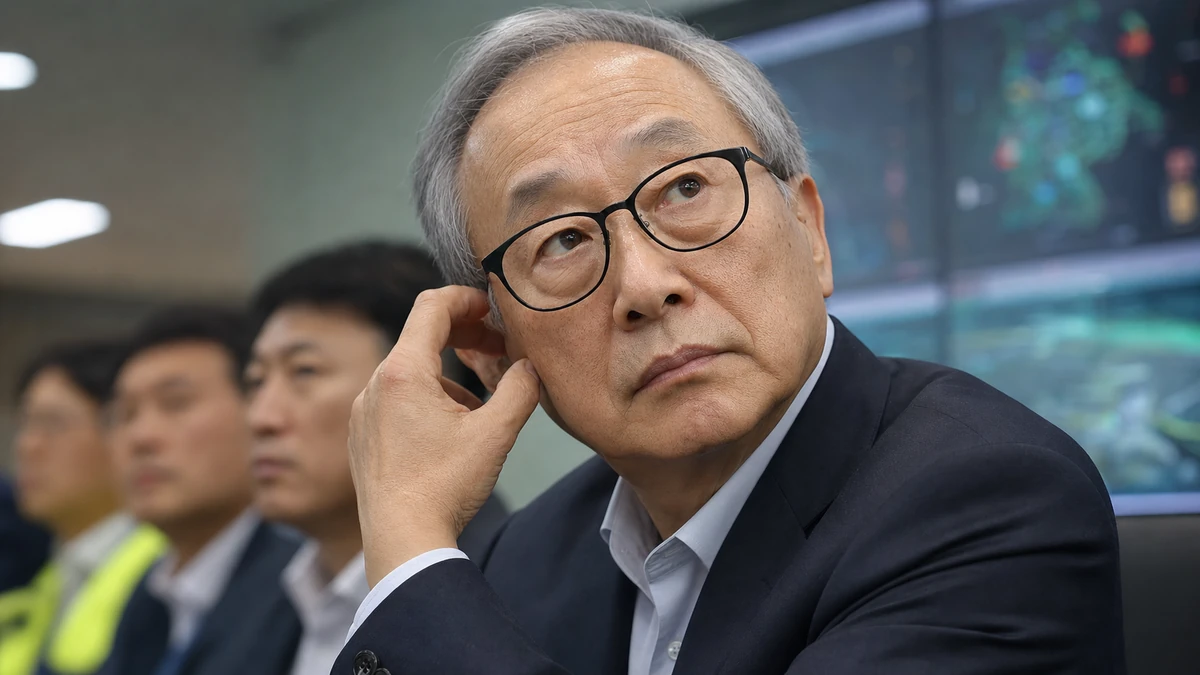
The country’s finance ministry said Tuesday it is launching a series of on-site visits to public institutions that are considered strong examples of AI-driven innovation, beginning with Korea Airports Corp. at its facilities in Seoul’s Gangseo district. The point, officials said, is not simply to stage a showcase. It is to examine whether AI systems already being used in one public agency can be adapted elsewhere, what obstacles stand in the way, and what policy changes might be needed to make broader adoption possible.
For American readers, the move may sound like a wonky bureaucratic exercise. But it reflects a larger question governments around the world are now trying to answer: How do you move beyond talking about AI in abstract terms and put it to work in places where safety, public trust and everyday operations matter?
South Korea’s answer, at least for now, is to begin with critical infrastructure. Its first stop was an airport operator, where officials reviewed a safety management and disaster response system that combines AI with a “digital twin,” a technology that creates a virtual replica of a real-world environment so operators can simulate scenarios before they happen. In a setting like an airport, where delays, equipment failures, weather events and emergencies can cascade quickly, the appeal is obvious.
The government’s message is equally clear. Seoul does not want public-sector AI transformation to remain stuck at the level of strategy decks, white papers and pilot rhetoric. It wants to see how the technology behaves in real working environments and whether those results can be turned into a repeatable model across the state.
That matters not only as a governance story, but as an economic one. Public institutions are major buyers of technology. When governments decide to adopt a tool, they do more than modernize internal operations; they help create demand, validate products and open markets for private firms. In this case, smaller AI companies from the private sector also participated in the site visit, underscoring how public procurement can become a testing ground for the country’s domestic tech industry.
In the United States, similar debates have played out around federal modernization efforts, smart-city projects and the growing use of AI in transportation, health systems and emergency management. South Korea’s latest move offers a window into how another U.S. ally is trying to solve the same problem: making AI useful, accountable and scalable inside government.
Why an airport came first
Korea Airports Corp. was not an accidental choice for the first inspection site. The public corporation plays a central role in operating many of South Korea’s airports, making it responsible for a complex network of aircraft movement, passenger flow, facility management and emergency response. Airports are among the most demanding environments in modern public infrastructure. They must operate with precision, absorb disruption quickly and maintain public confidence even when conditions change by the minute.
That makes them a natural place to test technologies designed to detect risk early and model different outcomes in advance. According to the ministry, the system under review combines AI with digital-twin technology to support safety management and disaster response. In plain terms, it means building a virtual version of an airport environment and then using software to analyze possible incidents, simulate response options and improve decision-making.
Americans may already be familiar with the broad concept, even if not the name. Digital twins have been used in manufacturing, logistics, energy systems and major transportation projects. NASA has long relied on simulation-heavy approaches, and U.S. infrastructure operators increasingly use sensor-driven modeling to monitor bridges, electrical grids and industrial equipment. What South Korea is doing at the airport level fits into that same technological family, but with a public-sector emphasis: protecting people, maintaining essential services and preparing for emergencies.
Airports are also especially symbolic. They are national gateways, highly visible to international travelers and central to the smooth functioning of a globally connected economy. If a government wants to signal that its AI ambitions are not just theoretical, an airport is a compelling place to do it. The stakes are easy to understand. A failure can affect thousands of passengers, freight schedules, security operations and public confidence all at once. A successful system, on the other hand, can help operators identify hazards faster, rehearse response protocols and manage disruptions with greater precision.
South Korea’s focus on airports also fits the country’s broader reputation for embracing digital infrastructure. The nation is already known for high broadband penetration, advanced electronics manufacturing and strong public-private coordination in technology. Applying those strengths to airport safety is a logical extension of a model that has often emphasized fast implementation, centralized planning and tangible outcomes.
Still, the government is being careful not to present this as a finished success story. What officials are saying, at least at this stage, is narrower: They want to study how the system functions in practice, what has made it effective, what problems remain and whether the model has broader relevance. In a field crowded with hype, that restraint may be one of the more notable parts of the story.
A policy experiment with economic consequences
Although the announcement is framed as a public-sector innovation initiative, it is also unmistakably an industrial policy story.
Officials said smaller private AI companies involved in developing innovation projects also joined the visit. That detail matters. In many countries, AI conversations tend to center on a handful of giant firms with deep computing power and global brand recognition. South Korea, like others trying to build a more resilient domestic tech ecosystem, has reason to look beyond its largest corporate champions and ask how smaller companies can gain real operating experience.
Public institutions can provide that opportunity. When a government agency adopts a private company’s technology in a real-world setting, the company gains more than revenue. It gets proof of concept, a reference customer and a chance to refine its product under demanding conditions. For smaller firms, especially those trying to break into a market dominated by bigger players, that can be decisive.
From the public agency’s perspective, the arrangement can also be attractive. Government bodies often struggle to keep pace with rapidly evolving technologies when they rely only on internal systems or traditional procurement cycles. Working with private AI developers can provide access to tools and expertise that would be difficult to build from scratch.
That is one reason this story sits comfortably on the business page as well as in government and technology coverage. AI in the public sector is not just about administrative efficiency. It creates a market. A ministry that encourages public agencies to test and adopt AI systems can help shape demand across multiple domains, from facilities management and transportation to safety oversight and emergency response.
For American readers, there is a familiar parallel in the role the U.S. government has long played in catalyzing technological markets, whether through defense contracts, infrastructure spending, health research or energy programs. Government demand often helps turn emerging tools into viable industries. South Korea appears to be trying something similar on a more targeted scale in public-sector AI.
That does not mean every participating company is guaranteed a breakthrough, or that every pilot will succeed. The current initiative should be understood less as a victory lap than as a policy experiment linking public need with private capability. But even as an experiment, it offers a useful example of how AI adoption can be tied to domestic economic strategy rather than treated solely as a technical upgrade.
What South Korea means by “public institution” innovation
Part of the cultural and institutional context here may be unfamiliar to readers outside Korea. In South Korea, “public institutions” often refers not only to central government ministries but also to state-run or state-affiliated bodies that manage critical functions such as transportation, finance, infrastructure and public services. These organizations can resemble a mix of government agencies, public authorities and quasi-independent corporations familiar to Americans through entities like port authorities, transit agencies or certain federally chartered institutions.
That structure makes them an important bridge between national policy and daily life. They are close enough to government to carry out public objectives, but operational enough to manage airports, utilities, transportation systems and other services people actually use. If South Korea wants to prove that AI can improve governance in visible, measurable ways, these institutions are a logical place to start.
The ministry’s site-visit program suggests a hands-on style of policymaking that is also recognizable within Korea’s administrative culture. Rather than limiting reform to top-down directives, officials are signaling that they want to gather evidence from frontline operations: what factors drove success, what barriers slowed progress, which tasks could be replicated elsewhere and where existing rules may no longer fit the technology.
That last point deserves emphasis. AI adoption in government is rarely just a software story. Even when a tool works technically, institutions still have to answer difficult questions. Who is responsible if a recommendation generated by AI turns out to be flawed? What kinds of data can be used, and under what safeguards? How should employees be trained? Do legacy regulations prevent agencies from using more efficient workflows? Can a system designed for one environment be trusted in another?
South Korean officials appear to be acknowledging those realities upfront. The ministry said the relay-style visits will continue through the end of the year, with a focus on identifying both success factors and obstacles, as well as possible solutions, opportunities for expansion and the need for institutional reform. That is a more grounded approach than simply declaring that AI will transform government and leaving agencies to figure out the details later.
There is also a subtle but important political message in that framework. By going to operating sites rather than relying exclusively on reports from headquarters, the government is presenting itself as serious about implementation. In many democracies, including the United States, voters have grown accustomed to flashy modernization promises that stall once they reach procurement rules, staffing limits, union concerns, data silos or budget constraints. A field-based review process does not solve those problems automatically, but it at least acknowledges that they exist.
The challenge of making AI work in government
If the promise of public-sector AI is easy to describe, the difficulty is making it durable.
Government agencies are not startups. They cannot move fast and break things, particularly in areas like airport operations, disaster response or public safety. A system that helps prioritize risks in a consumer app is one thing. A system that affects decisions at a major transportation hub is something else entirely. It must be reliable, auditable and compatible with existing chains of responsibility.
That is why the South Korean ministry’s emphasis on identifying obstacles may be as important as its interest in success stories. In practice, the biggest barriers to public-sector AI often have less to do with the algorithm itself than with organizational and legal realities. Data may be fragmented across departments. Staff may need training. Procurement rules may favor old vendors or slow new contracts. Existing guidelines may not clearly define how AI outputs should be used in operational decisions.
There are also broader concerns familiar to policymakers in Washington, Brussels and other capitals: transparency, bias, cybersecurity and overreliance on automated systems. Governments must not only deploy useful technology but persuade the public that the systems are trustworthy and subject to oversight. In an airport setting, that standard is especially high.
The digital-twin model offers one way to reduce some of that risk because it allows agencies to test scenarios in a virtual environment before applying changes in the real world. In theory, that can improve preparedness without exposing the public to unnecessary danger. But theory is not enough. Officials still need evidence that simulations reflect real conditions closely enough to guide decisions, and that the AI components are interpreting data in a dependable way.
This is where South Korea’s current initiative could become more than a one-off visit. If the government systematically gathers lessons from multiple institutions, compares where projects succeeded or failed, and then uses that information to refine regulations and operating guidelines, it could build a stronger foundation for adoption than countries that rely only on scattered pilots.
The ministry has already indicated that feedback from the field will be incorporated into a 2027 plan for expanding AI activation in public institutions, and that related rules governing public bodies could be revised if necessary. That suggests this year’s site visits are not merely ceremonial. They are meant to feed directly into the next phase of policy design.
In the American context, it is the difference between announcing an innovation initiative and building an implementation roadmap. One generates headlines. The other has a better chance of reshaping how institutions actually work.
Why this matters beyond South Korea
At first glance, a ministry visit to an airport authority in Seoul may seem like a niche domestic development. But the implications are broader.
Governments across the world are under pressure to modernize aging systems while handling tighter budgets, labor constraints, security threats and public demands for better service. AI has been marketed as a solution to nearly all of those problems. Yet the real test is not whether leaders can describe the technology’s potential. It is whether institutions can integrate it responsibly into essential services.
South Korea’s approach is worth watching because it combines three elements that are often discussed separately: technological deployment, economic development and institutional reform. The government is not only promoting AI use in public agencies; it is examining how that use can support smaller private tech firms and how lessons from actual operations can feed back into policy and regulation.
That integrated approach may hold lessons for allies such as the United States, where debates over AI often splinter into separate tracks: one focused on innovation and competition with China, another on ethics and safety, and another on procurement and modernization inside government. South Korea is effectively trying to connect those tracks through a practical, site-based process.
There is also a geopolitical dimension, even if it is not explicit in the ministry’s announcement. South Korea has spent years trying to position itself as a technologically advanced middle power, one capable of exporting not only hardware and entertainment but also governance models and digital solutions. In the same way Korean pop culture, consumer electronics and semiconductors have reshaped the country’s global image, public-sector digital innovation offers another channel for influence.
That does not mean other countries can simply copy and paste what Seoul is doing. Administrative structures, legal traditions and procurement systems vary widely. But the underlying idea — test AI where it matters, study what works, identify what breaks, and adjust the rules accordingly — is portable. It is also refreshingly pragmatic at a moment when AI policy is often split between boosterism and fear.
For now, the facts remain limited. The ministry has started its relay of site visits. Korea Airports Corp. was the first stop. Officials reviewed an airport safety and disaster response system that combines AI and digital-twin technology. Smaller private AI firms were included in the process. And the government says what it learns will help shape a broader public-sector AI plan through 2027, along with possible institutional changes.
But even within those constraints, the significance is clear. South Korea is trying to turn AI in government from a slogan into an operating model. It is doing so not first in a lab or a conference room, but in one of the most sensitive and demanding parts of public infrastructure. If that approach yields credible results, it could offer a useful template for governments far beyond the Korean Peninsula.
The bottom line
The most important part of South Korea’s new initiative may be its modesty. Officials are not claiming that AI has already solved airport safety or transformed the public sector overnight. They are doing something less dramatic and potentially more valuable: checking the machinery, interviewing the operators and asking what can realistically scale.
That may not sound glamorous in an era of AI superlatives. But for governments, it is often the difference between technology theater and durable reform.
If South Korea can show that AI and digital-twin tools improve safety management in airports, create real opportunities for domestic tech firms, and produce enough operational evidence to justify broader institutional change, it will have achieved something more meaningful than a successful pilot. It will have shown how a digitally ambitious government can move from promise to practice.
And in a world where nearly every government says it wants to harness AI, that kind of proof may become one of the most valuable exports of all.
Comments
Post a Comment