South Korean duo falls just short at LPGA’s Dow Championship, but their runner-up finish underscores Korea’s enduring strength in women’s golf
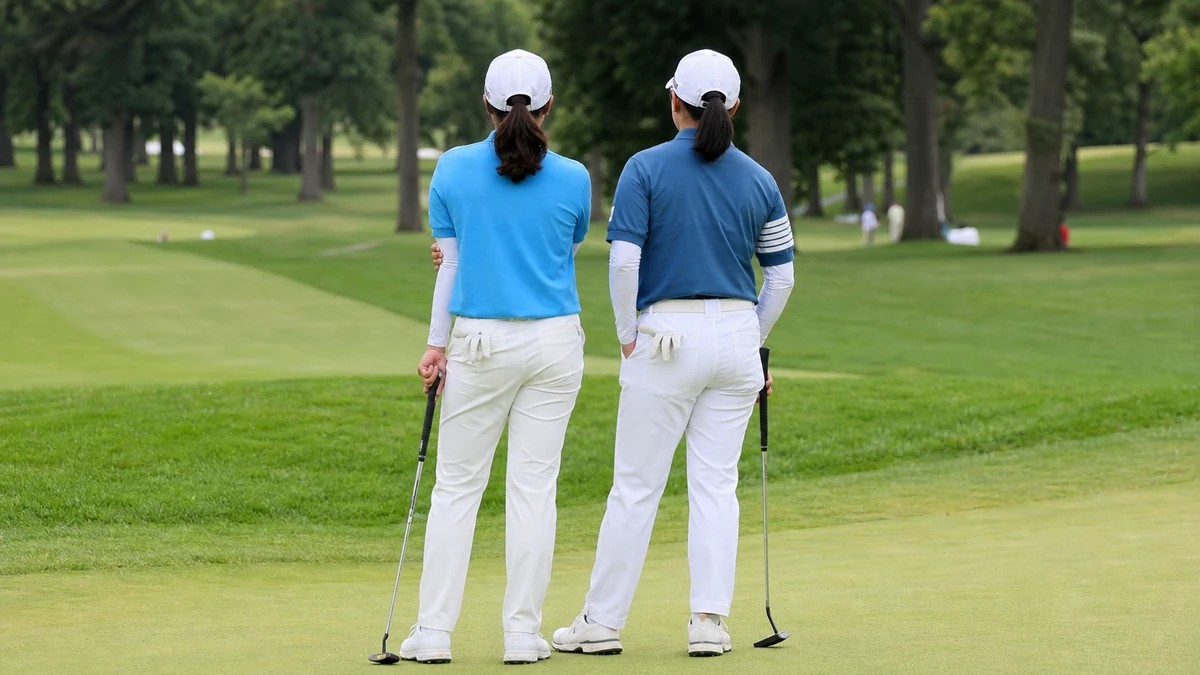
A near miss in Michigan carries a bigger story
On the final day of the LPGA Tour’s Dow Championship in Midland, Michigan, South Korea’s Kim Hyo-joo and Choi Hye-jin delivered exactly the kind of round that usually gives a team a real chance to win. They made no bogeys. They rolled in five birdies. They posted a clean, composed 5-under 65 in the final round and finished the week at 15-under-par 265.
It still was not enough.
An American pairing, Gina Kim and Yana Wilson, went even lower on Sunday, shooting 8-under to reach 17-under 263 and claim the title by two shots. For Kim and Choi, the result was runner-up, the kind of finish that can feel both impressive and frustrating at the same time. On paper, a two-shot loss is straightforward. In context, it was far more dramatic: two elite South Korean players performed with control under pressure, only to be overtaken by a late charge.
That tension is part of what made this result resonate beyond the leaderboard. The Dow Championship is not a standard week on the LPGA calendar. It is one of the tour’s few team events, a format that changes the emotional rhythm of professional golf. Instead of one player managing her own mistakes and momentum, two players share responsibility, strategy and pressure. That makes chemistry matter almost as much as raw shot-making.
Kim and Choi showed plenty of both.
For American audiences who may follow women’s golf mostly through majors, stars like Nelly Korda or the Solheim Cup, this week in Michigan also offered a reminder of a longer-running global story: South Korean women remain one of the deepest and most influential forces in the sport. Even without taking home the trophy, the Korean contingent once again crowded the top of an LPGA leaderboard, not just with one standout pairing but with multiple teams in contention through the final round.
Kim and Choi’s second-place finish, then, was more than a close call. It was another data point in the sustained excellence of Korean women’s golf on American soil, in an American tour event, under a format that tests trust as much as technique.
How the Dow Championship works — and why it feels different
For casual sports fans in the United States, the easiest comparison for the Dow Championship is to think of it as a more intimate, weeklong cousin of golf’s better-known team events. It is not quite the Ryder Cup, and not quite the Solheim Cup, because players here are not representing countries or continents. Instead, they choose partners and compete as two-player teams across four rounds.
The format alternates between foursomes and four-ball, and that distinction matters.
In the first and third rounds, teams play foursomes, also known as alternate shot. Two players share one golf ball, taking turns hitting it until the hole is complete. One player tees off on odd-numbered holes, the other on even-numbered holes. It is a demanding format because every swing directly affects a partner’s next shot. A drive into trouble is not just your problem; it becomes your teammate’s recovery shot. In that sense, foursomes can feel like the golf equivalent of a basketball team trying to run offense with one player handing the ball to another after every dribble.
In the second and fourth rounds, teams play four-ball. Each player uses her own ball, and the better score on each hole counts for the team. That format invites aggression. If one player is safely in position for par, the other can go flag-hunting in search of birdie. But four-ball is not just a free-for-all. Players still need a sense of timing and awareness. A team that understands when to attack and when to settle can separate itself quickly.
Kim and Choi were particularly strong in that final-round four-ball setting. Their bogey-free 65 suggests not only clean execution but clear decision-making. No mistakes. No unraveling. No panicked stretch coming home. In many tournaments, that kind of score wins or at least forces a playoff. This time, it left them second because Kim and Wilson were even hotter.
That is part of why team golf can be so compelling. In a typical 72-hole individual event, a player can often grind through a round and wait for others to slip. In a four-ball finale, the board can move quickly. Birdies pile up. Momentum shifts fast. A steady round may not be enough if another pairing catches fire. That is essentially what happened in Midland, where the South Korean duo played the kind of golf coaches love while the American team produced the kind of scoring burst fans remember.
The format also puts personality and partnership at the center of the week. Golf is usually a solitary profession, a sport built around individualized routines, caddies, swing thoughts and emotional self-management. Team events disrupt that. Players have to align tempos, read each other’s moods and trust one another’s instincts. At the Dow Championship, success depends on whether two accomplished professionals can become something more than the sum of their parts.
Why Kim Hyo-joo’s week mattered beyond the runner-up finish
For Kim Hyo-joo, the result carried a particularly sharp edge.
Kim is one of the most accomplished South Korean players of her generation, a polished veteran whose game has long translated well to the LPGA Tour. She has built a reputation for consistency, precise iron play and the kind of calm competitive presence that keeps her in the mix year after year. This week presented a chance to move one step closer to a clean milestone: the 10th LPGA Tour victory of her career.
That number matters in any sport. Double-digit wins on the LPGA Tour do not happen by accident. They mark staying power, not just talent. In American sports terms, it is the difference between having a good stretch and building a body of work that commands historical respect. Ten wins does not automatically place a player in the very top tier of all-time greats, but it does affirm that she has been a durable force in one of the deepest talent pools in the world.
Kim came close, but the breakthrough will have to wait.
Still, it would be a mistake to frame the week mainly as a collapse or missed opportunity. Nothing in the final round resembled a breakdown. A bogey-free 65 in a pressure situation is not evidence of a player losing control. It is evidence of a player doing almost everything right. The reason Kim did not leave Michigan with another title was not that her team stumbled; it was that another team surged harder.
That distinction matters in evaluating form. In golf, a disappointing result can come from poor execution, bad course management, shaky nerves or simply being outplayed. This week fits mostly into that last category. Kim’s ball-striking, putting and strategic discipline all appeared strong enough to win. In a season where players often search for signs that a victory is near, those are positive indicators.
For American readers less familiar with Kim’s standing, it is worth noting that she represents a broader generation of South Korean stars who helped shape the LPGA over the last decade and beyond. South Korea has produced a striking pipeline of elite women golfers, many of whom have come to the United States, adapted to life on tour and won repeatedly at the highest level. Kim belongs firmly in that tradition. Every time she contends, she reinforces the idea that Korean golf’s influence is not a passing trend but a structural reality.
So yes, the milestone remains unfinished. But the week in Michigan also sent a clear message: Kim is still very much a factor whenever a trophy is on the line.
For Choi Hye-jin, the chase for a first LPGA win looks alive again
If Kim’s story this week involved a delayed milestone, Choi Hye-jin’s involved a familiar and often nerve-racking pursuit: the search for a first LPGA Tour victory.
Anyone who follows professional golf in the United States knows how stubborn that first win can be. Talented players can pile up top-10 finishes, contend regularly and still find themselves waiting for the week when everything finally lines up. The pressure is psychological as much as technical. Once a player gets close often enough, every leaderboard becomes a test of whether she can convert.
Choi has now added another meaningful chapter to that process.
Her runner-up finish alongside Kim did not erase the fact that she is still seeking that first LPGA title, but it did reinforce that she belongs in the conversation on big weekends. In a team event, one player cannot carry everything alone. Success reflects shared execution, mutual stability and the ability to contribute when opportunities appear. Choi did that. A 15-under total in this format is not accidental, and neither is staying in the hunt through the final round.
For readers in the U.S. who may not know her background, Choi arrived on the LPGA Tour with significant expectations after a strong career in South Korea, where the domestic women’s tour is one of the most competitive in the world. The Korean LPGA, commonly called the KLPGA, is not simply a minor stop or developmental circuit. It is a serious proving ground with its own stars, sponsors, fan culture and media attention. Success there often signals a player has the game to compete internationally.
That context helps explain why Choi’s progress matters. When Korean players transition to the American tour, they are not merely prospects learning the ropes. Many arrive with polished resumes and considerable pressure. They are adjusting not only to stronger global fields but also to travel, language, courses, media demands and a sports culture far from home. A first LPGA win can therefore feel like a validation of adaptation as much as skill.
Choi did not get that validation this week in the form of a trophy. But she did get something close to equally important in the long run: more proof that she can be present at the decisive moments of a tournament. In sports, especially golf, repeated exposure to contention matters. It teaches pacing, emotional control and resilience. It can also harden a player against the sting of disappointment.
That is why runner-up finishes can be deceptive. They hurt in real time because the victory seemed reachable. But they can also serve as previews. Choi’s week in Midland looked very much like the work of a player inching toward a breakthrough rather than drifting away from one.
Korean women’s golf remains one of the LPGA’s defining powers
The biggest takeaway from the Dow Championship may not be the near miss by one team, but the breadth of the South Korean showing overall.
Kim Hyo-joo and Choi Hye-jin finished second at 15-under. Another Korean duo, defending champions Im Jin-hee and Lee So-mi, made a major move on the final day, shooting 9-under and climbing into a tie for third at 14-under 266. Yet another pairing featuring Korean players, Kim A-lim and Yoon Ina, finished tied for seventh at 11-under 269. In other words, this was not a one-off performance by a single hot partnership. Korean names appeared across the leaderboard.
That kind of depth is significant. In American sports language, it is the difference between having a star player and having a system. South Korea’s women’s golf success is often discussed through individual champions, but the more enduring story is institutional strength. The country has developed a culture that consistently produces technically refined, mentally tough and internationally competitive players.
Part of that comes from infrastructure: strong junior programs, serious coaching and a highly competitive domestic pipeline. Part of it comes from the status women’s golf holds in South Korea. While golf in the United States can sometimes fight for attention behind football, basketball and baseball, women’s golf in South Korea occupies a more visible and culturally prominent place than many Americans might assume. Top players can become household names, and performances on the LPGA Tour are followed closely back home.
There is also an intergenerational element. Success breeds imitation. As one wave of Korean stars wins overseas, younger players grow up with tangible role models and a clear career path. That has helped create a self-sustaining cycle. The LPGA Tour is now accustomed to Korean contenders not just at majors but across the schedule, on different courses and in different formats.
The Dow Championship offered a useful stress test of that reputation because team golf asks for more than textbook swings. It demands adaptability, communication and a willingness to balance individual instincts with collective strategy. The fact that multiple Korean pairings thrived in that environment suggests their competitive edge is not limited to individual stroke play. They are also capable of translating discipline and tactical intelligence into shared formats.
For American audiences, this should not be viewed as an abstract international trend. It is a central part of the modern LPGA story. Korean players are not visitors briefly passing through the tour. They are among the athletes who define it, shape its standards and expand its global appeal. When they occupy several spots near the top of the board in Michigan, that is not surprising anymore. It is part of the tour’s normal competitive reality.
The American winners delivered the kind of closing charge that changes everything
That broader Korean success should not overshadow what Gina Kim and Yana Wilson accomplished. Their final-round 8-under performance was the decisive act of the tournament.
In a four-ball finale, aggressive scoring can rewrite a leaderboard fast, and that is exactly what happened. While Kim Hyo-joo and Choi Hye-jin remained steady and error-free, the American duo found another gear. By the end of the day, their total of 17-under had flipped the outcome and secured the trophy.
For fans in the United States, the winners’ charge was a reminder of why this event has a distinct place on the LPGA schedule. It invites volatility in the best sense. A team with momentum can make birdies in bunches and suddenly put pressure on every group around it. That creates a Sunday atmosphere that is slightly different from standard tournament golf. It feels looser, faster and, at moments, more like a sprint than a marathon.
The result also carried a certain symbolism. An American team winning an LPGA event on home soil by overtaking one of the strongest international pairings in the field is the kind of finish the tour would welcome, particularly in an era when women’s golf continues to broaden its audience. The LPGA’s strength has always been its international texture. Weeks like this show that clearly: an American team wins in Michigan, a Korean duo nearly takes the title, and several other Korean players are in the hunt to the end.
That mix is healthy for the sport. It gives local fans someone to cheer for while preserving the global quality that makes the LPGA unique among major American sports leagues. In that sense, the Dow Championship delivered on two levels at once: a homegrown winning story and a strong demonstration of the international depth surrounding it.
Why this runner-up finish may matter more than it first appears
Sports are full of results that look simple in the standings and richer in hindsight. Kim and Choi’s runner-up finish in Midland fits that pattern.
On one level, it was a painful near miss. Kim had a shot at her 10th LPGA title. Choi had a chance to claim her first. They played a final round without a bogey and still walked away without the trophy. That sting will not disappear just because the scorecard looked solid.
But another reading is just as valid, and perhaps more useful. The week showed Kim still has the game to contend deep into Sunday. It showed Choi continues to move within reach of a breakthrough. It showed Korean players, collectively, remain a formidable presence even in a quirky team format that rewards cohesion as much as talent. And it showed that the gap between winning and finishing second in elite golf can be less about failure than timing — one team is excellent, another team is simply hotter.
There is a phrase often used in American sports coverage when a team loses despite playing well: sometimes you tip your cap. That feels appropriate here. Kim and Choi gave themselves a legitimate chance. They did the disciplined work required to win. The Americans just produced a bigger finish.
For English-speaking readers who may be newer to the Korean side of women’s golf, this story also offers a useful lens into why South Korea remains so prominent in the game. The success is not mysterious. It is visible in the precision, steadiness and depth on display. Even when a Korean team does not win, it often shapes the tournament and raises the standard for everyone else.
The Dow Championship ended without a Korean trophy celebration. Yet it still reinforced the same conclusion the LPGA has been offering for years: South Korean women’s golf is not merely relevant on the global stage. It is one of the stage’s central pillars. In Midland, that truth was there from the opening rounds through the final putts on Sunday.
And because of that, the story does not end with a loss. It continues with what comes next — Kim’s next push for a 10th LPGA win, Choi’s next shot at a first, and another reminder to anyone watching that when Korean players populate a leaderboard, the rest of the field ignores them at its own risk.
Comments
Post a Comment