South Korean President Appears at G7 Welcome Ceremony in France, Signaling Expanding Role in Global Diplomacy
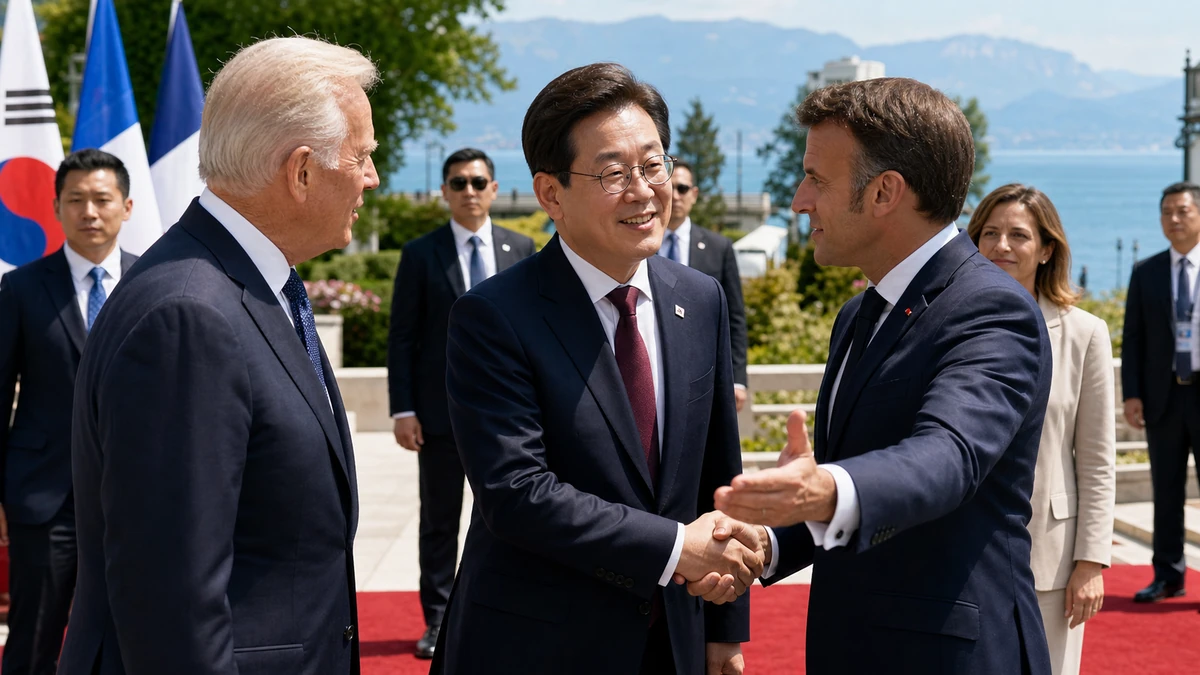
A Stage Set on Lake Geneva: South Korea Steps Into the G7 Spotlight
EVIAN-LES-BAINS, France — Against the backdrop of the French Alps and the quiet shores of Lake Geneva, South Korean President Lee Jae-myung appeared Monday at the official welcome ceremony for the Group of Seven (G7) summit, joining world leaders in one of the most closely watched diplomatic gatherings of the year.
The G7 is an informal bloc of advanced democracies — including the United States, France, Germany, Italy, the United Kingdom, Canada and Japan — that coordinate on global economic and security issues. While South Korea is not a member, it was invited as a guest nation, a status that has become increasingly significant as Seoul’s influence in technology, trade and security policy has grown.
Lee was greeted by French President Emmanuel Macron, the host of this year’s summit in the lakeside resort town of Evian-les-Bains. The welcome ceremony, staged before formal talks begin, is more than protocol. In modern diplomacy, it functions as a carefully choreographed moment where alliances are signaled, relationships are reaffirmed and geopolitical hierarchies are subtly displayed.
For South Korea, a country still formally divided from North Korea and heavily reliant on global trade, participation in such a setting reflects its evolution from postwar aid recipient to an export-driven economy deeply embedded in the international system.
Macron’s Welcome and the Quiet Language of Diplomatic Ritual
When President Lee entered the venue, Macron’s handshake and public greeting marked the start of a familiar diplomatic ritual that often carries as much weight as formal negotiations.
In summit diplomacy, ceremonial moments — seating arrangements, arrival order, brief exchanges on the sidelines — are widely read by analysts as indicators of influence and access. While they may appear symbolic or even superficial to outside observers, these interactions often set the tone for substantive discussions later in the summit.
Evian-les-Bains, known in the United States more for its bottled mineral water brand than its political relevance, has temporarily become the center of global diplomacy. Leaders from across Europe, North America and invited partner countries are using the venue to signal cooperation on issues ranging from global supply chains and artificial intelligence governance to ongoing geopolitical tensions.
Lee’s presence alongside other invited leaders highlights South Korea’s position as what diplomats often call a “middle power” — a country that is not a superpower but wields significant influence through economic strength, technological capacity and alliance networks.
Trump and Lee: A Brief Encounter with Global Attention
One of the most closely watched moments of the welcome event came when Lee was seen speaking with U.S. President Donald Trump during a brief interaction following the group photo session.
Although no formal meeting was announced, even short exchanges between U.S. and South Korean leaders at multilateral events are often scrutinized for signals about alliance priorities. The U.S.-South Korea relationship remains a cornerstone of Seoul’s foreign policy, shaped by military cooperation, trade ties and shared strategic interests in the Indo-Pacific region.
However, officials and observers cautioned against reading too much into the encounter. In the context of summit diplomacy, such interactions are typically informal and do not imply specific policy agreements or decisions.
Still, in Washington and Seoul alike, body language and brief conversations at events like the G7 are frequently analyzed for clues about future negotiations, particularly on defense spending, trade balances and coordination on North Korea policy.
For American audiences, the dynamic is familiar: similar attention is often paid to U.S. presidential interactions with allies at NATO or UN General Assembly meetings, where brief hallway conversations can sometimes precede formal diplomatic breakthroughs — or amount to little more than courtesy exchanges.
Why Guest Status at the G7 Matters for South Korea
South Korea’s participation in the G7 summit as a guest country reflects a broader trend in global governance: the gradual expansion of influence beyond traditional Western powers.
Unlike full members, guest nations do not participate in all decision-making processes. However, they are invited to contribute to discussions on selected global issues, often reflecting their regional importance or expertise in specific sectors.
For South Korea, those areas include semiconductor manufacturing, digital infrastructure, defense technology and supply chain resilience — all issues that have become central to global economic competition in recent years.
In the language of international relations, this role positions South Korea as a key “bridging state” between advanced economies and emerging markets. Its inclusion in G7 discussions signals recognition that global challenges — from climate change to artificial intelligence regulation — cannot be addressed solely by the traditional Western core.
The presence of additional European leaders, including Italian Prime Minister Giorgia Meloni, underscores the summit’s broader multilateral nature. These interactions allow South Korea to maintain steady engagement with multiple partners rather than relying exclusively on bilateral alliances.
The Group Photo: More Than a Ceremony
The official summit photograph — in which President Lee stood alongside other world leaders — is often treated as a formality. In practice, it functions as a visual statement of inclusion.
Such images are widely circulated by governments, news organizations and think tanks, becoming shorthand for global alignment at a particular moment in time. Being present in the frame signals participation in the international system’s decision-making core, even for non-member states.
For South Korea, the image carries domestic and international significance. At home, it reinforces the government’s foreign policy narrative of active global engagement. Abroad, it communicates that Seoul is not merely reacting to global developments but helping shape them.
In American terms, it is comparable to a country being seen at the table during a NATO summit or a White House multilateral meeting — not necessarily as a decision-maker, but as a recognized stakeholder in the conversation.
The G7 itself remains one of the most influential informal governing bodies in global affairs, even as its relative share of global GDP has declined compared with emerging economies. Its continued relevance lies in its ability to coordinate policy among advanced democracies.
Diplomacy in Motion: Meetings, Moments and What Comes Next
Following the welcome ceremony, President Lee was expected to participate in expanded sessions of the G7 summit, where invited leaders typically engage in discussions on global economic stability, security challenges and technological governance.
At this stage, however, only specific interactions from the welcome event have been confirmed: the greeting by President Macron, the group photo session, and brief exchanges with leaders including President Trump and Italian Prime Minister Meloni.
Diplomatic analysts emphasize that such summits operate on multiple layers. The most visible moments — handshakes, photos, short conversations — are often the surface layer of a much deeper process involving working-level negotiations and policy coordination.
It is also important to distinguish between presence and outcomes. Attendance at a high-profile summit does not automatically translate into policy agreements or joint declarations. Instead, it provides access, visibility and opportunities for future engagement.
For South Korea, this access is strategically valuable. In a world increasingly shaped by competition over technology, supply chains and security alliances, maintaining a seat in major global forums ensures that Seoul remains part of the conversation — even when it is not formally in charge of the agenda.
A Broader Signal: South Korea’s Expanding Diplomatic Footprint
Lee’s appearance at the G7 welcome ceremony reflects a broader evolution in South Korea’s foreign policy posture over the past two decades. Once primarily focused on security concerns related to the Korean Peninsula, Seoul now plays a more visible role in global economic governance and multilateral diplomacy.
For American audiences, South Korea is often associated with its major technology firms, cultural exports such as K-pop and film, and its strategic alliance with the United States. But its participation in forums like the G7 underscores a deeper transformation: the country is increasingly viewed as a stable democratic partner in an era of global uncertainty.
This shift is particularly relevant as global institutions face pressure from rising geopolitical tensions and economic fragmentation. Countries like South Korea are being drawn into leadership conversations not because of military power alone, but because of their integration into global systems of production, innovation and finance.
As the summit continues in Evian-les-Bains, the long-term significance of these early ceremonial moments will depend on what follows behind closed doors. But the message from the opening scene is already clear: South Korea is no longer on the margins of global diplomacy. It is standing, quite literally, in the frame.
Comments
Post a Comment