South Korea’s Kim Min-sol Surges to No. 24 in Women’s Golf World Rankings, Signaling Another Rising Force in a Deep Talent Pipeline
A breakout climb that reaches beyond one good week
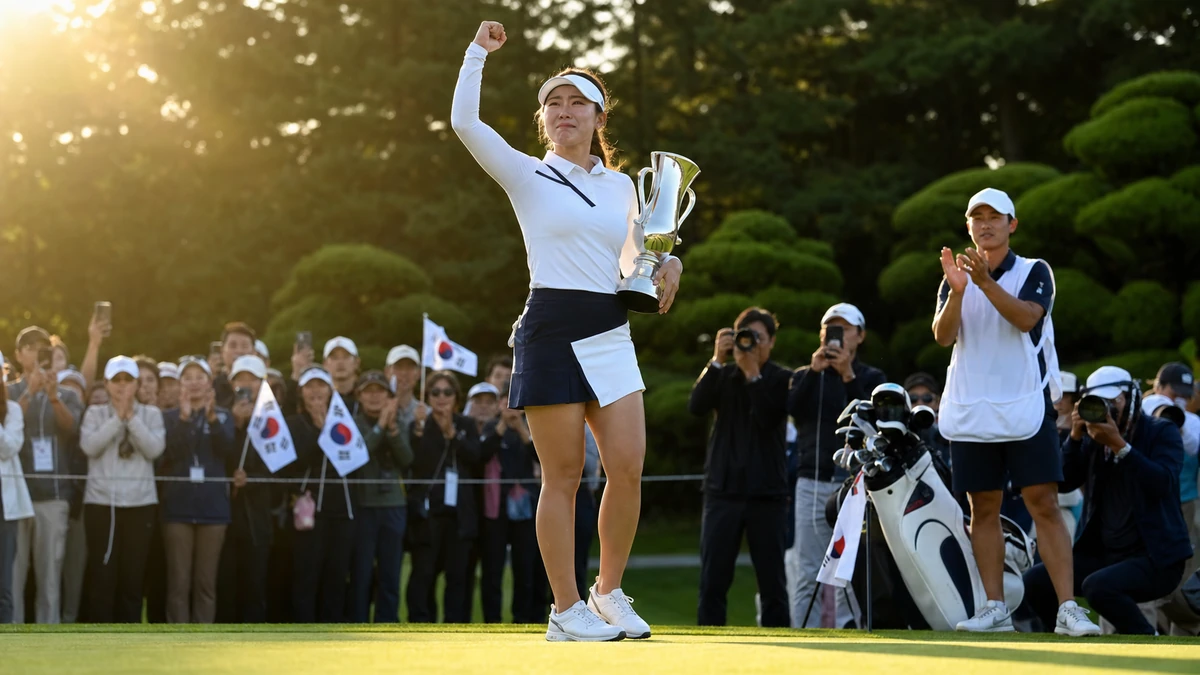
South Korea’s Kim Min-sol made one of the biggest moves in this week’s women’s golf world rankings, jumping 14 spots to No. 24 after winning the Korean Women’s Open, according to Yonhap News Agency. The ranking update, released Monday, gave Kim an average of 2.76 points and pushed her to the highest position of her career.
On paper, it is a straightforward sports story: a player wins a major domestic championship and is rewarded in the rankings. But Kim’s rise carries a larger meaning, both for followers of women’s golf and for readers outside South Korea who may not closely track the country’s sports scene. Kim began 2026 ranked No. 72 in the world. By last week she had climbed to No. 38. Now she is No. 24, a leap that reflects not just a single hot tournament but a season that has steadily changed how the sport evaluates her.
In a rankings system designed to reward consistency over time, that kind of movement matters. Golf rankings do not function like a viral moment on social media or a March Madness Cinderella run that flares up and disappears. They are meant to digest recent results, strength of competition and sustained performance. When a player rises nearly 50 spots within the same season, it usually means something substantial has changed.
For American readers, the easiest comparison may be the way a tennis player suddenly breaks into the global conversation after stringing together strong results at multiple events, not just one Grand Slam. Or the way a young LPGA player goes from a name mostly known to insiders to someone broadcasters start mentioning as a contender whenever she appears in the field. Kim is not yet at the very top of women’s golf, but her latest move suggests she is getting much harder to ignore.
Just as important, her rise highlights a familiar but still striking pattern in international golf: South Korea keeps producing elite women players at a remarkable rate. For years, the country has functioned as one of the sport’s deepest talent factories, and Kim’s surge is the newest example of that pipeline still delivering.
Why the Korean Women’s Open matters
The immediate trigger for Kim’s jump was her victory at the Korean Women’s Open Golf Championship, one of the marquee events on the KLPGA Tour. For readers in the United States, the KLPGA is South Korea’s main women’s professional golf circuit, roughly analogous in domestic significance to how Americans think about the LPGA as the country’s top women’s tour, though the Korean tour also serves as a major proving ground for players aiming to establish or strengthen their international reputation.
The Korean Women’s Open is not just another tournament stop. In South Korea, it is one of the most prestigious championships on the women’s calendar, carrying the weight that national opens often do in golf. Winning it means more than collecting a trophy or a paycheck. It places a player in a lineage of champions and gives her a result that resonates both domestically and internationally.
That explains why Kim’s ranking rise felt so immediate and so visible. Her victory on June 14 did not remain isolated as a local achievement appreciated only by Korean golf fans. Two days later, it had already translated into a tangible change in the world rankings. The sequence underscored how connected the modern golf ecosystem has become: performances on a strong domestic tour can quickly influence a player’s global standing.
For American sports audiences used to seeing major attention concentrated around the LPGA, the PGA Tour and the majors, it can be easy to overlook how powerful certain national tours are in shaping the world game. South Korea’s women’s circuit is one of those tours. It is competitive, demanding and closely watched, and success there often serves as a serious indicator of global potential.
Kim’s Korean Women’s Open victory also matters because it was her second KLPGA win of the year. That helps separate her current rise from the kind of one-off breakthrough that can create excitement without proving much staying power. Two wins in a season suggest something more durable: form, composure and the ability to close.
From No. 72 to No. 24, the numbers tell a bigger story
The most revealing part of Kim’s rise may be where she started. Opening the year at No. 72 and reaching No. 24 by midseason is not a modest improvement. It is a reintroduction. It tells the golf world that a player previously outside the inner circle of weekly global attention is now forcing her way toward it.
The 14-spot leap from No. 38 to No. 24 in a single week naturally draws headlines, and it should. But that jump makes the most sense when viewed as the latest stage in a broader trend. Kim’s results have been building. The rankings, which can sometimes feel abstract to casual fans, are in this case providing a clean numerical summary of a season that has gained momentum month after month.
Her average of 2.76 points is also significant because it represents the best mark of her career ranking-wise. In practical terms, that means Kim is not simply revisiting a previous peak. She is setting a new standard for herself. Athletes often speak in vague terms about confidence, growth and turning points, but rankings can give those ideas hard edges. No. 24 is not speculation. It is evidence.
For American readers who follow women’s golf only intermittently, the ranking movement is worth noting because the women’s game is increasingly global and layered. The top of the sport is no longer defined by one country or one tour. A rise like Kim’s reflects how much top-level competition exists beyond the tournaments most visible on U.S. television. It also shows how quickly the hierarchy can shift when a player puts together a strong run.
There is another reason the numbers matter: they suggest that Kim has moved from promising player to relevant player. There is a difference. Plenty of golfers are described as talented. Fewer force the rankings to acknowledge them this decisively. When the sport’s measurement system begins to catch up to what fans on the ground have been seeing, that is often when a new phase of a career begins.
South Korea’s enduring influence in women’s golf
Kim’s ascent lands in a broader national context that American audiences may recognize even if they do not follow Korean golf week to week. South Korea has long been one of the dominant powers in women’s golf, producing major champions, world No. 1 players and a seemingly endless stream of technically sharp, mentally disciplined professionals.
In the United States, fans have watched South Korean stars shape the LPGA for years. Names such as Pak Se-ri, Inbee Park, Ko Jin-young and Kim Hyo-joo are part of a longer story about how South Korea became central to the women’s game. Pak, in particular, is widely credited with inspiring a generation after her breakthrough success in the late 1990s. In Korean sports culture, she occupies a place that goes beyond statistics: a trailblazer whose achievements helped convince young players and their families that women’s golf could be a serious and prestigious path.
That legacy matters when evaluating Kim’s rise. She is not emerging from a vacuum. She is stepping into a system that has already proved it can develop world-class talent. South Korea’s women’s golf culture is known for its deep competitive structure, rigorous training and strong domestic interest. Young players grow up in an environment where excellence is expected, and where domestic events can feature fields strong enough to sharpen players for international competition.
In that sense, Kim’s story is both individual and systemic. Individually, she has earned this ranking through her own results. Systemically, her rise reinforces the idea that South Korea’s talent pipeline remains robust. That may be especially notable at a moment when the global sports conversation around South Korea often centers on pop culture exports like K-pop, Korean dramas and film. Golf does not always command the same cultural spotlight internationally, but it has been one of the country’s most consistent engines of soft power in sports.
For American readers, the larger takeaway is simple: when a South Korean woman starts climbing rapidly in golf, history says the rest of the world should pay attention. The country’s track record suggests that today’s rising player can become tomorrow’s major contender.
What this week’s rankings say about the global women’s game
Kim’s rise comes in a ranking landscape that already reflects how international women’s golf has become. American star Nelly Korda remained No. 1 in the latest rankings. Thailand’s Jeeno Thitikul held No. 2, and South Korea’s Kim Hyo-joo was No. 3. That top three alone captures the sport’s worldwide spread: the United States, Thailand and South Korea all represented at the very top.
Within that picture, Kim Min-sol’s move to No. 24 adds depth to South Korea’s presence. Kim Hyo-joo’s position near the summit shows that the country still has an established elite performer competing with the best in the world. Kim Min-sol’s surge, meanwhile, suggests another layer of strength: a newer face rising fast enough to expand that national footprint.
This matters because the health of a sports power is not measured only by whether it has a single superstar. It is also measured by whether there is a next wave. In American terms, think about the difference between a college basketball program built around one exceptional player and one that keeps producing top-level talent year after year. The latter reflects an ecosystem, not a one-time burst. South Korea’s women’s golf story has increasingly looked like the latter for a long time.
Kim’s rise also offers a reminder that rankings can tell a story about movement beneath the top five or top 10, where many casual fans tend to focus. The jump from No. 38 to No. 24 does not make her the favorite at every major overnight. But it does place her closer to the group that shapes tournament narratives, attracts broader media attention and begins to enter conversations about bigger stages.
As women’s golf continues to internationalize, players like Kim help show why the sport can be compelling beyond its most famous names. There is always another contender emerging from a strong national system, another player translating domestic success into global relevance, another storyline waiting just outside the familiar spotlight.
Why this resonates beyond Korea
To readers outside South Korea, especially in the United States, Kim’s rise may seem at first like a niche ranking note. But it resonates because it touches several bigger themes in modern sports: globalization, development systems and the way local success can suddenly matter on an international scale.
Golf is unusual in that way. A player can compete primarily in one national environment yet still affect the worldwide conversation through the ranking system. That creates a bridge between local fans and global audiences. Kim won one of the biggest titles on South Korea’s women’s calendar, and almost immediately, the global numbers reflected it. The moment translated.
There is also the emotional side that sports fans everywhere understand. Rankings are statistics, but they are also shorthand for belief. A move from No. 72 to No. 24 tells fans that what they have been watching is real. It validates excitement. In South Korea, where women’s golf has a substantial following, Kim’s climb gives supporters another player to rally around. Internationally, it introduces a competitor whose trajectory now looks worth following.
For Americans who may know South Korean sports mainly through Olympic archery, soccer or baseball in the World Baseball Classic, women’s golf deserves a place on that list of national strengths. And unlike some sports whose domestic structures remain less visible abroad, women’s golf regularly creates direct connections between Korean competition and international recognition.
Kim’s current standing does not guarantee what comes next. Rankings can rise and fall, and golf is notoriously unforgiving about assuming linear progress. The careful reading of this week’s news is not that she has already arrived at the very top, but that she has clearly entered a more serious tier of attention. Her Korean Women’s Open title, her two KLPGA wins this season and her new career-high ranking all point in the same direction.
That direction is why this story matters. South Korea has produced another women’s golfer whose results are becoming impossible to dismiss as local-only success. Kim Min-sol’s latest jump in the world rankings is, at minimum, the clearest sign yet that her season has moved from promising to consequential. In a sport where reputation is built shot by shot and week by week, that is a meaningful threshold.
The message of the moment
The simplest version of this story is still the most powerful. Kim Min-sol won a major domestic championship in South Korea and surged to No. 24 in the women’s world rankings, the best mark of her career. But the fuller meaning is that the rise appears to be earned through accumulation, not accident.
She started the year at No. 72. She climbed to No. 38. She now sits at No. 24 with an average of 2.76 points. Those numbers describe a player gaining traction fast, and they also reinforce a familiar truth about women’s golf: South Korea remains one of the sport’s most reliable producers of elite talent.
For American audiences, Kim may still be an introduction rather than a household name. But in global golf, introductions like this can quickly turn into bigger stories. Her latest move in the rankings does not close the book on her season. It opens a new chapter, one that more fans well beyond South Korea are now likely to notice.
Comments
Post a Comment