Torrential Rain Disrupts a UNESCO-Recognized Festival in South Korea, Offering a Reminder That Living Traditions Must Bend to Nature
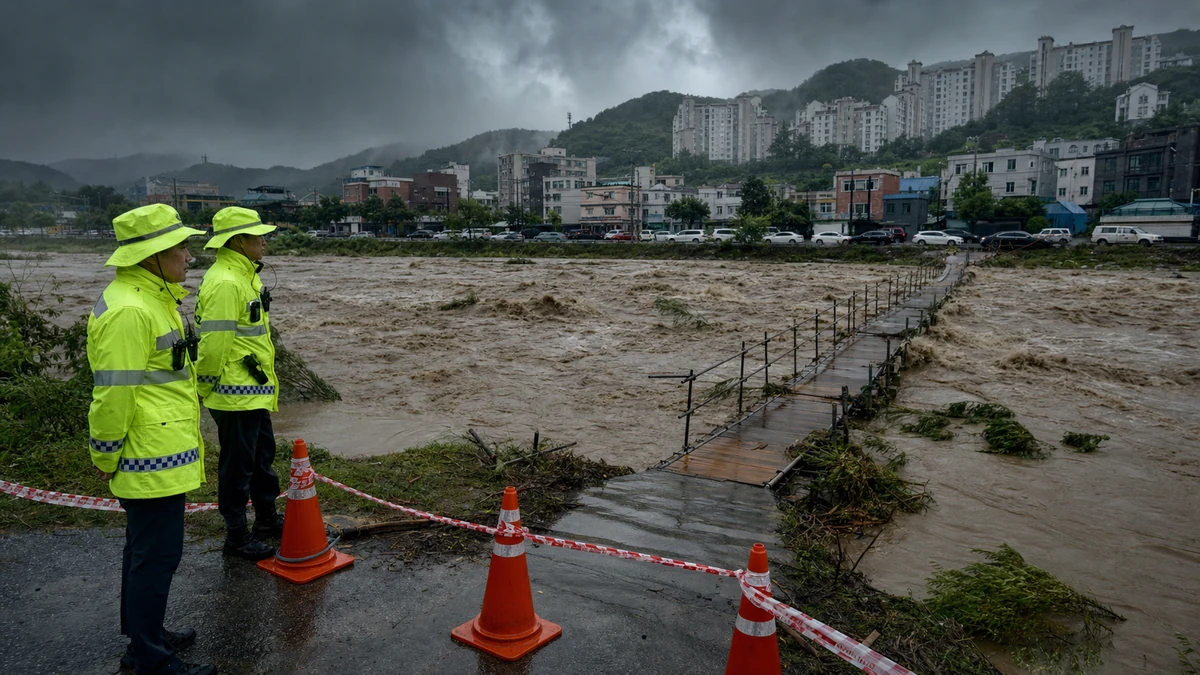
A major rainstorm reshapes one of South Korea’s best-known traditional festivals
Torrential rain forced organizers of South Korea’s Gangneung Danoje festival to cancel some events and move others indoors this week, disrupting a centerpiece cultural celebration on the country’s northeast coast and underscoring a reality familiar to festivalgoers anywhere: even the most cherished traditions must sometimes yield to the weather.
The changes came Friday after heavy downpours drenched Gangneung and surrounding parts of Gangwon Province, according to South Korean authorities and local organizers. Rainfall totals were especially severe in nearby mountainous areas, with Misiryeong recording as much as 207.5 millimeters, or a little more than 8 inches, while parts of the Gangneung area, including Bukgangneung and the coastal district of Jumunjin, also saw unusually high rainfall.
For Americans, the easiest comparison may be to a beloved regional fair, a heritage parade or a longstanding community celebration that suddenly has to rewrite the day’s script because a river rises, winds pick up or storm warnings roll in. But Gangneung Danoje is more than a local fair. It is one of South Korea’s most important traditional festivals, recognized by UNESCO as part of the world’s intangible cultural heritage, a designation reserved not for buildings or monuments but for living practices, rituals, music and community traditions handed down over generations.
That distinction matters. When weather disrupts a sporting event or a pop concert, the inconvenience is straightforward. When it affects a festival like Danoje, the disruption lands differently, because the event is tied not just to entertainment but to ritual, place and season. In Gangneung, those elements are deeply intertwined. The festival’s rhythms are linked to the local landscape, especially the Namdae Stream area where much of the action unfolds, and to a broader Korean cultural calendar rooted in agriculture, seasonal change and communal observance.
Rather than shutting the entire festival down, organizers chose a middle path: some outdoor programs were canceled outright, while others were relocated indoors in an effort to protect participants and preserve as much of the festival experience as possible. It was a practical decision, but also a revealing one. It showed that traditional culture, often romanticized as timeless and unchanging, is in fact highly adaptive when confronted with real-world conditions.
What Gangneung Danoje is — and why it matters
Gangneung Danoje, held annually in the eastern coastal city of Gangneung, is one of the signature traditional festivals in South Korea. This year’s event opened June 15 and is scheduled to run through June 22. At its core, Danoje is linked to Dano, a traditional seasonal observance that historically fell on the fifth day of the fifth month of the lunar calendar. In Korea, as in other parts of East Asia, that period has long been associated with rites for health, protection, good harvests and communal well-being.
To an American audience, the word “festival” might suggest something like a food fair, a music lineup or a tourism-driven city celebration. Gangneung Danoje includes those public-facing elements, but it is also grounded in older religious and communal practices. UNESCO recognized it not because it is simply colorful or popular, but because it preserves a complex blend of rituals, folk performances, games, shamanic traditions and civic participation that have endured across centuries.
In practical terms, that means the event brings together both ceremony and spectacle. Visitors can encounter ritual observances, traditional music and dance, folk games, literary competitions and family-friendly activities, all set within a city that has become one of the most recognizable cultural destinations on South Korea’s east coast. Gangneung itself is already familiar to many domestic travelers for its beaches, coffee culture and proximity to mountain scenery, but during Danoje, it becomes a stage for something older and more symbolic.
That symbolic dimension is part of what makes weather disruptions especially notable. This is not merely a case of vendors packing up tents or a stage act being delayed. The festival’s identity is rooted in outdoor space, processions, movement and the relationship between community and environment. When those conditions become unsafe, the festival can continue only by altering some of the very elements that make it distinctive.
For foreign travelers, and especially for readers in the United States who may know South Korea primarily through K-pop, Korean dramas and high-tech consumer brands, stories like this broaden the picture. They show a country whose global cultural influence is not confined to contemporary exports but also extends to regional traditions that remain active, public and deeply meaningful.
What changed on Friday as the storm moved in
Friday’s rain directly affected the Gangneung festival grounds, where rising water and deteriorating conditions made portions of the outdoor schedule difficult or impossible to operate safely. Organizers canceled the Gangwon Youth Activity Grand Festival, known as D.Y.F., as well as a swing competition that had been scheduled as part of the day’s programming.
The swing event may sound unusual to readers unfamiliar with Korean folk customs, but traditional swinging is associated with Dano celebrations in Korea and has historical roots as a seasonal pastime. In modern festival settings, such competitions are often part performance, part recreation and part cultural reenactment. Like many events centered on large outdoor structures and active public participation, it becomes hard to justify continuing in heavy rain and unstable conditions.
Other programs were not scrapped entirely but shifted indoors. That included a writing competition and an art event, both of which are common features of Korean local festivals and often invite participation from students, families and amateur artists. Moving them inside allowed organizers to preserve the spirit of the day’s programming while reducing exposure to storm-related hazards.
Such decisions may seem straightforward, but on the ground they require a complex logistical scramble. Organizers must redirect foot traffic, update signage, notify visitors, coordinate staff and volunteers, and recalibrate sound, seating and schedules on short notice. Festivalgoers, meanwhile, have to rethink transportation, timing and expectations. A family that came for open-air games may instead find itself navigating indoor venues. A tourist planning to photograph riverside scenery and performances may be left adjusting to a much narrower window of safe access.
In a large American city, event planners often have robust weather contingency plans for marathons, state fairs or holiday festivals. Gangneung Danoje’s response appeared to follow a similar logic: do not overreact by abandoning the event wholesale, but do not press ahead in ways that place visitors, performers or staff at unnecessary risk. That balance is increasingly central to cultural event management in an era of more volatile weather.
Why the river and the temporary bridge matter so much
Much of the festival is centered around the Namdae Stream in Gangneung, and that geography is not incidental. The riverfront setting helps create the atmosphere of the event, allowing visitors to experience performances, ritual spaces and pathways in a landscape that feels open, communal and historically grounded. Yet the same features that make the setting evocative in fair weather can make it vulnerable during intense rain.
One of the most visible consequences of Friday’s storm was the closure of a temporary bridge installed for the festival. Known in Korean as a “seopdari,” the structure is traditionally made in a simple, rustic style using natural materials. To foreign visitors, it may resemble the kind of temporary crossing erected for a historical reenactment, harvest fair or rural folk festival. During Danoje, it serves not only as a practical connector between parts of the festival space but also as a cultural symbol, reinforcing the event’s connection to older local traditions.
When the stream swells, however, that same bridge becomes an obvious safety concern. Restricting access is not merely a bureaucratic decision; it is an acknowledgment that the river is an active force in the life of the festival. This is one of the central truths embedded in many traditional celebrations, in Korea and elsewhere: the landscape is not just scenery. It is part of the event’s meaning, and sometimes part of its risk.
That relationship may be less familiar to Americans used to major events in convention centers, stadiums or tightly controlled urban plazas. But it would be recognizable in places where local identity is inseparable from terrain and climate — think of flood-prone river festivals in the Midwest, coastal seafood festivals during tropical storm season, or mountain gatherings where wildfire smoke or sudden weather fronts can upend plans. In such cases, the environment is never a neutral backdrop. It shapes what is possible.
In Gangneung, Friday’s adjustments illustrated that principle clearly. The festival did not lose its cultural significance because a bridge closed or a contest moved indoors. If anything, the moment highlighted how living traditions function in real time: they are negotiated with weather, water, place and public safety, not preserved in perfect form under glass.
The broader tourism impact across Gangwon Province
The storm’s effects extended beyond Gangneung Danoje itself. Heavy rainfall in Gangwon Province also led to restrictions in the nearby Seoraksan area, one of South Korea’s most famous mountain destinations. Authorities controlled access to high-elevation hiking trails in Seoraksan National Park after the rainfall intensified.
For travelers, that matters because Gangneung and Seoraksan are often part of the same itinerary. Much as U.S. tourists might pair a heritage festival with a national park visit, domestic and international visitors in South Korea frequently combine coastal sightseeing, cultural events and mountain excursions into a single regional trip. In that sense, the storm did not just alter one festival day. It changed the experience of the broader east coast travel corridor.
Weather advisories were also in place Friday afternoon for parts of the region, including Sokcho and Yangyang, while strong wind and rough sea conditions affected the eastern coastline. That meant the disruption was not limited to a single venue or city block. It was regional, touching mountains, roads, coastlines and public event spaces at once.
For local businesses, this kind of shift can be consequential. Restaurants, hotels, taxi drivers, café owners and market vendors often rely on festival traffic and seasonal tourism. When a major event scales back its outdoor programming, the effect ripples outward. Visitors may shorten stays, change routes or spend less time on foot in surrounding commercial districts. Those are familiar vulnerabilities in tourism economies from South Carolina beach towns to New England foliage regions, and they apply just as readily in South Korea.
Still, there is another side to the story. A cautious, transparent response can also protect a destination’s reputation. Visitors are more likely to trust an event or city that prioritizes safety than one that appears slow to react to obvious hazards. In that respect, Gangneung’s decision to cancel some activities, move others inside and restrict access to risky infrastructure may have caused disappointment in the short term but helped preserve confidence in the long term.
A lesson in how traditional festivals survive in a changing climate
The most striking part of Friday’s disruption may be that the festival was not entirely halted. Instead, organizers adjusted, selectively and quickly. That is worth noting because it speaks to a broader question facing cultural institutions around the world: how do communities preserve tradition without pretending the conditions around those traditions have stayed the same?
In many countries, heritage events are marketed through images of continuity — costumes, rituals, songs and settings presented as if they exist outside time. But that is rarely true. Living culture survives precisely because it adapts. Ceremonies shift locations. Schedules change. Infrastructure is modernized. Safety rules evolve. What remains constant is not the exact format of every hour on the program, but the community’s commitment to carrying the tradition forward.
That dynamic is especially important as extreme weather becomes more common and more disruptive worldwide. Whether the issue is heat waves affecting summer festivals in Europe, wildfire smoke reshaping public events in the American West, or torrential rains disrupting monsoon-season travel in Asia, organizers increasingly have to build flexibility into celebrations once assumed to be relatively stable.
Gangneung Danoje offers a useful case study. Its UNESCO status might lead some outsiders to imagine an event preserved in almost ceremonial stillness. Friday’s reality was the opposite: a globally recognized tradition responding in real time to local danger. That does not diminish its authenticity. It demonstrates it. A museum display does not have to worry about a river rising. A living festival does.
There is also an important cultural point here for international readers. In South Korea, traditional festivals are not simply tourist products manufactured for outside consumption. They are embedded in local identity and civic memory. Even when they attract visitors from across the country and abroad, they remain community events first. The decision to alter the schedule, then, was not just an operational call. It reflected a responsibility to residents, participants and the festival’s custodians as much as to tourists.
What international readers should take away from Gangneung’s stormy festival day
For readers outside Korea, the image of a rain-soaked festival on the country’s east coast may at first sound like a narrow local story. In fact, it captures several bigger themes at once: the endurance of regional tradition in a globalized country, the growing challenge of weather volatility for cultural tourism, and the way heritage is sustained not by rigidity but by adaptation.
Gangneung is often promoted as a city where sea, food, coffee and culture meet. During Danoje, it becomes something more layered: a place where modern tourism intersects with ritual memory and community performance. Friday’s storm did not erase that identity. It revealed its practical limits and its resilience.
That may be the most useful way to understand what happened. The story is not that a famous Korean festival failed because of rain. It is that a major cultural event met difficult conditions and responded the way responsible public institutions increasingly must — by scaling back where necessary, moving what it could, and refusing to confuse tradition with inflexibility.
For American audiences used to seeing South Korea through the lens of Seoul’s dazzling urban pace or the global reach of Korean entertainment, Gangneung Danoje offers another frame entirely. It shows a country where heritage remains local as well as national, seasonal as well as symbolic, and vulnerable to the same forces of weather and geography that shape community life everywhere.
By day’s end, the festival’s revised schedule may have disappointed some visitors who arrived expecting uninterrupted outdoor spectacle. But the adjustments also affirmed something more durable: the value of a living tradition lies not in perfect conditions, but in the community’s ability to carry it forward when conditions are anything but perfect.
Comments
Post a Comment