
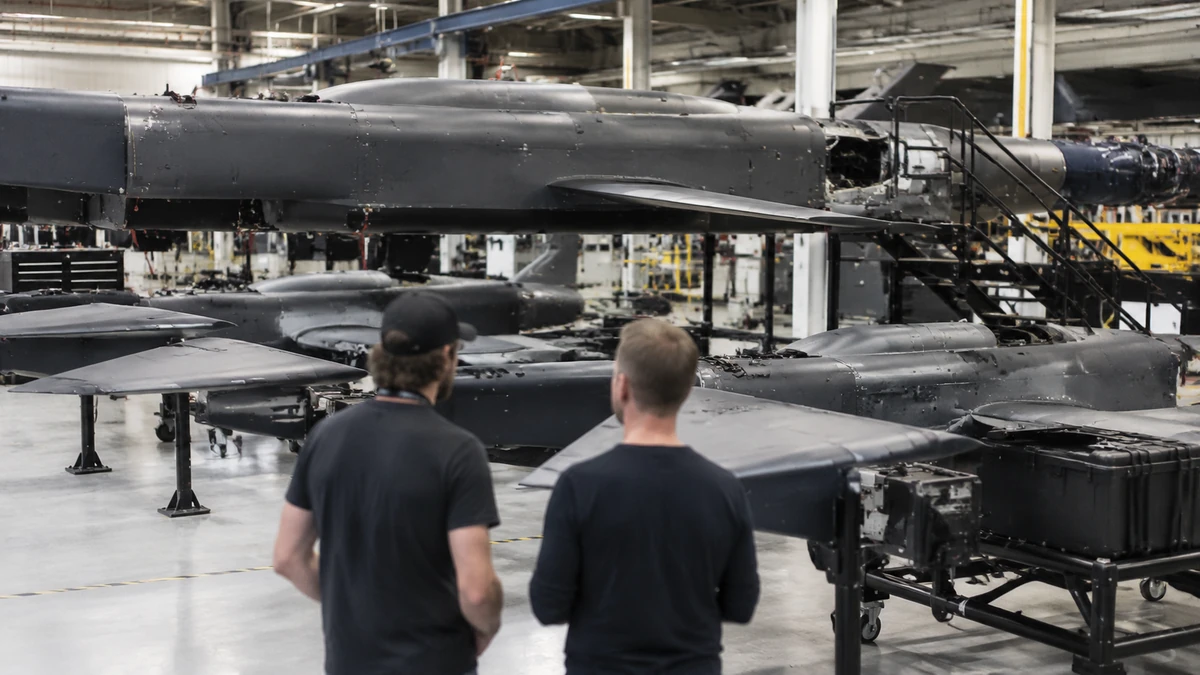
A Silicon Valley-style defense company raises a Washington-sized question
When the chief executive of Anduril Industries called for a “reset” of America’s arms export control system, the remark landed as more than a routine corporate complaint about regulation. It touched a nerve in one of the most important debates now shaping U.S. national security policy: How much of the West’s military production base should remain tightly controlled in the United States, and how much should be shared with allies?
According to reports on an interview published June 14, Anduril CEO Brian Schimpf argued that the United States needs to make large numbers of lower-cost weapons and that allied countries should play a bigger role in expanding that production capacity. To make that possible, he said, the U.S. system of arms export controls — especially the rules known as the International Traffic in Arms Regulations, or ITAR — needs a reset.
That wording matters. In Washington, “reform” is a familiar and often vague term. “Reset” suggests something broader: not just streamlining paperwork, but rethinking the balance between control and cooperation. And that is why Schimpf’s comments have drawn attention beyond the defense industry. They point to a larger question the United States and its partners have been wrestling with for years, but with greater urgency since Russia’s war in Ukraine and rising tensions in the Indo-Pacific: If democracies want to deter conflict and replenish stockpiles quickly, can they do it with a defense production model built for a different era?
For American readers who do not follow export-control law, ITAR can sound like obscure bureaucratic jargon. In practice, it is one of the central guardrails governing how U.S. weapons and related military technology can be shared abroad. The system was designed to prevent sensitive know-how from spreading to adversaries or unstable actors. That mission still has bipartisan support. But critics increasingly argue that the same rules can also slow collaboration with close allies, making it harder to scale production at the speed current security challenges may require.
Schimpf’s intervention is significant partly because of who he is and what kind of company he leads. Anduril is not a legacy defense contractor in the mold of Lockheed Martin, Northrop Grumman or Raytheon. It belongs to a newer class of defense technology firms that borrow the language and operating style of Silicon Valley: software-driven systems, rapid iteration, autonomy, sensors and lower-cost platforms produced at larger scale. When a company like that pushes for a change in export controls, it signals not just a lobbying effort but a shift in how parts of the defense sector think about speed, cost and industrial capacity.
What ITAR does — and why companies say it can become a bottleneck
ITAR is the regulatory framework the U.S. government uses to control the export of defense articles, services and technical data. Administered by the State Department, it covers a wide range of military items and related technology. In plain English, if a weapons system, part, blueprint or technical process is deemed sensitive, moving it to another country or even sharing certain information with foreign nationals can require government approval.
That may sound strict because it is. And it is strict for understandable reasons. A fighter jet, missile component, drone sensor or targeting software is not the same as exporting household electronics or auto parts. Military technology can alter the balance of power, reveal U.S. capabilities or eventually fall into the wrong hands through espionage, diversion or political change in a partner country. Export controls exist because governments have learned, often the hard way, that once sensitive technology spreads, it is hard to pull back.
Still, what protects can also constrain. Defense companies and some policy analysts have long argued that ITAR can operate as a choke point in global defense supply chains, even when the countries involved are treaty allies or longstanding security partners. The problem is not simply that approvals take time, although they often do. It is also that companies designing multinational production lines may avoid using U.S.-controlled components or technology in the first place if they believe those rules will complicate manufacturing, maintenance, upgrades or re-export down the line.
That dynamic is sometimes described in industry shorthand as the “ITAR taint” problem: once a product incorporates enough controlled U.S. content, the rules can affect what happens to it afterward. Supporters of reform say this can discourage collaboration rather than protect it. Defenders of the current system counter that the answer is better administration and narrower tailoring, not a broad loosening of safeguards.
Schimpf’s comments appear to sit squarely inside that debate. Based on the reporting available, he did not present a detailed legislative blueprint, and no policy change has been announced by the U.S. government. But by framing the issue around a “reset,” he suggested that the problem is not merely one of inefficient case processing. He implied that the existing control structure may not match a world in which allied production, co-development and distributed manufacturing are becoming more central to deterrence.
The real issue behind the headline: cheap, numerous weapons
The most revealing part of Schimpf’s argument may be his emphasis on the need for low-cost weapons produced at scale. That idea reflects a broader transformation underway in military thinking.
For decades, much of the American defense industrial model has centered on highly sophisticated, expensive platforms that take years to design and field. Think aircraft carriers, stealth aircraft, top-tier missiles and advanced command systems. Those systems remain crucial, and no one serious in defense policy argues they are obsolete. But recent conflicts have underscored another reality: quantity matters, too.
Ukraine’s war against Russia has shown how quickly large-scale fighting can burn through munitions, drones, air defenses and spare parts. It has highlighted the importance of resilient supply chains and the ability to replace losses rapidly. Meanwhile, U.S. military planners focused on the Indo-Pacific have increasingly talked about the value of attritable systems — platforms, especially unmanned ones, that are cheaper, easier to field and acceptable to lose in combat if they help achieve a larger objective.
That is the world in which a company like Anduril sees opportunity. The startup has built its brand around autonomous systems, border and base surveillance technologies and lower-cost military hardware that can be produced faster than traditional big-ticket programs. So when its CEO talks about mass production, he is not just making an abstract geopolitical point. He is also making an argument aligned with the business and technological philosophy of his company.
Still, the substance of the issue goes beyond one firm’s commercial interests. If the United States truly needs a deeper bench of factories, subcontractors and partner nations capable of producing key military systems and components, then export controls inevitably become part of the conversation. You cannot ask allies to help build more without also asking what technical data they can access, what components they can manufacture, what assembly work they can perform and what legal restrictions govern those steps.
In other words, production scale is not just a factory-floor problem. It is a rules problem.
Why allied participation is efficient — and politically sensitive
On one level, Schimpf’s point is intuitive. No single country, even the United States, can easily produce everything it may need in a crisis while also sustaining long-term competition with major rivals. Sharing production across allied nations can spread costs, expand manufacturing capacity and reduce pressure on any one industrial base. It can also reinforce political alignment: countries that build together tend to plan together, train together and sustain systems together.
Americans are already familiar with versions of this logic in other sectors. The semiconductor debate, for example, has pushed Washington to think more seriously about trusted supply chains with partners such as Japan, South Korea, Taiwan and European allies. Energy security debates often follow a similar pattern. Defense is different because the stakes are higher and the technologies more sensitive, but the underlying policy dilemma is recognizable: how do you deepen interdependence with friends without creating new vulnerabilities?
That is where the controversy begins. Expanding allied participation in weapons production sounds efficient, but it raises difficult questions about oversight and sovereignty. Which countries count as sufficiently trusted partners? Would they receive broader standing permissions, faster licensing or special exemptions? How would Washington ensure that technology shared for one purpose is not later transferred, intentionally or accidentally, in ways the United States did not anticipate? What happens if a partner’s domestic politics shift or if a future government adopts a foreign policy at odds with Washington?
These concerns are not theoretical. Export control systems are built on the assumption that military technology is uniquely consequential. Even among allies, intelligence sharing and weapons cooperation are often tiered, limited and highly compartmentalized. The United States may fight alongside allies, but it does not automatically treat all allies equally when it comes to access to top-tier military know-how.
That is why Schimpf’s use of the word “reset” is so provocative. The closer allies move from being buyers to being co-producers, the more export control becomes a question of power-sharing. This is not just about selling finished equipment abroad. It is about who gets to make it, modify it, maintain it and potentially build the next version of it. Those are deeply strategic decisions.
A debate shaped by Ukraine, China and the strain on Western arsenals
Although the reported remarks came from a corporate leader rather than a government official, the timing helps explain why they resonate. Western governments have spent the past several years confronting uncomfortable facts about defense readiness. The war in Ukraine has exposed the limits of peacetime production assumptions. Stockpiles that once appeared adequate suddenly looked thinner. Munitions manufacturing that had been optimized for efficiency rather than surge capacity came under pressure. And policymakers found themselves asking whether NATO countries and other U.S. partners could collectively sustain a prolonged period of high demand.
At the same time, strategic competition with China has intensified the sense that industrial capacity itself is part of deterrence. American officials increasingly speak not only about military capabilities in the abstract but about the ability to produce ships, missiles, drones, sensors and batteries over time. In a prolonged crisis, the side with the more adaptable industrial ecosystem may hold an advantage.
This is where Anduril’s framing dovetails with a much larger policy current. A lower-cost, higher-volume approach to some categories of weapons fits the lessons many defense thinkers have drawn from recent conflicts. So does the idea of relying more heavily on trusted allies to build resilience into the supply chain.
Yet the United States has never found it easy to reconcile that ambition with its habit of guarding military technology closely. Washington wants capable allies, but it also wants control. It wants interoperability, but it worries about leakage. It wants speed, but it fears relaxing safeguards in ways it may later regret. Those tensions are not signs of policy failure so much as enduring features of American statecraft.
That is why no one should confuse Schimpf’s comments with an imminent rule change. The reporting summarized a public argument, not a finalized proposal. There is no indication from the material available that the U.S. government has adopted a new ITAR policy, approved a specific change or laid out an implementation timetable. What exists now is a signal that pressure is building for a broader argument over how the rules should evolve.
Why this story traveled internationally, including in South Korea
At first glance, a U.S. export-control debate might seem like inside baseball even for many American readers, let alone audiences overseas. But it becomes international news because U.S. defense rules do not stay inside U.S. borders. They shape the terms under which allies buy American systems, participate in production networks and handle military technologies linked to the United States.
That is one reason the story drew attention in South Korea, where defense issues are followed closely not only because of the threat from North Korea but also because South Korea has become an increasingly prominent player in global arms manufacturing. Even without any specific evidence in this case that South Korea is directly involved in Anduril’s argument, Korean readers can easily see the relevance. If the United States were ever to alter how it manages export controls with allies, the effects could ripple through procurement decisions, technology partnerships and supply-chain planning across many countries.
For American audiences, it helps to understand that Korean news coverage often places U.S. alliance questions in a broader regional and industrial context. In South Korea, debates about missile defense, ammunition stocks, alliance coordination and domestic defense production are not abstract foreign policy topics. They sit close to everyday national security consciousness in a way many Americans may associate more with countries near active conflict zones or longstanding military threats.
So when a U.S. defense executive argues that allies should do more of the making, not just the buying, foreign media outlets naturally pay attention. The comment raises a practical question for countries that are U.S. partners: If Washington wants more shared production, how much trust is it actually prepared to extend?
The policy fight ahead is about design, not slogans
The strongest takeaway from this episode is not that America’s export-control regime is suddenly about to be dismantled. It is that the old balance between security restrictions and industrial cooperation is being challenged more openly. The pressure is coming from several directions at once: battlefield lessons, supply-chain stress, rising demand for lower-cost systems and the growing role of tech-driven defense firms that move faster than traditional procurement culture often expects.
If the debate advances, the hard part will not be agreeing on broad goals. Few policymakers would oppose making the United States and its allies more capable of producing what they need. Few would argue for abandoning safeguards on sensitive military technologies. The real conflict lies in the details: which allies qualify for easier rules, which categories of systems can be shared more flexibly, what oversight mechanisms are acceptable and how much bureaucratic risk the U.S. government is willing to tolerate in exchange for speed and scale.
There is also a domestic political angle. Calls to loosen or redesign export controls can trigger suspicion in Washington because they are easily framed as putting corporate convenience ahead of national security. Companies like Anduril may argue that the current system is outdated for an era of allied industrial integration. Critics may hear something else: an effort by private industry to reduce constraints on lucrative international business. Both interpretations can coexist, which is part of what makes the debate politically charged.
For now, the most accurate way to read Schimpf’s remarks is as an opening in a continuing policy argument, not as proof of a settled new direction. His call for an ITAR “reset” distills a larger strategic dilemma into a single phrase. If the United States wants democracies to build more military capacity together, it may have to share more authority and accept more complexity. If it refuses, it may preserve tighter control but at the cost of speed, scale and flexibility.
That trade-off is no longer a niche concern for export lawyers and defense contractors. It is becoming a central test of how the United States and its allies prepare for a world in which industrial capacity, not just technological superiority, may determine the balance of power. In that sense, the significance of this story is not the headline-grabbing word “reset.” It is the unresolved question underneath it: whether America can modernize the rules of military cooperation without weakening the protections those rules were built to provide.



0 Comments