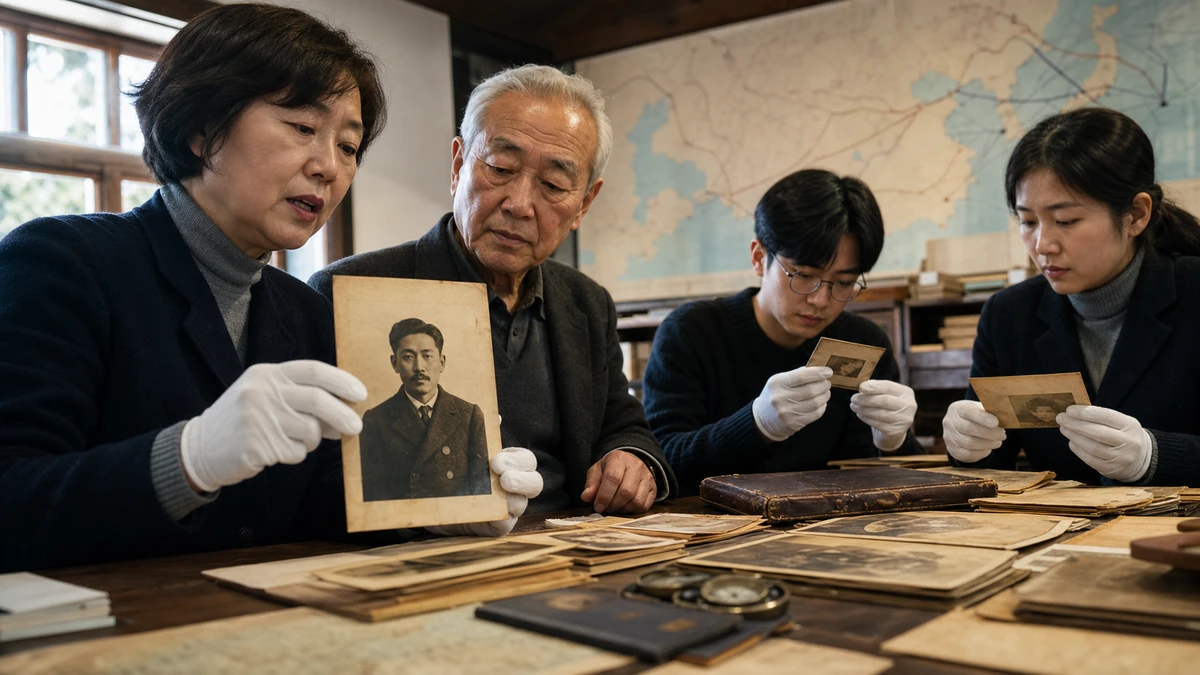
A forgotten name returns in a city built by memory
In the southwestern South Korean city of Gwangju, a community founded by ethnic Koreans with roots in the former Soviet Union is bringing renewed attention to a man whose life stretched across some of the most turbulent fault lines of the early 20th century. Goryeoin Village, a well-known settlement and cultural hub for descendants of Soviet Koreans in Gwangju, said this week it has selected independence activist Kim Jeong-ha as the 27th figure recognized through a joint historical recovery project with Koryo Ilbo, a Korean-language newspaper published in Moscow.
On its face, the announcement might sound like a routine addition to a historical roster. It is not. The project, focused on identifying and supporting descendants of Korean independence activists in Russia’s Primorsky region and across the former Soviet sphere, is part archival work, part family tracing effort and part act of public remembrance. In Kim’s case, it is also a reminder that Korea’s struggle against Japanese colonial rule did not unfold neatly within the borders of the Korean Peninsula. It spilled into today’s Russia and China, into Shanghai’s political underground and even into Moscow, following the paths of exile, organizing, survival and resistance.
For American readers, one useful comparison might be the way historians continue to recover overlooked figures from the U.S. civil rights movement or from anti-fascist struggles in Europe — people whose contributions were real but scattered across intelligence files, local newspapers, aliases and fragmented family memories. Kim’s story fits that pattern. He was born in 1897 in what is now North Korea and died in 1938 during the Stalin era, after years of activity linked to the Korean independence movement. Between those dates, according to the Gwangju project, he worked across the Russian Far East, Manchuria, Shanghai and Moscow, taking part in armed resistance, intelligence gathering and youth education.
The breadth of that record is precisely what makes him significant today. His life suggests that the Korean independence movement was not only a military or nationalist cause but also a transnational network that depended on teachers, organizers, informants and community leaders as much as it did on fighters. Recovering his name now says as much about how South Korea remembers its past as it does about the man himself.
Why this matters beyond Korea
For many Americans, Korea’s independence story is often compressed into a few familiar markers: Japan’s colonization of the peninsula from 1910 to 1945, the March 1 independence movement of 1919, liberation at the end of World War II, and then the division of the peninsula that led to the Korean War. Those milestones are important, but they can obscure how geographically dispersed the anti-colonial struggle really was.
Many Korean activists operated outside Korea because they had little choice. Japanese imperial surveillance was pervasive. Arrest, torture and imprisonment were common. As a result, activists moved through border regions and diaspora communities, especially in the Russian Far East, Manchuria and Chinese treaty-port cities such as Shanghai. These places became staging grounds for independence organizations, armed groups, schools, publications and political networks. In that sense, Kim’s movements across Vladivostok-area communities, Manchuria, Shanghai and Moscow reflect a larger truth: Korean resistance was often a story of people in motion.
That broader geography can be hard to visualize if one thinks of independence movements only in terms of fighting on home soil. But many anti-colonial campaigns have depended on exile communities. Irish nationalists organized in the United States. Anti-apartheid activists built support networks abroad. Leaders of colonized nations often relied on foreign cities as bases for fundraising, diplomacy, media work and covert operations. Korea was no exception.
Kim’s rediscovery also highlights another point that resonates well beyond East Asia: the fragility of historical memory when records are scattered across languages, governments and generations. The fact that his work is being revisited through cooperation between a community in Gwangju and a newspaper in Moscow underscores how history can survive in unlikely places. It also shows how diaspora communities often become guardians of stories that nation-states themselves only later piece back together.
The world Kim Jeong-ha moved through
According to the project organizers, Kim Jeong-ha devoted himself to the independence cause from the late 19th-century world into the brutally unstable 1930s, moving through several of the key spaces that shaped Korean exile politics. He was active in the Russian Far East, known in Korean as Yeonhaeju, a region that included communities of ethnic Koreans who had migrated there in large numbers before and during Japanese colonial rule. He also worked in Manchuria, the vast northeastern region of China that became a major base for Korean guerrilla activity. His path then extended to Shanghai, long a magnet for political exiles and revolutionaries, and to Moscow, where competing visions of socialism, anti-imperialism and state control collided.
Each of those locations carried its own political meaning. The Russian Far East was home to a significant Korean diaspora that supported schools, churches, newspapers and political organizing. Manchuria was both refuge and battleground, a place where armed resistance could be mounted but where danger was constant. Shanghai was, in some ways, the nerve center of Korean nationalist exile politics; the Provisional Government of the Republic of Korea was established there in 1919. Moscow represented another kind of hub — one connected to Soviet power, ideology and international networks, but also, eventually, to repression.
Kim’s work reportedly spanned armed struggle, intelligence collection and youth education. That mix matters. It suggests he was not simply a fighter in the narrow sense Americans may associate with the term “independence activist.” Rather, he appears to have been part of the broader infrastructure of resistance. Armed action may attract the most attention in public memory, but movements do not endure on force alone. They require information, strategy, communication and the training of younger generations. In that respect, Kim’s story points to the less cinematic but equally essential labor that sustains political struggle.
The emphasis on youth education is especially telling. Education in colonial and exile settings often served as more than schooling. It was a way to preserve language, identity and political purpose. Teaching young people could mean preparing future organizers, helping communities survive cultural erasure and ensuring that resistance outlived a single generation. If armed struggle represented the immediate front line, education was the long game.
Just as important is the mention of intelligence gathering. The available summary does not provide operational details, and responsible reporting requires caution on that point. Still, the inclusion of intelligence work alongside combat and education indicates that Kim was involved in reading conditions on the ground, transmitting information or helping movements act on knowledge rather than impulse. That role complicates any one-dimensional image of an independence activist. He was operating in a world where survival depended on secrecy, mobility and judgment.
The significance of an alias in a police state
One of the most revealing details in the account is that Kim reportedly also used the name Lee Seong-beom, among other aliases, to evade Japanese surveillance. To modern readers, aliases can sound theatrical, the stuff of spy novels and resistance dramas. In colonial East Asia, however, they were often a practical necessity. Names could be altered to cross borders, protect associates, confuse investigators or continue work after a crackdown.
But what helped a person survive in one era can erase that person in another. When an activist appears in different records under different names, the paper trail begins to fracture. A report in one archive might describe a teacher. Another file, under another name, might describe a courier or fighter. Still another source might record an arrest, a transfer or a death. Unless researchers can connect those pieces, the historical record remains splintered, and descendants may never know the full story of the person they are related to.
That is one reason the language of “discovery” or “excavation” used by Korean organizations in these projects matters. It is not simply ceremonial. It describes genuine reconstruction work. Researchers must compare names, dates, places and roles across multiple records, often in Korean, Russian, Chinese and Japanese. They also have to account for spelling variations, political bias in official documents and the fact that colonial authorities had their own reasons for misidentifying or simplifying the people they tracked.
For an American audience, there is a familiar parallel in immigration records, military files or surveillance documents involving people who moved between languages and legal systems. A name written one way on a passenger list may appear differently in a census, and differently again in a police report. Historians of marginalized communities know this problem well. What looks like a bureaucratic discrepancy can mean the difference between being remembered and being lost.
Restoring Kim’s identity, then, is about more than correcting a line in a database. It is about turning scattered evidence back into a human life. To say that Kim Jeong-ha also moved under the name Lee Seong-beom is to illuminate not just what he did, but the dangers he faced while doing it. The alias itself becomes evidence of colonial pressure.
Why Goryeoin Village is leading the effort
The institution at the center of this announcement also deserves explanation. Goryeoin Village in Gwangju is not just a neighborhood label. “Goryeoin” refers to ethnic Koreans in the former Soviet Union, many of whose ancestors migrated to the Russian Far East in the late 19th and early 20th centuries before later being forcibly deported by Stalin in 1937 to Central Asia. In recent decades, some descendants have migrated to South Korea for work, study or resettlement, and Gwangju has become one of the country’s best-known centers of that community.
That makes the village an especially fitting place for this kind of memory work. It stands at the intersection of homeland, diaspora and historical displacement. The same routes that once carried anti-colonial activists through borderlands later became routes of exile for ordinary Koreans under Soviet rule. In other words, the community’s own existence reflects the same border-crossing history that shaped Kim’s life.
The partnership with Koryo Ilbo in Moscow is equally significant. Newspapers in diaspora communities often function as more than media outlets; they are archives, translators, connectors and keepers of communal memory. By working with a Korean-language paper based in Russia, the project is effectively linking present-day institutions to the transnational world that figures like Kim inhabited. The method mirrors the subject.
This is the project’s 27th such selection, according to the organizers, and that number matters in its own right. It signals persistence rather than one-off commemoration. In an age when public remembrance often favors grand anniversaries, monuments and headline-driven ceremonies, there is something strikingly methodical about identifying one person at a time, reconstructing a biography and seeking descendants who may still carry the consequences of that history. It is an archival approach to memory, and arguably a more durable one.
There is also a subtle but important shift in emphasis here. The project is not only about honoring the dead. It explicitly includes finding and supporting descendants. That reflects a broader view of historical justice — one that asks not only who was brave, but who has lived in the aftermath. It recognizes that the legacy of colonial resistance did not end in 1945. It continued through families, migration, poverty, displacement and inherited silence.
A life shaped by two empires — and crushed by another
If Japanese colonial rule formed the original pressure that drove activists like Kim across borders, the summary of his life points to another harsh reality of the era: exile did not necessarily guarantee safety. Kim is said to have died in 1938 amid repression under Stalin’s regime, a year after the mass deportation of ethnic Koreans from the Soviet Far East to Central Asia. That detail places his story within a second major trauma — one that is still insufficiently understood outside specialist circles.
For many Americans, Stalinist repression may evoke the Great Purge, show trials and labor camps. What is less widely recognized is how those campaigns also ensnared ethnic minorities and political migrants across the Soviet Union, including Koreans. In the Soviet Far East, Korean communities that had once seemed like strategic assets or revolutionary allies were increasingly treated with suspicion, especially amid fear of Japanese espionage. The result was collective punishment on a vast scale.
Kim’s death in 1938, after years spent resisting one empire, suggests the tragic irony faced by many stateless or displaced activists of the time. They fled colonial domination only to encounter new authoritarian dangers elsewhere. That does not diminish the significance of Soviet anti-imperial rhetoric in earlier decades, nor does it erase the support some Korean activists found in socialist circles. But it does remind us that history rarely offers clean moral geography. The same places that offered refuge could become sites of persecution.
That complexity is part of why Kim’s recovery matters now. He does not fit neatly into a single national narrative or ideological template. He was a Korean independence activist, but also a migrant political actor in Russian and Chinese spaces. He was involved in armed resistance, but also in education. He worked under multiple names. He moved through communities later scarred by Soviet state violence. The very difficulty of summarizing him in one line may be what makes him so historically valuable.
How South Korea remembers the independence movement today
There is also a contemporary Korean story embedded in this announcement. South Korea has long honored prominent independence figures, but in recent years there has been growing interest in recovering lesser-known activists, regional networks and diaspora histories that had fallen outside the mainstream national narrative. That shift reflects a maturing historical culture — one less satisfied with a handful of iconic names and more willing to examine the complicated social worlds that made resistance possible.
In practical terms, that means more attention to archives, local initiatives and cross-border collaboration. It also means recognizing that not all heroes looked like textbook heroes. Some were teachers. Some were couriers. Some changed names repeatedly. Some died far from home. Some left behind descendants who were never fully integrated into South Korea’s official memory of the independence struggle.
The work of naming and renaming has special weight in Korea, where the legacy of colonization remains emotionally and politically charged. Public debates continue over forced labor, wartime sexual violence, textbooks and historical accountability. Against that backdrop, recovering someone like Kim is not just a backward-looking exercise. It is part of an ongoing argument about whose sacrifices count, how a nation tells its founding story and whether historical recognition can extend beyond the most familiar figures.
For American readers, there is a useful lesson here. Nations often build their civic memory around a selective set of symbols. Over time, that can flatten the past into something simpler than it really was. Efforts like the one in Gwangju push in the opposite direction. They insist that history is richer, messier and more geographically entangled than public ritual alone can capture.
The meaning of connecting scattered memories
Ultimately, the rediscovery of Kim Jeong-ha is about more than a single activist. It is about how societies recover lives that were fragmented by empire, war, surveillance and exile. It is about the labor required to connect a birth name to an alias, a hometown to a diaspora settlement, a political struggle to a surviving family line. And it is about accepting that some of the most important chapters in national history happened far from the nation’s current borders.
Kim’s life, as presented by the project, ran from 1897 to 1938, but those dates alone say almost nothing. What gives them meaning are the routes between them: Hamgyeong Province to the Russian Far East, borderland activism to Shanghai, education to intelligence work, anti-colonial resistance to Stalin-era repression. The map of his life is also a map of modern Korean upheaval.
In that sense, the announcement from Gwangju offers a larger invitation. It asks readers to think of independence not only as a victory eventually achieved in 1945, but as a long, uncertain process carried by people whose names could disappear into paperwork, whose movements crossed political systems and whose descendants might one day need others to piece their stories back together.
For a community like Goryeoin Village, built by descendants of Koreans whose own history spans the Soviet Union and the Korean Peninsula, this kind of remembrance is not abstract. It is lived. The past is not a sealed archive; it is in the neighborhoods people build, the languages they preserve and the names they fight not to lose.
By selecting Kim Jeong-ha as the 27th figure in its recovery effort, the project has done something both modest and profound. It has added one more person back into public memory. But in doing so, it has also illuminated an entire world of movement, danger, conviction and historical fracture — a world that shaped Korea, and that still has much to teach anyone trying to understand how freedom movements survive when borders, governments and even names themselves cannot be trusted to hold.
Comments
Post a Comment