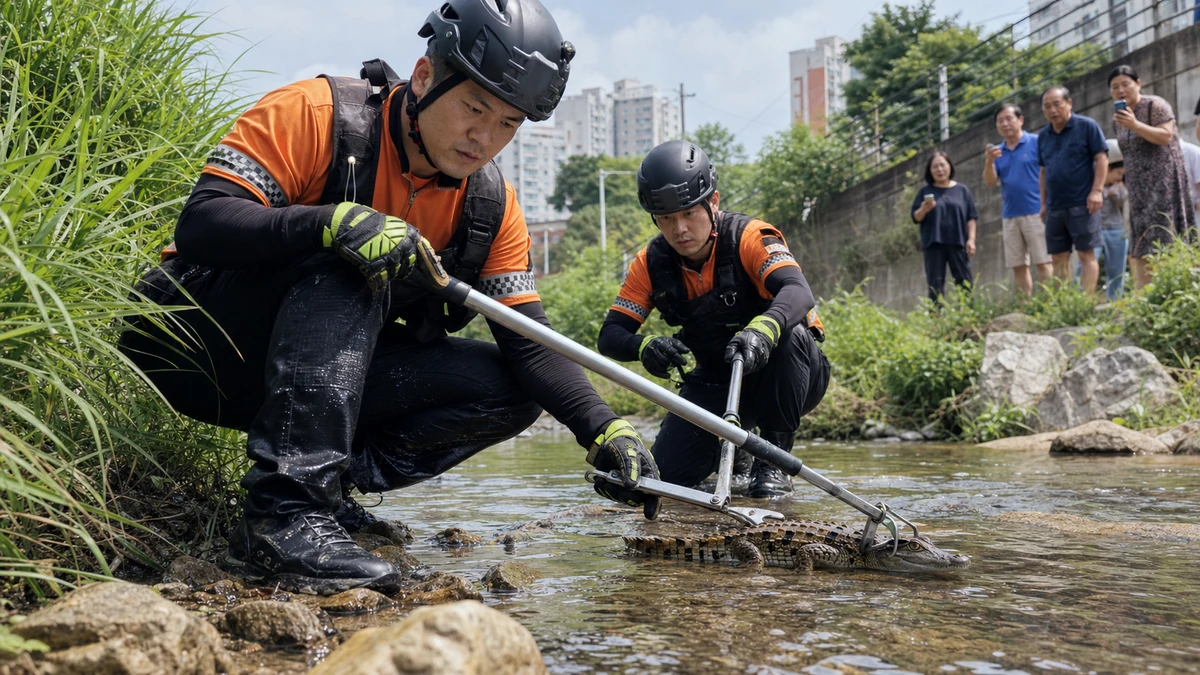
An unlikely sighting in an everyday place
In the United States, people are used to occasional headlines about alligators turning up in unexpected places — a Florida swimming pool, a golf course pond, even the edge of a suburban parking lot. In South Korea, though, the appearance of a crocodilian in a neighborhood stream is the kind of scene that stops people in their tracks. That is what happened Saturday in Yeoju, a city in Gyeonggi Province southeast of Seoul, where a passerby spotted what appeared to be a small crocodile in the Soya Stream and called authorities.
According to local reporting, the animal was found around 11:27 a.m. in the Chang-dong area of Yeoju. Firefighters responded and captured the reptile at 12:06 p.m., roughly 39 minutes after the initial report. The animal measured about 50 centimeters, or just under 20 inches, long — hardly the size of the fearsome adult crocodiles that dominate nature documentaries, but large enough to alarm residents in a country where such an animal would not normally be expected in an urban waterway.
The crocodile’s exact species has not yet been identified, and officials have not determined how it ended up in the stream. Those unknowns matter. They leave open questions that range from the mundane to the unsettling: Was it once kept as an exotic pet? Was it abandoned? Did it escape from a private owner or facility? Or is there another explanation entirely? For now, South Korean authorities are drawing a careful line between what is known and what is speculation.
That caution is significant. In an era of viral clips and rapidly spreading rumors, unusual animal sightings can quickly become exaggerated into tales of invasive predators, negligent owners or broader public danger before basic facts are established. What is confirmed so far is limited but clear: A small crocodile-like animal was spotted in a public stream, a citizen reported it, firefighters captured it, and the animal is expected to be handed over to Yeoju city authorities on July 20 for the next stage of official handling.
Even with those facts alone, the incident has resonated because it unfolded not in a remote wilderness but in a piece of ordinary civic landscape. The stream where the reptile was found is part of the kind of local environment that residents might pass during a weekend walk, on an errand, or while getting some air in the summer heat. That familiarity is part of what makes the sighting so striking. This was not a story about venturing deep into the wild and finding something unexpected. It was about the wild — or something resembling it — intruding into the routines of city life.
Why this feels so unusual in South Korea
To American readers, South Korea is often associated with megacities, high-speed trains, cutting-edge technology and, increasingly, global pop culture exports such as K-pop, Korean dramas and Oscar-winning films. It is not generally imagined as a place where a crocodile might emerge from a local stream. That perception is not just stereotype; it also reflects geography and ecology. South Korea has mountains, rivers, wetlands and a rich range of native wildlife, but crocodiles are not part of its natural environment.
That helps explain why the first witness reportedly described the animal not simply as a crocodile but as something like “a pet crocodile.” The wording suggests uncertainty, surprise and an attempt to make sense of an unfamiliar creature by placing it in the closest recognizable category. In South Korea, as in the United States, exotic pets do exist, though they remain far outside the mainstream. A small reptile in a stream is more likely to prompt questions about private ownership than assumptions about native wildlife.
There is also a cultural and geographic element to the setting itself. Local streams in South Korea are often closely woven into everyday urban life. Some are engineered flood-control channels; others have walking paths, embankments and nearby residential or commercial areas. They are not necessarily untouched natural habitats in the American sense of a marsh, bayou or backwoods creek. Instead, they often function as shared civic spaces where nature and infrastructure meet.
That means the Yeoju sighting took place in the kind of location where ordinary residents, not trained outdoors enthusiasts, are likely to encounter something strange. The drama lies partly in the contrast. A familiar setting — a neighborhood stream on an otherwise normal Saturday — briefly became the scene of an unexpected wildlife response. It is the same kind of jolt Americans might feel if a small caiman were seen in a drainage canal outside a strip mall in a place where it clearly does not belong.
The animal’s size adds another layer of context. At about 50 centimeters, it was not a giant predator stalking a town. But size does not erase the shock of the sight. For many people, the mere outline of a crocodilian body — the snout, the tail, the low, armored shape — is enough to trigger alarm. In a country where most residents would never expect to see such an animal outside a zoo, aquarium or television screen, even a juvenile-sized specimen would register as startling.
A small incident that says something larger about public response
One of the most notable aspects of the Yeoju case is how unremarkable the initial human response was in the best possible sense. The passerby who spotted the animal did not try to capture it, move it or turn the moment into a reckless close encounter. Instead, the witness alerted the authorities. Firefighters arrived and handled the situation. From report to capture, the sequence appears to have unfolded quickly and in an orderly way.
That may sound simple, but it is worth emphasizing. Encounters with unfamiliar animals often invite a mix of curiosity, bravado and panic. Social media has made it easy for bystanders to treat strange sightings as content before they are treated as public-safety situations. In the United States, wildlife officials routinely warn people not to approach bears, snakes, alligators or other animals for photos or videos. The same principle applies here, even if the exact level of danger posed by this particular reptile remains unclear.
The timeline also helps frame the response. The initial report came at 11:27 a.m., and the animal was captured at 12:06 p.m. That 39-minute window is brief enough to suggest authorities treated the call seriously, but long enough to remind readers that even a small animal in a contained area can take time to secure safely. Reports indicate firefighters needed about 30 minutes after dispatch to complete the capture. The operation was not instantaneous, which underscores both the uncertainty of the moment and the value of having trained responders involved.
In South Korea, the fire service often plays a broader role in emergency response than some Americans might assume from the term alone. Firefighters routinely handle rescue calls, public hazards and animal-related incidents in addition to fires. In that respect, the response in Yeoju fits a familiar pattern: a local resident reports an unusual but potentially risky situation, emergency personnel intervene, and the matter is passed to the relevant administrative authority for follow-up.
That final step is important. Local reports say the captured animal is scheduled to be handed over to Yeoju City Hall on July 20. In American terms, that may sound slightly unusual because city halls are not typically the first institutions people associate with live-animal custody. But in South Korea, local governments often coordinate public administration across a wide range of issues, including environmental management and interagency handling. The transfer signals that the immediate emergency phase is over and that the case is moving into an official review stage.
The biggest questions are the ones no one can answer yet
For now, the most responsible way to cover this story is to focus not only on what happened but on what remains unknown. Officials have not publicly identified the crocodile’s species. They also have not explained how the animal entered the stream, how long it may have been there, whether it had been living in captivity, or whether any laws may have been violated if it was privately owned.
Those gaps are not minor details. They are the heart of the story’s second phase. Without a species identification, it is difficult to say much with confidence about the animal’s likely origin, behavior or long-term care needs. “Crocodile” is often used loosely in everyday language, especially in translation or breaking-news situations, but the broad category can include several different animals that non-specialists may confuse with one another, including juvenile crocodiles, caimans and other related reptiles. A 50-centimeter specimen could look dramatic to a passerby while still leaving specialists with important taxonomic questions to sort out.
The phrase “pet crocodile,” which appears in witness reporting, should therefore be treated carefully. It reflects the witness’s impression, not a confirmed fact. That distinction matters in journalism. Too often, unusual-animal stories harden into a satisfying narrative before the evidence arrives: an irresponsible owner buys an exotic pet, the animal outgrows its enclosure, and it is dumped into the nearest waterway. That scenario is plausible enough to circulate quickly, especially online, but at this stage it remains speculation.
South Korea, like many countries, has wrestled with the challenges posed by exotic-animal ownership, online trading and gaps between public fascination and practical care. The same is true in the United States, where stories of abandoned snakes, illegally owned monkeys and escaped reptiles have periodically prompted debates over regulation. If the Yeoju animal does turn out to have been kept by a private owner, the case could invite similar questions. But until authorities release more information, those questions remain just that — questions.
This is where restraint becomes part of good reporting. The fact that something is eye-catching does not make every possible explanation equally credible. What is established right now is narrower and, in some ways, more interesting: a citizen in a Korean city noticed something strange in an ordinary stream, recognized that it did not belong there, and triggered a rapid civic response. The mystery of where the reptile came from may eventually prove compelling. But it should not outrun the facts.
Urban nature, public space and the surprise factor
There is another reason the Yeoju incident has drawn attention beyond its oddity. It taps into a broader modern reality: urban residents often think they have neatly separated human life from the natural world, only to be reminded that the boundary is porous. In cities across the globe, wildlife appears in places where people least expect it. Coyotes roam Chicago. Monkeys seize food in parts of South and Southeast Asia. Wild boars wander through Japanese neighborhoods. In Florida, alligators have become almost a cliché of suburban adaptation.
South Korea has its own versions of this phenomenon, though usually involving native species. People sometimes encounter wild boars in semi-urban areas, birds of prey near rivers, or water deer along roads and green belts. But a crocodile-like reptile in a residential stream belongs to a different category altogether because it is so clearly outside the expected ecological script.
That contrast helps explain the strong public fascination. The story is not simply about danger. It is about disruption of the familiar. A stream that residents may know as a place for walking, seasonal scenery or routine neighborhood movement suddenly became a site of uncertainty. In many Korean cities and towns, waterways are intimately connected to daily life in a way Americans might compare to greenways, creekside trails or restored urban river corridors. They are part of the texture of ordinary community life. Something alien appearing there feels less like a distant environmental issue and more like a breach in the everyday.
There is also an emotional dimension to these stories that transcends borders. People are drawn to moments when the predictable landscape of daily life briefly reveals something uncanny. A shark near shore, a moose downtown, a mountain lion in a backyard — these incidents attract attention not only because they may pose risks, but because they force people to see familiar spaces differently. The Yeoju sighting fits that pattern. For a few minutes on a Saturday, an ordinary Korean stream became the setting for a scene that might have felt more at home in a tabloid headline from a warm-weather American state.
At the same time, the facts argue against sensationalism. This was a small animal, not a full-grown apex predator. There are no reports in the available summary of injuries, aggressive behavior or a wider public emergency. That balance is crucial. The incident was unusual enough to merit attention but not so dramatic that it should be inflated into a crisis narrative. In that sense, it is a useful reminder that compelling news does not always require catastrophe. Sometimes it only requires an unexpected turn in an ordinary place.
What happens next after the capture
Once the reptile is transferred to Yeoju city authorities, the public will likely look for answers to several practical questions. Where will the animal be housed? Who will identify the species? Will the case be referred to wildlife, veterinary or environmental specialists? And if the reptile is found to have been kept illegally or abandoned, will there be an effort to locate whoever was responsible?
None of those answers were included in the reported summary, and that absence itself is a reminder of how early this story still is. Capture ended the immediate public-safety concern, but it did not resolve the larger issue of origin. In many such cases, the administrative handoff is the beginning of a slower, less visible process: examination, documentation, species confirmation and possible investigation.
For American readers, it may help to think of this as the point where a strange neighborhood call passes from first responders to the machinery of local government. The headlines tend to focus on the moment of capture because it is visual and immediate. But the more consequential work may come later, when officials determine what exactly the animal is and whether its appearance reveals a broader problem, such as illicit trade, neglect or gaps in oversight.
There is also the matter of public messaging. Incidents like this can prompt a surge of online speculation, and authorities often face pressure to explain more before they have all the facts. That makes disciplined communication especially important. If officials release more details — about species, source or legal implications — those findings will shape whether this remains a quirky one-day story or becomes part of a larger conversation about exotic animals and public responsibility.
Until then, the most solid takeaway is also the simplest. A local resident saw something that did not belong in a city stream and reported it. Emergency responders arrived and removed the animal. The system, at least in this small test, worked. That may not be as cinematic as the sighting itself, but it is arguably the real story.
A modest mystery with wide appeal
For all its local specificity — a stream in Yeoju, a Saturday report, a 50-centimeter reptile, a 39-minute response window — this story has broad appeal because it combines three elements readers everywhere recognize: surprise, uncertainty and ordinary people encountering the unexpected. It does not require deep prior knowledge of South Korea to understand why the image lands so powerfully. A person out for a routine walk sees what looks like a crocodile in the water. Authorities are called. The animal is captured. Everyone is left wondering how it got there.
There is, however, something distinctly Korean in the backdrop. South Korea’s dense urban development, carefully managed civic spaces and highly networked public culture make incidents like this feel especially vivid. The contrast between orderly daily life and a reptile that seems imported from another climate or continent is part of what gives the story its texture. For international audiences who often encounter Korea through polished entertainment and high-tech imagery, the Yeoju sighting offers a different kind of glimpse into everyday life: one in which a local stream, a watchful passerby and a prompt fire response become the center of attention.
It is also a useful case study in how to read strange news responsibly. The temptation in any unusual animal story is to leap immediately to a bigger narrative — criminal trade, reckless pet ownership, environmental collapse, bureaucratic failure. Sometimes those narratives turn out to be true. Sometimes they do not. The discipline of journalism lies in resisting the leap until the evidence catches up.
For now, the known facts are enough to tell a compelling story. In Yeoju, a city stream briefly became a site of astonishment. A citizen reported what appeared to be a pet crocodile. Firefighters captured a 50-centimeter reptile within about half an hour. City authorities are expected to take custody next. Everything beyond that remains unresolved.
That unresolved quality may be why the incident lingers in the imagination. A small crocodile is, in one sense, a minor event. But its presence in such an ordinary setting opens a larger question about the hidden routes by which unfamiliar animals move through modern societies — through commerce, private fascination, neglect and accident — until one day they appear where they should not be. In Yeoju, that question surfaced in a neighborhood stream under the summer sun. The reptile has been removed. The curiosity it left behind has not.
Comments
Post a Comment