A UNESCO Win for Korea’s Tidal Flats Puts Seosan on the Global Map — and Raises the Stakes for Conservation
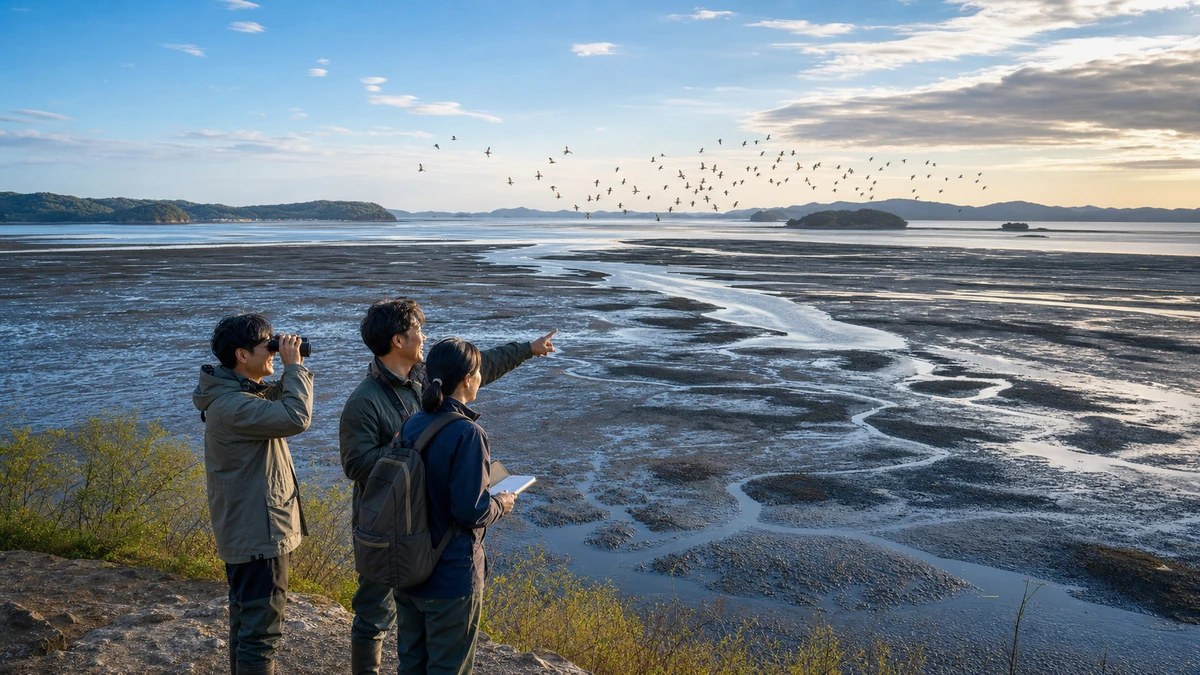
A coastal landscape most Americans have never heard of just gained global recognition
For many Americans, South Korea brings to mind Seoul’s neon skyline, K-pop, Oscar-winning films, Samsung smartphones or perhaps the tense border with North Korea. Far fewer would immediately think of mudflats. But on July 25, 2026, one of Korea’s lesser-known natural landscapes moved into the international spotlight when UNESCO expanded the World Natural Heritage listing for “Getbol, Korean Tidal Flats” to include the Seosan tidal flats in Garorim Bay, on South Korea’s west coast.
The decision, made at the 48th session of the UNESCO World Heritage Committee in Busan, marks more than just another line on a tourism brochure. It is a formal global acknowledgment that the tidal flats near Seosan, a city in South Chungcheong province, are part of a natural ecosystem with universal value — the kind of place the international community believes should be protected not simply for one country, but for humanity as a whole.
That may sound abstract. But the designation matters in practical ways. UNESCO recognition can elevate a place’s international profile, attract scientific attention, strengthen conservation efforts and help local governments make the case that development should not come at the expense of ecological survival. In Seosan’s case, local officials are celebrating the decision as a defining milestone, one that helps transform the city’s image from a regional coastal community into what it calls a “world heritage city.”
Still, the most important part of the story is not branding. It is the ecosystem itself. Tidal flats — broad coastal zones exposed at low tide and submerged at high tide — are among the world’s most productive and most threatened environments. They function as nurseries for marine life, feeding grounds for migratory birds and natural buffers that absorb carbon and help protect shorelines. In the United States, a useful comparison might be the growing appreciation for wetlands in places such as Louisiana’s coast, the Chesapeake Bay or the salt marshes of Georgia and the Carolinas. Once dismissed as muddy wastelands, these landscapes are increasingly understood as ecological infrastructure.
Korea’s west coast tidal flats fit that same pattern, but with their own distinctive geography and cultural history. The newly added Seosan area in Garorim Bay represents one more piece of a larger environmental mosaic that UNESCO says deserves protection on a global scale.
What exactly are Korea’s “getbol,” and why do they matter?
The Korean word “getbol” refers to tidal flats, a coastal environment created by the constant movement of tides, sediment and marine life. At first glance, a tidal flat can seem visually plain, especially to visitors expecting dramatic cliffs or tropical beaches. There are no postcard-blue waters or towering peaks. Instead, there is open mud, shifting channels, shellfish beds, seabirds and an ever-changing shoreline governed by the moon and the sea.
Yet that apparent simplicity is deceptive. Tidal flats are biologically rich. They sustain crabs, worms, clams and countless microscopic organisms that in turn feed fish and migratory birds. They also serve as a vital link in the East Asian-Australasian Flyway, one of the world’s major migratory bird routes, stretching from the Arctic through East Asia and all the way to Australia and New Zealand. Birds stop in these coastal zones to rest and refuel, making the health of Korea’s tidal flats a matter of international ecological importance.
To American readers, it may help to think of these areas as a mix of estuary, wetland and habitat corridor — places whose value becomes clear not because they are conventionally scenic, but because they support entire chains of life. Scientists and conservationists have long warned that when wetlands disappear, the damage does not stay local. Fish stocks, bird populations and coastal resilience all suffer.
In Korea, tidal flats also hold cultural meaning. For generations, coastal communities have depended on them for food and livelihoods, gathering shellfish, seaweed and other marine resources. In that sense, getbol are not only ecological zones but lived landscapes, woven into local routines and regional identity. That connection can be easy for outsiders to miss. International audiences often encounter South Korea through its urban exports — music, film, beauty products and technology — while rural and coastal environments remain largely invisible. UNESCO’s decision helps correct that imbalance by drawing global attention to a part of Korea that exists far from the image of glitzy Seoul.
The expanded listing also reinforces a broader idea that has gained traction worldwide: natural heritage is not limited to spectacular wilderness. It includes quieter, working landscapes whose value comes from biodiversity, ecological continuity and the long relationship between people and place.
Why Seosan’s inclusion is a milestone years in the making
The newly recognized Seosan tidal flats did not arrive at this moment overnight. Their inclusion in UNESCO’s World Natural Heritage framework follows a decade-long progression of official protections and growing recognition inside South Korea.
According to local authorities, the Seosan tidal flats were designated in 2016 as the country’s first Marine Life Protected Area. That was a significant step in its own right. It meant the central government had already identified the zone as ecologically important enough to merit legal protection focused on marine species and habitat. In 2025, the area gained another layer of status when it was named South Korea’s first National Marine Ecology Park, broadening the frame from species protection to ecosystem-scale stewardship.
Now comes the UNESCO expansion. Seen together, those steps tell a clear story: the area’s importance has been recognized at local, national and now international levels. For conservationists, that layered process matters. UNESCO designations are often treated in public discussion as grand ceremonial moments, but they usually rest on years of groundwork — research, regulation, political negotiation and evidence that a place’s value can be documented and defended.
That is especially important in an era when environmental recognition can sometimes be confused with marketing. World heritage status can boost visitor interest, but it also imposes expectations. Governments are not simply being handed a prestigious title; they are being entrusted with a responsibility to preserve what earned that title in the first place.
In Seosan, city officials have emphasized the international visibility that comes with the new designation. That is understandable. For a city not widely known outside Korea, the UNESCO label serves as a kind of global shorthand. An American traveler may never have heard of Seosan, but “UNESCO World Natural Heritage” instantly signals significance in a way that crosses language barriers. It tells visitors, researchers and policymakers alike that this is not just another patch of coast — it is a place the world has agreed is worth protecting.
But local officials’ enthusiasm also reflects something deeper: an effort to redefine civic identity through nature. Around the world, cities often build their reputations around sports teams, architecture, festivals or industry. Seosan appears to be making a different argument — that its defining asset is an ecosystem. That is a powerful and somewhat unusual proposition, especially in a country where rapid industrialization and urban development have long shaped local ambitions.
The UNESCO backstory: a 2021 recommendation that set the stage
The July 2026 decision is technically an expansion, not an entirely new inscription. UNESCO first recognized “Getbol, Korean Tidal Flats” in 2021. At the time, the World Heritage Committee recommended that South Korea consider extending the property to include additional tidal flat areas in the country’s northwestern region in order to strengthen habitat protection.
That recommendation matters because it reveals how UNESCO views these ecosystems: not as isolated destinations, but as connected habitats. Expanding the listing was not just a bureaucratic exercise or a matter of adding more names to a prestigious roster. It reflected the ecological reality that tidal flats function as part of a broader network. Species move across them. Tides connect them. Migratory birds depend on chains of safe feeding grounds rather than a single stop.
In other words, conservation logic — not civic pride alone — drove the expansion. Garorim Bay’s Seosan tidal flats fit into that wider habitat story. By bringing them under the umbrella of “Getbol, Korean Tidal Flats,” UNESCO is acknowledging that the environmental integrity of Korea’s coastal wetlands is best understood across a larger geographic scale.
There is also symbolic weight in where the decision was made. The committee session took place in Busan, South Korea’s second-largest city and a major port, at BEXCO, a convention and exhibition center often used for large international gatherings. For South Korea, hosting a meeting that then reaffirmed the global significance of its natural heritage carries a certain national prestige. Yet the real significance lies less in the conference hall than in the landscape outside it: an often-overlooked coastal environment that has now been elevated onto the world stage.
For American readers familiar with UNESCO mostly through headline sites such as Yellowstone, the Grand Canyon, Independence Hall or the Statue of Liberty, the Korean tidal flats may seem like a different category of landmark. That is precisely the point. UNESCO’s world heritage framework is not limited to dramatic monuments or iconic vistas. It also recognizes ecological systems whose importance emerges through science, biodiversity and long-term stewardship.
In that sense, Seosan’s addition reflects a growing international willingness to honor places whose value is subtle but essential — places that remind us the health of the planet depends as much on mud, marsh and migration routes as on cathedrals and canyons.
Seosan’s new image: from local coast to “world heritage city”
Local governments everywhere understand the power of narrative. Cities want a story they can tell investors, tourists, residents and the wider world. Seosan’s response to the UNESCO announcement suggests officials see this designation as a turning point in how the city introduces itself internationally.
In its public messaging, Seosan has highlighted that the city has entered the ranks of a “world heritage city.” That phrase carries ambition. It suggests the tidal flats are no longer viewed merely as peripheral nature on the edge of town, but as a central civic asset — something that can anchor Seosan’s reputation far beyond Korea.
That may sound like boosterism, but it reflects a real shift in how places build identity in the 21st century. Cities once leaned heavily on industrial growth, shopping districts or large-scale construction projects to prove relevance. Increasingly, though, environmental distinction can be just as powerful, particularly when travelers and younger residents place growing value on sustainability, authenticity and quality of place.
There is an American parallel here too. Think of how communities near national parks, protected coastlines or restored wetlands often weave those landscapes into their local identity. A place such as Asheville, North Carolina, benefits from the Blue Ridge Mountains not just as scenery, but as a core part of its brand. Coastal communities near protected estuaries or barrier islands do something similar. The landscape becomes both a source of pride and a practical economic asset.
For Seosan, Garorim Bay’s tidal flats could now play a comparable role. The UNESCO label gives local officials and tourism agencies a globally legible way to explain what makes the city distinctive. To someone encountering Seosan for the first time, the message becomes simpler: this is a place that contains a coastal ecosystem recognized as globally important.
Still, a more recognizable identity brings new pressure. Once a city’s natural environment becomes part of its international image, the stakes for protecting that environment rise sharply. Visitors may come. Infrastructure may expand. Local businesses may seek to capitalize on new attention. The challenge is ensuring that the ecosystem is not loved to death — a familiar problem from overtourism in destinations worldwide. Seosan’s opportunity, and test, will be whether it can translate recognition into careful management rather than unchecked commercialization.
Conservation first, tourism second
If there is one point that deserves emphasis, it is this: UNESCO did not recognize Seosan’s tidal flats because they would make a good attraction. It recognized them because they contribute to habitat protection and ecological continuity.
That distinction matters. Around the world, world heritage status often gets folded into local tourism campaigns, and some of that is inevitable. More visibility usually means more interest. But in the case of Korea’s tidal flats, the conservation purpose is especially clear. The World Heritage Committee’s 2021 recommendation for expansion was explicitly tied to protecting tidal flat habitats in Korea’s northwest. This was not about adding another scenic stop to a travel itinerary. It was about strengthening the protective framework around a living ecosystem.
For Seosan, that means the new designation should ideally shape how visitors experience the area. The tidal flats should not be presented merely as a backdrop for photos or as a novelty where people can tromp through the mud for a few hours. They are places where interpretation, education and access control matter. Visitors need to understand why the habitat is fragile, how it supports marine and bird life, and why the area has been successively recognized as a protected marine zone, a national marine ecology park and now part of a UNESCO-listed natural heritage site.
That message resonates well beyond South Korea. In the United States, public debates over national parks, wetlands and coastal resilience often turn on the same question: Are these places primarily commodities for recreation, or shared environmental assets that must be managed carefully, even when that limits certain kinds of use? The best stewardship models usually try to balance both, allowing people to appreciate a place while setting firm boundaries around what can be exploited or altered.
The history of the Seosan tidal flats suggests Korean officials understand that balance, at least in principle. The area’s earlier protected status laid the groundwork by treating the coast as something to conserve before it became something to market internationally. UNESCO recognition adds prestige, but it should also reinforce that order of priorities.
For residents, the challenge may be to embrace the benefits of higher visibility without losing sight of what made the area worthy of attention in the first place. For foreign visitors, the challenge is simpler but just as important: to arrive not as consumers of a trend, but as guests in a habitat whose meaning extends beyond sightseeing.
What this moment says about South Korea’s global identity
There is a broader cultural dimension to this story, especially for audiences outside Asia. South Korea has spent the past two decades dramatically expanding its global footprint through entertainment, technology and cuisine. K-pop groups fill stadiums in Los Angeles. Korean films win at the Oscars. Korean skincare lines occupy shelves at American retailers. Korean food has moved from niche dining to the mainstream, with kimchi, Korean fried chicken and bibimbap now familiar to many Americans.
That success has helped shape an image of South Korea as fast-moving, trend-setting and highly urban. The UNESCO recognition of Seosan’s tidal flats complicates that picture in a useful way. It reminds international audiences that Korea’s story is not only about cultural exports and urban modernity. It is also about landscapes, ecological stewardship and local identities rooted in coastlines, fisheries and rural environments.
That does not mean South Korea is unique in using heritage to broaden its image. Many countries do the same. But in Korea’s case, the contrast is especially striking because the nation is so often framed abroad through pop culture and geopolitics. A story about tidal flats may not seem flashy, yet it adds depth to how outsiders understand the country.
It also highlights a theme that increasingly defines international affairs: the merging of environmental protection with soft power. Countries are judged not only by what they produce and export, but by what they preserve. Protecting biodiversity, hosting international environmental discussions and securing recognition for ecologically important sites all contribute to national standing. They signal that a country sees itself as a steward, not just a competitor.
For Seosan, the immediate result is a stronger claim to international relevance. For South Korea, the moment offers something larger: evidence that even a relatively ordinary-looking coastal landscape can carry world-level significance when its ecological role is properly understood. That lesson may sound modest, but it is exactly the kind of perspective UNESCO was designed to encourage.
And for English-speaking readers who may never have heard of Garorim Bay before now, the message is straightforward. A muddy stretch of coast in western Korea has become part of the shared natural inheritance of the world. The recognition did not happen because the place suddenly changed. It happened because institutions, scientists and governments caught up to what the ecosystem had long been telling them: that places do not need to be spectacular in the conventional sense to be invaluable. Sometimes the most important landscapes are the ones that teach patience, interdependence and humility — one tide at a time.
Comments
Post a Comment