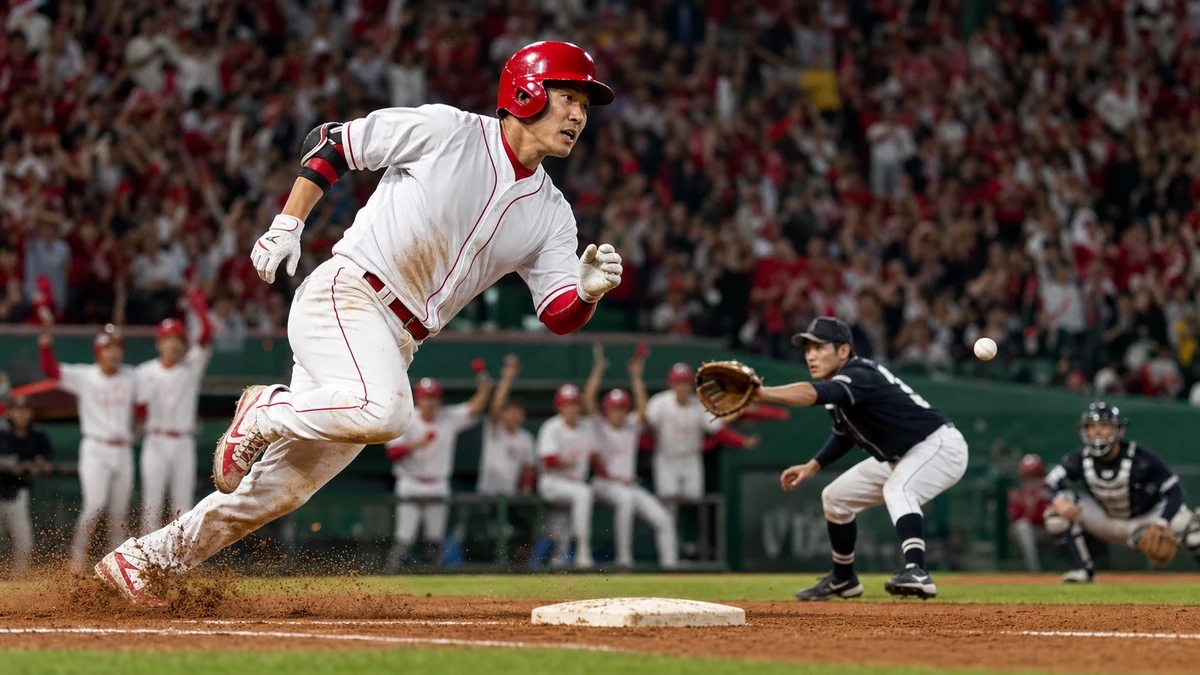
A night that was bigger than the box score
On a warm summer night in Incheon, a veteran outfielder for the KIA Tigers delivered the kind of all-around performance baseball people love because it resists easy summary. Yes, the numbers were impressive: Kim Ho-ryeong, a 34-year-old center fielder, went 3 for 6, scored three runs and stole a base as KIA rolled past the SSG Landers 12-2 on the road. But the line in the box score tells only part of the story. The more revealing truth is that Kim affected the game in nearly every way a leadoff hitter and center fielder can: by getting on base, by forcing pressure with his legs, by finishing scoring chances and, in the game’s most important defensive moment, by erasing an SSG rally before it could become a real threat.
For American readers who may be less familiar with South Korea’s Korea Baseball Organization, or KBO, this was the sort of performance that translates easily across baseball cultures. Think of the classic top-of-the-order player who sets the pace for an offense, combined with a rangy center fielder whose glove can change momentum in an instant. In the United States, fans might compare that archetype to the old-school value of a player who can impact a game without needing to hit a home run. Kim did not merely contribute to a lopsided victory. He helped shape its rhythm from the opening inning and then slammed the door on the one stretch when the game still felt competitive.
That matters because the final score, by itself, risks making the game sound simpler than it was. KIA eventually won by 10 runs, but in the middle innings this was still a live contest, and SSG had an opening to make things interesting. Kim’s performance became the connective tissue between KIA’s offensive outburst and its ability to keep SSG from gaining any emotional foothold. It was not just a hot hitting night. It was a demonstration of how one player can influence baseball vertically, from the first batter’s box to the deepest part of the outfield.
Why the leadoff role matters in Korean baseball
Kim started in the No. 1 spot in the batting order and in center field, which in itself says a great deal about what KIA asked of him. In baseball everywhere, the leadoff hitter is expected to do more than collect hits. He is supposed to start the offense, raise the stress level for the opposing pitcher and create opportunities for the hitters behind him. In the KBO, where pressure baseball, contact hitting and aggressive baserunning still carry cultural weight even in an era shaped by power, the leadoff role remains especially important. A good leadoff hitter can make an entire lineup feel more dangerous.
Kim fulfilled that assignment almost perfectly. He reached safely three times, and every one of those trips on base ended with him crossing home plate. That is the kind of efficiency managers crave from the top of the lineup. A table-setter is not merely judged by whether he reaches base, but by whether his presence changes the inning. Kim’s did, repeatedly. Once aboard, he turned stationary opportunities into moving ones. His stolen base was only one official act of aggression, but it symbolized a larger point: SSG had to account for him in multiple ways, and that created space for the rest of KIA’s offense to operate.
For readers more accustomed to Major League Baseball’s modern obsession with launch angle and slugging percentage, this kind of performance offers a reminder that run creation can still be cumulative rather than explosive. A leadoff hitter who singles, advances, distracts the battery and eventually scores is doing more than padding a stat line. He is reshaping the inning. Kim’s three runs were not side notes in a 12-run night. They were evidence that he served as the ignition point again and again.
There is also something telling about the age attached to this performance. At 34, Kim is not a prospect or a young breakout star. He is an experienced player who understands pace, positioning and the value of winning small exchanges within a game. Veterans often survive by adjusting, by seeing one extra angle, by reacting one beat faster because they have encountered the moment before. That instinct would become decisive in the fifth inning.
The play that stopped the game from changing
The game’s signature moment came in the bottom of the fifth, when KIA led 5-2. A three-run margin in the middle innings is comfortable, but hardly safe. One extra-base hit can reignite a dugout, bring a crowd back to life and suddenly turn a game into a tense late-inning fight. That is the situation SSG faced with one out and a runner on first when Park Sung-han drove a ball toward the gap in right-center field.
Off the bat, it looked dangerous. A ball hit into that patch of outfield grass often means a double, and in many cases it means a chance to push a runner into scoring position with momentum building. Instead, Kim accelerated to the spot, laid out and made a diving catch. If the play had ended there, it still would have been one of the best moments of the night. But what elevated it from a highlight to a turning point was what happened next.
Immediately after securing the ball, Kim got it back to first base, where the runner, Jung Jun-jae, had failed to return in time. Double play. In a matter of seconds, SSG went from imagining a possible rally to walking off the field. One out became three. A threat disappeared. A stadium that had reason to believe the game might tighten instead had to absorb a sudden silence.
American fans know this kind of sequence well, even if the uniforms and league are different. It is the baseball version of a strip-sack returned for a touchdown in football, or a chase-down block that flips a playoff game in basketball. It does more than prevent damage. It drains belief from one side and transfers it to the other. KIA did not just record two outs on one batted ball. It stole the inning’s emotional energy.
That is why the play mattered so much, even in a game that later became a blowout. The final margin can obscure the exact moment a contest tilted irreversibly. In this case, the fifth inning was the hinge. If the ball falls, SSG has a runner in scoring position and fresh momentum. If it skips past a diving outfielder, the inning could become even more expensive. Instead, Kim turned risk into reward and sent KIA back to the dugout still firmly in control.
The hidden difficulty of the double play
Diving catches are easy to celebrate because they are visually dramatic. A player leaves his feet, extends his glove and snatches a ball just before it hits the grass. But the real difficulty of Kim’s play was not just the dive. It was the judgment that preceded it and the awareness that followed it.
Outfielders have to make split-second calculations about trajectory, speed and angle. When a center fielder commits to a diving attempt, he is accepting a real downside: if he misses, the ball can roll into open space and turn a likely single or double into something worse. That is especially true in center field, where so much ground must be covered and where mistakes tend to be amplified. Kim did not dive recklessly. He read the ball, understood he had a realistic chance to catch it and made a decisive play. That distinction matters. Great defense is not only about effort. It is about choosing the right moment for maximum effort.
The second decision may have been even more impressive. After a diving catch, an outfielder’s body is often twisted or off-balance. Vision can be compromised. The instinctive exhale that comes with securing the ball can trick a player into treating the catch as the end of the sequence. Kim did the opposite. He processed the baserunner’s mistake, got rid of the ball quickly and accurately, and completed the double play. In other words, he did not admire the catch. He kept playing.
That combination of range, boldness and follow-through is exactly why center field is often described as the captaincy position of the outfield. In Korean baseball, as in the American game, center fielders are expected to patrol the largest defensive space and make clean judgments on balls that challenge the geometry of the field. Kim’s play compressed all of those responsibilities into one sequence. He covered the gap, executed the catch and then turned defense into attack by taking away not just a hit, but a runner as well.
There is a phrase that surfaced around the play: “Ho-ryeong Zone,” a nickname-like way of describing the range Kim appeared to own in the outfield. For English-speaking readers, it is similar to the way fans in the U.S. sometimes talk about a defender’s territory as if it belongs personally to him, a shorthand for elite coverage. The expression captures the feeling that a ball which might be a routine hit against another team can die in a certain player’s airspace. On this night, Kim made that concept feel real.
How defense can feel offensive
One of the enduring pleasures of baseball is that the sport occasionally blurs the line between preventing runs and creating them. A spectacular defensive play can feel as energizing as a two-run double, not because it changes the scoreboard directly, but because it alters the psychological economy of the game. Kim’s fifth-inning sequence was a perfect example. SSG believed it had a promising ball in the gap. A second later, it had nothing.
That is why strong outfield defense is often more aggressive than casual observers realize. It is not passive run prevention. It is an act of disruption. Kim erased a likely hit, denied advancement and ended the inning. In practical terms, he removed possibilities: no runner in scoring position, no building crowd noise, no deeper stress for KIA’s pitcher, no chance for SSG to string together pressure. A single defensive burst undid an entire offensive idea.
For American audiences who may know South Korean sports primarily through global events like the Olympics, the World Baseball Classic or the international fame of stars such as Shohei Ohtani in neighboring Japan, this is also a useful reminder of why KBO games have attracted international fans in recent years. During the early months of the coronavirus pandemic, when KBO games were among the few live sports broadcasts available to U.S. audiences, many Americans were introduced to the league’s pace, emotion and tactical variety. They saw a style of baseball that often puts a premium on contact, movement and crowd energy. Kim’s performance fit that appeal almost perfectly. It had action on the bases, drama in the field and a player whose impact was visible well beyond one category.
And while KIA’s offense ultimately produced enough runs to make the result comfortable, blowouts are often built on quieter structural moments. A team scores, protects a lead, denies a comeback and then extends the advantage once the opponent’s resistance fades. Kim was central to that structure. He helped start scoring innings at the top of the order. Then, when SSG threatened to reclaim momentum, he cut the threat off at the source.
A complete performance from a veteran player
There is a tendency in modern sports coverage, especially in highlight culture, to isolate the one clip most likely to travel on social media. In Kim’s case, the diving catch and doubling off the runner would understandably become that clip. But reducing the night to one viral sequence would undersell what made it impressive. His offensive work mattered. His baserunning mattered. His defensive awareness mattered. The completeness of the performance is what gave it its force.
Kim collected three hits in six at-bats, which means he produced in half of his official trips to the plate. He scored three times, which means he repeatedly converted those chances into actual runs. He stole a base, which underscored his willingness to keep pressure on SSG after reaching. And he played the most important defensive role in the game’s decisive moment. That is not a player getting hot in one area. That is a player dictating terms across the game’s full map.
There is also something broadly relatable for American readers in seeing a veteran player author this kind of performance. U.S. fans have long cherished the seasoned ballplayer who may not fit the superstar marketing mold but wins admiration through instincts, preparation and toughness. Kim’s night carried that energy. He was not just productive. He was dependable in the most demanding moments. He looked like the sort of player managers trust because he understands context — when to push, when to attack a ball, when to finish a play instead of admiring the first half of it.
That may be why performances like this tend to linger in fan memory even after the standings move on. Numbers survive in records, but memory often preserves action in sequence: the sprint into right-center, the body leaving the ground, the glove closing, the quick throw, the unexpected second out. Those are the flashes that turn a regular-season game into a story people retell.
What American readers should take from it
If you are new to Korean baseball, Kim Ho-ryeong’s night offers a compact introduction to what makes the KBO compelling. It shows how a game can be shaped by a player who does not need to dominate through home run power alone. It shows why defense in the outfield can be as emotionally loud as offense. And it shows the strategic importance of the leadoff spot in a baseball culture that still prizes pressure, tempo and situational awareness.
KIA’s 12-2 win over SSG will be recorded as a convincing road victory, and Kim’s stat line will sit neatly beside it: 3 for 6, three runs, one stolen base. But those numbers do not fully capture the texture of the evening. The richer truth is that Kim helped open the game, stabilize it and then widen the path to victory. He connected offense and defense in a way baseball rarely allows one player to do so cleanly in a single night.
In a sport obsessed with specialization and metrics, there is still room to appreciate the game in older, fuller terms: who changed the temperature of the field, who sensed the moment, who turned possibility into certainty. On this night in Incheon, that player was Kim. For KIA fans, it was the kind of performance that reinforces why a seasoned center fielder can still command a game. For anyone watching from outside Korea, it was an accessible, vivid reminder that baseball excellence has many dialects, but the language of a complete performance is universal.
Comments
Post a Comment