The AI gold rush is creating unexpected winners
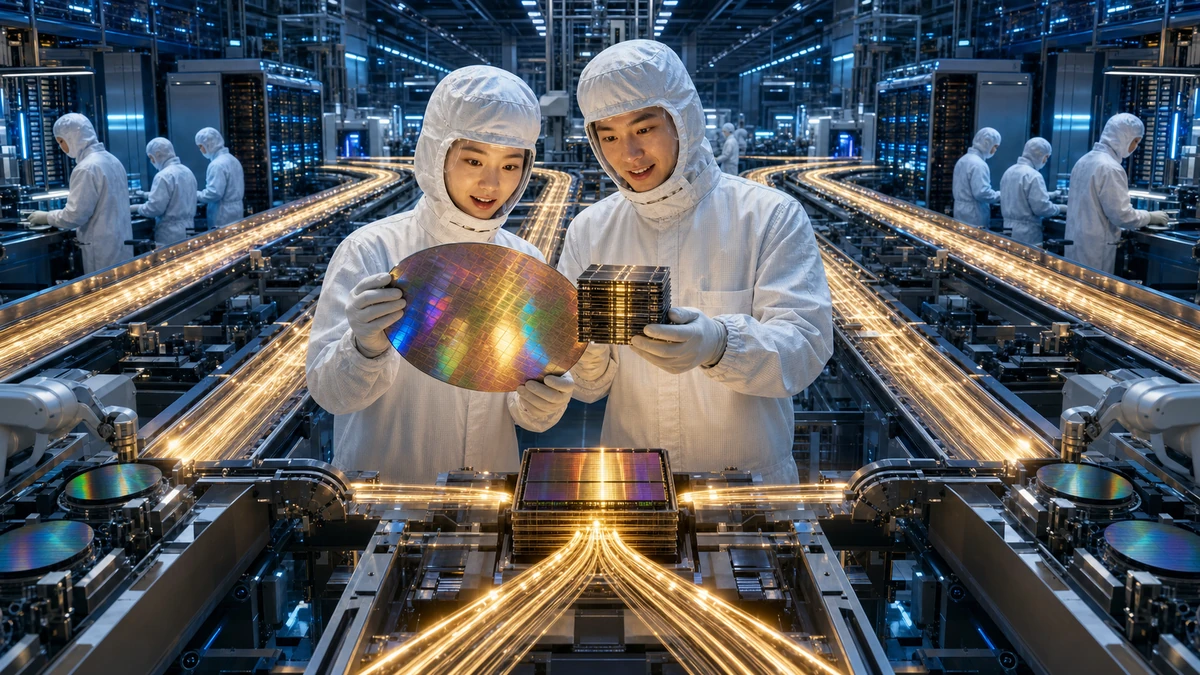
For most Americans, the artificial intelligence boom is usually told through familiar corporate names: Microsoft, Google, Amazon and Meta. The story often centers on splashy chatbot launches, eye-popping stock prices and the race to build ever-larger data centers across the United States. But behind that very visible contest is a less glamorous, deeply important layer of the global tech economy: the memory chips that allow AI systems to process and store enormous amounts of information.
That is where South Korea comes in.
A new look at second-quarter results from the world’s five largest memory chipmakers shows just how dramatically money is flowing through the AI supply chain. Together, Samsung Electronics, SK Hynix, Micron Technology, Japan’s Kioxia and SanDisk posted combined free cash flow of 14.8 trillion yen in the quarter, equivalent to roughly 135.65 trillion won, according to a report cited by Yonhap News Agency. Compared with the same period a year earlier, that figure was 92 times larger.
The number is striking not just because it is large, but because it helps explain who is profiting first from the current AI build-out. While Big Tech companies are pouring capital into data centers, advanced servers and cloud infrastructure, the companies supplying critical memory components are increasingly the ones holding more cash at the end of the quarter.
For South Korea, that is more than a favorable earnings story. It is another sign that two of its flagship companies, Samsung Electronics and SK Hynix, sit near the center of an industrial shift that stretches from Silicon Valley boardrooms to factory floors in Asia. AI may look like a software race to consumers, but its economic backbone is hardware. And on that front, Korea’s role is becoming harder to miss.
What the numbers say about the new AI economy
The figures cited in the report go beyond revenue growth or net profit alone. They focus on free cash flow, a closely watched measure on Wall Street because it reflects how much cash a company actually has left after paying for operations and capital spending. In simpler terms, it is the money left in the till after the bills for running and expanding the business are paid.
That makes the second-quarter surge especially notable. These memory manufacturers did not simply book higher sales on paper. As a group, they generated far more real cash than they did a year earlier, even while continuing to invest in production. The same analysis found that the five companies’ combined net profit rose to 24.7 trillion yen, about 16 times the year-earlier level. Kioxia alone, Japan’s only publicly listed memory maker, reportedly saw free cash flow jump 28-fold from a year earlier to 749 billion yen.
Some accounting periods differ from company to company. Micron’s figures cover March through May, and SanDisk’s number was based on market estimates rather than finalized earnings. That means the totals are not perfectly apples to apples. But the broader trend is clear enough to matter: cash and profits are both rising sharply across the memory sector at the same time AI infrastructure spending is accelerating.
That is the critical link. The AI boom is not a one-company story, and it is not even just a software story. It is a chain reaction. Companies building AI services need more data centers. Data centers need more servers. Servers need advanced memory chips. When the spending starts at the top of that chain, the cash can collect downstream in the hands of the suppliers making the most indispensable parts.
For readers more familiar with American tech giants than with semiconductor manufacturing, think of it this way: during a housing boom, the biggest excitement may surround developers and home prices, but suppliers of lumber, concrete and wiring can become some of the most immediate financial beneficiaries. In the AI era, memory makers are increasingly playing that supplier role.
Why memory chips matter so much in AI
Not all semiconductors do the same job, and that distinction matters here. Logic chips, such as the graphics processing units used to train AI models, tend to get the headlines. Nvidia has become the public face of the AI hardware frenzy for precisely that reason. But memory chips are just as essential to making those systems work at scale.
AI models need to move huge volumes of data quickly. That requires specialized high-performance memory, including high bandwidth memory, or HBM, which has become one of the hottest products in the semiconductor market. HBM helps processors access data faster and more efficiently, which is crucial for training large language models and running AI services with acceptable speed.
This is where SK Hynix, in particular, has emerged as one of the most strategically important companies in the global tech stack. The South Korean firm has become a major supplier of advanced memory used alongside AI accelerators. Samsung, long one of the world’s dominant memory producers, is also racing to strengthen its position in that market. Micron, the Idaho-based American chipmaker, is another important player, while Kioxia and SanDisk remain key names in storage and memory-related products.
In everyday consumer life, memory chips are easy to overlook because they are hidden inside devices. But in the data-center era, they are not side components. They are performance bottlenecks, pricing power centers and, increasingly, a strategic chokepoint. As American technology companies compete to build AI tools for search, work, shopping, social media and cloud computing, they cannot do it without enough memory supply.
That dynamic helps explain why the money is moving the way it is. AI leaders in the United States are spending heavily now in hopes of future returns. The hardware suppliers that make those ambitions physically possible are collecting cash sooner.
South Korea’s outsize role in a global supply chain
South Korea has long been a semiconductor heavyweight, but its prominence can be easy to underestimate for audiences outside Asia. In the American imagination, South Korea is often better known for K-pop, Korean dramas, beauty products and globally recognized consumer brands. Those exports are real and influential, part of the broader phenomenon known as the Korean Wave, or “Hallyu,” the global spread of Korean popular culture. But alongside those soft-power success stories sits an industrial base that is far less visible and arguably even more important to the world economy.
Semiconductors are one of South Korea’s most consequential industries, and memory chips are among its crown jewels. Samsung Electronics and SK Hynix are not regional niche players. They are central firms in a business that underpins smartphones, PCs, cloud services, electric vehicles and now AI. When analysts talk about strategic competition in technology, Korea is often one of the countries they mean, even if it receives less public attention than the United States or China.
The latest quarter underscores that reality. The inclusion of both Samsung and SK Hynix among the five global memory producers highlighted in the report is significant because it shows Korea is not merely adjacent to the AI boom. It is plugged directly into it. The cash being generated by AI-related hardware demand is flowing in part to Korean companies at the heart of that supply chain.
For Washington policymakers, that carries implications as well. The United States wants more semiconductor manufacturing at home and has pushed that goal through the CHIPS and Science Act. At the same time, American tech leadership still depends on close partnerships with Asian manufacturers, including firms in South Korea, Taiwan and Japan. The modern chip ecosystem is so specialized and globally dispersed that no single country controls every piece of it.
That helps explain why Korean semiconductor news matters well beyond Seoul. The fortunes of Samsung and SK Hynix can shape pricing, availability and investment decisions across the entire AI industry, including in the United States.
Big Tech is spending first, suppliers are cashing in now
One of the most revealing aspects of the reported data is the contrast with America’s largest tech companies. During the same period, according to the Nikkei analysis referenced by Yonhap, Alphabet, Microsoft, Amazon and Meta posted negative free cash flow tied to their aggressive investments in AI data centers and related infrastructure.
That does not mean those companies are in financial distress. Far from it. These are some of the richest corporations in the world. But it does illustrate the current shape of the AI race. The companies trying to dominate AI services are laying out huge sums up front. They are building capacity before the full profits from that capacity arrive. Their suppliers, by contrast, may be benefiting more immediately from the spending spree.
It is a familiar pattern in industrial revolutions. Railroads, telecom networks and internet infrastructure all required periods when builders spent enormous amounts before seeing proportional returns. Along the way, suppliers of key equipment often experienced windfalls. In the AI cycle, memory manufacturers are among those suppliers.
That matters because it complicates the popular narrative that all AI money is flowing primarily into a handful of American platform companies. In reality, some of that capital is being transferred outward through the supply chain, enriching component makers in South Korea, Japan and the United States. The software layer may capture public attention, but the hardware layer is collecting tangible financial rewards in the present.
The distinction is especially important for investors and policymakers. It suggests that the AI economy is not just about which chatbot gains users or which cloud provider wins market share. It is also about who supplies the scarce, high-value components needed to keep the entire system running. Right now, memory makers appear to have secured a privileged position in that equation.
The opportunity comes with risks
As impressive as the quarter appears, it would be a mistake to read the numbers as proof of an endlessly rising trend. Semiconductor markets are famously cyclical. Booms can be dramatic, but so can downturns. A 92-fold jump in combined free cash flow says as much about how quickly conditions have improved from a weaker base as it does about current strength.
The underlying question is whether Big Tech’s AI infrastructure spending will remain intense enough to sustain today’s momentum. If companies keep racing to build more data centers, demand for advanced memory may stay strong. But if spending cools, projects are delayed or supply catches up faster than expected, pricing power for memory makers could weaken.
There are also geopolitical and operational risks. Semiconductor supply chains are vulnerable to trade disputes, export controls, energy constraints and shifts in national industrial policy. The United States and China remain locked in a broader technology contest that affects chip equipment, advanced manufacturing and cross-border sales. South Korean companies, like others in the sector, must navigate relationships with both Washington and Beijing while continuing to invest heavily in new capacity.
Competition within the industry is another wild card. Samsung, SK Hynix and Micron are all investing to expand or improve their offerings in advanced memory. That is healthy for innovation, but over time it can also pressure margins if too much capacity comes online or if customers push for lower prices.
In other words, the current quarter offers a snapshot, not a guarantee. Still, the snapshot is revealing. It shows that at this stage of the AI expansion, memory is not just necessary infrastructure. It is a profitable one.
Why this story matters to ordinary readers
At first glance, a report about free cash flow at memory chipmakers may seem remote from everyday life. But the financial story connects directly to technologies many people already use or soon will. AI tools embedded in office software, online search, smartphones, digital advertising, retail logistics and customer service all depend on the physical build-out happening now.
That means the growth of AI is not only changing how people interact with technology. It is also redistributing economic power across borders and industries. The chatbot a college student uses to brainstorm an essay, the AI assistant integrated into workplace software, or the recommendation engine shaping a shopping feed all sit atop a web of hardware investment whose rewards are being shared across multiple countries.
South Korea’s place in that web is a reminder that globalization in technology is alive, even as governments talk more openly about industrial self-reliance and strategic decoupling. Americans may experience AI through products designed in California or Washington state, but the machines enabling those services rely on components made by companies with major operations in places like Icheon, Suwon and Cheongju in South Korea.
There is a broader lesson here too. For years, much of the public conversation about tech has focused on apps, platforms and digital experiences. The AI era is pulling attention back to heavy industry: fabs, power supply, cooling systems, chip packaging, storage and memory. The future of software is increasingly determined by who can provide the physical means to run it.
That makes South Korea’s memory giants more than background players. They are part of the core cast in one of the defining economic stories of the decade.
A hardware reality beneath the AI hype
The fascination with AI can sometimes make the technology feel abstract, even magical. Marketing language emphasizes intelligence, creativity and transformation. But every AI promise rests on an industrial foundation of concrete, steel, electricity and silicon. The quarter’s results from the world’s leading memory makers offer a blunt financial reminder of that fact.
As American tech titans spend aggressively to build the next generation of computing infrastructure, companies making essential memory components are emerging as some of the clearest financial beneficiaries. Among them, South Korea’s Samsung Electronics and SK Hynix stand out not only because of their scale, but because their success highlights how deeply the AI economy depends on global manufacturing networks.
For American readers, that is the real takeaway. The AI race is not confined to Silicon Valley, Seattle or Austin. It runs through clean rooms and semiconductor plants across Asia. It rewards not just the companies writing code or selling cloud subscriptions, but also the firms producing the specialized parts that let advanced computing happen at all.
That does not diminish the importance of the software giants. If anything, it clarifies the ecosystem they are helping create. The build-out of AI services is generating a parallel boom among the suppliers that feed the machines. And for now, South Korea is one of the places where that boom is showing up most clearly in hard cash.
If the current investment cycle continues, the Korean chip sector could remain one of the most important—and underappreciated—winners of the AI age. In a moment when much of the world is focused on what artificial intelligence can say, the semiconductor numbers offer a different view: the real story may also be about who gets paid when AI is built.
Comments
Post a Comment