A brutal heat wave is reshaping a familiar summer ritual
On a summer weekend that would normally send people streaming into parks, promenades and tourist sites, parts of southeastern South Korea instead offered a different picture: beachgoers clinging to the water’s edge, walkers hugging narrow strips of shade, and city parks sitting unexpectedly quiet under a punishing sun.
Authorities issued the highest level of heat warning for parts of North Gyeongsang Province, including the historic city of Gyeongju and the coastal city of Pohang, as temperatures surged deep into dangerous territory. In Gampo, a seaside area on Gyeongju’s eastern coast, the daytime high reached 39.2 degrees Celsius, or about 102.6 degrees Fahrenheit, according to weather monitoring cited by South Korean media. Nearby locations also baked in upper-90s to triple-digit heat by American standards, underscoring that this was not an isolated hot spot but a regional event.
For American readers, the scene may sound familiar. In recent summers, Phoenix, Las Vegas, Dallas and parts of Florida have all become examples of what happens when tourism, recreation and ordinary urban life collide with extreme heat. South Korea is now confronting a similar reality. In one of the country’s best-known travel corridors, the question was no longer simply where to go, but how to move, when to move and how long to stay outside at all.
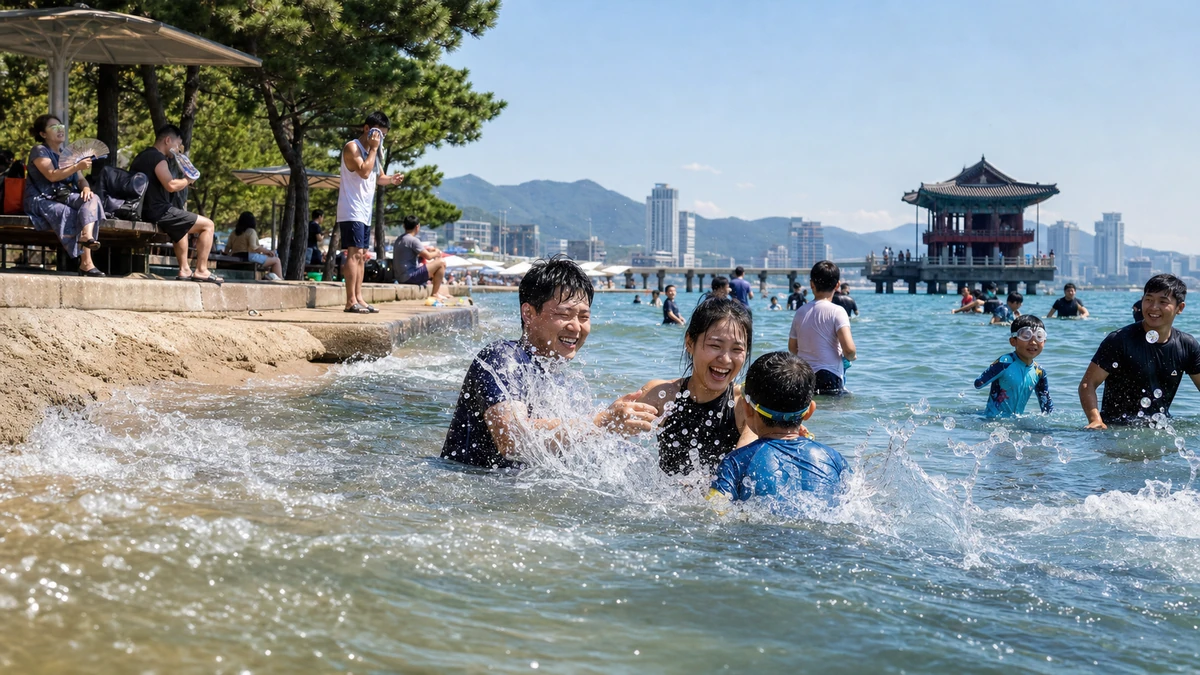
The shift was visible in real time. At Yeongildae Beach in Pohang, one of the city’s best-known waterfront destinations, visitors still entered the water and set up in shaded areas near the shore. Elsewhere in the city, however, outdoor life appeared to contract. Parking lots at neighborhood parks were sparse. Walking trails that usually attract runners and families saw people stopping only where an overpass or a cluster of trees provided relief. Umbrellas, handheld fans and slow, deliberate movement replaced the leisurely sightseeing pace that often defines Korean summer travel.
What emerged was more than a weather story. It was a snapshot of how climate extremes are changing the rhythm of daily life and leisure in South Korea, a country whose summer identity has long mixed beach trips, mountain walks, city festivals and quick weekend escapes.
In Pohang and Gyeongju, the geography of heat matters
The numbers themselves tell only part of the story. Automatic weather monitoring showed Gampo at 39.2 degrees Celsius, with other nearby areas also recording blistering readings: around 38 degrees Celsius in parts of Daegu, 37.9 in Guryongpo in Pohang and 37.8 in Gigye, another part of the Pohang area. Official representative observation sites showed somewhat lower temperatures in some cases, highlighting an important fact that many travelers anywhere in the world learn the hard way during heat waves: conditions can vary dramatically even within the same city or region.
That distinction matters in South Korea, where place names can sometimes mislead foreign visitors into thinking of a city as a single, uniform destination. Gyeongju, for instance, is often marketed internationally as an open-air museum. It was the ancient capital of the Silla Kingdom and remains one of the country’s most important historic destinations, home to royal tombs, Buddhist relics and sites recognized by UNESCO. Many Americans encountering Gyeongju for the first time may imagine temple roofs, grassy burial mounds and broad, photogenic landscapes. But Gyeongju also includes coastal zones like Gampo, where marine exposure, pavement, development patterns and local conditions can produce heat that feels very different from inland heritage districts.
Pohang, too, is a city of contrasts. It is known as an industrial city and steelmaking hub, but it is also a beach destination with urban parks, shoreline roads and public recreation spaces. A visitor can move in a single day from a waterfront setting to a built-up downtown corridor to a shaded linear park created along former rail infrastructure. Under ordinary summer conditions, that variety is part of the appeal. Under extreme heat, those differences become a matter of physical comfort and, potentially, safety.
The visual contrast reported from Pohang was striking. Yeongildae Beach remained active because it offered two key forms of relief: water and shade. Visitors could swim, cool off and then retreat beneath a windbreak forest, where tents and resting areas provided shelter from direct sun. In urban parks and walking routes, by contrast, the amenities that normally make a public space inviting were not enough. An ornamental waterfall or a landscaped path may look refreshing, but if they do not provide deep, sustained shade, many people simply will not stay.
That may seem obvious, but it reflects a broader change in how people use public space during extreme weather. The old assumption that a park is automatically a summer refuge breaks down when heat indexes soar and tree cover is uneven. In that environment, the most valuable urban infrastructure is not necessarily a scenic overlook or a long walking route. It may be a dense grove, a shaded bench, a covered passage or immediate access to water.
South Korea’s summer travel culture is adapting in plain sight
Summer travel in South Korea has its own rhythms, some of which may be unfamiliar to U.S. readers. The country’s geography, dense population and extensive transit network make short domestic trips especially common. A weekend can include a beach stop, a seafood meal, a quick walk through a scenic district and a return home the same day. Families, couples and friend groups often build itineraries around seeing several places in relatively tight time windows. There is also a strong culture of seasonal travel tied to specific moments: cherry blossom trips in spring, mountain foliage in fall and beach or valley outings in summer.
In that sense, the scenes from Pohang and Gyeongju point to a subtle but important shift. The issue was not that people stayed home altogether. Rather, they appeared to be redesigning the day around survivable pockets of time and space. Instead of moving continuously from site to site, they clustered around places where cooling was built into the environment. The beach worked not because it was glamorous, but because it offered alternating access to immersion and shelter.
This is a notable change in a country where summer tourism has often meant energetic movement: hiking, temple visits, market hopping, café stops and long walks through historic or scenic districts. In recent years, South Korea has also become a major destination for international travelers drawn by K-pop, K-dramas, Korean food and beauty culture. Those visitors frequently arrive with ambitious itineraries, hoping to fit in major urban attractions, historical sites and coastal excursions in a compressed schedule.
Extreme heat complicates that model. It forces a more local, more patient style of travel. The reward becomes less about checking landmarks off a list and more about finding a workable rhythm — a morning by the water, a midday retreat indoors, an evening stroll when the sun drops. For travelers raised on whirlwind itineraries, whether in Seoul, Tokyo, Rome or New York, that can feel like a loss of efficiency. But it may increasingly be the only realistic way to experience certain destinations in midsummer.
There is also a social dimension. In South Korea, practical sun avoidance carries less stigma than it sometimes does in the United States. Parasols, arm coverings and portable fans are common sights in hot weather. What may look to some Americans like excessive preparation is, in fact, an ordinary form of adaptation. During this heat wave, those tools took on greater importance, as did the simple act of choosing a shady route over an exposed one. The summer traveler’s map became less about landmarks than microclimates.
Why Yeongildae Beach stayed busy while parks emptied out
Yeongildae Beach’s popularity during the heat wave helps explain what kinds of public spaces still function under extreme summer conditions. The beach is not just an expanse of sand. It is an environment that lets visitors modulate exposure. Someone can go into the water, emerge to rest in the shade, sit under trees, cool down again and remain in one area without prolonged exertion. That flexibility is crucial when temperatures climb above what the body can comfortably handle during sustained activity.
By comparison, urban parks and walking trails often ask more of visitors. Reaching a shaded stretch may require walking across exposed pavement or open ground. Even when a park includes greenery, not all vegetation creates equal relief. Young trees, decorative landscaping and wide, open lawns may do little to lower perceived heat in the middle of the day. A rail-trail park or neighborhood greenway may still be attractive in the early morning or after sunset, but at peak afternoon heat it can feel less like an escape than a test of endurance.
That pattern is not unique to South Korea. American cities have learned similar lessons, sometimes painfully, during prolonged heat events. In Chicago, New York and Washington, urban planners and public health experts increasingly focus on “cool corridors,” tree canopy coverage and accessible cooling centers because traditional assumptions about public outdoor enjoyment no longer hold during hotter summers. South Korean cities, with their dense development and active public-space culture, are confronting parallel questions.
The imagery from Pohang captures that transition in human terms. People were not avoiding outdoor space altogether; they were editing it. A bench in full sun was effectively unusable. The shade beneath an overpass became a temporary refuge. A path that ordinarily invites exercise became a route navigated with caution, an umbrella and a handheld fan. Meanwhile, at the beach, the logic of staying put made sense. Long itineraries lost their appeal. One place, if it offered enough relief, was enough.
For travelers, that change can be counterintuitive. Modern tourism often prizes movement, variety and photographic productivity. But in high heat, stillness becomes its own strategy. Staying near the shoreline, resting under a stand of trees and moving only when necessary is not a lesser version of travel. It is adaptation — and increasingly, smart adaptation.
The warning signs of a hotter future are becoming harder to ignore
South Korea is hardly alone in facing more intense heat. Across Asia, Europe and North America, hotter summers are pushing governments, businesses and families to reconsider everything from working hours to vacation habits. What makes the South Korean case especially revealing is how quickly visible daily behavior changes when temperatures jump into clearly dangerous territory.
Heat is often called a silent hazard because it does not produce the dramatic visuals of a typhoon, wildfire or flood. Yet it can be just as disruptive. It alters foot traffic, suppresses outdoor commerce, strains infrastructure and raises health risks for older adults, children, outdoor workers and anyone without easy access to air conditioning or shade. In tourist areas, it changes not just comfort levels but the basic economic geography of a day. Some businesses benefit when visitors cluster near beaches, cafés and indoor attractions. Others lose out when promenades, parks and historic outdoor sites become difficult to visit during peak afternoon hours.
For a country like South Korea, where domestic tourism is deeply woven into seasonal life, that has broad implications. The classic summer outing may need to be redesigned around heat resilience. Hotels and local governments may have to market not just destinations but safe timing: sunrise walks, evening programs, sheltered rest zones and clear heat advisories in multiple languages. Beach areas may become more attractive not only because they are scenic, but because they are structurally better suited to a hotter climate when paired with shade and amenities.
This also matters for international perceptions of Korea. Much of the country’s global image is tied to dynamism — fast trains, fast trends, fast-moving cities and tightly packed itineraries. But extreme weather introduces friction into that story. Visitors may increasingly need to think less like consumers of a bucket list and more like residents navigating climate conditions. The travel lesson from Pohang and Gyeongju is simple but important: in a heat wave, the smartest trip is often the slowest one.
That message resonates well beyond Korea. Americans planning summer travel have had to learn similar lessons in places from the Grand Canyon to Orlando. The old idea that vacation means pushing through discomfort to maximize the day is losing ground to a more climate-aware mindset. Hydration, shade, reduced midday exposure and realistic pacing are no longer optional footnotes. They are central to the itinerary.
For visitors, the new rule may be to follow the shade
For anyone heading to South Korea in August, the practical takeaway from this weekend’s heat is not that travel should stop. It is that travel must become more selective, more place-specific and more weather-literate. A city name on a map does not tell the whole story. Conditions on a coast, in a downtown district and along a walking trail can differ meaningfully even within the same metropolitan area. A destination that seems manageable on paper may be punishing at 2 p.m., while another a few miles away may be tolerable because of sea breeze, water access or tree cover.
That is especially important in a place like Gyeongju, where many of the signature attractions are outdoors. The city’s appeal lies in its landscape as much as its monuments: broad skies over ancient tombs, temple compounds framed by mountains and open historic grounds meant to be explored on foot. In extreme heat, those spaces may still be worth seeing, but the timing becomes everything. Early morning and evening are no longer just more pleasant; they may be the only sensible windows for extended visits.
Pohang offers a complementary lesson. Not every successful summer outing needs a packed schedule. At Yeongildae Beach, the combination of water and shaded rest transformed a dangerous-weather day into one that still allowed recreation, if carefully managed. That kind of setting — where a person can alternate between activity and recovery without long exposure — may become more valuable as heat waves grow more frequent.
There is a deeper cultural point here as well. Travel in South Korea has often been portrayed abroad through the lens of efficiency: seamless transit, tightly sequenced stops and an impressive amount accomplished in a short time. What this heat wave revealed is another, quieter Korean travel practice: adjusting quickly to conditions, reading the environment closely and finding comfort in a well-chosen pause. The sight of people gathering under a beachside windbreak forest or lingering only in the shadow beneath an elevated roadway may not fit the glossy tourism brochure. But it reflects a lived intelligence about summer that deserves attention.
As climate pressures intensify, that intelligence may become part of the global travel vocabulary. Whether in South Korea, the American South or the Mediterranean, the future summer itinerary may depend less on ambition than on adaptation. The destinations will still matter. So will the landmarks, the food and the scenery. But on days when the heat reaches dangerous levels, the real map is drawn by water, shelter and the movement of the sun.
In Pohang and Gyeongju, that map was visible everywhere this weekend. It ran from the surf at Yeongildae Beach to the shade under coastal trees, from quiet city parks to the narrow bands of relief beneath urban structures. It suggested a different way to understand summer in South Korea: not as a season abandoned to heat, but as one reorganized around it. For travelers and residents alike, the challenge is no longer simply to get outside and enjoy the day. It is to know where relief lives — and to plan the day around finding it.
Comments
Post a Comment