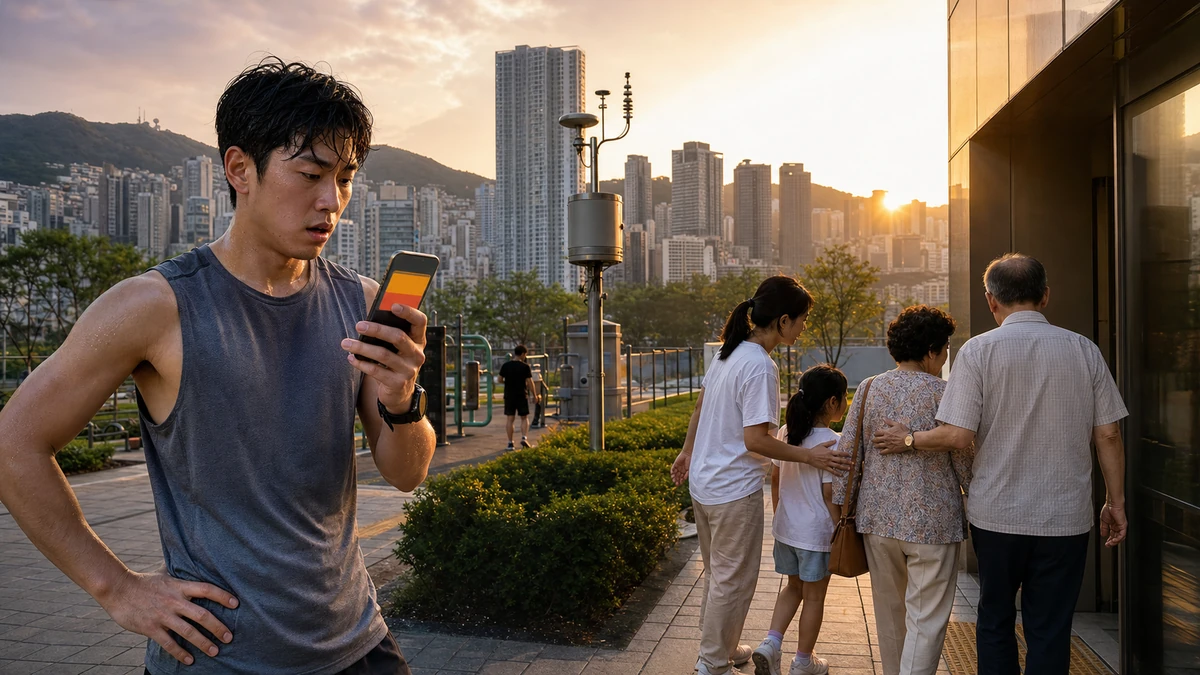
An invisible hazard settles over part of Busan
Busan, South Korea’s second-largest city and one of Asia’s busiest port hubs, issued an ozone advisory for four central districts at 7 p.m. on July 19 after air pollution levels crossed the government’s warning threshold. According to data compiled by the Korea Environment Corp., a public agency under South Korea’s Environment Ministry, the area’s hourly average ozone concentration reached 0.1257 parts per million, just above the advisory benchmark of 0.12 ppm.
That number may sound technical, even abstract, to readers used to checking weather apps for thunderstorms or heat alerts rather than the chemistry of the air. But in practical terms, the advisory means something simple: residents, commuters and tourists spending the evening outdoors in central Busan were being told to rethink how long and how hard they exert themselves outside. For older adults, children, and people with respiratory or heart conditions, officials advised cutting back on outdoor activity altogether. For everyone else, the guidance was less severe but still clear: avoid strenuous exercise outdoors.
The warning did not cover all of Busan, a sprawling coastal metropolis known for beaches, seafood markets, mountain trails and dense urban neighborhoods. Instead, it applied to four districts in the city’s central zone, underscoring a point that is increasingly familiar in large global cities from Los Angeles to Seoul: air quality risks can vary by neighborhood, hour and weather pattern, even within the same metropolitan area.
Unlike a typhoon, a flash flood or even a punishing heat wave, high ozone does not dramatically change the look of a city. Streets remain crowded. Joggers still head toward river paths. Families may continue strolling after dinner. Tourists may still line up for sunset photos along the waterfront. But public health officials treat ozone advisories seriously because the health effects can build quietly, particularly for people whose lungs or hearts are already under strain.
That is why this advisory matters beyond a single data point on a summer evening. It offers a window into how South Korea manages urban environmental risk in real time and how city life in one of the world’s most wired societies can be shaped by a pollution threat that most people cannot see.
What an ozone advisory means in South Korea
In South Korea, ozone alerts are issued in stages based on hourly average concentrations. An ozone advisory begins at 0.12 ppm. A higher-level warning is issued at 0.30 ppm, and a serious warning begins at 0.50 ppm. Busan’s reading of 0.1257 ppm placed the city squarely in the first category: elevated enough to trigger official precautions, but not near the more severe tiers.
That distinction is important. A first-level advisory is not the same as a full-scale emergency. It does not mean people should panic, and it does not mean the air is equally dangerous to everyone. But it is also not the kind of notice public health officials issue casually. These tiered systems are designed to translate raw measurements into behavioral guidance. In this case, the message was calibrated rather than alarmist: sensitive groups should limit outdoor exposure, and the general public should scale back intense outdoor activity.
For American readers, the concept is roughly comparable to checking an Air Quality Index alert in cities such as Denver, Phoenix or Atlanta during high-ozone days in the summer, when strong sunlight and heat help create ground-level ozone pollution. The difference is that South Korean public messaging often emphasizes regional precision, with alerts announced for particular districts or subregions rather than for an entire city at once. That can matter in a place like Busan, where urban density, traffic patterns, industrial activity and coastal weather conditions can shape pollution levels over short distances.
South Korea’s alert framework also reflects how deeply integrated public advisories are in daily life. Korean residents are accustomed to checking highly detailed real-time information ranging from weather radar and subway delays to fine dust levels and heat warnings on their phones. Air quality alerts are part of that broader public information culture. The expectation is not merely that the government will publish environmental data, but that ordinary people will use it to make small, practical decisions about the day ahead — or, in this case, the evening ahead.
That may sound routine, but it represents a broader civic habit: turning specialized environmental measurements into everyday public guidance. A decimal-heavy pollution reading becomes a decision about whether to go for a run, let a child play outside after dinner, or keep an elderly parent indoors with the windows closed.
Why evening ozone matters more than many people realize
The timing of the Busan advisory is especially notable. A 7 p.m. warning comes at an hour when many people are just beginning what in Korea is often an important part of the day’s social life. In the United States, readers might think of the period after work when neighbors walk the dog, children ride bikes, or people head to a park before sunset. In South Korea, summer evenings often carry similar rhythms but at even greater urban intensity: office workers gather outdoors after long workdays, families take neighborhood walks, and fitness enthusiasts fill riverside paths, public parks and outdoor exercise areas.
Busan, in particular, is a city built around movement between dense neighborhoods, waterfronts and commercial districts. Summer evenings can draw people outside after the day’s worst heat begins to ease. That makes an ozone advisory at 7 p.m. more than a technical public notice. It becomes a direct intervention in the city’s leisure hours, especially in a season when residents and visitors may assume the biggest danger is heat, not air chemistry.
Ground-level ozone forms when pollutants emitted by vehicles, industrial facilities and other sources react in sunlight. It is different from the ozone layer high in the atmosphere, which protects Earth from ultraviolet radiation. At street level, ozone is considered a harmful pollutant that can irritate the lungs, worsen asthma, trigger chest discomfort and make breathing more difficult, especially during physical exertion. Because people breathe more deeply and rapidly while exercising, a runner, cyclist or someone playing a vigorous outdoor sport may feel the effects sooner than a person sitting quietly outside.
This is one reason public health officials separate advice for sensitive groups from advice for the general public. A healthy adult strolling briefly outdoors may face a different level of risk than a child with asthma at a playground or an older adult with heart disease climbing hills in humid weather. The distinction in the Busan advisory reflects that reality. It does not impose a blanket ban on going outside. Instead, it asks residents to match their behavior to both the measured risk and their own health condition.
For tourists, the timing matters, too. Busan is one of South Korea’s most visited domestic and international destinations, often compared to a Korean answer to a major American coastal city: energetic, scenic and defined by its relationship to the sea. Visitors may not immediately understand Korean environmental notices or know whether the advisory applies to the entire city. But the key point is that such alerts are often localized. A traveler staying in Busan should not assume that a citywide label tells the full story; district-level information can be more meaningful than the city name alone.
The challenge of reporting a threat people cannot see
There is a reason ozone alerts can be harder for the public to process than warnings about torrential rain or extreme heat. Heavy rain floods streets, stalls traffic and fills television screens with unmistakable images. Heat waves announce themselves physically, with oppressive afternoons and sleepless nights. Ozone does not present itself that way. No dramatic cloud appears over a neighborhood. No visible line marks where an advisory begins. Daily life can look entirely normal even when the air has crossed a threshold that warrants caution.
That invisibility can lead in two directions, both of them problematic. One is overreaction, in which people hear the word “advisory” and assume catastrophic conditions that the data do not support. The other is dismissal: if the sky looks clear and the streets are busy, the risk can seem theoretical. The value of the Busan notice lies in its specificity. Officials did not announce a vague concern; they cited an hourly average concentration, a defined threshold and a limited geographic area. That level of detail is exactly what allows the public to respond proportionately rather than emotionally.
This is an increasingly familiar challenge for cities around the world. As climate change intensifies heat, alters atmospheric conditions and compounds existing pollution problems, many urban hazards are becoming more data-driven. Residents are asked to interpret warning levels, concentration values and neighborhood-specific maps rather than simply looking outside. In that sense, modern urban resilience depends not only on infrastructure, but also on public literacy: the ability to understand what a number means and what action it reasonably calls for.
South Korea has spent years building out systems that make those numbers accessible. Environmental and meteorological agencies regularly issue updates through websites, mobile platforms and media channels. Korean news coverage often includes not just the existence of an advisory, but the exact measurement, the relevant threshold and the practical recommendations attached to it. That style of reporting can feel dense to foreign readers, but it reflects a civic expectation that numbers should lead directly to behavior.
In Busan’s case, the number 0.1257 ppm is significant not because it is dramatically higher than the threshold, but because it crossed the line that triggers an official response. In public health terms, thresholds matter. They provide a shared rulebook for when concern becomes action. That action may be modest — postponing an evening run, shortening a family outing, checking on an elderly relative — but modest actions can still matter when risk is widely distributed across an urban population.
Who faces the greatest risk and what officials are advising
South Korean authorities specifically urge caution for older adults, children, and people with respiratory or cardiovascular disease when ozone advisories are in effect. That guidance aligns with longstanding public health research showing that these groups are more vulnerable to the effects of air pollution. A child’s lungs are still developing, and children often spend more time in active outdoor play. Older adults may already have reduced respiratory capacity or underlying medical conditions that make it harder to tolerate polluted air. People with asthma, chronic obstructive pulmonary disease, heart disease or similar illnesses may experience worsened symptoms even during brief exposure.
For those groups, the wording of the guidance is important. Officials did not simply recommend taking it easy; they advised refraining from outdoor activity. For the general public, by contrast, the emphasis was on avoiding strenuous activity outdoors rather than all outdoor movement. That difference may seem subtle, but it is meaningful. It recognizes that risk is not uniform and that intensity matters. A light errand is not the same as a long-distance run. Sitting at an outdoor cafe is not the same as playing a competitive soccer match.
That sort of calibrated advice can be especially useful in a city during peak travel season. Busan in July is not just a home for residents going about their routines. It is also a magnet for visitors who may spend long hours outside sightseeing, walking markets, climbing stair-heavy neighborhoods or heading toward beaches and waterfront attractions. A tourist who might shrug off an air alert at home could be more vulnerable after a day of heat, dehydration and physical exertion. The cumulative burden matters.
For families, the advisory also becomes a caregiving issue. A parent may be healthy enough to tolerate a short walk, but still decide against taking a child to an outdoor playground. An adult planning evening exercise may need to reconsider if accompanying an elderly relative. Public advisories like Busan’s often sound individual on paper, but in practice they are relational. One person’s choice about whether to go outside often depends on the health of the people around them.
In practical terms, the best response on a night like this is not complicated. Sensitive groups should stay indoors as much as possible. Others should consider shortening outdoor plans, moving workouts inside, lowering exercise intensity, or delaying more strenuous activity until conditions improve. These are small adjustments, but they reflect the central logic of environmental health guidance: when the risk is measurable and time-limited, behavior does not need to stop altogether — it needs to become smarter.
A broader picture: Korea’s patchwork of summer alerts
The Busan ozone advisory also arrived amid a wider landscape of weather and environmental warnings in South Korea, highlighting how fragmented summer risk can be. On the same day, other parts of the country were dealing with heavy rain alerts and heat-related notices. That combination is not unusual in Korea’s monsoon and midsummer season, when flooding, humidity, tropical nights and air quality issues can overlap or unfold in quick succession.
For readers outside Korea, it may be tempting to read such developments as a single national weather story. But South Korea’s geography and weather systems often produce highly localized impacts. A county inland may be coping with dangerous rainfall while a coastal city is managing ozone exposure. Another area may be under a heat advisory, with sweltering nighttime temperatures that make recovery difficult even after sunset. Each warning uses different thresholds and calls for different behavior. A rainfall warning is not an ozone warning; a heat advisory is not a flood alert.
That distinction is central to how Korean authorities communicate risk. The country’s warning culture is built on categories, regions and measurable triggers. Citizens are expected to note not just that an alert exists, but what kind of alert it is, where it applies and what behavior it is supposed to change. In the Busan case, the relevant fact was not simply that “South Korea had bad weather” or that “Busan had pollution.” It was that four central districts in Busan recorded an hourly ozone average above the advisory threshold at 7 p.m., prompting a specific set of recommendations.
This approach reflects a society that is both highly urbanized and highly networked. In a country where smartphone alerts, public transit apps and government information portals are central to daily life, there is a practical expectation that people can make fine-grained decisions based on live data. That does not eliminate risk, but it can make public response more precise. A resident does not need to cancel an entire weekend because one evening advisory was issued in one part of the city. But that resident is expected to understand what the advisory means for that evening’s specific plans.
There is a lesson here for other countries as well. As environmental hazards become more frequent and more varied, public communication may need to move beyond one-size-fits-all warnings. Region-specific and time-specific guidance, though more complicated, can help people make better choices. The tradeoff is that the public must be willing to engage with nuance rather than relying on broad headlines alone.
What Busan’s advisory says about modern city life
At one level, this is a straightforward public health story: an environmental measurement crossed a threshold, and authorities issued guidance. But at another level, Busan’s evening ozone advisory captures something broader about urban life in the 21st century. More and more, city residents live by dashboards — temperatures, pollution readings, rainfall probabilities, transit disruptions, energy demand and real-time maps that quietly shape ordinary decisions. The city is no longer interpreted only through sight and experience. It is increasingly interpreted through numbers.
That shift can be disorienting. Many people still trust what they can feel more than what they can measure. If the breeze off the water feels pleasant, it is hard to accept that the air may still be unhealthy for a child with asthma. If the streets are lively and restaurants full, it can feel unnatural to treat the evening as one requiring caution. Yet that tension between visible normalcy and invisible risk is now a basic feature of contemporary urban living, from wildfire smoke in the western United States to ozone spikes in East Asian port cities.
Busan’s advisory also reflects a cultural reality of South Korean cities: evening hours matter. In a society where long workdays are common and nighttime social life remains important, warnings issued after the traditional workday can have outsized effects on how people experience public space. A 7 p.m. air alert is not just a footnote to daytime weather. It shapes exercise, family routines, tourism and commerce during some of the most active hours of the summer day.
For American readers, the closest analogy may be an air quality warning that arrives just as a city’s waterfront trail, neighborhood park or downtown entertainment district begins filling for the evening. Nothing appears shut down, and no one is ordered inside. But the advisory changes the calculation. It asks people to trade impulse for information — to check the map, understand the threshold, and decide whether tonight’s run, stroll or sightseeing plan should be shortened, delayed or dialed back.
That, ultimately, is the significance of Busan’s 0.1257 ppm reading. It is not a dramatic number on its face. It is a number that became meaningful because a public system connected it to a threshold, a place and a set of actions. In doing so, it turned invisible chemistry into practical civic knowledge. For the residents and visitors in the affected parts of Busan on this summer evening, the message was neither panic nor indifference. It was something more useful: pay attention, know where you are, understand who is vulnerable, and let the data guide how you move through the city tonight.
Comments
Post a Comment