A different kind of summer break
In the United States, summer vacation often brings a familiar menu of activities: camps, museum trips, Little League games, beach weekends and long evenings at the local pool. In South Korea, where summer can be hot, humid and densely urban, families are also looking for ways to make school break feel memorable. But one program in the country’s southwest is offering a distinctly local answer: step into the woods after dark, follow the glow of moonlight and flashlights, and learn to see insects not as background noise of summer, but as neighbors in a living ecosystem.
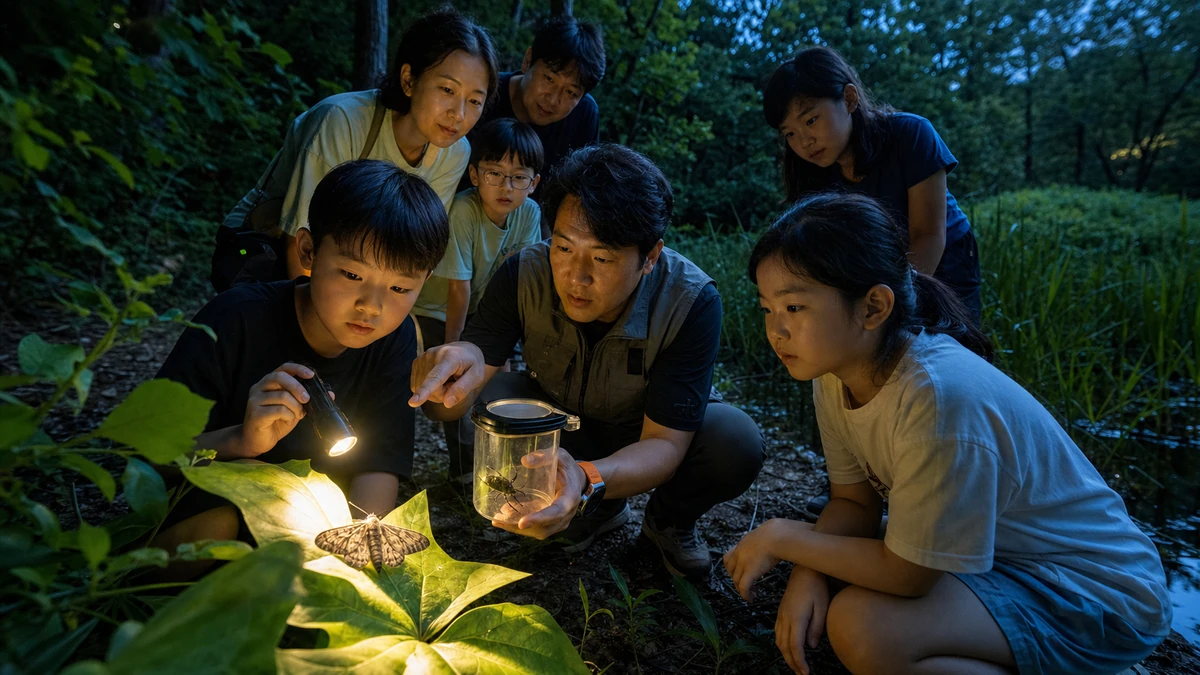
Officials in North Jeolla Province, now formally known as Jeonbuk State, say they will run a summer vacation program called “2026 Moonlight Insect Exploration” seven times for elementary and middle school students and their families. The program, announced by the Jeonbuk State Natural Environment Training Institute, is designed as a hands-on nighttime ecology class in which participants observe insects in the wild and hear from experts about how the creatures live, feed and interact with their habitat.
The first session is scheduled to begin July 24 in Jeonju, the provincial capital, at a forest site called Poljjak Poljjak Maengkkongi Forest. Additional sessions are expected to take place across other parts of Jeonbuk, including Muju, Iksan and Gunsan. Rather than bringing children into a lecture hall and showing them slides of beetles and moths, the program turns actual nighttime habitat into the classroom.
That distinction matters. In a country where academic pressure is often intense and after-school education can dominate children’s time, outdoor programs can carry significance beyond simple recreation. The appeal here is not only that children will see insects up close, but that they will learn outside the formal rhythms of school, with parents or guardians alongside them. It is part family outing, part science lesson and part reframing of what summer leisure can look like in South Korea.
At a time when many countries are struggling to reconnect children with nature after years of screen-heavy routines, the program also taps into a broader concern shared far beyond Korea: how to help young people experience the natural world as something immediate and worth paying attention to, not merely something discussed in textbooks or encountered through video clips.
Why the night matters
The title itself offers a clue to the program’s concept. “Moonlight” is not just branding. It signals that the program is built around the atmosphere and ecology of nighttime. For many children, and for plenty of adults, a forest visited after sunset feels like an entirely different place from the same trail under afternoon sun. Sounds sharpen. Movement becomes more noticeable. Creatures that remain hidden during the day emerge into view.
That is especially true for insects. Summer evenings are prime time for many species, whether they are drawn to light, active in cooler temperatures or simply easier to notice against the darkness. In practical terms, a nighttime outing can make the natural world feel dramatic in a way daylight sometimes does not. A child who might shrug at a chapter on insect life cycles can become deeply engaged when a moth lands nearby or a beetle appears on tree bark under a flashlight beam.
For American readers, the closest comparison may be a ranger-led night hike at a national park, a firefly walk at a nature center or one of the after-dark wildlife programs run by state park systems in summer. The difference is that in Korea, especially in highly populated regions, programs like this can also serve as a reminder that meaningful encounters with nature do not require a major wilderness trip. They can happen in managed local forests, urban-edge green spaces and community-accessible sites close to where families live.
The nighttime setting also reflects everyday summer logic in Korea. July and August are often brutally hot, with sticky air, heavy monsoon moisture and heat advisories that can make midday outdoor activity unpleasant or even risky. Scheduling a nature program after sunset is not only atmospheric; it is practical. It allows children and parents to avoid the worst heat while turning the evening itself into part of the experience.
That seasonal reality may sound familiar to readers in the American South or Southwest, where families often delay walks, sports and outdoor chores until the sun goes down. But in Korea, where apartment living is common and many people spend long hours indoors at school, work or private academies, a structured nighttime ecology program can offer a particularly appealing break from routine.
More than bug-spotting
Organizers say the program is designed to emphasize discovery and understanding rather than rote memorization. That may sound like a small difference, but it speaks to a larger educational philosophy. Instead of asking children to simply learn the names of insects, the program aims to start with direct observation: find a living creature, look closely, ask what it is doing, and then build knowledge from there with help from specialists.
That approach turns the insect from an object of curiosity into a doorway to ecology. Why is one species active at night while another is not? What does its body shape suggest about how it moves or feeds? Why does it appear in that particular patch of forest? What role does it play in the food web? Even basic questions can help children see that small organisms are not random decorations in nature but part of a system.
In educational terms, it is the difference between being told about a pond ecosystem and kneeling beside the water to see what is actually there. American science educators often describe that kind of learning as experiential or inquiry-based. Korean officials involved in environmental education often use a related concept sometimes translated as “ecological sensitivity,” meaning not just knowledge of nature, but an attentive attitude toward living things and the environments they inhabit.
That phrase can sound abstract in English, but its meaning is fairly concrete. It suggests cultivating the habit of noticing life forms that people usually ignore, and recognizing that even very small creatures matter. In a world shaped by climate anxiety, biodiversity loss and increasingly digital childhoods, that is no small goal. An insect walk is unlikely to transform environmental policy, but it can influence how children understand the living world around them.
The Jeonbuk institute said participants will hear expert explanations about insect characteristics and lifestyles as they observe them. That expert component is central. Without it, a nighttime walk might remain just an entertaining outing. With it, the experience becomes interpretation: children and adults are given a framework for what they are seeing, which helps move the event from spectacle to understanding.
The result is a hybrid that many public agencies in Korea are increasingly trying to create: programs that are educational without feeling like school, and recreational without being empty entertainment. In that sense, “Moonlight Insect Exploration” reflects a broader shift in how local governments present public learning opportunities to families.
Family time, Korean style
One of the most notable features of the program is that it is aimed not only at students but also at their families. That may seem obvious to American readers used to parent-child museum days, zoo sleepovers or school break programming that encourages adult participation. In Korea, though, the family element has its own resonance.
School-age children in South Korea often have tightly structured schedules, especially as they get older. In addition to regular school hours, many attend hagwon, or private after-school academies, for subjects such as math, English, science or music. The result is that truly shared learning time between children and parents can be limited, especially during the school year. Summer break offers a window to reclaim some of that time, and programs like this are designed to make the most of it.
There is also an important social message embedded in the format: meaningful family activities do not have to involve expensive travel or major entertainment venues. In Korea, as in the United States, summer can bring financial pressure for parents who feel they should provide memorable experiences for their children. A province-run ecology program offers a different model, one rooted in local public resources rather than commercial attractions.
In practice, that means a family in Jeonju or another Jeonbuk city may be able to spend a summer evening doing something educational and unusual without booking a resort, driving across the country or spending heavily on tickets. That accessibility matters in any discussion of public programming. It is one thing to celebrate family nature experiences in principle; it is another to make them realistically available.
The program also creates a shared experience across generations. Parents do not simply drop children off for instruction. They observe together, listen together and ask questions together. That changes the dynamic. The adult is not only supervisor but participant, and the child is not the sole learner. For many families, that can create the kind of memory that sticks: not a staged performance or packaged attraction, but a moment of collective discovery in an ordinary regional forest transformed by darkness and attention.
It is also a reminder that Korean local life contains far more variety than the international image often suggests. Much foreign coverage of South Korea centers on Seoul, K-pop, technology and geopolitics. Those are important stories, but they can eclipse the rhythms of everyday provincial life. A family insect exploration program in Jeonbuk will never command the global spotlight in the way a summit meeting or a chart-topping pop act does. Yet it reveals something equally real about contemporary Korea: local governments trying to build community, support families and deepen environmental awareness through small-scale, place-based programs.
From Jeonju to Gunsan, local nature as public space
The schedule begins in Jeonju and extends to other parts of Jeonbuk, including Muju, Iksan and Gunsan. That geographic spread is significant. Rather than concentrating the program in a single flagship location, organizers are taking it around the province, linking several communities through a shared educational theme.
For readers unfamiliar with the region, Jeonbuk is a largely agricultural and mid-sized urban area in southwestern South Korea. It does not have the global profile of Seoul or Busan, but it plays an important role in Korean food culture, local heritage and regional identity. Jeonju is especially well known domestically for traditional cuisine and its historic hanok village, a district of Korean-style homes that draws tourists. Muju is associated with mountain scenery and outdoor recreation. Gunsan, a port city, carries layers of modern Korean history. Iksan is known for both industry and archaeological heritage.
By holding events in multiple locations, the province is effectively recasting these areas not just as places to live or visit, but as learning environments. The forest, in this framing, is not simply scenery. It is civic infrastructure of a kind: a public asset that can host education, leisure and community engagement. That idea has parallels in the United States, where local governments and nonprofit groups often use parks, wetlands and trails as sites for nature education. But in Korea’s more compressed geography, where urban development and green space exist in close proximity, the relationship between daily life and nearby habitat can be especially immediate.
There is a subtle regional development dimension here as well. The program does not advertise itself as a tourism driver or economic booster, and officials have not framed it in those terms. Still, when families visit natural spaces across different cities and counties, those places gain visibility and value. The message is that regional identity is built not only through major festivals, infrastructure projects or commercial landmarks, but also through ordinary landscapes and the living things within them.
That can shape how residents see their own communities. A forest at night, filled with insect activity and interpreted by experts, becomes more than undeveloped land. It becomes a site of meaning. In places that sometimes struggle to hold the attention of younger generations drawn to larger cities, programs like this can reinforce the idea that local spaces are worth exploring and caring for.
The seven-session format also suggests something more durable than a one-off event. This is not merely a ceremonial summer kickoff. Spread across the school vacation period and multiple locations, the program functions as a seasonal series, giving it a stronger identity as a recurring regional offering.
What this says about Korea’s public ecology education
The organizing institution is a provincial natural environment training center, a type of public body that may be unfamiliar to many American readers. In South Korea, local governments often operate institutes, centers and training facilities dedicated to environmental learning, youth programs or civic education. These organizations can serve as a bridge between formal school systems and community-based public learning.
That matters because South Korea’s education system is often discussed primarily through the lens of test scores, competition and college admissions. Those realities are real and deeply influential, but they are not the whole picture. Alongside the pressure-cooker reputation, there is also an ecosystem of public programs aimed at broadening what education looks like outside the classroom.
“Moonlight Insect Exploration” fits squarely into that effort. It embodies a form of state-supported educational programming that is less about achievement metrics and more about encounter, awareness and attitude. In other words, it asks children not just to know more, but to notice more.
The institute has said it hopes the program will help students feel closer to nature and ecosystems and that it plans to diversify ecology education aimed at building that kind of sensitivity. That language reflects a wider concern in Korea, as in many developed countries, about environmental literacy. As children grow up in increasingly digital and urban settings, public agencies are trying to create experiences that foster attentiveness to natural systems before those systems become too abstract or too distant.
There is also an implicit conservation lesson. Insects are often overlooked in mainstream environmental storytelling, which tends to favor large mammals, forests or marine life. Yet insects are essential pollinators, decomposers and food sources within ecosystems. Teaching children to observe them carefully can help expand the public imagination of what biodiversity means. Conservation starts to look less like saving only charismatic wildlife and more like understanding the dense web of small lives that make habitats function.
That idea has growing relevance worldwide. Scientists in Europe, North America and Asia have all raised alarms in recent years about declines in insect populations, with implications for agriculture, ecosystems and food chains. A local summer program in Korea will not solve that problem, but it does address one of the conditions beneath it: whether the next generation grows up valuing creatures that are easy to ignore.
An American lens on a Korean summer tradition in the making
For American readers, it may be tempting to file this as a charming local-interest story from abroad, the kind of small-bore seasonal item that reveals a bit of regional color. It is that, but it is also more than that. Stories like this help explain how South Korea is negotiating questions that many societies share: how to give children meaningful time outdoors, how to make public education feel alive, how to support families without turning every experience into a consumer product, and how to define local culture beyond marquee attractions.
What stands out most is the way several elements overlap. It is a summer break activity, but also an educational program. It is a family outing, but also a public service. It is hyperlocal, rooted in specific forests and communities, yet it speaks to global concerns about environmental awareness and children’s relationship to nature. The evening format gives it a sense of novelty, but the underlying idea is straightforward: go outside, look carefully and learn together.
There is something refreshingly modest about that. In an era when so many youth programs are branded around achievement, prestige or high production value, an insect walk in the woods offers a quieter proposition. Wonder can begin with what is already nearby. Education can happen without desks. A memorable summer night does not have to be loud.
For international audiences accustomed to seeing South Korea through the lenses of pop culture and high-tech modernity, the Jeonbuk program offers another image: children and parents moving through a darkened forest, stopping to examine tiny lives under expert guidance, and leaving with a slightly altered sense of the world around them. That image may be small in scale, but it says something important about the country’s everyday civic culture.
Officials have advised families interested in joining to check the natural environment institute’s website for detailed participation information, including schedules and registration. The core structure already announced is clear: seven sessions during summer vacation, open to elementary and middle school students and their families, beginning in Jeonju and continuing through other parts of Jeonbuk with a focus on nighttime observation and expert-led ecological learning.
In the end, the value of the program is not merely in how many sessions it offers or how many places it visits. Its significance lies in how it reimagines a summer evening. In Jeonbuk, at least for a few nights this season, the forest becomes a classroom, insects become teachers of a sort, and family time becomes a way of practicing attention. In a world where that attention is increasingly fragmented, that may be one of the most meaningful lessons on offer.
Comments
Post a Comment