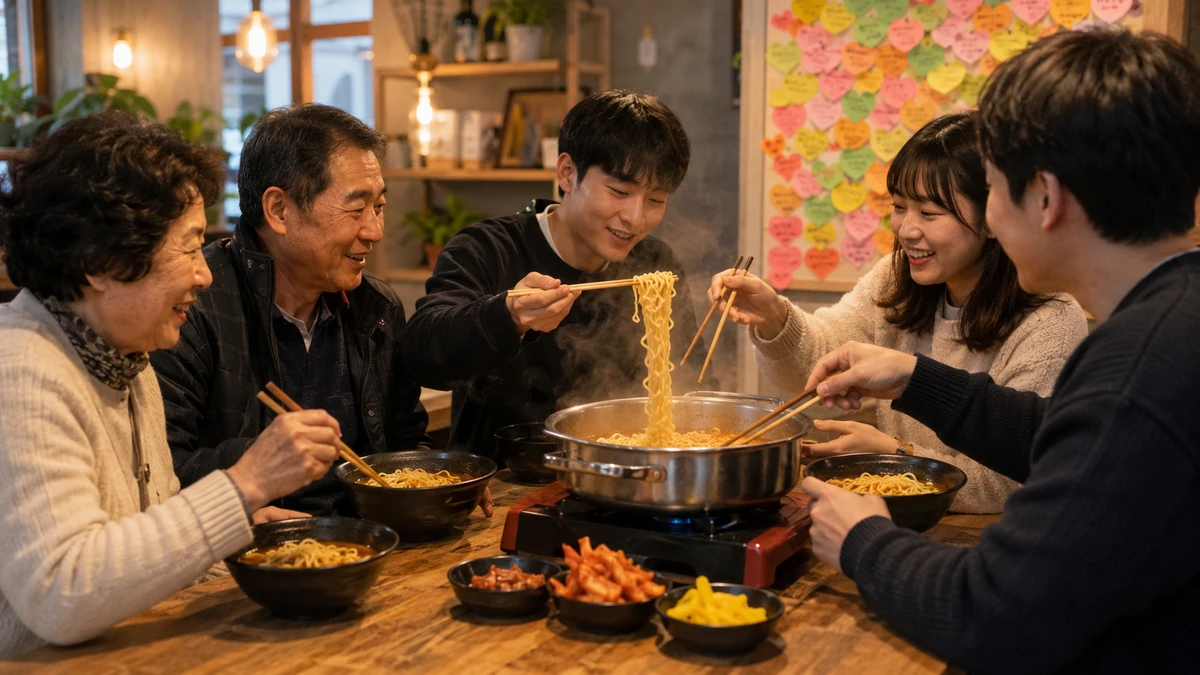
A simple meal, and a quiet public health experiment
In Jinju, a midsize city in South Korea’s South Gyeongsang province, officials are trying something disarmingly simple to address a deeply modern problem: loneliness. In a modest community space called Hamkkehamo, people walk in, choose a packet of donated instant noodles, boil water, sit down and eat with strangers. There is no registration book, no proof of need, no formal intake process and, just as important, no visible label marking the place as a facility only for the vulnerable. It is meant to feel less like a social service office and more like a neighborly kitchen table.
The idea may sound small, even quaint, compared with the sprawling government programs often associated with aging populations and mental health crises. But the challenge the space is meant to address is anything but minor. South Korea, like many wealthy democracies, is grappling with a rise in single-person households, weakening neighborhood ties and what Koreans call “godoksa,” or lonely deaths — cases in which a person dies alone and remains undiscovered for some time. The term carries social and moral weight in South Korea, where rapid urbanization, intense work culture and demographic change have upended older expectations about family and community life.
According to local officials, Jinju opened Hamkkehamo last month after confronting a striking demographic reality: single-person households account for 43% of homes in the city, higher than the national average of 36.1% and the highest share in South Gyeongsang province. Living alone is not, by itself, a crisis. In the United States, solo living has also become more common, especially among young professionals, older adults and people priced out of family-sized housing. But policymakers in both countries increasingly recognize that when living alone is paired with unemployment, aging, illness or social withdrawal, it can become a risk factor for severe isolation.
That is the social gap Hamkkehamo is trying to narrow. Instead of asking isolated residents to present themselves as clients in need of help, the project uses a familiar food — ramyeon, the Korean version of instant noodles — as a low-pressure reason to show up. The meal is quick, inexpensive and universally recognizable in South Korea, where instant noodles are not just pantry staples but a shorthand for everyday survival, student life, late-night work and simple comfort. In that sense, the space is doing more than feeding people. It is using a shared ritual to make first contact easier.
Why instant noodles matter in Korea
To an American reader, it may help to think of instant noodles in South Korea as occupying a place somewhere between boxed mac and cheese, diner coffee and a bowl of chicken noodle soup — cheap, ubiquitous, deeply unpretentious and emotionally familiar. Nearly everyone in South Korea knows what it means to make ramyeon. It is the quick meal eaten after a long day, the convenience-store dinner for students, the food shared on a camping trip or after a night out. It is associated with ordinary life, not ceremony.
That cultural familiarity is central to why this project works. A community center built around counseling sessions or outreach appointments can unintentionally intimidate the very people it hopes to reach. People who feel ashamed of their financial struggles, social withdrawal or mental health problems may avoid places that make them feel singled out. A room where people simply make noodles together lowers that barrier. No special explanation is required. No one has to announce that they are lonely.
In Korean society, as in many others, there can be real stigma around admitting emotional hardship or social isolation. South Korea has spent years confronting issues related to depression, youth burnout, elderly poverty and self-isolation, but many residents still find it easier to ask for practical help than personal help. Food can bridge that divide. A bowl of noodles gives people something to do with their hands, something to talk about and a socially acceptable reason to linger.
That dynamic may be especially meaningful in a country where meals traditionally carry strong communal meaning. Korean dining culture often emphasizes shared side dishes, conversation and eating together. Solo dining is much more common today than in previous generations, but the symbolism of sharing a table still matters. Hamkkehamo appears to draw on that cultural memory without turning it into nostalgia. The setting is not a recreation of an old village life. It is a practical adaptation to a more atomized urban present.
Even the name Hamkkehamo carries local resonance. “Hamkke” means “together” in Korean, while “hamo” is associated with the regional dialect used in South Gyeongsang. That makes the space sound informal, local and inviting — closer to “let’s do this together” than to the official language of government welfare programs. For a city initiative, that tone matters. It signals that the space is not only about service delivery but about belonging.
The rise of living alone, in Korea and beyond
South Korea’s changing household structure is part of a broader social transformation that will be familiar to Americans watching similar trends unfold at home. Fewer people are marrying young. More older adults are living independently or apart from adult children. Economic pressure, job mobility and housing costs are reshaping where and how people live. In South Korea, those shifts have occurred at extraordinary speed, layered onto one of the world’s fastest-aging societies.
That speed has consequences. Traditional family support systems have weakened faster than new forms of community support have developed. In previous generations, an older person living alone in a smaller Korean city might still be closely tied to relatives, neighbors or a local market community. Today, a resident may live physically close to others but remain socially invisible. Apartment living, irregular work hours and digital communication can create a paradox familiar in many industrialized societies: dense cities with thin social ties.
The concern over lonely deaths reflects that anxiety. In Japan, the issue has long been associated with “kodokushi,” a term that has entered global discussions about aging and isolation. South Korea faces a related problem, though the causes vary. Some cases involve elderly people living in poverty. Others involve middle-aged men who become disconnected after job loss or family breakdown. Still others involve younger people who retreat from social life altogether. The public response has ranged from door-to-door welfare checks to smart-home monitoring systems, but many interventions happen after isolation is already severe.
That is what makes Jinju’s approach noteworthy. Hamkkehamo is designed not as a last resort, but as an early, low-stakes point of contact. It is less about rescue than about prevention. Someone does not need to qualify as at risk, or even identify themselves that way, to come in. The theory is that if a city can create enough ordinary, welcoming places where social contact happens naturally, it may reduce the chances that residents disappear into silence.
For American audiences, there is an echo here of debates over “third places,” the informal gathering spots outside home and work that sociologists and urban planners say are essential to civic life. Think coffee shops, barber shops, church basements, senior centers, libraries or the local diner where regulars know one another’s names. In recent years, the United States has had its own reckoning over disappearing third places, social fragmentation and what former Surgeon General Vivek Murthy has called an epidemic of loneliness. Jinju’s noodle table is, in its own way, a Korean version of that same search for connection.
A welfare model built on low pressure, not labels
One of the most striking features of Hamkkehamo is what it does not require. There is no member list. The space does not sharply distinguish between people seen as isolated and everyone else. Officials and organizers appear to have made a deliberate decision not to let the site look like a narrowly targeted welfare facility, where entering the door might feel like publicly acknowledging distress.
That design choice reflects a sophisticated understanding of how shame and pride affect who seeks help. In many societies, including South Korea and the United States, people are often reluctant to enter services that appear to be for “other people” — the poor, the elderly, the mentally ill, the socially withdrawn. Universal spaces, by contrast, can be more effective precisely because they do not force people to explain themselves first. A person can stop in for noodles, rest for a bit and end up in conversation without ever framing the visit as a plea for assistance.
Local organizers say that strangers in the space naturally begin asking one another simple questions: Where do you live? How did you hear about this place? Those are ordinary questions, but in a fragmented urban environment they can function as the beginning of community. The act of selecting a noodle brand, waiting for water to boil and sitting down together creates a short shared routine. That routine may be small, but it gives people the structure that conversation often needs.
There is a lesson here for public policy. Governments tend to measure services through visible outputs: how many people registered, how many meals distributed, how many counseling sessions completed. But social trust and emotional comfort do not always show up neatly in those metrics. A person who comes in only once, reads notes left on a wall by previous visitors and feels less alone for an hour has experienced something real, even if it is hard to quantify. In that sense, Hamkkehamo sits at the intersection of public welfare and civic culture.
The walls of the space reportedly hold handwritten messages from visitors who found comfort there. Those notes matter not only as testimonials, but as a form of peer signaling. They tell newcomers that others have entered this room feeling awkward or burdened and left feeling seen. In American terms, it is a bit like the community bulletin board in a neighborhood cafe or the handwritten thank-you notes that can make a pantry or church hall feel less institutional. People often trust traces of lived experience more than official slogans.
Community donations turn a meal into a civic gesture
The noodles served at Hamkkehamo are not just purchased by the city and distributed to visitors. They are donated by residents. That detail gives the project an added layer of meaning. The city may have created the infrastructure, but the broader community helps stock the table. In practical terms, a donated packet of instant noodles is not a large financial contribution. Symbolically, though, it allows residents to participate in caring for neighbors they may never meet.
That model of small-scale giving is especially resonant in South Korea, where local civic participation often operates through churches, neighborhood associations, volunteer groups and municipal social programs. It also reflects a belief that preventing isolation cannot be the government’s job alone. Bureaucracies can fund spaces and coordinate services, but a sense of warmth is harder to legislate. It has to be enacted.
There is also something fitting about the choice of item being donated. Ramyeon is inexpensive enough that many people can contribute, which means the act of giving is accessible rather than exclusive. A community meal funded only by major donors or corporate sponsors might feel more formal and more distant. A shelf filled by ordinary residents suggests a different kind of solidarity — one built from repeated, modest acts.
American communities have their own versions of this ethic, whether through soup kitchens, Little Free Pantries, neighborhood fridges or faith-based meal trains. But Hamkkehamo’s approach stands out because it is not centered on emergency hunger relief. The food is not only solving a material need, though for some visitors it may help with that as well. It is serving as social architecture. The donated noodles say, in effect, there is a place for you at this table, and someone in this city thought enough of a stranger to help set it.
That matters in a time when so much modern life pushes social interaction toward the transactional or the digital. Food delivery apps make it easy to eat without seeing anyone. Online communities can be meaningful, but they do not always replace face-to-face contact. Hamkkehamo is built around the premise that a very analog form of togetherness — cooking, eating and talking in the same room — still has unique value.
The limits of the project, and why they may not tell the whole story
For all the warmth surrounding the idea, Jinju’s experiment remains small. The city currently operates two such spaces, and daily usage is said to be around 10 people per site. By the standards of large public programs, those numbers may look modest. They also raise obvious questions: How many isolated residents even know the spaces exist? Can such a small-scale effort meaningfully affect a citywide problem? And how should officials judge success in a program designed around informal human contact?
Those are fair questions. A room cannot help people who never hear about it. Outreach will matter if the city hopes to expand the program’s reach, especially to residents who are homebound, wary of strangers or disconnected from local information networks. There is also the risk that projects like this can be celebrated as charming innovations while deeper structural issues — precarious work, unaffordable housing, elder poverty, weak mental health systems — remain unresolved.
But it would be a mistake to dismiss the initiative simply because it is small. Many people who are isolated do not begin by seeking intensive intervention. They begin by testing whether a place feels safe. A low-pressure environment can be the first rung on a longer ladder of support. Someone who is unwilling to sit down with a caseworker may still be willing to share noodles. Someone who is not ready to describe their struggles may still be ready to answer a casual question from the person across the table.
In other words, Hamkkehamo may be best understood as connective tissue rather than a standalone solution. It does not replace income support, health care, counseling or senior services. It creates a softer entry point into community life, one that can make other forms of help easier to reach later. That logic is increasingly important in aging societies, where the challenge is not only delivering services but also preventing people from falling out of sight before services can reach them.
There is a broader policy lesson here as well. Governments often chase innovation through technology: apps, sensors, predictive analytics, digital case management. Those tools can be useful, and South Korea has embraced many of them. But some social problems are stubbornly human. They require trust, routine and a reason to leave the apartment. A steaming bowl of noodles may not look like innovation in the Silicon Valley sense, but it may be innovative in a more durable way: It is easy to understand, relatively cheap to replicate and culturally legible to the people it hopes to serve.
What Jinju’s noodle table says about the future of community
City officials say they plan to expand the number of hubs aimed at preventing isolation, with the long-term goal of building what they describe as a welfare community in which everyone can remain connected. If that happens, the challenge will be preserving the very qualities that make Hamkkehamo appealing now: openness, informality and the absence of stigma. Scale can bring resources, but it can also bring bureaucracy. The success of a place like this depends on feeling human rather than procedural.
Still, the experiment offers something valuable far beyond Jinju. Around the world, policymakers are searching for ways to rebuild local social fabric without romanticizing the past or forcing intimacy. The most effective solutions may not always be grand. Sometimes they begin with a routine so ordinary that it barely announces itself. Put out a familiar meal. Create a room where nobody has to justify entering. Let conversation arrive indirectly.
For readers outside Korea, the story also broadens how Korean culture is often understood abroad. Much of the Korean Wave, or Hallyu, has reached American audiences through blockbuster exports: K-pop, Oscar-winning films, streaming dramas, beauty products and food trends. Instant noodles themselves are part of that global Korean cultural footprint, appearing in American grocery chains, college dorm rooms and viral online taste tests. But in Jinju, ramyeon is not a trend item or brand phenomenon. It is something more grounded: a local language of care.
That may be the most compelling part of the story. In an era of loneliness that spans continents, one South Korean city is betting that connection does not always require a major revelation, a formal diagnosis or a complicated program design. Sometimes it starts when someone walks through a door, pulls a packet of noodles off a shelf and realizes there is already a place set for them.
Whether Hamkkehamo grows into a larger model remains to be seen. Its current footprint is limited, and no one should pretend a bowl of instant noodles can solve the full complexity of modern isolation. But as a statement of civic imagination, it is hard to ignore. In the simplest possible terms, Jinju is asking a question that cities everywhere, from Seoul to Chicago, are still trying to answer: How do you help neighbors become visible to one another again? In one small room in South Korea, the answer begins with boiling water.
Comments
Post a Comment