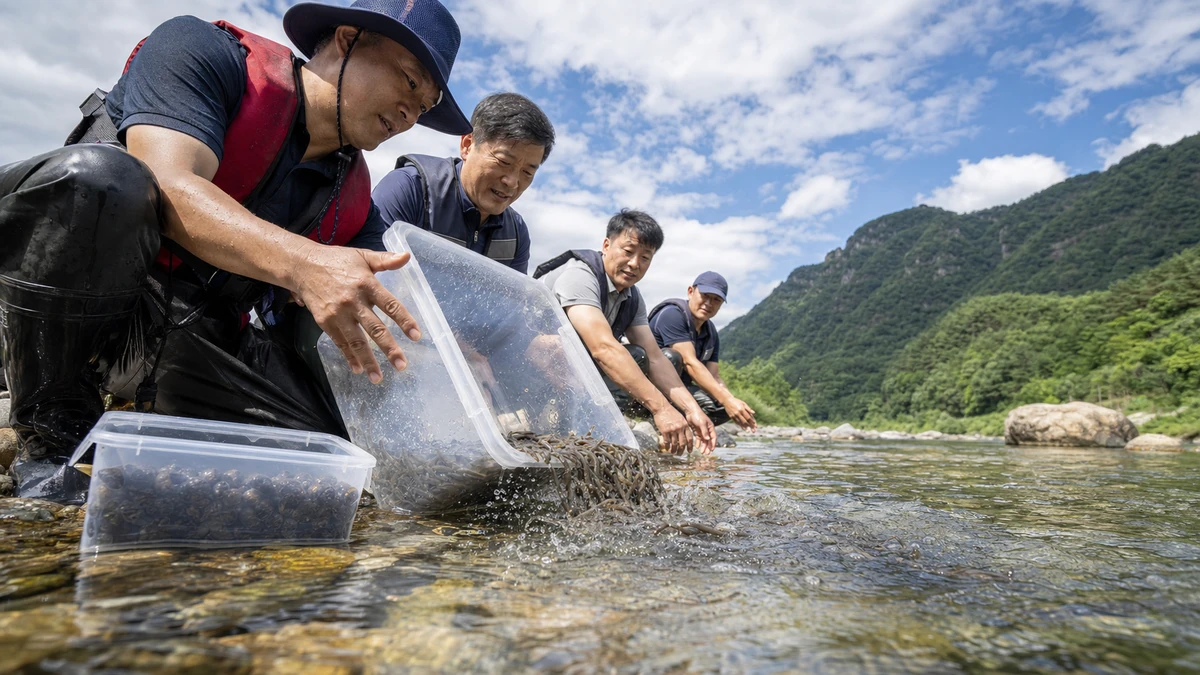
A restoration project far from Seoul’s spotlight
In an era when local governments often chase attention with splashy festivals, waterfront redevelopment plans or headline-grabbing tourist attractions, officials in South Korea’s Gangwon Special Self-Governing Province are making a quieter bet: that restoring life in local rivers can strengthen a region just as meaningfully as building something new.
Provincial officials said this week that they released 270,000 native freshwater animals into two major river systems in Gangwon, a mountainous province in northeastern South Korea better known internationally for ski resorts, dramatic landscapes and the 2018 Winter Olympics. The release included 70,000 fish known locally as daenonggaengi and 200,000 freshwater snails called gotche dareulgi, according to South Korean authorities and local reporting.
The effort is part of a broader push to rebuild inland fishery resources, or the living species that inhabit rivers, streams and lakes rather than the ocean. In practical terms, that means trying to restore native populations that have declined over time because of habitat pressure, changes in water quality, altered river flows and the broader ecological strain that has affected freshwater systems around the world.
For American readers, the idea may call to mind state hatchery programs that stock trout in mountain streams, or restoration work aimed at reviving salmon runs in the Pacific Northwest. But the South Korean case has its own local character. This is not only about biodiversity in an abstract sense. It is also about preserving regional food culture, maintaining the ecological identity of river communities and treating waterways as lived-in environments rather than just scenic backdrops.
That distinction matters in Gangwon, where rivers are woven into everyday life and local cuisine in ways that may be less familiar to readers outside Korea. The species released this week are not simply biological units counted by the thousands. They are part of a local world that includes riverbank villages, traditional dishes and a sense of place built as much from small native species as from mountain views.
Officials described the releases as free distributions into the wild, supplied through the province’s own inland fisheries resource center. That public production system is central to the story. Rather than purchasing stock from outside suppliers, Gangwon says it bred and raised the animals itself, then returned them to provincial waterways as part of a longer-term management strategy.
It is the kind of government initiative unlikely to trend globally. Yet it offers a revealing look at how South Korean regions beyond Seoul are increasingly defining development not only through infrastructure and visitor numbers, but through ecological care and the protection of local distinctiveness.
What was released, and where it went
The releases took place over two days in two separate parts of Gangwon. On July 29, the province released 35,000 daenonggaengi into the Pyeongchang River in Yeongwol County, specifically in Ongjeong-ri in the town of Hanbando-myeon. On July 30, authorities released another 35,000 of the same species into the Hantan River in Cheorwon County, in Guntan-ri, Galmal-eup. Together, those stockings accounted for all 70,000 fish prepared in this round of the project.
The larger share of the overall effort involved gotche dareulgi, a native freshwater snail, with 200,000 individuals included in the province’s broader release total of 270,000. Officials emphasized that the project was designed not around a single species, but around the idea of recovering inland ecosystems through multiple native organisms.
That matters because healthy freshwater systems are built from layers of life, not just one prized fish. Snails, bottom-dwelling species and other less glamorous organisms play critical roles in the food web, water quality and the overall function of river habitats. In that sense, stocking native snails alongside native fish suggests a more ecological approach than a simple numbers exercise aimed at boosting one species for short-term catch potential.
The two rivers chosen for the fish release are also significant. The Pyeongchang River, which flows through Yeongwol, is part of a region known for dramatic cliffs, rural landscapes and waterways that have long shaped local settlement and foodways. The Hantan River, which runs through Cheorwon near the heavily fortified border region with North Korea, is famous for basalt gorges and volcanic terrain. Both rivers are tourist draws, but they are also working ecosystems that support local communities.
By splitting the fish release between two river systems instead of concentrating it in one site, provincial officials signaled that they see native-species recovery as a regional undertaking rather than a one-off demonstration project. The decision suggests an effort to reconnect restoration with watershed-scale thinking, recognizing that ecological health is tied to networks of streams and tributaries, not just isolated destinations.
There is also a symbolic message in where these animals were released. For many visitors, places like Yeongwol and Cheorwon can be consumed visually, as beautiful, photogenic parts of Korea outside the capital region. But the province’s approach frames those rivers not as scenery alone, but as habitats — spaces where bottom-feeding fish, snails and other native life forms belong, and where ecological recovery is part of preserving the character of the place itself.
Why these species matter in Korean local culture
To understand why this project has drawn notice in South Korea, it helps to understand what is meant by native or local species in the Korean context. The fish at the center of this release, daenonggaengi, is described by provincial officials as a bottom-dwelling species used in maeuntang, a spicy fish stew popular in Korea. Maeuntang is a rustic, deeply familiar dish often associated with riverside restaurants, fishermen and local travel. It is less a fine-dining symbol than a hearty regional food, the kind of meal that ties geography directly to taste.
That is an important cultural point for English-speaking readers. In many American conservation stories, species recovery is framed through recreation, endangered wildlife law, scientific stewardship or climate resilience. In Korea, those themes matter too, but food culture is often inseparable from ecological identity. A native fish can be valued at once as habitat-dependent wildlife, as an ingredient in a local dish and as part of a community’s memory of place.
The freshwater snail included in the project carries similar cultural resonance. In Korea, freshwater snails known broadly as daseulgi have long appeared in regional cooking, often in soups and broths prized for their earthy flavor. They are associated with clean streams and seasonal harvesting traditions. Different local varieties can carry distinct identities tied to place, much in the same way Americans might associate certain oysters with specific bays or certain trout with particular rivers.
That overlap between ecology and cuisine is one reason the Gangwon project stands out. It is not merely an attempt to increase biomass in rivers. It is also, in a small but meaningful way, an effort to preserve the living foundations of a local food culture. When officials talk about native species, they are implicitly talking about a wider cultural ecosystem that includes family meals, local markets and rural culinary traditions that are easy to overlook in a country more often portrayed abroad through K-pop, technology and urban modernity.
There is another layer as well. The Korean term often translated as “native species” or “local species” carries a sense of belonging to a place, not just appearing there by chance. That makes restoration emotionally and politically resonant. It aligns with a broader South Korean concern about preserving regional identity in a country where economic and cultural power is heavily concentrated in and around Seoul.
For Gangwon, a province that has long marketed its mountains, rivers and slower pace of life, caring for species that live in riverbeds and end up in local kitchens can become a statement about what kind of development matters. It suggests that regional pride does not have to rest only on major resorts, real estate projects or social media-ready attractions. It can also rest on the less visible labor of keeping a river ecologically alive.
The public hatchery model behind the effort
Gangwon officials said the daenonggaengi released into the rivers were juvenile fish at least about 2 inches long, produced by the province’s own inland fisheries resource center. In Korean administrative terms, “inland waters” refers to freshwater environments such as rivers, streams and lakes, as distinct from the sea. That distinction is important in a country where marine fisheries often receive more public attention, but where freshwater ecosystems remain critical to rural communities.
The fact that the fish were produced through a public provincial facility rather than sourced externally is more than a bureaucratic detail. It suggests an institutional model in which breeding, cultivation and release are part of one coordinated system. For policymakers, that can mean greater control over species selection, release timing and quality management. For local residents, it can signal that the province is investing in long-term stewardship rather than staging a symbolic event.
In the United States, fish stocking programs are often run by state wildlife agencies with a mix of conservation, recreation and resource-management goals. Gangwon’s approach shares some of that logic, but it appears more explicitly tied to restoring local species and freshwater ecological infrastructure. In other words, the province is not just trying to create fishing opportunities. It is trying to sustain a public capacity to replenish native life in rivers over time.
That public capacity matters because ecological restoration rarely succeeds as a one-day ceremony. Releasing juvenile fish or snails is only the first step. Survival depends on water quality, habitat conditions, predation, seasonal flows and the suitability of spawning or settlement areas. Stocking alone cannot overcome a degraded river system. Without broader environmental health, a release can become little more than a photo opportunity.
Provincial officials have not presented this week’s release as a magic fix, and that restraint is notable. The project is better understood as infrastructure for recovery — a way to reinforce populations and create conditions in which native species have a better chance of establishing themselves. Whether those species thrive will depend on what happens after the cameras leave: how rivers are managed, how habitats are protected and whether human pressure on freshwater systems is kept in check.
Still, building and maintaining a public system capable of producing native stock may itself be one of the more important accomplishments here. At a time when regional governments around the world face pressure to show quick returns, Gangwon is putting resources into a program whose success may be measured slowly and indirectly. That kind of investment is harder to publicize than a new bridge or visitor center, but it may be more consequential for the ecological future of local waterways.
A broader lesson about regional identity and development
One reason this story resonates beyond the technical details of fish and snail releases is that it reflects a growing tension in regional policy debates, in South Korea and elsewhere: what does it actually mean to make a place stronger?
For decades, development in many parts of the world has been framed in visible, concrete terms — new construction, marquee events, transportation links, commercial districts. Those things matter, and South Korea has pursued them aggressively over the course of its rapid modernization. But as local governments look for ways to stand out in an era of demographic decline, aging populations and competition for visitors, some are turning to assets that cannot be built overnight: landscape, local food, ecological quality and authenticity.
Gangwon is a natural testing ground for that shift. The province has long occupied a distinctive place in the South Korean imagination. It is less densely urbanized than the Seoul metropolitan area, rich in forests and rivers, and often marketed as an escape from city life. Yet tourism alone can flatten a place into scenery. Restoration efforts like this one push back against that tendency by insisting that a river’s value lies not only in how it looks to visitors, but in how it functions as a living system for residents and native species.
That may sound modest, but it touches on a larger philosophical change. A river can be treated as a product, packaged for sightseeing and recreation. Or it can be treated as a shared ecological base that supports biodiversity, everyday experience and local traditions. Gangwon’s native-species release points to the second view.
There is also a subtle political message in focusing on species closely linked to local cuisine and rural waterways. South Korea’s global image is often dominated by Seoul, by high-speed connectivity and by the export power of its entertainment industry. Those are real and significant parts of the country. But they can overshadow the complexity of provincial life. Stories like this remind outside audiences that Korean identity is also built in farming counties, river valleys and food traditions tied to specific landscapes.
For American readers, the parallel might be the difference between seeing Montana only through national park brochures and understanding the daily stewardship that sustains trout streams, ranchland ecosystems and local food traditions. The same can be said of Appalachia, the Mississippi River basin or the Gulf Coast. Places endure not just because they attract outsiders, but because people continue to care for the ecological systems that make local life possible.
What success would look like — and what remains uncertain
The obvious temptation in any stocking announcement is to treat the number released as the measure of success. In this case, that number is 270,000. It is large enough to sound impressive, and officials clearly want the scale of the effort to be recognized. But ecologists would almost certainly caution that the meaningful question is not how many animals went into the water this week. It is how many survive, adapt and contribute to a healthier freshwater system over time.
That uncertainty does not diminish the value of the project. It simply puts it in the proper frame. Native species restoration is a process, not an event. For fish like daenonggaengi, success would mean more than temporary presence in the river. It would mean stable populations, suitable habitat on the river bottom, successful reproduction and enough ecological resilience to withstand seasonal and human pressures. For freshwater snails, it would mean the ability to settle, persist and support the broader web of life in those waterways.
Long-term monitoring will matter. So will questions that are not answered by release totals alone: Are river conditions improving? Are there barriers to movement? Is water quality sufficient? Are the released animals genetically appropriate for the waters they enter? These are the kinds of issues that determine whether a restoration program becomes substantive or remains mostly symbolic.
There is also a challenge familiar to conservation efforts everywhere: public patience. Ecological outcomes often unfold slowly, while political cycles move quickly. A program like this may produce few dramatic visuals beyond the initial release, yet its real value lies in persistence. If provincial officials maintain the effort, track outcomes and pair stocking with habitat protection, the project could become a model for how local governments use public institutions to support freshwater biodiversity.
Even if the immediate biological results are mixed, the initiative may already have one broader success: it reframes public conversation about what counts as regional investment. By putting native fish and snails at the center of a provincial announcement, Gangwon is saying that the small life forms under a river’s surface deserve policy attention too. That is a statement about values as much as management.
And that may be why the story is worth attention far beyond Korea. Around the world, communities are wrestling with how to preserve local identity under pressure from climate stress, demographic change and homogenized development. Sometimes the answer involves a major public works project. Sometimes it begins with a far less dramatic act: raising native species in a public facility and returning them, by the tens of thousands, to the rivers where they belong.
Why a small ecological story travels internationally
At first glance, the release of native fish and freshwater snails in two Korean rivers may seem too local to matter internationally. But in another sense, it is exactly the kind of story that travels well because it speaks to a universal dilemma: how modern societies can protect the ordinary ecological fabric that supports culture, memory and daily life.
South Korea is often covered abroad through big themes — security tensions with North Korea, semiconductor exports, celebrity culture and urban trends. Those topics are important, but they can narrow the lens. This river-restoration effort offers a view of another Korea: one where provincial officials, hatchery workers and local communities are engaged in the patient work of maintaining freshwater ecosystems that most outsiders will never see.
It is also a reminder that the appeal of a region is not always produced by novelty. Sometimes it comes from continuity. A river where native species still live, a local stew still tastes like the place it comes from, and a public institution still knows how to cultivate and return those species to the wild — that is a form of regional strength, even if it does not fit the usual development playbook.
Gangwon’s project does not romanticize nature as untouched wilderness. These are managed landscapes, shaped by human decisions. But the province’s approach suggests that management can aim not only at extraction or spectacle, but at repair. It recognizes rivers as ecological foundations and cultural corridors at the same time.
For readers in the United States and elsewhere, that idea is familiar in spirit even if the species are not. Whether the setting is a Korean mountain river, an Appalachian stream or a Western trout watershed, the underlying question is similar: what kind of relationship do communities want with the waters that run through them?
Gangwon’s answer, at least this week, is clear. It is betting that restoring native life to its rivers is not a side project. It is part of what makes the region itself worth sustaining.
Comments
Post a Comment