Jellyfish Stings Rise on South Korea’s Jeju Beaches as Summer Swimmers Face an Earlier-Than-Usual Warning
A summer postcard comes with a new caution
For many travelers in South Korea, Jeju is what Hawaii, the Florida Keys or Cape Cod can be for Americans: a beloved island escape associated with beach vacations, family trips and long-awaited summer breaks. The volcanic island off the southern coast of the Korean Peninsula is one of the country’s best-known travel destinations, drawing honeymooners, parents with children, teenagers on school breaks and international visitors looking for clear water, resort districts and a slower pace than the mainland.
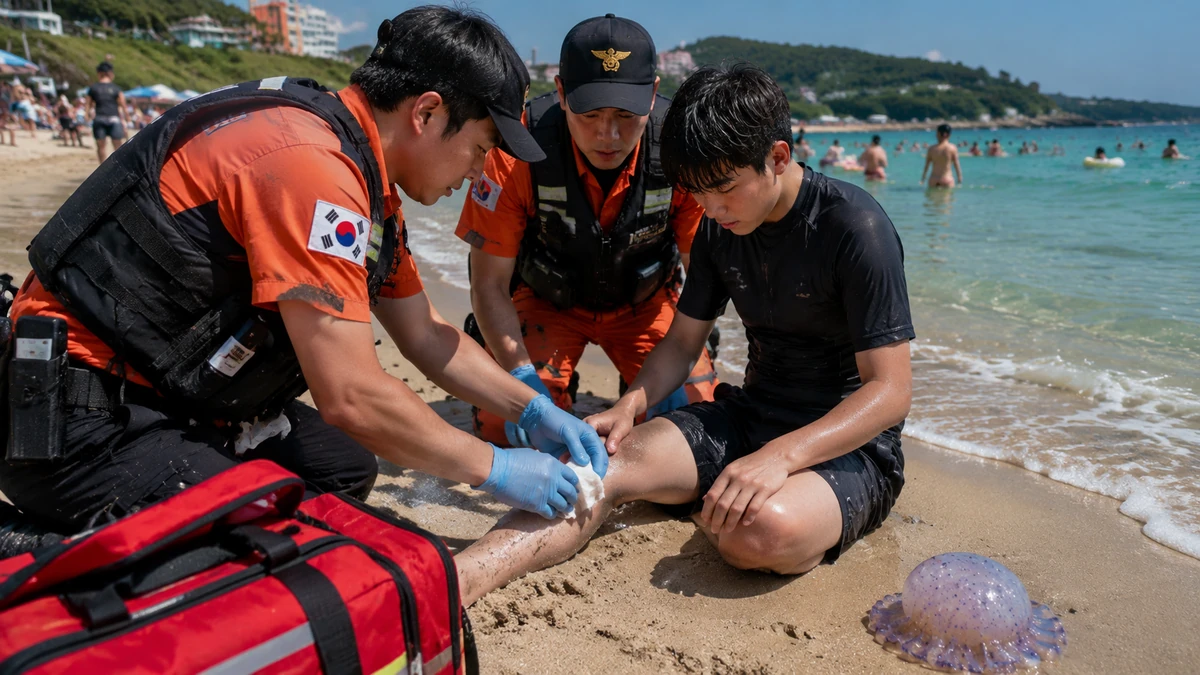
That is part of why a seemingly modest public safety update out of Jeju carries broader significance this summer. Jeju authorities say seven jellyfish sting incidents have been recorded at the island’s beaches so far this season, according to information relayed by South Korea’s emergency response authorities and reported by Yonhap News Agency. The most recent case involved a teenager stung while swimming July 23 at Jungmun Beach, a well-known beach in Seogwipo on the island’s southern side.
On its face, seven cases may not sound like a headline-grabbing number in a peak tourist destination that can host large crowds. But public health and beach safety experts often warn that raw incident totals can be misleading when removed from context. The more important point here is not simply the number itself. It is that confirmed sting incidents are happening where people actually swim, at the same time officials say toxic jellyfish are spreading along South Korea’s coasts earlier than usual this year.
That combination turns what might otherwise be dismissed as a routine summer nuisance into a practical warning for beachgoers. It suggests that this is no longer just a matter of marine life spotted offshore or environmental changes noticed by specialists. The risk has reached the part of the coastline where vacationers wade, children splash and teenagers spend their afternoons in the surf.
For American readers, this may sound familiar in structure even if the location is not. Beaches around the United States regularly post warnings for rip currents, bacteria levels, shark sightings or jellyfish blooms. The lesson is often the same: a beach can still look calm, photogenic and inviting while carrying hazards that are not immediately obvious to the eye. In Jeju this summer, the message from officials appears to be that jellyfish belong in that category.
What officials confirmed — and what they did not
According to Jeju’s fire and disaster authorities, seven jellyfish sting cases have been counted at beaches on the island this summer as of July 24, 2026. One confirmed case occurred a day earlier at Jungmun Beach, where a teenager was stung while in the water. Officials also said toxic jellyfish have been spreading along South Korea’s coastal waters faster than in a typical year.
Those are the central verified facts. Just as important in responsible reporting is what has not been established from the available information. Authorities have not publicly detailed which species were involved in each sting, how severe the symptoms were, whether the incidents were clustered at particular times of day or whether any one beach accounted for a disproportionate share of the cases. The information released also does not include beach attendance figures, which means the numbers cannot be used to calculate relative risk for the average visitor.
That distinction matters. Readers should not interpret the data to mean Jeju’s beaches are broadly unsafe, nor should they assume the problem is too small to warrant attention. Without comparative figures from the same period in previous years, and without detailed use data for each beach, it is not possible to say whether a specific shoreline is especially dangerous or whether the overall chance of being stung remains low. The responsible takeaway is narrower but still meaningful: repeat incidents have already occurred, and authorities are signaling that jellyfish presence should be part of beach-day decision-making this summer.
In an era of viral travel clips and algorithm-driven tourism advice, there is also a temptation to overread sparse facts. A dramatic social media post can quickly turn a straightforward safety advisory into a narrative of crisis, while boosterish tourism content can push in the opposite direction and minimize legitimate warnings. The available evidence supports neither extreme. It supports caution, attention to official updates and a willingness to treat local safety guidance as more reliable than general vacation imagery.
That may sound obvious, but it is not always how people travel. Vacationers often operate on schedules, not conditions. Families book hotel stays months in advance. Friends organize beach outings around one free weekend. International travelers may have only one shot to see a famous shoreline before flying home. Under those circumstances, there is a natural tendency to assume that if the weather looks good, the plan should go ahead. Jellyfish are a reminder that water conditions are more complicated than a sunny forecast.
Why Jeju matters beyond South Korea
To understand why this story resonates, it helps to understand what Jeju represents in South Korean life. Jeju is not just another beach destination. It is one of the country’s signature leisure spots, a place heavily featured in domestic travel advertising, Korean television and honeymoon itineraries. For many Koreans, a Jeju trip carries some of the same emotional associations Americans might attach to a long-planned family trip to Maui or a summer week at a favorite Atlantic or Gulf Coast beach town.
That makes public safety information from Jeju relevant not only to local residents, but also to people who arrive with little knowledge of day-to-day marine conditions. Domestic tourists from Seoul or Busan may know the island’s reputation without knowing what the water is like on a specific day. Foreign tourists may know Jeju from K-drama filming locations, social media travel reels or airline promotions, yet have almost no familiarity with how local Korean beaches communicate risk.
There is a cultural layer here worth explaining for international readers. In South Korea, many public beaches operate with structured management during the summer season, including lifeguards, posted notices and local government oversight. That does not mean every visitor carefully reads every warning. It does mean that official signage and public announcements often play a central role in how risk is communicated. For travelers from abroad, especially those relying on old blog posts or machine-translated travel summaries, it can be easy to miss the difference between evergreen tourism information and live safety guidance tied to that day’s conditions.
That gap matters more when the risk is something difficult to spot in advance. Unlike rough surf, thunderclouds or visibly polluted water, jellyfish may not be apparent from the shore. A beach can appear peaceful and still present a meaningful hazard. That is especially true for families with children and teens, who may be excited to enter the water quickly once they arrive.
The teenager stung at Jungmun Beach underscores this point. Teenagers are old enough to move independently in the water and young enough to be less attuned to subtle warnings, especially on a vacation outing. Parents may assume older children can handle themselves; older children may assume they do not need the same reminders as younger siblings. The result can be a blind spot in family safety planning — one that becomes more important when a hazard is mobile, seasonal and not immediately visible.
An earlier spread changes the summer calculus
One phrase in the Korean reporting deserves special attention: toxic jellyfish are spreading along South Korea’s coasts faster than usual this year. Even without a detailed scientific breakdown in the released information, that timing alone changes how beachgoers should think about summer safety.
Beach risks are often managed through habit. People return to the same place they visited last year. They remember that a certain week in late July was fine the previous summer. They rely on anecdotal impressions: the water looked clear, the kids had no trouble, nobody mentioned a problem. But an earlier-than-usual spread means last year’s timing may offer little guidance this year. A beach season that feels familiar on the calendar may be different in the water.
For Americans, a useful analogy might be the way allergy seasons, wildfire smoke or hurricane patterns can shift the timing of ordinary seasonal expectations. A family might think of early summer one way based on past experience, only to find that environmental conditions have moved the risk window. The same logic applies here. If jellyfish activity is arriving or intensifying earlier than expected, waiting until the peak of vacation season to pay attention may be too late.
What can be said with confidence is behavioral rather than biological: beachgoers should check current conditions before getting in the water, not assume the sea is safe because a prior visit was uneventful. The Korean summary does not establish the reason for the earlier spread, and it would be irresponsible to pin it on any single cause without evidence. What matters for the public is the practical consequence. Conditions this summer may not line up with memory.
This is particularly relevant in a tourism economy shaped by online archives. Travel advice on the internet ages badly when it comes to safety. A blog post from two summers ago might still be useful for restaurant tips or bus routes, but it is not a dependable guide to marine conditions in a given week. The same is true of crowdsourced review platforms, where visitors may describe the beach atmosphere in glowing terms without mentioning day-specific risks that were absent when they went. In safety matters, recency beats nostalgia.
The hidden challenge of beach safety in the social media era
Modern tourism encourages people to consume destinations visually first. Jeju is especially susceptible to that pattern because it photographs so well. Basalt coastlines, resort beaches and bright summer water all lend themselves to the kind of imagery that circulates widely on Instagram, YouTube and short-form travel video platforms. Those images reinforce a simple promise: this is where you go to relax.
But beach safety information rarely travels with the same force. Warning signs do not go viral the way sunsets do. Official notices are often in Korean first, and even where multilingual support exists, travelers may not seek it out. A visitor can arrive armed with recommendations for cafes, scenic drives and photo spots, yet still know almost nothing about that day’s ocean conditions.
That mismatch is not unique to Korea. Americans see it at beach destinations at home, where visitors sometimes ignore surf flags, underestimate heat or assume that a crowded shoreline must be safe because so many other people are there. Crowds can create a false sense of security. If others are swimming, the thinking goes, it must be fine. But many beach hazards are democratic: they do not care whether a place is popular.
The Jeju cases are a reminder that safety information is part of travel quality, not an obstacle to it. That distinction is important. Warning people about jellyfish is not anti-tourism. It is what allows tourism to function more safely and honestly. A destination that clearly communicates risk respects visitors enough to let them make informed choices. A beach day does not become worse simply because travelers know what to watch for; in many cases, it becomes better because expectations are grounded in reality.
There is also a basic issue of accessibility. Foreign travelers may depend on hotel staff, beach personnel, local officials or real-time translation tools to understand advisories. Families may need to make sure children and teens understand the warning, not just the adult who read it. If one person in the group catches the notice and the others charge into the water assuming everything is normal, the warning has not effectively done its job. Safety information works only when it becomes shared behavior.
How to read the number seven without overreacting — or shrugging it off
Any time public safety news includes a small, concrete number, readers tend to split into two camps. One camp sees seven and thinks the threat is being exaggerated. The other sees confirmed incidents and assumes something alarming is spiraling out of control. Both reactions flatten the truth.
Seven confirmed sting cases at Jeju beaches this summer are significant because they represent real exposure in real swimming areas. They show the hazard is not theoretical. The latest known case happened just one day before the July 24 update, and it involved a teenager at a popular beach. That gives the issue immediacy. This is not an old advisory being recirculated; it reflects current summer conditions.
At the same time, seven is not enough by itself to support sweeping claims about overall danger, comparative beach risk or trend lines over multiple years. Without attendance data, no one can say from this release how frequently stings are occurring relative to the number of swimmers in the water. Without more detail on severity, no one should embellish the medical impact beyond what has been confirmed. The number should heighten attention, not invite speculation.
This is a familiar problem in health and safety reporting. Numbers can be either overdramatized or underinterpreted depending on the audience’s priors. During flu season, storm season or food recall season, the most responsible reading often lies in the middle: take the warning seriously, but stay within what the evidence supports. In the Jeju case, that means recognizing that repeated stings have happened and that authorities are signaling broader coastal jellyfish activity, while also acknowledging the limits of the data released so far.
If more detailed information becomes available later — such as species identification, symptom severity or comparative historical records — the public picture may become clearer. For now, the soundest conclusion is also the most practical one: do not treat beach entry as an automatic decision. Treat it as a judgment call informed by the latest official guidance.
What this means for families, tourists and beachgoers now
The Korean reporting did not provide specific first-aid guidance or treatment protocols, and it is important not to fill that gap with unverified instructions. What it does support is a prevention-first approach. Before entering the water, beachgoers should check whether local authorities or beach managers have posted jellyfish-related notices. If staff issue cautions, visitors should take them seriously even if conditions look calm.
For families, the key point is collective awareness. It is not enough for one parent or group organizer to notice a warning while everyone else assumes the day is routine. Children and teens should be told, plainly, that jellyfish presence is possible and that local instructions matter. In many beach settings, risk communication breaks down not because authorities failed to issue a warning, but because the message never became a shared plan among the people actually entering the water.
For tourists from outside Korea, the practical lesson is to prioritize same-day, on-site information over old travel content. That includes hotel concierge advice, official beach notices, lifeguard instructions and government updates where available. Translation apps can help, but they should be used to understand current warnings, not replace them with generalized assumptions based on travel marketing.
For travelers on fixed itineraries, the harder lesson may be emotional rather than logistical. A beach day is often one of the most anticipated parts of a vacation. Nobody wants to rethink plans after arriving at the shore. But water safety often requires exactly that kind of flexibility. Changing the timing of a swim, limiting time in the water or choosing another activity that day may feel disappointing in the moment. It is still preferable to treating official cautions as background noise.
And for local officials and tourism operators, the challenge is to keep communication direct, visible and multilingual where possible. In a destination with high visitor turnover, clear warnings are not merely a technical requirement. They are part of public trust. Visitors are more likely to make reasonable decisions when they feel they are being told the truth in a timely way.
Jeju remains one of South Korea’s signature summer destinations, and nothing in the current reporting suggests that travelers should panic or write the island off. But the latest sting incidents do signal that this year’s beach season comes with a sharper need for attention. In the simplest terms, the water deserves a closer look before people jump in. On an island famous for relaxation, that may be the most useful kind of summer advice: enjoy the beach, but let current conditions — not vacation momentum — guide the day.
Comments
Post a Comment