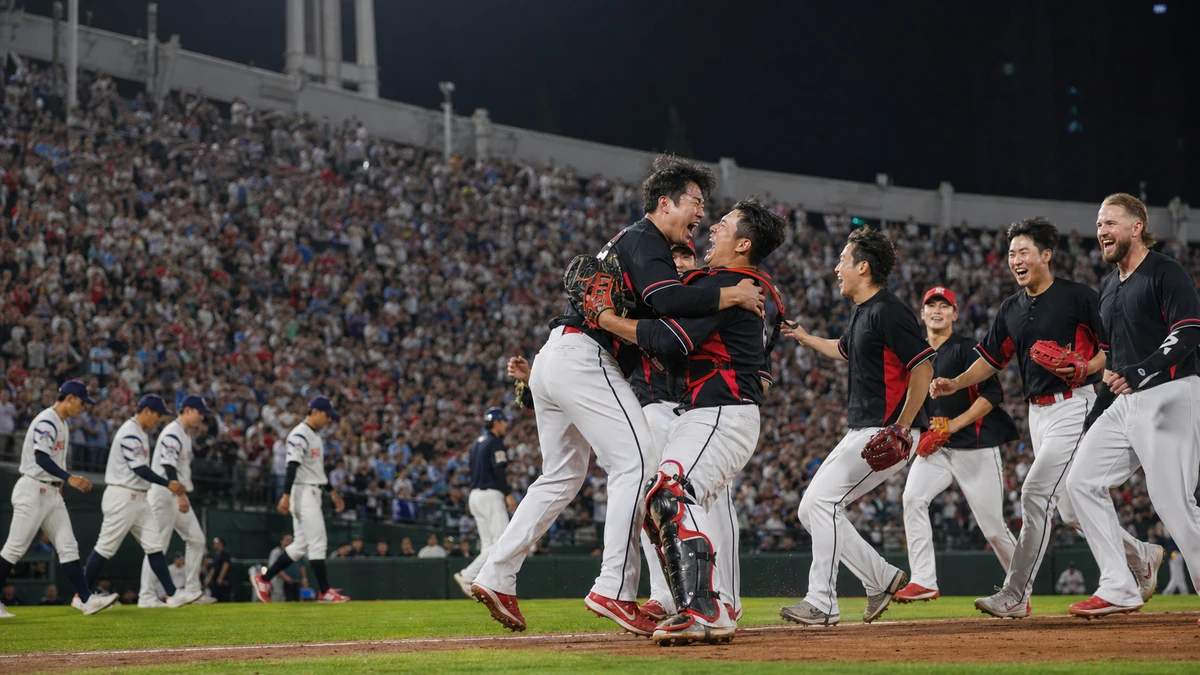
A winning streak with real stakes in South Korea’s baseball race
For American sports fans, a nine-game winning streak in late July usually signals one thing: a club that has moved beyond a pleasant hot stretch and into the territory of a serious contender. That is where the KT Wiz now find themselves in South Korea’s top professional baseball league.
KT beat the Lotte Giants 6-1 on Friday in Busan, matching the longest winning streak in franchise history at nine games and moving another step closer to the top of the Korea Baseball Organization standings. The victory did more than add another number to the streak column. It underscored how this run has been built: an early offensive punch, reliable starting pitching, and enough lineup depth to keep pressure on opponents even after the first big blow lands.
South Korean baseball, better known internationally as the KBO League, may be most familiar to many Americans from the early months of the COVID-19 pandemic, when ESPN broadcasts introduced U.S. viewers to bat flips, thunderous cheering sections and a style of play that mixed power, contact hitting and relentless crowd energy. But the league has long had a devoted national following of its own, and games between clubs like KT and Lotte carry the emotional charge that Americans might associate with regional baseball culture in cities such as St. Louis, Philadelphia or Boston.
Friday’s game at Sajik Baseball Stadium, Lotte’s home in Busan, arrived with that kind of atmosphere and with real consequences in the standings. KT improved to 53-35-2, good for second place, while first-place Samsung remained just 2.5 games ahead. That margin matters in a long baseball season because it keeps the pennant race very much alive. Unlike a team piling up wins in the middle of the pack, KT is now applying direct pressure near the top of the league table.
The nine-game streak also ties a franchise mark set in 2019, a benchmark that carries particular meaning for a comparatively young club. The KT Wiz joined the KBO in 2015, making them one of the league’s newer teams in a baseball culture where several clubs trace their identities back decades. Matching a franchise record in that context is not just a statistical note. It is part of the team’s ongoing effort to define its place in Korean baseball.
And the way KT got there mattered as much as the result itself. This was not a game rescued by one desperate late swing or a bullpen escape in the ninth. It was a game the Wiz appeared to seize early, shape on their terms, and manage with the confidence of a club that expects to win.
An early home run set the tone
KT wasted little time showing why winning streaks can feel intimidating to the team on the other side. In the top of the first inning, Kim Hyun-soo reached base after being hit by a pitch, immediately giving the visitors traffic on the bases. Then came the first major turning point of the night: foreign hitter Sam Hilliard launched a two-run home run over the right-field wall, pushing KT ahead 2-0 before the game had fully settled in.
For an American audience, Hilliard’s name may stand out. He is a former major leaguer, part of the steady exchange of talent between MLB and the KBO. That pipeline has become one of the defining features of modern Korean baseball. Some Americans head to Korea looking to reset or revive their careers; others become central figures on contenders, serving not just as imported power bats but as stabilizing middle-of-the-order presences. Hilliard filled that role Friday, and his home run did more than put two runs on the board.
In games involving long winning streaks, the psychological dimension is impossible to ignore. Players are professionals, and no one wants to overstate momentum, but ballclubs are still made up of people who understand what is at stake. A team chasing a record can feel both excitement and pressure. By striking first and striking hard, KT avoided the kind of tentative opening that can feed anxiety. Hilliard’s swing effectively told everyone in the park that the Wiz were not there to protect a streak; they were there to extend it.
KT kept attacking after the home run. Heo Kyung-min followed with a run-scoring double, stretching the lead to 3-0 in the opening inning. That additional run was significant because it demonstrated that the offense was not relying on one isolated power moment. The Wiz turned an early chance into a fuller inning, the baseball equivalent of a team stepping on the gas instead of settling for an initial advantage.
American fans would recognize the blueprint. It is similar to the way a good road team in MLB tries to quiet a crowd early: get a baserunner, produce an extra-base hit, add an insurance run before the home fans have a chance to settle into rhythm. In Busan, one of Korea’s most passionate baseball cities, that kind of start matters. Sajik is known for its lively atmosphere, and Lotte supporters are among the most emotionally invested in the league. An early three-run deficit changes the emotional temperature in a stadium like that.
By the end of the first inning, KT had not only the lead but also the shape of game it wanted. With three runs already on the board, its starter could work from ahead, the bullpen could be mapped out more calmly, and Lotte was pushed into chase mode almost immediately.
So Hyeong-jun gave KT the kind of start contenders need
If Hilliard’s home run supplied the highlight, starting pitcher So Hyeong-jun provided the structure that made the whole evening hold together. Korean reports described So’s outing as strong, and that strength was central to why KT never let the game drift back toward uncertainty.
This is one of baseball’s universal truths, whether in Seoul, Busan or Chicago: long winning streaks are hard to sustain if a team constantly needs explosive offense to survive. At some point, the starter has to take control, limit damage and allow the lineup to breathe. That is especially true when a team has already built an early lead. The best starters turn those situations into orderly games, reducing the opponent’s ability to generate momentum inning by inning.
So did exactly that. With a 3-0 cushion from the first, he kept Lotte’s offense contained and let KT operate from a position of relative calm. The final score, 6-1, suggests a game in which the home side never truly solved the puzzle in front of it. Lotte managed only one run, and limiting an opponent to a single tally on the road is usually enough to make any well-timed offensive support stand up.
For readers less familiar with the KBO, it is worth noting that Korean baseball often places a slightly different emotional emphasis on starting pitching than many American conversations do, especially in an era when MLB discourse can revolve around bullpen games, openers and aggressive pitch-count management. In Korea, a composed outing from a starter can still feel like the backbone of a win in a very traditional sense. It is not merely about analytics or matchup optimization; it is about control, rhythm and the sense that the team is playing from a stable base.
That stability was evident Friday. KT did not appear rushed at the plate, and its defense was not forced into a constant state of emergency. There is a symbiotic quality to baseball when a team is playing well: an early lead relaxes the pitcher, and good starting pitching keeps the offense from pressing for more than it needs. During winning streaks, that cycle can become self-reinforcing.
So’s outing also highlighted an important distinction between a lucky streak and a convincing one. Lucky streaks often feature repeated escapes, one-run swings and dramatic late turns that are exciting but difficult to trust. Convincing streaks feature games like this one, where the lead is established, protected and gradually widened. That is the sort of win that suggests a team’s current form is sustainable, even if no streak lasts forever.
KT showed depth, not just star power
One of the clearest lessons from Friday’s game was that KT’s offense is functioning through multiple channels. Hilliard’s first-inning homer will draw the most attention, and understandably so. But the Wiz did not win simply because one hitter delivered one big swing.
Kim Hyun-soo, who reached on the hit-by-pitch that set up Hilliard’s homer, played a connecting role in more than one scoring sequence. In the sixth inning, after Choi Won-jun doubled to put a runner in scoring position, Kim added a sacrifice fly to make it 4-0. That run did not carry the visual punch of a home run, but it may have been just as instructive. It showed that KT could manufacture offense in a more methodical way, moving a runner and cashing in without needing another ball to leave the yard.
That kind of versatility matters. In baseball, especially over a long season, teams that depend entirely on dramatic swings can become vulnerable when the home runs stop falling. Teams that can score in different ways tend to be more resilient. KT’s scoring on Friday reflected that broader toolkit: a player reaching by getting hit, a two-run homer, a run-scoring double, a later extra-base hit, a sacrifice fly and enough sustained execution to get to six runs by game’s end.
Heo’s RBI double in the first and Choi’s sixth-inning double were also reminders that offensive depth is often what separates contenders from clubs that merely have a few recognizable names. When different players can initiate or finish rallies, opposing pitchers have fewer easy lanes through the lineup. The pressure never fully lifts.
For Americans accustomed to MLB rosters where stars can dominate the storyline, Korean baseball offers a slightly different rhythm of appreciation. Team identity often emerges through coordinated contributions rather than a singular superstar narrative. That does not mean stars are absent. It means fans and analysts alike are often quick to point out how innings are assembled collectively. Friday’s game fit that pattern. Hilliard’s home run may have set the direction, but Kim, Heo, Choi and So all had visible hands in shaping the result.
The broader point is that KT looked like a balanced club. It scored early, added on later, pitched effectively and avoided allowing the moment to become bigger than the baseball itself. That is precisely the profile of a team that can be dangerous over the stretch run.
Why nine straight wins means more in the KBO standings
A nine-game streak always looks impressive in a standings graphic, but its significance depends on where it happens and whom it affects. In KT’s case, this is not a feel-good burst from a team trying to climb back to .500. It is a direct intervention in the race for first place.
After Friday’s results, KT sat at 53-35-2 with a .602 winning percentage. Samsung, still in first, stood at 57-34-2, a .626 clip. The gap between them was 2.5 games. That is narrow enough to keep every upcoming series under close watch, especially if both teams continue winning. Samsung, notably, has also been on a hot run, extending its own winning streak to three games. In other words, KT has not been making up ground because the league leader collapsed. It has been charging forward while the leader remains steady.
That dynamic should sound familiar to fans who have followed tight MLB division races, where a second-place team can play exceptional baseball and still spend days or weeks waiting for the club ahead to stumble. The pressure works in both directions. The team in front knows there is little room to relax, while the team behind knows every missed opportunity hurts twice.
KT’s standing relative to the rest of the top tier adds another layer. LG was in third at 53-40, with the same number of wins as KT but five more losses. KIA sat further back at 50-43-2. So the Wiz are not only chasing the Lions at the top; they are also protecting valuable ground against the teams behind them. That balancing act often defines the middle stretch of a pennant race. You are trying to catch one opponent without getting caught by another.
For American readers unfamiliar with Korean standings conventions, ties are also part of the KBO table, unlike MLB where games continue until there is a winner. The presence of ties can subtly shape how records are discussed and how distance in the standings is perceived over time. KT’s two ties are part of the arithmetic, but the main takeaway is straightforward: the Wiz have pushed themselves into a position where the top of the table is no longer theoretical. It is within reach.
That is what makes the nine-game run so meaningful. A streak can be entertaining on its own, but when it compresses a race near the top, it becomes part of the league’s central drama. Every win starts to feel less like a continuation of momentum and more like a statement about who may still matter most in September.
Busan, Lotte and the atmosphere around a struggling home club
There was another side to Friday’s story, and it belonged to Lotte. The Giants fell to 40-51-2 and dropped their fourth straight game, leaving them in eighth place. If KT arrived in Busan carrying momentum, Lotte entered the game under the weight of a very different trend.
For those unfamiliar with the geography and culture of South Korean baseball, Busan is not just another stop on the schedule. It is the country’s second-largest city and a place with a reputation for fierce regional pride. Lotte, one of the KBO’s older and most recognizable clubs, draws support that can feel almost civic in character. Losing streaks land hard in markets like that because baseball is woven into local identity.
That helps explain why Friday’s result carried emotional contrast even beyond the standings. KT was chasing history for its own franchise, while Lotte was trying to stop a slide before it worsened. Same field, same game, completely different kinds of pressure.
American readers might think of a struggling team playing in front of a deeply loyal fan base that still shows up expecting a fight. That is often the Lotte experience. The Giants have one of the most passionate followings in Korean baseball, and their home crowd is famous for coordinated songs and a level of organized cheering that can surprise first-time visitors from the United States. Korean baseball culture is notably more participatory than the typical American ballpark experience. Fans do not simply react; they perform, chant and drive the rhythm of the night.
That context made KT’s early strike all the more important. Silencing a crowd in a stadium like Sajik is not easy, and once Lotte fell behind, the pressure shifted quickly onto the home side. Instead of settling into the comfort of home support, the Giants had to play catch-up from almost the opening moments.
There is also a broader competitive reality facing Lotte. Teams stuck in the lower half of the standings often become dangerous spoilers, especially at home, because they have less to lose and every upset can reshape the race above them. KT avoided falling into that trap Friday. It handled a vulnerable opponent the way stronger teams are expected to, which is often harder than it sounds in baseball.
What comes next: a chance at a new franchise record
The immediate significance of Friday’s win is obvious: KT tied the longest winning streak in club history. The next significance is even more compelling. With another victory Saturday against Lotte in Busan, the Wiz would set a new franchise record with 10 straight wins.
According to the announced pitching matchup, KT is set to send Sauer to the mound against Lotte’s Beasley. Previews and probable starters can only tell so much, but the outline of the next game is already clear. KT will try to repeat the same formula that has carried it through this streak: reach base early, convert chances before the game settles, get quality work from the starter, and create breathing room again in the middle innings.
That may sound simple, but one of the striking things about this nine-game run is how unspectacularly solid it appears from game to game. There is a temptation in sports coverage to romanticize winning streaks as if they are magical events. More often, they are built from repeatable habits. Friday’s game offered a compact version of those habits: quick scoring, steady pitching, additional run production, and very little self-inflicted chaos.
Of course, no streak guarantees the next result. Baseball is built to punish certainty. A team can look sharp for a week and then lose 3-2 on a bloop single and a bullpen mistake. But if the question is whether KT looks like a club playing some of the best baseball in the KBO right now, Friday did little to challenge that view.
For American audiences still discovering the rhythms of Korean baseball, this is part of the sport’s appeal. The names may be different, the cheering culture may be louder and more choreographed, and the standings may include ties, but the core drama is instantly familiar. A team gets hot. A race tightens. A road game against a desperate opponent turns into a test of composure. A starting pitcher sets the tone. A power hitter changes the mood of the night with one swing. The standings shift, and the next day suddenly feels bigger.
That is where KT stands now. The Wiz have matched their best run ever and moved within striking distance of first place. They did it not with a fluke or a frenzy, but with the kind of measured, complete performance that suggests the story may not be close to finished.
If they win again, they will have more than a new franchise record. They will have another piece of evidence that this summer surge is not just a headline — it is a real threat to the balance of the KBO pennant race.
Comments
Post a Comment