Naver Lands $10 Billion From Nvidia and Brookfield in Bid to Become a Global AI Infrastructure Power
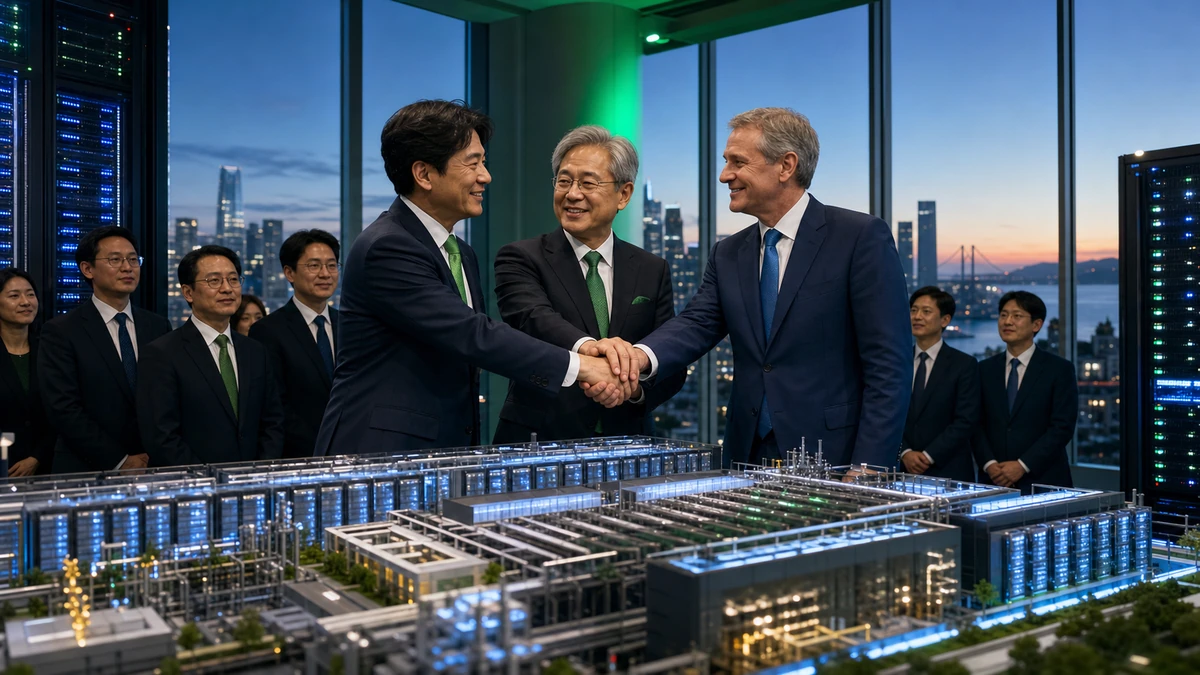
A South Korean internet giant makes an unusually big AI bet
Naver, the South Korean technology company often described as the country’s closest equivalent to Google, said it has secured a total of $10 billion in investment and financing commitments from Nvidia and Brookfield Asset Management to expand its global artificial intelligence infrastructure business. The announcement, made in San Francisco by Naver founder and board chairman Lee Hae-jin, signals a major escalation in how Korean companies are positioning themselves in the worldwide AI race.
According to the company, Nvidia will make a strategic $1 billion investment, while Brookfield, the global alternative asset manager known for large-scale infrastructure and real estate deals, will provide support of up to $9 billion. Naver said the money will be used to build what it calls a global “AI factory” business — a term increasingly used in the industry to describe the full stack behind artificial intelligence, from the data centers and chips that power models to the cloud services and software tools that businesses actually use.
For American readers, the headline number alone stands out. Ten billion dollars is the kind of figure usually associated with hyperscale investments by U.S. tech giants such as Microsoft, Amazon or Google, or by sovereign-backed industrial programs in the Middle East. For Naver, a company better known internationally for web search, digital comics, cloud services and online commerce inside Korea, the announcement marks a sharp move into the capital-intensive world of AI infrastructure.
It also reflects a broader shift in South Korea’s technology ambitions. For years, Korean companies have been central to the global electronics supply chain — especially in semiconductors, displays, smartphones and memory chips — but they have often played a smaller role in the consumer-facing software platforms and cloud ecosystems dominated by American firms. Naver’s new push suggests Korea no longer wants to be seen only as a supplier of components in the AI age. It wants a bigger share of the platforms, computing capacity and services that sit on top of the hardware.
The announcement comes as demand for AI computing continues to surge worldwide. Training and operating advanced AI systems requires vast quantities of graphics processing units, or GPUs, as well as huge amounts of electricity, cooling capacity and networking equipment. In that environment, access to infrastructure has become a strategic advantage. Naver is effectively arguing that it can combine Korean engineering, its own software and service experience, and global capital to build a competitive AI backbone for customers beyond its home market.
Why Naver matters in Korea, even if many Americans know little about it
To understand the significance of the deal, it helps to understand Naver’s place in South Korean life. In the United States, people might think of the internet in terms of Google for search, Amazon for commerce, Meta for social platforms and Microsoft or Amazon for cloud computing. In South Korea, Naver has long occupied a uniquely influential role across several of those categories at once. It began as a search company but expanded into shopping, payments, maps, content, advertising, cloud services and digital publishing. It also became a central gateway to the Korean internet.
Naver’s importance is partly rooted in language and culture. Korean is a distinct language with its own script, Hangul, and local digital habits developed somewhat differently from those in the United States. Domestic internet companies had room to build powerful ecosystems because they were especially good at serving local users, local businesses and local content creators. Over time, Naver became more than a website. It became an institution in the Korean digital economy.
That helps explain why this investment matters beyond one balance sheet. When Naver expands, it is often read in Korea as a signal about where the country’s broader technology strategy is headed. The company has spent roughly three decades operating major online services while competing in a global environment shaped by American and Chinese tech giants. Its pitch now is that the operational experience it gained from running search, e-commerce, content and cloud products can be repurposed for a new era in which AI infrastructure itself becomes the business.
For U.S. readers, that shift might sound similar to how Amazon leveraged the computing needs of its own retail business to build Amazon Web Services, which then became a powerhouse in its own right. Naver’s situation is not identical, but the logic is familiar: a company that once built digital infrastructure primarily to support internal or domestic services now wants to turn that expertise into a large-scale platform business with international reach.
The phrase “AI factory” can sound like Silicon Valley branding, but the idea behind it is concrete. Naver is not talking only about building more warehouse-like server buildings. It is talking about combining data center design and operations, its own AI models, and cloud delivery into one business structure. In other words, the company wants to own more of the pipeline from raw computing power to finished AI services.
Nvidia brings more than money
Nvidia’s $1 billion strategic investment may be smaller than Brookfield’s financial commitment, but in some ways it could prove just as important. In the global AI economy, Nvidia’s role is difficult to overstate. Its chips have become the essential engines of modern AI, and access to them has been one of the biggest bottlenecks for companies trying to build large-scale models or AI cloud services.
That is why this is not simply a check-writing exercise. Naver said the partnership will expand both GPU supply and technical collaboration. For companies trying to scale AI, guaranteed or improved access to computing hardware can matter as much as capital, if not more. A billion dollars from Nvidia also serves as a market signal, suggesting that one of the most influential firms in the AI ecosystem sees strategic value in Naver’s infrastructure plan.
For South Korea, there is also a national strategic dimension. Korean companies are world-class in memory semiconductors, especially high-bandwidth memory, or HBM, which has become a critical part of AI hardware. Samsung Electronics and SK hynix are major global players in that field. Yet Korea has not produced an Nvidia equivalent in AI computing platforms, nor has it built a software ecosystem that matches the scale of the largest U.S. cloud providers. The gap is not in manufacturing sophistication alone. It is in the integration of chips, software, cloud services and developer ecosystems.
Naver’s partnership with Nvidia can be read as an attempt to narrow that gap from the application and infrastructure side. If Naver can secure computing resources and pair them with services it already knows how to run, it may be able to shorten the distance between AI development and real-world deployment. That matters because plenty of companies can experiment with AI models; fewer can reliably offer those capabilities as products to enterprises, developers and consumers at scale.
Still, money and chip access do not automatically guarantee success. The history of technology is full of expensive infrastructure bets that failed to generate sustainable businesses. The challenge for Naver will be deciding where to deploy that computing capacity, which AI products to prioritize and how efficiently it can connect hardware, software and customers.
Brookfield’s role points to the physical realities of the AI boom
If Nvidia represents the strategic computing side of this deal, Brookfield represents the industrial reality of building AI at scale. Training and serving advanced AI systems is not just a software challenge. It is an infrastructure challenge involving land, power, cooling, construction timelines, capital structure and long-term operational discipline. That is the kind of territory where Brookfield has experience.
Brookfield, headquartered in Toronto with a large global investment footprint, is one of the best-known names in alternative asset management, especially in assets that require patient capital and long build cycles. Its involvement suggests that Naver’s AI plans are not limited to a modest expansion of server racks. The company is preparing for a much larger, more utility-like buildout.
This matters because data centers are increasingly being discussed less like office buildings and more like power-hungry industrial campuses. The Korean report described the competitive shift in terms of “gigawatt-scale” infrastructure. For American readers, that phrase may be the clearest sign of how serious this is. A gigawatt is the sort of measurement more commonly associated with power plants and regional electricity systems than with consumer internet services. In the AI era, however, some of the largest computing projects are beginning to approach those kinds of energy requirements.
That raises obvious questions about electricity supply, cooling technology, site selection and local permitting. In the United States, these issues have already become central to debates around data center expansion in places such as Northern Virginia, Texas and parts of the Midwest. Korea, a smaller and more densely populated country, faces its own version of those constraints. The success of any AI infrastructure strategy will depend not only on financing and chips, but also on whether the company can secure reliable energy and operate facilities efficiently.
Naver’s claim is that its strength lies in not treating the data center as a stand-alone asset. Instead, it wants to tie physical infrastructure directly to AI models and cloud services. That approach could make economic sense if the company can drive demand through its own products and enterprise offerings rather than simply building capacity and hoping customers appear. In effect, Naver is trying to make the hardware side and the service side reinforce one another.
South Korea’s AI race is becoming an infrastructure race
Naver’s announcement also says something larger about South Korea’s technology landscape. The country’s AI ambitions are no longer centered only on writing better software or producing clever consumer apps. They are increasingly focused on securing the underlying computing foundation needed to compete globally.
That is a notable evolution for a country whose industrial success has long been tied to manufacturing excellence. Korea is home to some of the world’s most sophisticated chipmakers, battery producers and electronics manufacturers. It also has rich industrial data generated by advanced factories, supply chains and connected devices. Many policymakers and industry leaders see that combination as a potential advantage in the next phase of AI, especially in industrial and enterprise applications.
But that advantage has limits if the country lacks sufficient large-scale computing infrastructure or remains dependent on foreign platforms to deliver AI services. That is why Naver’s move is attracting attention. It suggests a model in which Korean strengths in engineering and operations are linked to AI models and cloud services rather than stopping at component supply.
Naver is not alone. SK Telecom, one of South Korea’s largest telecommunications companies, has also been pursuing expansion of AI data center capacity with Nvidia and Anthropic. Taken together, these efforts suggest that leading Korean companies increasingly view AI infrastructure as a new strategic growth pillar. The competition is no longer just about who has the best chatbot or the flashiest demo. It is about who can assemble the chips, energy, software, capital and customers needed to support AI at national and global scale.
There is a familiar parallel here for Americans. Just as the United States has seen hyperscalers race to lock in chips, build new facilities and sign long-term energy deals, Korea is entering its own version of that buildout phase. The difference is that Korean firms are doing so from a smaller home market and in the shadow of larger U.S. platforms. That makes execution especially important.
What Naver still has to prove
For all the ambition in the announcement, the hard part comes next. Building a global AI infrastructure business is not just a matter of raising money. Naver will need to answer several practical questions that every company in the sector is confronting.
First, there is power. AI data centers consume enormous amounts of electricity, and power availability has become a gating factor in many markets. A company can have the financing and the chips, but if it cannot secure enough energy at the right price and on the right timeline, expansion slows down quickly. Korea’s energy mix, grid capacity and environmental policy will all shape how far and how fast such projects can move.
Second, there is the question of GPU allocation and system design. Even with Nvidia as a strategic investor, hardware remains expensive and highly competitive. The real test is not just obtaining GPUs but using them effectively: deciding which AI models to train, which services to offer and how to maximize utilization across customers.
Third, there is market demand. Data centers are not valuable in the abstract. They become valuable when they support profitable services. Naver will need to convince enterprises, developers and perhaps governments that its AI cloud and model offerings are attractive alternatives or complements to U.S.-based options. That will require product quality, pricing discipline and trust.
Fourth, there is globalization. Naver has deep experience in Korea, but scaling infrastructure internationally means navigating different regulatory systems, energy markets, customer expectations and competitive pressures. Success at home does not automatically translate abroad, particularly in a sector where incumbents are already huge.
And finally, there is integration. The company’s thesis is that data center operations, AI models and cloud services will be more valuable together than apart. That may be true, but it is also organizationally difficult. Many companies are good at one or two parts of the stack. Fewer are consistently good at all of them.
Why this story matters beyond Korea
For English-speaking readers, it may be tempting to view this as a regional business story. It is more than that. The deal is part of a global reshuffling around who will control the infrastructure layer of AI. Until recently, most public attention centered on consumer-facing tools such as ChatGPT, image generators and AI assistants. But underneath the headlines, the race has increasingly shifted toward data centers, chips, electricity and financing.
Naver’s $10 billion announcement shows that this race is no longer limited to the biggest U.S. tech firms. Major international players are trying to build their own positions, often by combining local strengths with partnerships involving American technology and global capital. In this case, the formula is a Korean platform company, an American AI chip champion and a global infrastructure investor.
That combination makes strategic sense. Nvidia supplies the computing credibility and hardware linkage. Brookfield brings the kind of financial muscle and infrastructure discipline needed for massive buildouts. Naver contributes a real-world service ecosystem and a strong domestic technology base. The question is whether that combination can become something durable and globally competitive.
There is also a geopolitical subtext. In an era when countries are increasingly worried about technological dependence, AI infrastructure is becoming a matter of economic security as well as commercial opportunity. Korea has long been indispensable to the global electronics supply chain. Now it is trying to ensure it has a stronger role in the AI platforms and services those electronics make possible.
If Naver succeeds, it could help redefine how international tech competition is understood. Rather than a simple U.S.-China binary, the AI economy may increasingly feature middle powers with specialized strengths building influential positions through targeted alliances. Korea, with its mix of advanced manufacturing, highly connected consumers and globally experienced firms, is one of the clearest candidates to try.
For now, though, the announcement is best understood as a bold opening move rather than a completed transformation. The money is significant, the partners are notable and the ambition is unmistakable. But AI infrastructure has become one of the most expensive and unforgiving businesses in the world. Naver has secured a seat at the table. The next challenge is proving it can compete there.
Comments
Post a Comment