Nearly 900 South Korean Students Pitch Startup Ideas in Gyeonggi Province Competition, Reflecting a Broader Shift in Education
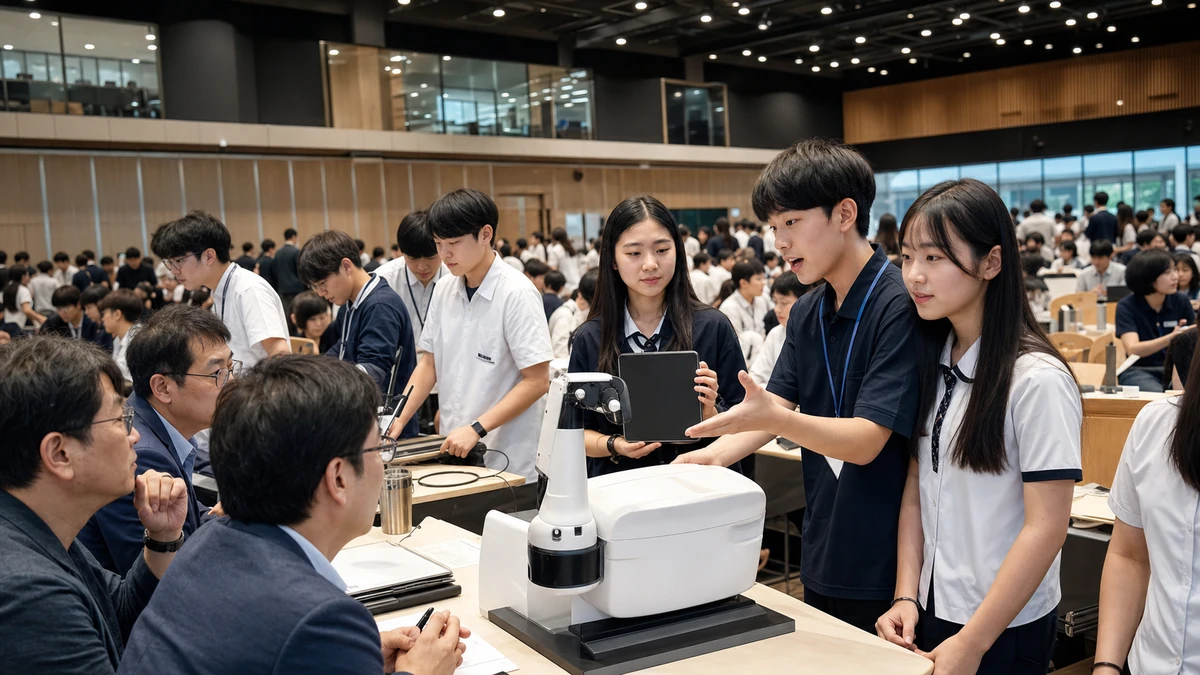
A startup competition that looks a lot bigger than a school project
Nearly 900 middle and high school students in South Korea gathered this week in Goyang, a city just northwest of Seoul, for a two-day entrepreneurship competition that offers a revealing look at how education is changing in one of the world’s most test-driven societies.
The event, organized by the Gyeonggi Provincial Office of Education, brought together 186 student startup clubs from schools across Gyeonggi Province, the populous region that surrounds the South Korean capital. According to the provincial education office, students are presenting business and problem-solving ideas through written evaluations and live presentations at the Goyang Media Education Center on July 21 and 22. At the end of the competition, four clubs will be selected to represent the province at a national contest in October in Seoul.
On paper, it may sound like a familiar academic competition — part science fair, part pitch contest, part debate tournament. But in South Korea, where the education system is still widely associated abroad with long study hours, high-stakes entrance exams and private cram schools, an event like this signals something broader. It suggests that schools are trying to make room for a different set of skills: collaboration, public speaking, creative thinking and the ability to define a problem before attempting to solve it.
That matters in a country where academic achievement has long been central not only to individual success but also to family expectations and national economic development. For many Americans, the closest comparison might be a statewide gathering that blends DECA, robotics club, mock Shark Tank and project-based learning. Yet the Korean version carries its own distinct significance because it unfolds inside a school culture that has historically placed enormous weight on standardized performance.
The students competing in Goyang are not simply showing off hypothetical companies. The event is designed around school-based startup clubs, meaning these teams have already spent time developing ideas together, dividing responsibilities and refining how to explain their proposals. That team-based structure is important. Rather than rewarding only the most polished solo speaker, the competition appears to recognize a process that includes brainstorming, drafting, organizing evidence and presenting as a group.
For educators and parents watching from outside Korea, the most notable takeaway may be that entrepreneurship here is being framed less as immediate profit-making and more as a learning method. Students are being asked to identify a challenge, develop an answer and defend their reasoning in front of adults who are not their regular teachers. Whether or not any of the ideas become real businesses is almost beside the point.
Why this matters in the context of Korean education
To understand why a youth startup competition is drawing attention, it helps to understand the pressure that typically shapes student life in South Korea. The country is famous for its fierce academic competition, especially surrounding the College Scholastic Ability Test, known in Korea as the suneung, a once-a-year exam that can influence university admissions and, by extension, career trajectories. In that environment, activities not directly tied to grades or test results have often been treated as secondary.
That has been changing, gradually and unevenly. In recent years, education officials and policymakers in South Korea have placed greater emphasis on what they often describe as creativity, convergence and future-oriented skills — ideas that overlap with what American educators might call 21st-century learning. Entrepreneurship programs, coding classes, maker spaces and student clubs have increasingly become part of that conversation.
The Gyeonggi Provincial Office of Education sits at the center of one of the country’s most influential school systems. Gyeonggi Province surrounds Seoul and includes a large share of South Korea’s student population. Policies introduced there often draw national attention because of the region’s size and proximity to the capital. When Gyeonggi promotes student entrepreneurship, it is not a niche experiment in a small district. It reflects a major public education authority trying to widen the definition of what learning can look like.
That broader shift also mirrors economic anxieties and ambitions in South Korea. The country built its modern economy on export powerhouses like Samsung, Hyundai and LG, but younger generations are coming of age in a more uncertain environment marked by slower growth, high youth competition and rising concerns about job stability. Entrepreneurship, in that sense, carries symbolic weight. It represents independence, innovation and the idea that students can become creators, not just applicants chasing limited opportunities.
Still, officials appear careful not to treat teenagers as miniature venture capital hopefuls. The education office’s description of the competition emphasizes challenge-seeking, creativity and problem-solving. Those terms suggest a pedagogical goal rather than a commercial one. In American terms, this is less about turning a ninth grader into the next Silicon Valley founder and more about teaching students how to think through real-world problems in a structured, public-facing way.
That distinction is crucial. In both the United States and South Korea, the word “startup” can evoke flashy technology companies, billion-dollar valuations and celebrity entrepreneurs. But in school settings, entrepreneurship often serves as a container for multiple forms of learning. It asks students to observe their surroundings, identify unmet needs, develop practical responses, write clearly and persuade an audience. In other words, it converts abstract classroom skills into a single project with visible stakes.
What students are actually being asked to do
One of the most telling features of the competition is its two-part evaluation process: written review and oral presentation. Students must first organize their ideas in document form and then explain them live before judges. That dual format may seem straightforward, but educationally it is doing a lot of work.
Writing forces structure. A team that has a clever thought but cannot define the problem, explain the need, outline a plan or anticipate challenges will have difficulty surviving a written screening. Presentation, by contrast, tests something different: whether students can translate a concept into language that outsiders quickly understand. It is one thing to discuss an idea among classmates who already share context. It is another to stand in front of unfamiliar adults and make the proposal coherent in a limited amount of time.
Together, those steps push students beyond improvisation. They cannot rely only on charisma, and they cannot hide behind a document that nobody questions in real time. The combination rewards preparation, logic, teamwork and adaptability. It also teaches a lesson many adults learn only later in college or at work: an idea is not fully formed until it can survive both the page and the room.
The scale of participation reinforces that this is not a showcase for a small elite group. Nearly 900 students divided across 186 clubs means the competition draws from a wide range of schools and likely a wide range of ability levels and interests. Some students may be natural presenters. Others may be researchers, designers, organizers or writers working behind the scenes. Because the entrants are clubs rather than individuals, the event implicitly recognizes that problem-solving in the real world is often collective.
That may be especially meaningful for middle school students, who are participating alongside high schoolers. In many school systems, younger students are encouraged to observe while older students lead. Here, both age groups are part of the same pipeline of idea development, documentation and public presentation. That structure gives students early exposure to the discipline of turning an intuition into a proposal that other people can evaluate.
The specific ideas being presented were not disclosed in the summary of the event, so it would be premature to assume the students are all pitching apps, green technologies or social enterprises. But the exact subject matter may be less important than the mental habits the competition encourages. Participants must look outward, notice a problem, decide what matters, discuss alternatives and reach agreement with teammates. Those are foundational civic and professional skills regardless of industry.
For an American audience, one way to think about this is to imagine if a statewide student contest combined the energy of a hackathon with the procedural rigor of a capstone presentation. The public nature of the event matters. Students are not merely completing an assignment for a grade; they are submitting their thinking to a formal process in which comparison, critique and advancement are built in.
The role of clubs in a culture known for exams
Another important detail is that the competition is organized around school clubs. In South Korea, student clubs have long existed as extracurricular spaces, but their role has evolved as schools have looked for ways to provide more holistic experiences. A startup club is not simply a pastime. It can function as a semi-structured lab where students practice cooperation in ways that ordinary lectures do not always allow.
That may sound routine to Americans familiar with extracurricular culture, where clubs often form a major part of high school identity. In South Korea, however, extracurriculars have often competed with the time demands of after-school academies, known as hagwon, where students go for additional instruction in subjects like math, English and science. A student who commits serious time to a startup club is, in effect, participating in a model of education that values exploration as much as exam preparation.
The club format also changes how achievement is measured. Traditional classroom settings often reward correct answers delivered individually. Club-based work requires students to negotiate roles, share ownership and produce something that belongs to the team. One student may be strongest at identifying community needs, another at organizing slides, another at speaking. The final presentation becomes a record not just of an idea but of a process.
That process-oriented emphasis may be one of the event’s most durable educational benefits. Even teams that do not advance will leave with experience in drafting, revising and responding to feedback. They will have encountered the gap between what makes sense inside a group and what makes sense to an outsider. That can be a difficult lesson, but it is one that often sharpens thinking more effectively than a multiple-choice exam ever could.
There is also a social dimension to bringing 186 clubs together in one venue. Students are exposed to peers from other schools who may approach similar problems from completely different angles. In a country where school communities can be intense and inward-looking, that kind of cross-school exchange has value. It lets students see that innovation is not a solitary trait possessed by a few standout classmates; it is a practice shaped by comparison, imitation, competition and revision.
Seen that way, the competition becomes more than a race for four winning spots. It turns into a temporary public square for student thinking. Participants are not only speaking to judges; they are implicitly speaking to one another, testing how their ideas hold up in a room full of equally motivated peers. The result is a learning environment that prizes articulation as much as inspiration.
Why outside judges add a dose of reality
The provincial education office said the judging panel includes experts with experience evaluating government-supported projects. That detail may sound bureaucratic, but it matters. It means students are not presenting solely to teachers who already understand school culture and may be inclined to interpret generously. They are facing evaluators accustomed to assessing proposals in more formal settings.
That does not mean the students are being judged as if they were seasoned founders seeking public grants. The standards for teenagers are likely different, and the summary did not specify the exact scoring criteria. But the presence of experienced evaluators introduces a measure of real-world accountability. Students must make their case clearly enough for adults outside their immediate educational orbit to follow.
In journalism terms, this is where the exercise becomes more than a feel-good youth event. External review changes the stakes. A strong idea that earned praise within a school club may appear underdeveloped when tested by someone encountering it for the first time. Conversely, a seemingly ordinary concept may stand out if students can explain its usefulness with precision and confidence. That mismatch between internal enthusiasm and external evaluation is one of the most important lessons any young innovator can learn.
It also mirrors what happens later in adult life, whether in business, public policy or nonprofit work. Good intentions are not enough. A proposal has to be legible to strangers. It has to anticipate questions. It has to show not only what is exciting about an idea but why the audience should care. By putting students in front of judges with project-evaluation experience, the competition introduces that reality early.
There is another subtle benefit here: objectivity. When young people receive feedback only from familiar adults, they may struggle to separate encouragement from assessment. Outside judges can provide a different signal. Even without knowing the exact comments delivered in Goyang, the structure itself suggests an effort to move student work beyond the comforting boundaries of school and into a more public arena.
That may be especially valuable in South Korea, where students often become highly skilled at mastering known expectations. Entrepreneurship, by contrast, demands tolerance for ambiguity. There is no single correct answer, no official solution manual and no guarantee that the first version will be persuasive. External judging reinforces that uncertainty while still keeping the experience educational rather than punitive.
From Goyang to Seoul: A local contest with a national pathway
The immediate outcome of the competition is straightforward: four clubs will be chosen to represent Gyeonggi Province at a national event scheduled for October at Seoul’s aT Center in Yangjae. But the pathway itself tells a larger story about how student opportunity is being structured.
The route begins at the school level, where startup clubs develop over time. It then expands to the provincial level, bringing together teams from across Gyeonggi. Finally, it opens onto a national stage in Seoul, the country’s political, economic and cultural center. For students, that progression can be powerful. It transforms a school activity into a ladder of public recognition and increasing challenge.
In practical terms, only a tiny fraction of the participating clubs will advance. Four out of 186 is a steep funnel. But educationally, the value of the competition is not limited to those winners. All participating teams go through the same basic process of preparing materials, defending their reasoning and being measured against external standards. That shared experience spreads the benefits far beyond the handful of finalists.
The choice of venue also carries symbolic weight. Goyang, while close to Seoul, is its own urban center and a regular site for large public events. Hosting the provincial contest there before sending finalists into the capital reflects a familiar Korean pattern in which local achievement seeks validation on a national stage. For American readers, it may resemble the way state champions move on to national finals in debate, business or science competitions.
At the same time, the pressure of advancement can sharpen motivation. Students know they are not simply giving a classroom presentation that disappears when the bell rings. They are participating in a selection process that could carry them into a much larger arena. That prospect can intensify the seriousness with which they treat preparation, teamwork and feedback.
It would be easy to focus only on the coming finalists and ask which ideas have the best chance to impress in Seoul. But that framing risks missing the more significant point. Long after the names of the winning clubs are announced, the deeper result may be that hundreds of students have now practiced a mode of learning based on initiative rather than memorization. They have had to decide what problem matters, how to explain it and how to stand behind their reasoning in public.
A window into South Korea’s changing definition of student success
For years, much of the foreign conversation about South Korean education has centered on rigor, pressure and performance. Those realities remain. But events like this one point to a more complicated picture. Korean schools are also becoming places where students are encouraged to build, present, collaborate and experiment — sometimes within systems still heavily shaped by competition, but increasingly with new kinds of goals.
The youth entrepreneurship competition in Gyeonggi Province does not erase the old model of education, and it would be naïve to suggest that startup clubs have replaced exam culture. What it does show is that public education officials are trying to broaden what counts as meaningful student achievement. A teenager who can identify a local problem, organize a team, draft a proposal and answer hard questions is demonstrating a form of competence that schools are beginning to value more visibly.
That shift resonates beyond Korea. In the United States, educators and employers alike have spent years debating whether schools do enough to prepare students for ambiguous, collaborative and fast-changing work environments. South Korea is wrestling with similar questions, though from a different starting point. Its answer, at least in part, appears to be creating structured opportunities where students can test ideas before adult judges and peers.
There is also something culturally significant about the phrase “challenge spirit,” a common expression in Korean educational and corporate settings that roughly refers to willingness to take on difficult tasks boldly. In an American context, the phrase might sound formal or even corporate. In Korea, it often signals a prized attitude: persistence in the face of uncertainty, combined with the courage to try something not guaranteed to succeed. That emphasis is visible in the way the competition is being described.
Ultimately, the most lasting impact of the Goyang event may have less to do with entrepreneurship in the narrow business sense than with confidence. Students are learning that their observations can be shaped into proposals, that their ideas can be heard in public and that feedback from strangers is something to engage rather than fear. For middle and high school students anywhere, that is a meaningful lesson. In South Korea, where public evaluation has so often been tied to tests, it may be especially consequential.
When the competition ends and four clubs move on to Seoul, the headlines will naturally focus on who won. But the broader story is that nearly 900 young people stepped outside the ordinary boundaries of classroom life and entered a forum that asked them not just what they know, but what they notice, what they imagine and how well they can bring others along. That is a different kind of education story — and one increasingly worth watching in South Korea.
Comments
Post a Comment