Padres’ Song Seong-mun goes hitless against Miami, but a walk and a sacrifice bunt offer a reminder that not every contribution shows up in the box sc
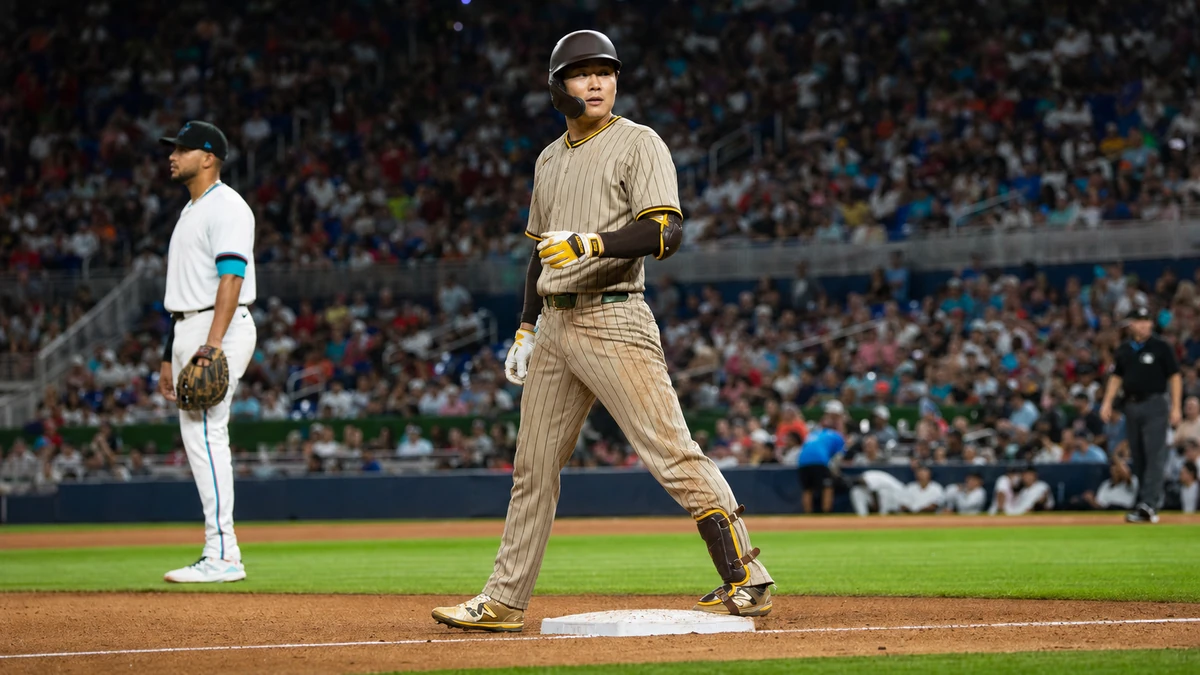
A quiet box score, and a more revealing story underneath
On the surface, San Diego Padres infielder Song Seong-mun did not have the kind of night that grabs headlines in the daily churn of Major League Baseball. In a road game against the Miami Marlins on June 25, the South Korean third baseman went 0 for 2 with a walk while batting ninth. His season average slipped from .226 to .221, the sort of incremental drop that can look discouraging in the unforgiving arithmetic of a long baseball season.
But baseball, perhaps more than any other major American sport, resists simplistic readings. A player can go hitless and still help tilt the shape of a game. A box score can suggest one thing, while the actual flow of the night suggests something more layered. That was the case for Song in Miami, where he ended a three-game stretch without reaching base, drew a walk, and laid down a sacrifice bunt that helped set up a key scoring opportunity for San Diego in a tightly contested game.
For American readers less familiar with Song, the broader context matters. He is part of a small but closely watched group of South Korean position players trying to establish themselves in the majors, a path that historically has been more difficult than the one taken by Korean pitchers. South Korea has produced major league standouts, from left-hander Hyun Jin Ryu to infielder Ha-Seong Kim and outfielder Shin-Soo Choo, but every Korean hitter arriving in the United States carries a certain amount of symbolic weight. Fans back home follow the details closely, often down to individual at-bats, because success in Major League Baseball still functions as a measure of arrival on the sport’s biggest stage.
That helps explain why a seemingly modest stat line can attract attention in Korean sports coverage. Song did not collect a hit against Miami, but he did something important: he found a way back onto first base after several frustrating games without doing so. To a casual fan, that may not sound like much. To players and coaches navigating the emotional swings of baseball, it can mean the difference between a slump deepening and a player regaining his footing.
The story of Song’s night in Miami, then, is not simply that he went hitless. It is that he contributed in smaller, strategically meaningful ways while trying to stop a brief skid from growing into something heavier.
How the night unfolded in Miami
Song started at third base and hit ninth for the Padres in an away game at loanDepot park, the Marlins’ home stadium in Miami. Batting ninth in the National League lineup can be a peculiar assignment. It is the bottom of the order, but it is not irrelevant. Managers often want that spot to serve as a bridge back to the top of the lineup, extending innings, making pitchers work and giving more dangerous hitters another chance to bat with runners on base.
His first official at-bat came in the third inning with San Diego trailing 1-0. Facing Miami right-hander Ryan Gusto, Song struck out swinging. In a vacuum, it was just one unsuccessful plate appearance. In the larger context of his recent form, it was a discouraging start. He had already gone three straight games without reaching base, and another empty trip to the plate risked reinforcing the feeling that he was pressing.
Yet the game did not end there for him, and that matters. Later, Song worked a walk, ending his on-base drought. A walk does not carry the same emotional charge as a line drive into the gap or a single through the infield, but it is still evidence of discipline, timing and survival. Especially for a hitter trying to rediscover rhythm, reaching base by any legal means can be a meaningful step.
His most important offensive moment came in the fifth inning. With the score tied 1-1 and a runner on first with nobody out, Song was asked to execute a sacrifice bunt. He did. The play moved the runner into scoring position and helped the Padres build the framework for a go-ahead rally. In statistical terms, a sacrifice bunt does the opposite of what many fans instinctively celebrate: it lowers the hitter’s individual opportunity to collect a hit and accepts an out in exchange for improved scoring position. In strategic terms, especially in a close game, it can be exactly what a manager wants.
Song’s final official at-bat came in the seventh with the game tied 2-2. This time, he lifted a fly ball to right field and was retired. So his ledger for the night closed with two official at-bats, no hits, one walk and one sacrifice bunt. That line tells the truth, but not the whole truth. It records the lack of hits. It does not fully capture the fact that he helped keep an inning moving, advanced a runner in a key spot and snapped a streak of games without reaching base.
Why Korean coverage pays close attention to games like this
To American audiences, a performance like Song’s might barely register outside the local market unless the player is already a star. For Korean audiences, the interest tends to be more intense and more granular. That is partly because overseas Korean athletes often are covered not just as individual competitors but as representatives of a national sports tradition competing abroad.
South Korea’s relationship with baseball runs deep. The sport has long been one of the country’s most popular professional games, and the Korea Baseball Organization, or KBO, is a major domestic league with passionate fan bases, organized cheering sections and a distinctly different ballpark culture from what many Americans are used to. Games in Korea can feel more like a cross between a baseball game and a college football atmosphere, complete with songs, chants and coordinated routines for individual players.
Because of that baseball culture, Korean fans tend to follow the everyday fortunes of their players in the majors with unusual intensity. A single walk, a sacrifice bunt, a defensive start at third base — none of it is too small to examine. In American sports media, national attention often goes to stars, milestones or controversy. In Korea, the simple fact of a Korean player carving out innings, at-bats and trust at the highest level can itself be newsworthy.
There is also a historical reason. For years, Korean players reaching Major League Baseball were relatively rare, and those who succeeded often became household names back home. Chan Ho Park, the pioneering Korean pitcher in the majors, opened a door in the 1990s. Later generations widened it. Still, there remains an understanding in Korean sports culture that the leap from the KBO to MLB is one of the most difficult transitions an athlete can make. The pitching is harder, the travel is longer, the scrutiny is constant, and the cultural adjustment is real.
So when Korean media noted that Song had reached base again after three games without doing so, it was not inflating a minor event. It was documenting a small but meaningful development in a player’s effort to hold his place and maintain confidence in a brutally competitive environment.
The baseball meaning of a walk and a sacrifice bunt
One of the easiest ways to misunderstand baseball is to focus only on hits. Hits matter, of course, and batting average remains one of the sport’s most familiar numbers. But any serious reading of a game requires looking at how a player contributes beyond the clean simplicity of single, double, triple or home run.
Song’s walk against Miami is a good example. To a non-baseball audience, a walk can seem passive, as if the batter merely stood there while the pitcher missed the strike zone. In reality, good walks often involve judgment, patience and an ability to avoid chasing borderline pitches. For a hitter in a cold stretch, drawing a walk can indicate that his approach has not completely unraveled even if the hits are not falling yet.
The sacrifice bunt is even more foreign to many casual fans, including some younger American viewers who have come of age during an era of baseball more skeptical of bunting. In basic terms, a sacrifice bunt is a deliberate play in which the batter taps the ball softly into fair territory, expecting to be thrown out while allowing a baserunner to advance. It is one of baseball’s clearest examples of individual statistics yielding to team strategy.
That trade-off is why Song’s fifth-inning bunt mattered. He was not chasing a prettier personal line. He was doing a job. In a 1-1 game with no outs and a runner on first, moving that runner into scoring position increased the Padres’ chances of manufacturing a run in a close contest. Whether analysts agree with bunting as a general philosophy is almost beside the point here. In that moment, the Padres asked Song to make a team-first play, and he executed it.
There is something especially revealing about that kind of assignment for a player batting ninth. Bottom-of-the-order hitters often are asked to absorb the less glamorous responsibilities of lineup construction: extend the inning, take pitches, move runners, avoid giving away at-bats, and turn the lineup over. Stars are usually judged by slugging percentage and runs batted in. Players in Song’s position often are judged by whether they can keep innings alive and make the lineup function as a connected whole.
That is why it is possible for Song’s batting average to decline while his actual contribution on this particular night remains defensible. The numbers and the game situation can point in slightly different directions. Baseball is full of nights like that.
The pressure of the ninth spot and the demands of third base
Song’s assignment Wednesday also says something about his role. He was in the lineup as both the No. 9 hitter and the starting third baseman, which means the Padres entrusted him with a defensive position that demands quick reactions, arm strength and consistency while also expecting him to help manage the lower third of the batting order.
Third base is sometimes called the “hot corner” because hard-hit balls get there fast. A player at the position has little time to react, and the defensive responsibilities can be physically and mentally taxing. For an infielder trying to establish himself in the majors, defensive reliability can buy time during offensive slumps. Teams may live with light hitting for stretches if a player is dependable in the field, handles game situations well and fits into the tactical plan.
Batting ninth carries its own kind of pressure. It is easy to think of the bottom of the order as the lineup’s least important slot, but in practice the ninth hitter often sets the stage for everyone else. A walk there can mean the leadoff hitter comes up with a man on base. A productive bunt can put stress on a defense and shift the geometry of the inning. A careless at-bat can do the opposite and cut off momentum.
For Song, reaching base once in that role after three games without doing so is not a cure-all, but it is a useful correction. Slumps in baseball are not measured only by the number of hitless games. They are measured by whether the player is still finding ways to participate, whether his timing is disappearing, whether his decision-making is deteriorating and whether the coaching staff still trusts him with meaningful innings.
The fact that Song remained in the lineup, took his place at third and was asked to bunt in a tight game suggests that he continues to be viewed as part of the Padres’ competitive machinery rather than an afterthought waiting for an opportunity. That matters as much as the 0-for-2 line in understanding where he stands.
From a three-hit breakout to a dry spell and back on base
Part of what made this game notable was the contrast with Song’s recent stretch. Just a few days earlier, on June 20 against the Kansas City Royals, he had collected three hits in a single game. For any hitter, especially one trying to strengthen his footing on a major league roster, a three-hit night can look like a turning point. It can suggest comfort, rhythm and the possibility of a sustained upswing.
Then baseball does what baseball often does: it refuses to move in a straight line. After that three-hit performance, Song went three consecutive games without reaching base at all. That kind of reversal is common over a 162-game season, but it can still feel jarring, especially when viewed from abroad by fans hoping one breakout performance will settle everything.
His walk in Miami ended that stretch. It did not erase the cold spell, and it did not restore the batting average that slipped to .221. What it did do was stop the run of games in which he had no presence on the bases. Sometimes the first step out of a slump is not a hard-hit single; it is a patient plate appearance, a borderline pitch taken for ball four, a small reset in the rhythm of competition.
This is one of the hardest truths for fans to accept, in any country: progress in baseball can be unspectacular. There are no guaranteed narrative arcs. A player does not necessarily go from three hits to stardom, or from three quiet games to collapse. More often, he bounces between moments of promise and frustration, accumulating evidence over time. Song’s recent sequence — three hits, then silence, then a walk and a team-oriented bunt — fits that pattern perfectly.
His season totals, 21 hits in 95 at-bats, compress all of those ups and downs into a single line. But the daily reality is much more volatile. Every hitter’s season is a collage of sharp stretches, empty nights, tactical contributions and incremental corrections. Song’s game in Miami was one of those incremental corrections.
What Song’s path says about Korean position players in the majors
There is a larger significance to Song’s season beyond what happened in one game against the Marlins. Korean pitchers historically have found clearer pathways into Major League Baseball than Korean infielders and outfielders. Position players must adjust not only to elite velocity and advanced scouting but also to daily defensive expectations, different clubhouse cultures and a style of baseball that can diverge sharply from what they knew in Korea.
For Korean hitters, the comparison point many fans will recognize is Ha-Seong Kim, the former KBO star who won admiration in San Diego not because he immediately dominated at the plate, but because he adapted over time, played strong defense and learned how to survive the league’s rhythms. That kind of progression has become a template for how Korean position players can earn trust in the majors even before the offensive numbers fully settle.
Song’s night against Miami, modest as it was, fits into that template. He did not produce a headline-grabbing offensive outburst. Instead, he played third base, took a walk, executed a bunt and participated in a one-run tactical battle. That may sound ordinary, but ordinary competence is often the foundation of a major league career.
There is also an international dimension to how these performances are interpreted. Korean players in MLB occupy a kind of double visibility. In the United States, they are competing for roles within a single franchise and a deeply crowded sports landscape. In South Korea, they can be watched as national figures whose daily box scores become part of a broader conversation about Korean athletic achievement abroad. That dual audience can magnify both success and struggle.
For American readers, this may resemble the way Japanese stars such as Shohei Ohtani or Ichiro Suzuki were once followed relentlessly by media in Japan, or the way soccer stars from smaller footballing nations become symbols of national pride in European leagues. The stakes are not just personal. They are also cultural.
That is why a game without a hit can still matter. Song’s ability to remain useful on a night when the bat did not produce speaks to the kind of versatility and resilience international players often need in order to stick. Flash gets attention. Function keeps players employed.
What to watch next
The obvious next question is whether Song can turn this small step into something more tangible at the plate. The unresolved issue from Miami is still his official at-bats. He struck out in one, flied out in another, and saw his average fall to .221. However useful the walk and bunt were, the Padres will still want harder contact and more hits from him over time.
That does not mean the Miami game should be dismissed as empty. If anything, it offers a clearer picture of where Song is right now: not locked in, not invisible, still searching, still contributing in the margins, still trusted enough to start and execute situational baseball. Those are not glamorous conclusions, but they are honest ones.
Baseball seasons are too long and too uneven to be judged solely by the loudest moments. Sometimes the most telling games are the ones in which a player does not have his best swing but still finds a way to matter. Song’s night against the Marlins was that kind of game. It broke a short on-base drought, showcased a team-first approach in a critical inning and underscored the reality that contribution is not always synonymous with hits.
For fans in San Diego, it was a minor subplot in a midsummer road game. For followers in South Korea, it was another checkpoint in the ongoing story of a Korean infielder navigating the world’s toughest baseball league. For anyone trying to understand the sport more deeply, it was a useful reminder that value can arrive quietly — in a walk, in a bunt, in a small act of steadiness when a player needs one most.
And for Song, after three games without reaching base, that quiet act of steadiness may have been the most important part of the night.
Comments
Post a Comment