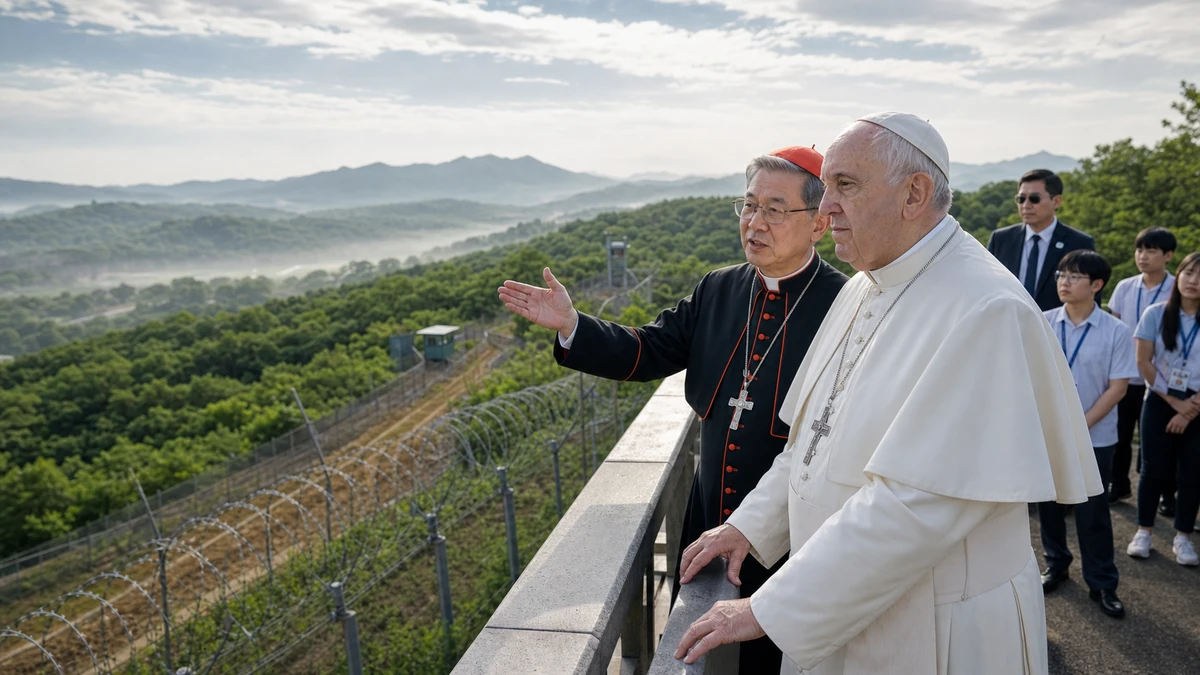
A possible papal stop at one of the world’s most heavily guarded borders
Pope Leo XIV is actively considering a visit to the Korean Demilitarized Zone during his first trip to South Korea in 2027, according to Cardinal Lazarus You Heung-sik, a senior Vatican official whose comments suggest the visit could carry significance far beyond the Catholic Church. If it happens, the stop would place the pope at one of the most symbolically charged places in Asia: a narrow strip of land that separates North and South Korea, technically still at war more than seven decades after the fighting stopped.
The possible visit comes as Seoul prepares to host World Youth Day in August 2027, a massive international Catholic gathering that regularly draws hundreds of thousands of young pilgrims, clergy and visitors from around the world. Pope Leo XIV is expected to attend that event, scheduled for Aug. 3-8 in the South Korean capital, marking what would be his first visit to the country as pope. It would also make him the fourth pope to travel to South Korea, a country where Catholicism is a minority faith but one with outsized cultural and political influence.
Nothing has been finalized. Vatican and South Korean officials have not announced a confirmed DMZ itinerary, and a possible visit to North Korea remains even more speculative. But the idea itself is notable. In Korea, where the border is not just a geopolitical fact but a living wound passed from one generation to the next, the presence of a pope at the DMZ would send a message that is instantly legible to a global audience: peace is unfinished business on the Korean Peninsula.
For American readers, the symbolism may be easiest to understand by imagining a world leader standing at a place that combines the historical weight of the Berlin Wall, the military tension of a Cold War front line and the emotional force of a divided family reunion site. The DMZ is not simply a border. It is the physical reminder of a conflict that has never formally ended and of a peninsula that remains split between two radically different political systems.
In that sense, a papal visit would not be a side trip for dramatic photographs. It would be a deliberate gesture at the intersection of faith, diplomacy and memory, connecting a major youth event in one of Asia’s most technologically advanced cities with one of the world’s last enduring Cold War flashpoints.
Why World Youth Day in Seoul matters well beyond the Catholic Church
The pope’s main reason for traveling to South Korea is World Youth Day, one of the largest recurring events in global Catholicism. For Americans unfamiliar with the gathering, World Youth Day is something like a cross between a papal summit, a global youth conference and a spiritual festival. It rotates among host cities and typically includes large outdoor Masses, cultural programming, pilgrimages and meetings between the pope and young Catholics from dozens of countries.
Its scale alone makes it important. But Seoul’s turn as host carries additional meaning. According to the Korean account, this will be the first time the event is held in a non-Catholic-majority country. That matters because South Korea offers a striking example of how Catholicism functions in a pluralistic Asian society. Christianity, including both Protestant and Catholic traditions, has had a visible public role in modern South Korea, but it exists alongside Buddhism, Confucian social traditions and a growing secular culture shaped by urban life, intense education pressure and global media.
Seoul is therefore an unusual but fitting stage. To many Americans, the city is known through K-pop, Korean dramas, beauty brands and cutting-edge consumer technology. But it is also a place where rapid modernization, democratic activism and unresolved national division coexist in everyday life. Glass towers and ancient palaces stand within the same neighborhoods. Young people gather in fashionable districts while military service remains a fact of life for most South Korean men. It is a city whose global image is sleek and modern, but whose politics and history are inseparable from the legacy of war.
That is part of what makes the 2027 event compelling. International pilgrims will not simply be flying into another megacity for a church convention. They will be arriving in a capital that sits relatively close to one of the most fortified borders in the world. The Korean summary points out that the event may allow young visitors to connect the energy of a global religious gathering with the historic reality of national division. If Pope Leo XIV emphasizes peace and dialogue, that connection could become the central theme of the trip.
That would fit the broader logic of papal travel. Modern popes do not visit countries merely to greet believers. Their trips are usually designed to spotlight moral issues, encourage local churches and send diplomatic signals without always speaking in overtly political terms. In South Korea, those themes may converge naturally: youth, peace, reconciliation and the challenge of maintaining hope in a place where history remains painfully unresolved.
The DMZ’s symbolism in Korean life and global politics
The Korean Demilitarized Zone stretches roughly 155 miles across the peninsula. Despite its name, it is surrounded by heavy military fortifications and remains one of the most closely watched borders on earth. It was created by the 1953 armistice that paused the Korean War, which killed or displaced millions of people and drew in the United States, China and other nations. No peace treaty ever followed. Technically, North and South Korea are still in a state of war.
For many Americans, the Korean War is often remembered as the so-called Forgotten War, overshadowed in popular memory by World War II and Vietnam. In Korea, it is not forgotten at all. The war’s legacy is everywhere: in family histories, in military readiness, in the political language of security and in the permanent reality of a divided peninsula. Some South Koreans have relatives in the North whom they have not seen in decades. For them, division is not an abstraction debated by diplomats. It is a private sorrow embedded in national life.
The DMZ has become a paradoxical symbol. It represents danger, but also the hope that conflict can be contained. It is a place of barbed wire, land mines and guard posts, but also of ceremony and diplomacy. When world leaders visit the area, the images circulate globally because the setting communicates tension without explanation. A pope standing there would add another layer: moral witness.
Cardinal You, according to the Korean report, described the border as a visible sign of separation and even raised the image of young people forming a human chain. That image is especially powerful in the context of World Youth Day. It suggests the trip could frame young people not merely as pilgrims attending an event, but as participants in a broader message about solidarity across national and ideological boundaries.
For a U.S. audience, it may help to think of how religious symbolism can reshape a political site. Just as a civil rights march can transform a city street into sacred public memory, a papal appearance can turn a militarized location into a stage for conscience. A visit to the DMZ would not erase the strategic realities of the Korean Peninsula. But it could recast the space, even briefly, as a place where the world is invited to imagine not only deterrence, but reconciliation.
That matters because the Korean Peninsula is often discussed internationally only in terms of missile tests, nuclear threats and summit speculation. A papal visit would broaden the frame. It would remind audiences that behind the security headlines are ordinary people, unresolved grief and an enduring desire for peace that still shapes Korean civic and religious life.
The Vatican’s cautious language, and why North Korea is a very different question
For all the attention the report has drawn, the most important fact may be what has not been decided. Cardinal You’s comments indicate that Pope Leo XIV is willing to consider a meaningful role related to peace on the peninsula and is actively weighing a DMZ stop. That is not the same thing as a confirmed schedule. In Vatican diplomacy, such distinctions matter.
The same is even more true for the possibility of a North Korea visit. The Korean summary makes clear that this remains highly uncertain and would depend on Pyongyang. Cardinal You reportedly said channels involving papal representatives and third countries could be used to explore contact, but he did not suggest any breakthrough had occurred. In other words, the door may not be closed, but it is certainly not open.
That caution is warranted. North Korea is among the most isolated states in the world, and religious activity there is tightly controlled. High-profile visits require not just logistical coordination but political approval at the highest level. Any papal trip to Pyongyang would be a major diplomatic event, one that would immediately raise questions about sanctions, propaganda, inter-Korean relations and the Vatican’s role in authoritarian settings.
American readers may recall earlier periods when papal diplomacy intersected with tense geopolitical environments, from John Paul II’s influence in communist Eastern Europe to Francis’ role in the thaw between the United States and Cuba. The Vatican often seeks openings where formal state relations are strained, using moral authority and patient dialogue rather than military or economic leverage. But that approach has limits, especially with governments that tightly control outside influence.
In the Korean case, even a DMZ visit would be easier to imagine than a North Korea stop. The border is accessible from the South, highly choreographed and already used for visits by international dignitaries. A trip to Pyongyang would require a fundamentally different level of political consent and would carry much greater risk of collapse even late in the planning process.
So while the headline-grabbing possibility of a papal visit to North Korea will inevitably draw attention, the more realistic and arguably more resonant development is the one already under discussion: a pope using his first South Korea trip to stand at the edge of division and speak about peace without pretending the hard realities have vanished.
The Korean cardinal at the center of the conversation
A key figure in this story is Cardinal Lazarus You Heung-sik, the South Korean church leader who relayed the pope’s thinking. In Vatican terms, You is not a peripheral voice. He became the first Korean to head a Vatican department when he was appointed prefect of the Dicastery for the Clergy in 2021, and he has remained a prominent bridge between the Holy See and the Korean Peninsula. He was elevated to cardinal in 2022, becoming one of the most visible Korean figures in the global church.
His biography matters here because he is not speaking about the peninsula from a great distance. According to the Korean summary, he has visited North Korea four times in the past as part of Catholic aid efforts. That gives him unusual credibility when discussing dialogue, contact and the slow, often frustrating work of keeping lines of communication from closing entirely.
He also seems to be framing the issue in characteristically pastoral terms. In the KBS interview cited in the Korean report, he described the need to keep knocking on closed doors, widening even the smallest opening if one appears. That language is revealing. It does not promise a diplomatic miracle. It describes peacebuilding as incremental, fragile and worth pursuing even when the visible results are modest.
That sensibility may resonate deeply in South Korea, where hopes for inter-Korean reconciliation have repeatedly risen and fallen over the years. Moments of optimism, including family reunions, cultural exchanges and high-level summits, have often been followed by long freezes. For many South Koreans, especially those old enough to remember previous cycles of engagement, peace is not a single event but a process of preserving possibility.
If Pope Leo XIV goes to the DMZ, it is likely in part because figures like Cardinal You have framed the visit not as a dramatic diplomatic gambit, but as a moral act consistent with that slower process. The gesture would say that even when political progress is stalled, the imperative to imagine peace remains.
What a 2027 papal visit could mean for South Korea’s global image
South Korea is already one of the world’s most recognizable cultural exporters. Its music, film, television, food and technology have made it deeply familiar to global audiences, especially younger ones. But world attention often reaches the country through two very different lenses: pop culture fascination on one hand, and security anxiety over North Korea on the other.
A papal visit tied to World Youth Day and a possible DMZ stop could merge those lenses in a new way. It would present South Korea not only as a trend-setting society or a frontline state, but as a place where global conversations about youth, faith, memory and peace are unfolding simultaneously. That is a more textured image than the one often seen abroad.
For visitors, especially first-time travelers from North America or Europe, the experience could be striking. They may come expecting a polished global capital known for subways, street fashion and digital sophistication, then find themselves confronting the reality that the border dividing the peninsula is still part of the nation’s everyday consciousness. In that sense, the story is not just about the pope. It is about the way South Korea invites the world to encounter contradictions it has learned to live with: openness and anxiety, cosmopolitanism and militarized tension, celebration and unresolved history.
That may be why the idea of a DMZ visit has captured attention even before any schedule is confirmed. The scene almost writes itself: the leader of the Catholic Church in Seoul for the world’s biggest Catholic youth event, then traveling to a border that has defined Korean history since the mid-20th century. It is the kind of image that can bring distant realities into focus for people who might otherwise pay little attention to the peninsula.
It also reflects how South Korea increasingly occupies a central role in global storytelling. Once often covered in American news mainly through war, dictatorship or nuclear crises, the country is now understood through many frames at once: democratic resilience, cultural influence, religious vitality and geopolitical vulnerability. A papal trip would touch all of them.
A trip not yet set, but already rich in meaning
The most responsible way to read the current reporting is with both interest and restraint. Pope Leo XIV has not yet committed publicly to a DMZ visit, and no North Korea stop has been arranged. But the fact that the possibility is being seriously discussed by a senior Korean cardinal is meaningful in itself. It suggests that the pope’s first trip to South Korea may be designed not only as an appearance at a major church gathering, but as a statement about what kind of moral presence the Vatican hopes to project in Asia.
For American audiences, this is a reminder that the Korean Peninsula cannot be reduced to periodic missile headlines or abstract great-power competition. It is also a human story, one in which religion, memory and diplomacy still intersect in ways that can move millions of people. The DMZ is a military boundary, but it is also a symbol of families cut apart, identities suspended and a peace never fully completed.
If Pope Leo XIV eventually stands there in 2027, he will be entering a space already thick with history. His words are unlikely to change the strategic balance overnight. No one should expect a single visit to unlock Pyongyang or transform inter-Korean relations. But symbolic acts matter, especially when they draw global attention to realities that the world has learned to treat as permanent.
And that may be the deeper significance of this developing story. World Youth Day in Seoul is poised to bring young Catholics from across the globe to a city that embodies both 21st-century dynamism and 20th-century unfinished business. A papal stop at the DMZ would tie those two Koreas together in the public imagination: the Korea of innovation, culture and global exchange, and the Korea still shaped by barbed wire and cease-fire lines.
In a news cycle often driven by spectacle, this would be a different kind of event: solemn, symbolic and patient. It would ask the world to look again at a border many have come to accept as permanent, and to consider whether the language of peace still has the power to widen even the narrowest opening.
Comments
Post a Comment