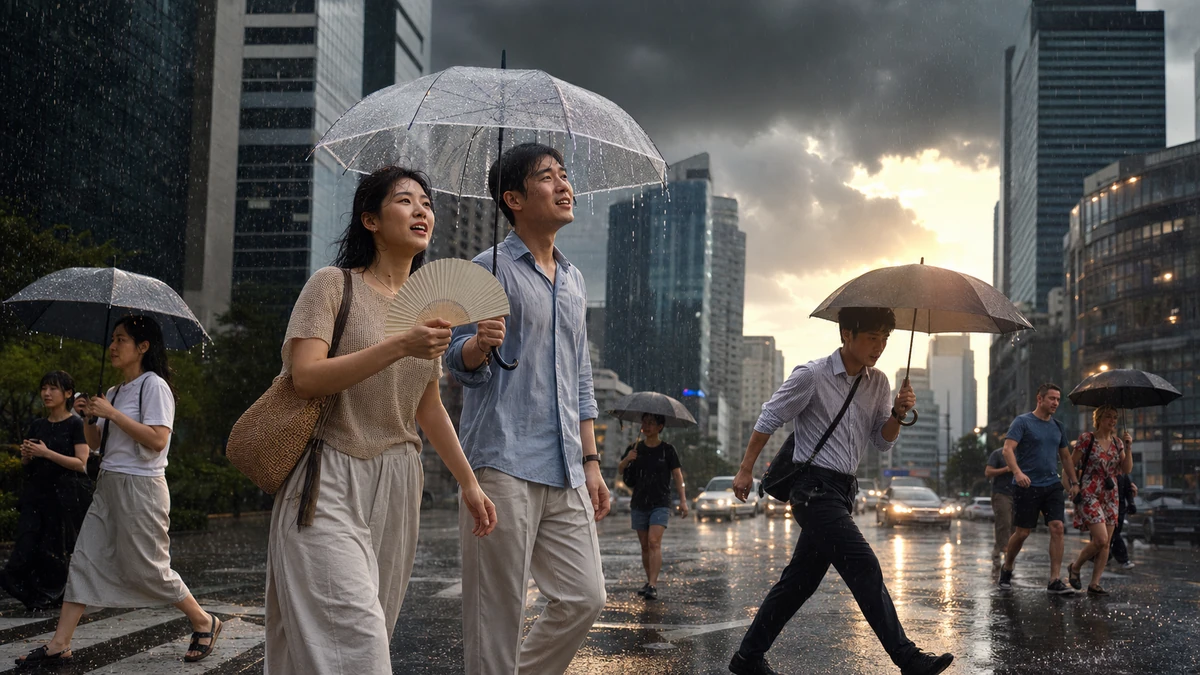
A weekend forecast that captures the reality of a Korean summer
South Korea is heading into a midsummer weekend with a weather pattern that may sound contradictory to American readers: rain in and around Seoul and parts of Gangwon Province, scattered showers farther south, and stubborn heat almost everywhere. That is the central message of the latest forecast for Saturday, July 25, 2026. Even where rain falls, forecasters say, the broader story is not relief but persistence — high temperatures, sticky humidity and another round of tropical nights, the Korean term for evenings so warm that the heat barely lets up after sunset.
For residents, it is the kind of forecast that shapes everything from a family outing to a subway commute. For foreign visitors, especially those arriving with postcard images of neon-lit Seoul, mountain trails in Gangwon or breezy seaside escapes in Jeju, it is a reminder that summer in South Korea can be both intensely urban and intensely meteorological. A traveler might need an umbrella in the morning, cold water and shade in the afternoon, and air conditioning well into the night.
In the United States, many readers will recognize the feeling from cities such as Washington, D.C., Atlanta or Houston, where a summer rainstorm does little to break the humidity and can sometimes make it feel worse. South Korea’s summer pattern often works in a similar way. Rain clouds and sudden showers may pass through, but unless a strong front fully clears the air, the muggy heat remains. In practical terms, that means the weekend forecast is less about choosing between rain gear or heat precautions and more about preparing for both at once.
The forecast also highlights a broader truth about South Korea that outsiders sometimes miss. Though the country is geographically compact compared with the United States, its weather can vary sharply by region, especially in summer. Seoul, the mountainous interior of Gangwon, the central Chungcheong region and the southern island of Jeju can all experience different forms of rainfall on the same day. That matters in a country where modern rail and road networks make it easy to cross from one weather zone into another in a matter of hours.
So while Saturday’s forecast may read like everyday weather news, it also offers a useful window into ordinary life in South Korea during peak summer: a season defined by quick changes, careful planning and a constant negotiation between outdoor activity and the need to duck inside.
Where the rain is expected — and where it is not
The most organized rainfall on Saturday is expected in the greater Seoul metropolitan area — including Seoul and Incheon — as well as inland and mountainous parts of Gangwon Province to the east. That region-by-region distinction is important. In American terms, this is not a single broad system soaking the whole country from top to bottom. It is a patchwork forecast, with meaningful local differences in timing, intensity and type of precipitation.
For Seoul, Incheon and southern Gyeonggi Province, expected rainfall is forecast at roughly 5 to 40 millimeters, or about 0.2 to 1.6 inches. That is a wide enough range to matter. It suggests some neighborhoods may see only light rain while others get a more substantial drenching depending on how rain bands develop and move. In a dense metropolitan area where millions rely on walking, buses and the subway, that kind of variable forecast can turn a normal outing into a stop-and-start day of checking radar maps and timing transfers.
North of there, northern Gyeonggi and the islands off the west coast known as the West Sea Five Islands are expected to receive more — around 20 to 60 millimeters, or 0.8 to 2.4 inches. That does not necessarily mean nonstop heavy rain, but it does indicate a greater chance of more concentrated rainfall. For people planning outdoor events, local excursions or even military-family visits in those areas, a casual assumption of “a little summer rain” could prove misleading.
Gangwon Province, home to mountain landscapes popular with hikers and weekend travelers from Seoul, also faces a divided forecast. Northern inland and mountain areas are expected to receive around 10 to 60 millimeters of rain, while central and southern inland and mountainous areas are forecast to get 5 to 40 millimeters. That may sound technical, but it reflects a real feature of Korean geography. Gangwon stretches across rugged terrain from inland valleys to high ridges and toward the East Sea coast. Weather conditions can shift rapidly even within the same province, especially when elevation is involved.
To Americans used to state-based weather maps, the Korean forecast may seem unusually granular. But in a country where mountain ranges, coastlines and urban heat can all influence local conditions over short distances, that level of detail is essential. If you are traveling from downtown Seoul to a resort area in Gangwon, you are not simply changing scenery. You may also be moving into a different rain pattern altogether.
Showers in the center of the country and on Jeju Island
Separate from the rain expected around the capital region and Gangwon are showers forecast for parts of central South Korea and Jeju Island. The distinction matters because a shower forecast in Korea, much as in the United States, usually signals something more intermittent and localized than a steady all-day rain. Conditions can look calm one moment and turn wet the next, often unevenly from one district to another.
Daejeon, Sejong and the broader Chungcheong region — including both South and North Chungcheong provinces — are expected to see showers from the morning through the evening, with estimated precipitation of 5 to 40 millimeters. In practical terms, that means residents and visitors should not interpret a bright start to the day as a guarantee of stable weather. A market visit, a riverside stroll or lunch on an outdoor patio could all be interrupted by a burst of rain that develops quickly and moves on just as fast.
That kind of weather is especially relevant on a summer weekend, when many Koreans take short domestic trips, visit cafes and shopping districts, or spend time in public parks and festival spaces. Korea’s cities are highly walkable in concentrated areas, but they are also built around frequent transitions between indoors and outdoors. A person may walk out of a subway station into humid heat, cross a plaza under bright sun, and then be caught in a shower before reaching the next indoor stop. The choreography of the day changes with the sky.
Jeju Island, one of South Korea’s top domestic and international tourist destinations, is also expected to see showers between morning and evening, though in smaller amounts — around 5 to 10 millimeters. That lower total does not mean weather will be irrelevant to travelers. Jeju’s appeal lies in movement: coastal drives, waterfalls, volcanic trails, beaches and neighborhoods spread across the island. Even a modest shower can complicate plans when visitors are moving between scenic sites, rental cars, bus routes and outdoor attractions.
For American travelers, Jeju is often compared loosely to Hawaii because of its island identity and tourism profile, though the comparison only goes so far. Jeju has its own landscape, culture and pace. What they do share is the reality that island weather can shift quickly and that seemingly minor forecast changes can ripple through a sightseeing itinerary. On Saturday, that means travelers would be wise to check updates throughout the day rather than relying on a single morning snapshot.
Why the rain will not bring much relief from the heat
If there is one point forecasters are emphasizing, it is that rain does not equal relief. South Korea’s heat is expected to continue nationwide even in regions where rain or showers develop. That may be counterintuitive to readers who associate rainfall with cooler air, but summer in Korea often delivers the opposite experience: rain that temporarily blocks the sun while pushing humidity even higher.
In meteorological terms, the discomfort comes not just from the air temperature but from the combination of heat and moisture. Anyone who has spent time in the U.S. South or Mid-Atlantic during July knows the sensation: step outside after a thunderstorm and the air can feel heavier, not fresher. Korea’s urban areas, especially Seoul, can amplify that effect through dense development, pavement and heavy summer activity.
Saturday’s forecast suggests that people should prepare for a day in which umbrellas and hydration are equally necessary. It is not enough to assume cloud cover will make outdoor time easy. Between the periods of rain, temperatures can remain high, and once the sun returns the atmosphere can feel even more oppressive. That is especially relevant on weekends, when people often linger outdoors longer than they would on a workday — shopping in open-air districts, visiting riverside parks, attending local events or navigating tourist sites.
There is also a cultural rhythm to summer weekends in South Korea that makes weather especially consequential. During the workweek, routines are more fixed: school, office commutes, regular meal stops. On weekends, movement becomes more varied and discretionary. Families head to malls or traditional markets, couples walk busy nightlife streets, and travelers move between cities using the country’s efficient rail and bus networks. Weather, in that setting, is not merely background. It can reshape traffic patterns, consumer behavior and where people decide to spend their time and money.
For visitors unfamiliar with Korea’s summer climate, the key mistake is often to think of rain as the main issue and heat as secondary. Saturday’s forecast suggests the opposite framework may be more useful. The heat is the baseline condition. Rain is an added complication layered on top of it.
The return of the “tropical night” and what that means
Another major feature of the forecast is the continuation of tropical nights across the country. In Korea, the term refers to nights when temperatures remain unusually high after dark, typically warm enough to make sleeping uncomfortable without cooling. It is a familiar part of the Korean summer, and it shapes daily life more than outsiders may realize.
Americans may know the experience from heat waves in cities like New York or Chicago, when apartment buildings hold the day’s warmth and the overnight low does not fall enough to offer real relief. Korea’s tropical nights operate in a similar way, especially in large urban areas where concrete, glass and traffic trap heat. Even when evening activities look inviting — and Seoul at night often does, with crowded restaurant districts, late shopping and brightly lit streets — the atmosphere can remain sticky and draining.
That matters because South Korean cities are famously active after dark. Dinner often starts later than many Americans might expect, and commercial neighborhoods can remain busy well into the evening. During hot weather, many residents and tourists shift outdoor plans to nighttime in hopes of avoiding the day’s worst heat. But when tropical nights persist, that strategy only partially works. The sun is gone, yet the physical stress of the heat remains.
For travelers, this can be a surprise. Korea’s summer nights are often visually appealing — lively sidewalks, open convenience stores, late-running cafes, illuminated palaces or riverfronts. But the idea that evening automatically means comfort is misleading during a tropical-night stretch. Long walks, crowded transit platforms and poorly ventilated streets can still feel exhausting.
The overnight heat also has broader public-health implications. Persistent warm nights can disrupt sleep, making it harder for people to recover from daytime heat exposure. That is especially relevant for older adults, children, outdoor workers and travelers who are already fatigued. In practical terms, the forecast is not simply telling people to plan a cooler nighttime backup. It is warning that there may be no true break from the heat at all.
How residents and travelers are likely to adapt
One reason weather stories carry real weight in South Korea is that the country’s daily infrastructure is highly responsive to changing conditions. In Seoul and other large cities, underground shopping arcades, subway corridors, department stores, office towers and food courts are often physically or functionally linked. A rainy or sweltering day does not necessarily force people to cancel plans; it encourages them to reroute them.
That flexibility is part of modern urban life in Korea. A group planning an afternoon outside may retreat into a museum, a shopping center or a cafe cluster connected to transit. A tourist walking through central Seoul can often pivot from street-level sightseeing to indoor activity within minutes. This is one reason weekend city life can continue even in difficult summer weather.
Still, the same is not always true outside major urban hubs. Mountain areas, coastal zones and islands can offer fewer indoor alternatives and less seamless transit. In Gangwon’s highland areas or on portions of Jeju, sudden rain and lingering heat can be more disruptive because there are fewer nearby shelters, less dense transportation and longer travel times between destinations. That means preparation matters more the farther one gets from the capital’s urban core.
For Saturday, the practical advice is simple but important: pack for two kinds of discomfort. An umbrella or lightweight rain jacket makes sense in the capital region, Gangwon, Chungcheong and Jeju. But so do water, breathable clothing, sun protection and a plan for regular indoor breaks. Travelers moving between cities should also check the weather not just for their destination, but for the route itself. In South Korea, a day trip can cross multiple forecast zones quickly.
This is also a good example of why weather stories in Korea often focus on behavior rather than just numbers. Rainfall estimates — 5 to 40 millimeters here, 20 to 60 there — do not mean every area will hit the maximum. They indicate a range of possible conditions shaped by local geography and storm development. The real takeaway is not a single exact figure. It is the need for flexibility.
A small weather story that says something larger about South Korea
At first glance, this may sound like routine seasonal coverage: some rain in the north, showers in central areas and on Jeju, heat everywhere. But for readers trying to understand contemporary South Korea beyond headlines about politics, technology or pop culture, there is something revealing in a forecast like this.
It shows a country where geography matters despite short distances; where summer life unfolds across dense cities, mountains and islands; and where public routines are shaped by a blend of mobility, weather awareness and indoor-outdoor flexibility. It also underscores a point that visitors often discover quickly: South Korea in summer is not just hot. It is layered. Conditions can be regionally specific, physically taxing and surprisingly changeable over the course of a single day.
That complexity helps explain why an ordinary weather bulletin can become a significant piece of daily information. For a family in northern Gyeonggi deciding whether to keep an outdoor plan, for a Seoul office worker thinking about an evening outing, or for a tourist moving between the capital and the coast, the forecast is not abstract. It affects when to leave, what to wear, how much water to carry and whether an all-outdoor itinerary is realistic.
As Saturday approaches, the message from South Korea’s forecast is clear: expect a summer day that asks for both caution and adaptability. Rain will likely affect the capital region and parts of Gangwon. Showers may interrupt plans in the Chungcheong region and on Jeju. But none of that erases the underlying heat, and the return of tropical nights means the discomfort may last long after sunset.
For Americans used to seeing weather as either a disruption or a backdrop, Korea’s midsummer weekend offers a reminder that it can be both — not dramatic enough to shut everything down, but influential enough to reshape how millions of people move through their day. In South Korea, that is not unusual. It is simply summer.
Comments
Post a Comment