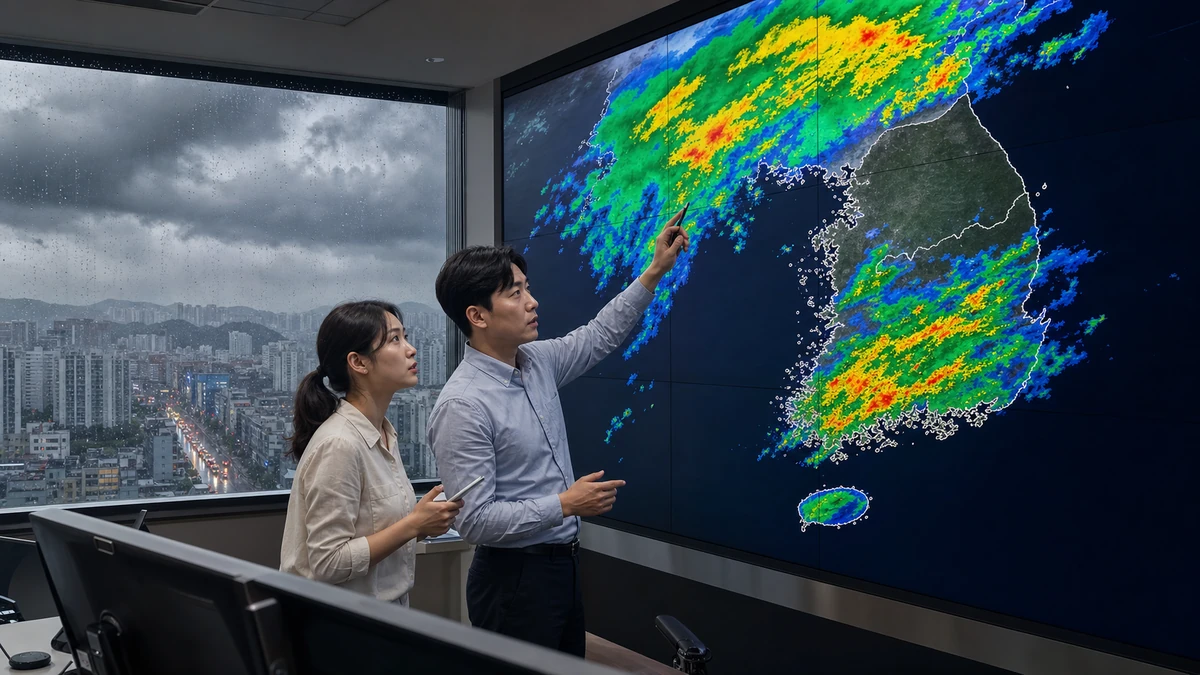
A cloudy national holiday is expected to turn into a much broader rain event
South Korea is heading into a wet stretch of weather that could reshape weekend travel, outdoor plans and city-to-city movement across the country, according to a forecast released Wednesday. Rain is expected to begin unevenly on Thursday, which is Constitution Day in South Korea, before expanding nationwide Friday, with some of the heaviest totals projected around the greater Seoul area.
For American readers, the timing matters almost as much as the rainfall totals. Constitution Day, observed July 17, marks the anniversary of the promulgation of South Korea’s constitution in 1948. It is a commemorative day rather than a major family holiday on the scale of Chuseok, often compared to Thanksgiving, or Lunar New Year. Still, the date carries civic symbolism, and in a country where summer travel, short regional trips and densely packed urban schedules are common, even a one-day shift in weather patterns can have outsized effects.
The forecast, reported by Yonhap News Agency, suggests Thursday will be mostly cloudy nationwide, but the rain will not fall evenly across the map. Instead, showers are expected to focus first on the Chungcheong region in central South Korea, much of the country’s southern provinces and Jeju Island off the southern coast. Then, beginning Friday, the rain is expected to widen and intensify across the country, including the Seoul metropolitan area, where forecasters warned of the potential for significant downpours.
That distinction is crucial. This is not a case of the entire country getting the same kind of weather at the same time. The center of gravity shifts by date and by region. Thursday’s biggest concern is farther south and through the country’s central belt. Friday and beyond, the focus moves north and broadens, with the capital region facing the possibility of much heavier rain.
In practical terms, that means a resident of Busan, a business traveler headed to Daejeon and a tourist staying in Seoul could all experience very different versions of the same weather system, depending on when and where they are moving. In a country about the size of Indiana but with high-speed rail, dense highways and major population clusters packed relatively close together, weather can quickly become a transportation story as much as a climate one.
What the forecast says for Thursday, by region
According to the outlook released Wednesday, the heaviest rain on Thursday is expected in parts of the southwest and southeast. Forecast totals for North Jeolla Province, Gwangju and South Jeolla Province are between 30 and 80 millimeters, or roughly 1.2 to 3.1 inches. The same 30 to 80 millimeter range is forecast for Busan, Ulsan and South Gyeongsang Province in the southeast.
That is the highest projected range listed for Thursday’s weather. Other southern areas are also expected to be wet, though not necessarily to the same degree. Daegu and North Gyeongsang Province are forecast to receive 20 to 60 millimeters, or about 0.8 to 2.4 inches. The central Chungcheong region, including Daejeon, Sejong, South Chungcheong Province and North Chungcheong Province, is also expected to see 20 to 60 millimeters.
Jeju Island, one of South Korea’s best-known domestic tourism destinations, is forecast to receive a comparatively lighter 5 to 10 millimeters, or about 0.2 to 0.4 inches, on Thursday. That does not mean Jeju will be bright and sunny. Forecasters still expect generally cloudy skies nationwide. But it does underscore a point that can get lost in broad summaries: “rain in Korea” on a given day can mean dramatically different conditions in different places.
That regional nuance matters in South Korea because daily life often involves intercity movement. It is common for people to live in one city and travel to another for work, education or family visits. Domestic tourism is also concentrated and fast-moving. A weekend itinerary might include a coastal stop, a provincial city and a return to Seoul, all within a day or two. Under those conditions, a rainfall map is not just a background detail for deciding whether to carry an umbrella. It can affect train schedules, road visibility, local events and the overall pace of travel.
For Americans used to thinking about weather across much larger geographic areas, South Korea’s compact size can be deceptive. Distances are shorter, but that often means weather systems are tracked more granularly, not less. A forecast difference of 20 to 30 millimeters between neighboring regions can carry real significance, especially in the middle of the summer rainy season, when bursts of heavy rain can be concentrated in narrow corridors.
Friday is the bigger story for Seoul and the capital region
While Thursday’s rain is expected to concentrate on the south and center of the country, forecasters say the more consequential shift begins Friday, when precipitation is expected to expand nationwide. For residents of Seoul, Incheon and Gyeonggi Province, the message is clear: Thursday may look gray, but Friday is the day to watch more closely.
The forecast calls for 50 to 150 millimeters, or about 2 to 6 inches, for Seoul, Incheon and Gyeonggi beginning Friday. In southern Gyeonggi, the projection is even more striking, with a possibility of more than 200 millimeters, or nearly 8 inches. That is the largest figure mentioned in the forecast and signals the potential for localized heavy rain rather than a routine summer shower.
For an American audience, those numbers are best understood not as apocalyptic on their own but as significant enough to disrupt ordinary routines, particularly in a heavily urbanized region. The Seoul metropolitan area is home to more than half of South Korea’s population when the broader surrounding region is included. It combines dense residential neighborhoods, underground transit systems, elevated roads, office districts and river-adjacent infrastructure in ways that make intense rain a major public concern.
South Korea is no stranger to summer downpours. The country’s monsoon season, known locally as “jangma,” typically brings concentrated periods of heavy rain in summer, often alternating with bursts of intense heat and humidity. For readers unfamiliar with the term, jangma is somewhat analogous to the East Asian rainy season that affects several countries, though the timing and intensity vary from year to year. In Korea, it is a recurring feature of summer life and a regular factor in planning everything from school commutes to outdoor baseball games.
That context helps explain why the Friday forecast commands so much attention. In Seoul, people are accustomed to checking not only whether it will rain, but when, how hard and in which district conditions might deteriorate. A forecast range of 50 to 150 millimeters is broad, and broad ranges often indicate uncertainty in where the heaviest bands will settle. Add the separate warning for southern Gyeonggi, and it becomes easier to see why forecasters and news outlets are emphasizing the need to follow updates closely rather than rely on a single umbrella-level summary.
Why the shift matters for travel, commuting and weekend plans
The most important takeaway from this forecast may be that timing matters as much as geography. Thursday and Friday should not be lumped together as one generic rainy period. Thursday’s pattern places the main burden on the south and the Chungcheong region. Friday’s outlook broadens that burden to the entire country and increases the risk substantially in the capital region.
That matters for anyone planning to move around South Korea over the weekend. A traveler starting in Gwangju or Busan on Thursday and returning to Seoul on Friday could encounter two separate rounds of meaningful weather. Someone leaving Seoul on Thursday morning might avoid the heaviest rain at departure, only to face more difficult conditions upon return. In that sense, this is less a one-day rain story than a moving weather event with implications that unfold in sequence.
South Korea’s transportation network is efficient, but efficiency can also make disruptions ripple quickly. High-speed KTX rail links major cities, intercity buses connect smaller hubs and domestic flights serve island and regional routes. Heavy rain can slow roads, affect visibility and force travelers to build in extra time even when large-scale cancellations do not occur. For commuters, rain during peak travel windows can mean crowded platforms, slower traffic and longer walks through waterlogged streets.
Urban travelers in Seoul and surrounding cities also tend to navigate a mix of above-ground and below-ground spaces: apartment complexes, bus stops, subway stations, office towers and shopping arcades. That built environment can make a rainy day manageable when showers are light, but much more taxing when rainfall intensifies rapidly. Foot traffic bottlenecks, wet stairs and reduced roadway visibility become routine concerns long before conditions reach the level of an emergency.
For visitors from abroad, especially those trying to see several Korean cities in a short period, the forecast is a reminder that South Korea’s compact geography does not reduce the importance of regional weather. In fact, it can amplify it. A traveler may pass through multiple forecast zones in one itinerary. The best strategy is not just to check the destination city, but to look at the route, the day and the likely change in weather over time.
Understanding the regional map: South, center and Jeju are not one category
One detail worth emphasizing is how often foreign coverage compresses Korean geography into overly simple labels. “Southern Korea” can sound like a single weather zone, but Thursday’s forecast shows why that can be misleading. The southwest, including North Jeolla, Gwangju and South Jeolla, is projected to receive 30 to 80 millimeters. The southeast, including Busan, Ulsan and South Gyeongsang, is also expected to get 30 to 80 millimeters. Meanwhile, Daegu and North Gyeongsang sit in a lower forecast range of 20 to 60 millimeters.
Those differences may not sound dramatic at first glance, but they shape expectations. A higher upper-end forecast can point to stronger bursts of rain, longer-lasting showers or a greater chance that some areas within the region get hit harder than others. It does not guarantee flooding in one place and calm weather in another, but it does tell residents and travelers not to assume uniform conditions.
The same is true for Jeju. To many international readers, Jeju is South Korea’s resort island, sometimes marketed as a honeymoon destination or compared loosely to Hawaii in terms of domestic cultural cachet, though the comparison has limits. In this forecast, Jeju’s expected rainfall of 5 to 10 millimeters on Thursday is notably lower than the totals projected for the mainland’s southern provinces. That means it should not simply be grouped together with “the south” as if all southern destinations face the same conditions.
The Chungcheong region deserves special attention as well because of its location in the country’s center. Daejeon and Sejong are major administrative and transportation nodes, and the surrounding provinces often serve as a corridor between Seoul and points farther south. Rainfall of 20 to 60 millimeters there on Thursday places the region squarely within the active weather zone, while also linking it to the broader system expected to expand nationwide by Friday.
For readers less familiar with Korean place names, one useful way to think about the map is this: Thursday’s weather concerns are spread across a central belt and much of the south, while Friday’s larger concern grows toward the capital region and eventually nationwide. The weather story moves. It does not stay fixed in one corner of the country.
Rainfall ranges, not single numbers, tell the real story
Another important feature of the forecast is that the rainfall totals are given as ranges rather than precise single values. That is standard in weather reporting, but it carries a practical message. A forecast of 20 to 60 millimeters does not just tell people how much rain may fall. It tells them there is meaningful uncertainty about exactly where the heavier pockets will develop and how long they will persist.
In the Thursday forecast, the Chungcheong region and Daegu-North Gyeongsang fall in the 20 to 60 millimeter range, while the southwestern and southeastern clusters sit in the 30 to 80 millimeter range. Starting Friday, Seoul, Incheon and Gyeonggi move into a 50 to 150 millimeter range, with southern Gyeonggi singled out for possible totals exceeding 200 millimeters. That progression suggests not just broader coverage but potentially stronger intensity in specific zones.
For people making practical decisions, the range can matter more than the average. A worker commuting mostly indoors and underground may experience a 30 millimeter day very differently from a delivery driver, a family on the highway or a tourist planning a walking itinerary through historic neighborhoods. In Korea, where many popular destinations involve outdoor markets, waterfront districts, temple grounds, mountain trails and palace complexes, even moderate rain can substantially alter the day’s rhythm.
It is also why responsible weather coverage tends to avoid dramatic simplifications. Saying “heavy rain in Korea this weekend” would not be entirely wrong, but it would be incomplete. Thursday is not the same as Friday. Seoul is not the same as Busan. Jeju is not the same as the mainland south. Broad statements can obscure the more useful truth, which is that the risk shifts over time and differs by location.
That dynamic is familiar to readers in the United States who follow Gulf Coast storms, Midwestern thunderstorm lines or nor’easters in the Northeast. The exact path matters. The corridor of heaviest rain matters. The difference between one county and the next can matter. South Korea’s scale is smaller, but the principle is the same.
A forecast that touches everyday life more than ceremony
Constitution Day gives this forecast a symbolic calendar marker, but the weather’s significance is less about ceremony than about routine. Unlike a major holiday when much of the country might shut down or move en masse, Constitution Day is better understood as a notable date on the civic calendar. That means the rain forecast lands in the middle of ordinary life: commutes, business trips, domestic travel, family visits and summer outings.
In that sense, the weather may affect life in a more direct way than many headline-driven political or court developments reported on the same day. Rain changes when people leave home, how long cross-country drives take, whether a neighborhood market is crowded or quiet and whether parents send children out with spare clothes and rain gear. It shapes habits in small ways that are deeply familiar to anyone living through a humid East Asian summer.
There is also a broader seasonal backdrop. July in South Korea can be oppressively humid even without rain, and cloud cover combined with intermittent showers often creates a stop-and-start pattern in daily activity. People move quickly between air-conditioned interiors and muggy sidewalks. Convenience stores stock ponchos and umbrellas near the entrance. Outdoor events become contingency exercises. Weather apps are checked frequently, sometimes minute by minute.
That is why the forecast’s sequencing matters so much. Thursday may be the day when southern and central residents most directly feel the rain. But Friday appears to be the day with the greater potential to affect the country’s largest population center and, by extension, a broader share of the national routine. For many in and around Seoul, the gray skies on Thursday may serve mainly as a warning of what is to come.
As of Wednesday, the clearest message from forecasters is straightforward: Pay attention not just to whether it will rain, but to where and when. Thursday brings a cloudy sky nationwide and more concentrated rain in the Chungcheong region, southern provinces and Jeju. Beginning Friday, the system is expected to spread across South Korea, with the capital region facing the possibility of particularly heavy downpours. In a country where timing and mobility shape everyday life, that distinction is likely to matter more than any single headline number.
Comments
Post a Comment