Samsung’s latest foldables are about more than a hardware refresh
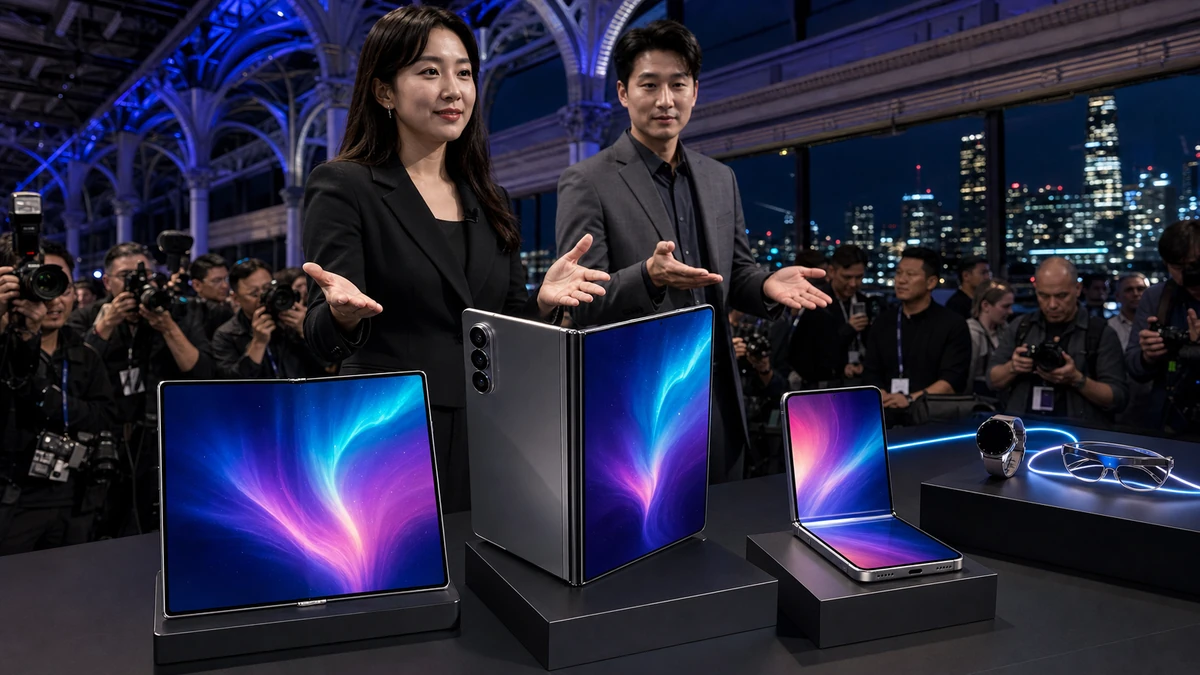
Samsung Electronics used a splashy event in London to introduce three new foldable smartphones — the Galaxy Z Fold8, Galaxy Z Fold8 Ultra and Galaxy Z Flip8 — but the company’s message went well beyond thinner hinges or brighter screens. The South Korean tech giant is signaling that it wants the next phase of the premium smartphone market to revolve around two ideas working together: foldable hardware and what it calls agentic artificial intelligence.
That makes this launch notable even in a market accustomed to annual upgrades. According to the Korean news agency Yonhap, Samsung presented the new devices at Galaxy Unpacked 2026 at Old Billingsgate in London, where it also showed off new wearable devices including a smartwatch and smart glasses. Put together, the presentation suggests Samsung is no longer trying to sell foldables as clever engineering experiments. Instead, it is trying to position them as the center of a broader connected device ecosystem — one in which AI becomes the glue linking phones, wearables and, eventually, everyday computing tasks.
For American consumers, there is a familiar parallel here. Think of how Apple has long sold not just the iPhone, but the idea that the iPhone works best when paired with an Apple Watch, AirPods, a MacBook and a growing suite of software services. Samsung’s latest move appears aimed at making a similar argument from a different direction: that the future premium mobile experience will be defined not by a single flagship slab phone, but by a network of devices organized around an AI assistant that can move across screens and contexts.
That matters because Samsung occupies a unique place in the global smartphone business. It is both one of the world’s largest phone makers and one of the few companies with the manufacturing scale, display technology and brand recognition to push a category like foldables into the mainstream. Foldable phones have been around long enough that simply folding in half is no longer enough to create buzz on its own. The question now is whether companies can turn that unusual form factor into something consumers find worth paying premium prices for year after year.
Samsung’s answer, at least for now, is to widen the lineup, refine how the devices are used when opened, and make AI a standard feature across the entire foldable family rather than a luxury reserved for the highest-end model. In other words, the company is trying to mature the foldable market the way automakers once expanded an emerging vehicle category: first prove the concept, then create multiple trims, price points and use cases so buyers can see themselves somewhere in the lineup.
A wider Fold8 suggests Samsung is rethinking the tablet-in-your-pocket pitch
The clearest design change highlighted in the Korean summary involves the Galaxy Z Fold8’s screen ratio. Samsung said it adopted a new aspect ratio with greater width than the previous model, a shift that may sound technical but speaks to a longstanding challenge for foldable phones: making them feel natural both when closed and when open.
For years, book-style foldables such as the Galaxy Fold series have promised two devices in one. Folded shut, they function like a smartphone; opened up, they are supposed to offer something closer to a compact tablet. In practice, that dual identity has often come with trade-offs. Some users have found the narrow outer screen awkward for typing or reading, while certain apps have struggled to take full advantage of the larger internal display. A change in aspect ratio is Samsung’s way of saying it is still tuning the basic experience of what a foldable should feel like in the hand and on the screen.
Even without detailed demos or model-specific use cases in the summary, the implication is clear: Samsung believes the shape of the open screen is now a competitive feature in itself. That is an important sign of how the foldable category is evolving. Early foldables were judged mostly on whether the screen could bend without breaking, whether the crease was distracting and whether the hinge felt sturdy. As the hardware improves, consumers are increasingly evaluating subtler questions: Does multitasking feel intuitive? Do videos and documents look better on the larger display? Is this genuinely more useful than a conventional premium phone?
Those are not glamorous marketing questions, but they are the ones that determine whether foldables remain niche status symbols or grow into a durable product category. In that sense, redesigning the screen ratio is about more than appearance. It is Samsung attempting to turn the act of unfolding the device into a more compelling everyday experience, not just a momentary wow factor in a store display.
For U.S. readers, the analogy might be the evolution of laptops from novelty ultra-portables into category-defining work machines. Once the basic concept was accepted, the real competition shifted to keyboard feel, screen shape, battery life and how well the machine fit into daily routines. Samsung seems to be betting that foldables are entering a similar stage, where incremental choices in proportion and usability matter more than the mere existence of a hinge.
The debut of an Ultra model shows Samsung sees room at the very top
The most symbolic addition in London was not the standard Fold8 or the Flip8, but the Galaxy Z Fold8 Ultra. This is the first time Samsung has applied its Ultra branding to a foldable phone, and that naming choice carries weight. In Samsung’s product language, “Ultra” has come to mean the top shelf — the model for buyers who want the most advanced camera, the biggest feature set and the highest price tag. By bringing that label to foldables, Samsung is effectively declaring that foldable phones are no longer a side experiment. They are important enough to support a full premium hierarchy of their own.
That may sound like a branding detail, but in consumer electronics, naming often reveals strategy. An Ultra model tells shoppers that the company expects different kinds of buyers even within the foldable niche. Some may want the standard Fold experience. Others may want a more fashion-forward clamshell device in the Flip8. And still others may be willing to pay extra for the most ambitious version of the foldable concept.
In the U.S. market, where premium smartphone buyers have grown accustomed to layered lineups — think iPhone, iPhone Pro and Pro Max, or Samsung’s own Galaxy S base, Plus and Ultra tiers — that structure is familiar. What is new is seeing Samsung apply the same segmentation logic to foldables. It suggests confidence that enough consumers now recognize the category for finer distinctions to matter.
The Korean summary did not include pricing, release dates or detailed specs for the Fold8 Ultra, so many practical questions remain unanswered. But strategically, Samsung may not need to answer all of them immediately to make its point. The point is that there is now a three-device foldable family: Fold8, Fold8 Ultra and Flip8. That lineup alone conveys that foldables are being treated less like a futuristic side branch and more like a core pillar of the premium mobile business.
It also gives Samsung a stronger defense against a broader industry problem: smartphone saturation. In mature markets such as the United States, Japan and much of Europe, many consumers hold on to phones longer because annual improvements can feel incremental. Expanding the lineup creates more reasons to upgrade, more opportunities for carriers and retailers to pitch different models, and more ways for Samsung to target buyers based on status, productivity or design preference.
Samsung wants AI to be the common thread across every foldable
Perhaps the most consequential part of Samsung’s announcement was not a device at all, but the company’s decision to extend agentic AI across the entire foldable lineup. The phrase may sound like Silicon Valley jargon, so it is worth unpacking for a general audience. In broad terms, agentic AI refers to software that does more than answer a question or generate text on command. It is meant to act more like a digital assistant that can carry out tasks, anticipate needs and connect actions across apps or devices.
That does not necessarily mean consumers will immediately experience a radically transformed smartphone. Companies across the tech industry are still figuring out what AI assistants can do reliably, what should happen on the device versus in the cloud, and how much automation users actually want. Still, Samsung’s choice to emphasize AI across all foldables rather than reserving it for a halo product is revealing.
It suggests the company sees the future battle in foldables shifting from industrial design to software experience. The folding screen is the physical differentiator, but AI is the layer that could make the device feel smarter, more personal and more useful over time. If Samsung can make a foldable phone capable of handling multitasking, searching, summarizing, scheduling and cross-device coordination in a way that feels genuinely seamless, it may create a stronger reason for consumers to accept the category’s premium price.
There is also an important competitive angle here. The smartphone industry is increasingly converging on AI as the next major selling point, much as it once fixated on mobile photography and later on 5G. Apple, Google, Samsung and a host of Chinese manufacturers are all looking for ways to persuade consumers that their devices are not just fast, but context-aware and proactive. By making AI central to the Fold8, Fold8 Ultra and Flip8 together, Samsung is trying to argue that its foldable ecosystem is not just visually distinctive — it is also computationally smarter.
For American audiences, a useful comparison is the transition from voice assistants such as Siri and Alexa to newer generative AI systems that promise to plan, draft, organize and act. Samsung is effectively telling the market that foldables should be a natural home for that evolution, because the larger and more flexible screens lend themselves to multitasking and contextual interaction. Whether that promise holds up will depend on execution, but the strategic direction is unmistakable.
Phones were only part of the story as Samsung expanded the ecosystem
Another reason the London event drew attention in Korea is that Samsung did not stop with phones. The company also unveiled a new smartwatch and smart glasses, broadening the scope of the presentation from a smartphone launch to a more ambitious ecosystem play. That choice matters because it reframes the foldable phone as a hub rather than a standalone product.
In practical terms, wearables can extend what a phone does without asking users to pull a device from their pocket every few minutes. A smartwatch can surface alerts, health data and quick interactions. Smart glasses, if they are executed well and gain consumer acceptance, could provide glanceable information or lightweight augmented experiences. By placing those devices on the same stage as the Fold8 family, Samsung was emphasizing the idea that the most valuable product is not any one piece of hardware, but the network created when they work together.
This is especially important because foldables, while eye-catching, still face adoption hurdles. They are typically expensive. Some buyers worry about durability. Others simply do not know whether a foldable would fit their routines. Ecosystem logic can help Samsung make the case in a different way. Instead of asking consumers to evaluate a foldable only as a phone, Samsung can present it as the centerpiece of a premium AI-driven setup that includes wrist-based computing and eyewear.
That is a familiar ambition in the tech industry, but it carries particular importance for Samsung. Unlike Apple, which operates a tightly controlled software ecosystem, Samsung works across a more complex landscape that includes Android, Google services and its own hardware stack. That means Samsung’s success often depends on creating value through hardware variety and smart integration rather than through total platform control. A foldable-centric AI ecosystem gives the company a narrative advantage: it can claim that its hardware range itself is the differentiator.
There is also a longer-term industrial significance here. If Samsung can establish foldables, watches and glasses as parts of one connected premium experience, it increases the number of touch points it has with consumers and reduces reliance on the yearly smartphone replacement cycle. That is a critical goal for large electronics firms searching for growth in a market where straight-line smartphone sales are harder to come by.
Why Samsung staged the event in London — and what that says about its global ambitions
The location of the launch was not incidental. Samsung chose Old Billingsgate in London, a historic event venue on the Thames, as the stage for a product family aimed squarely at the global premium market. Hosting such a launch in London rather than Seoul is a reminder of how Samsung wants these products to be read: not as Korean domestic releases, but as international lifestyle technology.
For American readers unfamiliar with South Korea’s corporate culture, Samsung is not just another large company. It is one of the country’s flagship conglomerates, part of a business tradition known as chaebol — family-founded industrial groups that grew rapidly during South Korea’s modernization and still play a major role in its economy. When Samsung launches a category-defining product, it is often doing so with an eye toward national prestige as well as commercial success. Its events are not only about gadgets; they are also about Korea’s place in the global technology hierarchy.
Staging the presentation in London helped underline that global orientation. It also fit the message of the event itself. Samsung was presenting foldables, wearables and AI as pieces of a unified story intended for consumers across markets and cultures. London, a city long associated with media, finance and international branding, offered a neutral yet cosmopolitan stage for that pitch.
The format of the event also reflected a broader shift in how technology is sold. As devices become more complex, companies need to explain not just what a product is, but why it matters in ordinary life. Samsung appears to understand that technical excellence alone is not enough. Storytelling, audience psychology and cultural translation now play a major role in global product launches, especially when the devices in question rely on concepts — such as agentic AI or foldable workflows — that still require consumer education.
A Tony-winning creative partner helped Samsung turn specs into story
One of the more intriguing details in the Korean summary is that Samsung brought in Park Chun-hyu, a playwright and lyricist, as a creative partner for the event’s storytelling and stage direction. Park, according to the summary, won Tony Awards in 2025 for the musical “Maybe Happy Ending,” including best original score and a book award. For American audiences, that is a significant cultural credential. The Tony Awards are Broadway’s most prestigious honors, and invoking them signals that Samsung wanted more than polished product demos. It wanted theatrical coherence.
That might sound unusual for a tech unveiling, but it makes sense in the current media environment. Product launches have become hybrid productions — part keynote, part entertainment, part brand mythology. Apple mastered that style years ago. Tesla events, when they land, often generate attention less for precise product detail than for spectacle and narrative ambition. Samsung’s collaboration with a decorated creative talent suggests it sees the presentation itself as a competitive asset.
There is also a broader Korean Wave angle here. Over the last two decades, South Korea has become a major exporter not just of electronics and cars, but of culture — from K-pop and television dramas to Oscar-winning and Emmy-winning storytelling. Americans are now far more likely than they once were to recognize Korean cultural output as globally influential. Samsung’s use of a Korean creative figure on an international stage underscores how closely the country’s technology and cultural soft power increasingly intersect.
In that sense, this was not only a device launch. It was a showcase of Korea’s ability to package innovation in ways that resonate across borders. The company’s explanation, as reflected in the Korean summary, was that it wanted to translate advanced technology into everyday language and create a more immersive stage experience. That is essentially the same challenge journalists face when covering AI and consumer tech: turning abstract systems into narratives that ordinary people can grasp.
It also reflects a deeper truth about the premium device market. The more similar products become in raw capability, the more companies need to differentiate on framing, identity and emotional resonance. A foldable phone is still a piece of hardware, but to sell it globally at premium prices, a company must make it feel like an idea people want to join.
The bigger question is whether consumers are ready for Samsung’s vision
Taken together, Samsung’s announcements point to a two-part strategy. First, broaden consumer choice within foldables through a three-device lineup that now includes an Ultra tier. Second, build an AI-centered ecosystem around those devices by linking phones with wearables and, potentially, more ambient forms of computing such as smart glasses. It is a sophisticated strategy, and in many ways a logical one.
But logic in consumer electronics does not always translate into adoption. The real test will be whether buyers see foldables as essential rather than intriguing, and whether Samsung’s AI features feel useful rather than forced. Consumers have heard grand claims about digital assistants before. Many remain skeptical, especially when new features appear to solve problems they did not know they had. Foldables face a related challenge: many shoppers admire them in stores but still leave with a more conventional phone.
Even so, Samsung’s latest move deserves attention because it marks a clearer, more mature articulation of what the company thinks the premium smartphone market is becoming. It is no longer enough to make the biggest screen, the best camera or the thinnest device. The next contest may be about creating a coherent personal computing environment — one where hardware form, software intelligence and cross-device coordination all reinforce one another.
Samsung is betting that foldables can sit at the center of that environment. By redesigning the Fold8’s display proportions, adding a Fold8 Ultra and spreading AI across the entire lineup, the company is trying to turn foldables from a conversation piece into a lasting platform. The smartwatch and smart glasses shown alongside the phones strengthen that case, suggesting a future in which the smartphone remains central but no longer acts alone.
For now, the most important takeaway is not any single specification, especially since many details remain to be filled in. It is the strategic message. Samsung wants the world to see foldables not as a quirky branch of the smartphone family tree, but as the premium branch — one broad enough to support multiple tiers, powerful enough to anchor an AI ecosystem and polished enough to command the world stage.
That is an ambitious proposition. But if any company has the scale, supply chain muscle and global brand recognition to try to pull it off, Samsung is on a short list. In London, it made clear that it intends to keep pressing that advantage.
Comments
Post a Comment